Home & Living
How paper towel holder support differs from roll control
Understand paper towel holder support by separating a stand or mounting bracket from the spindle and any added roll-control mechanism.
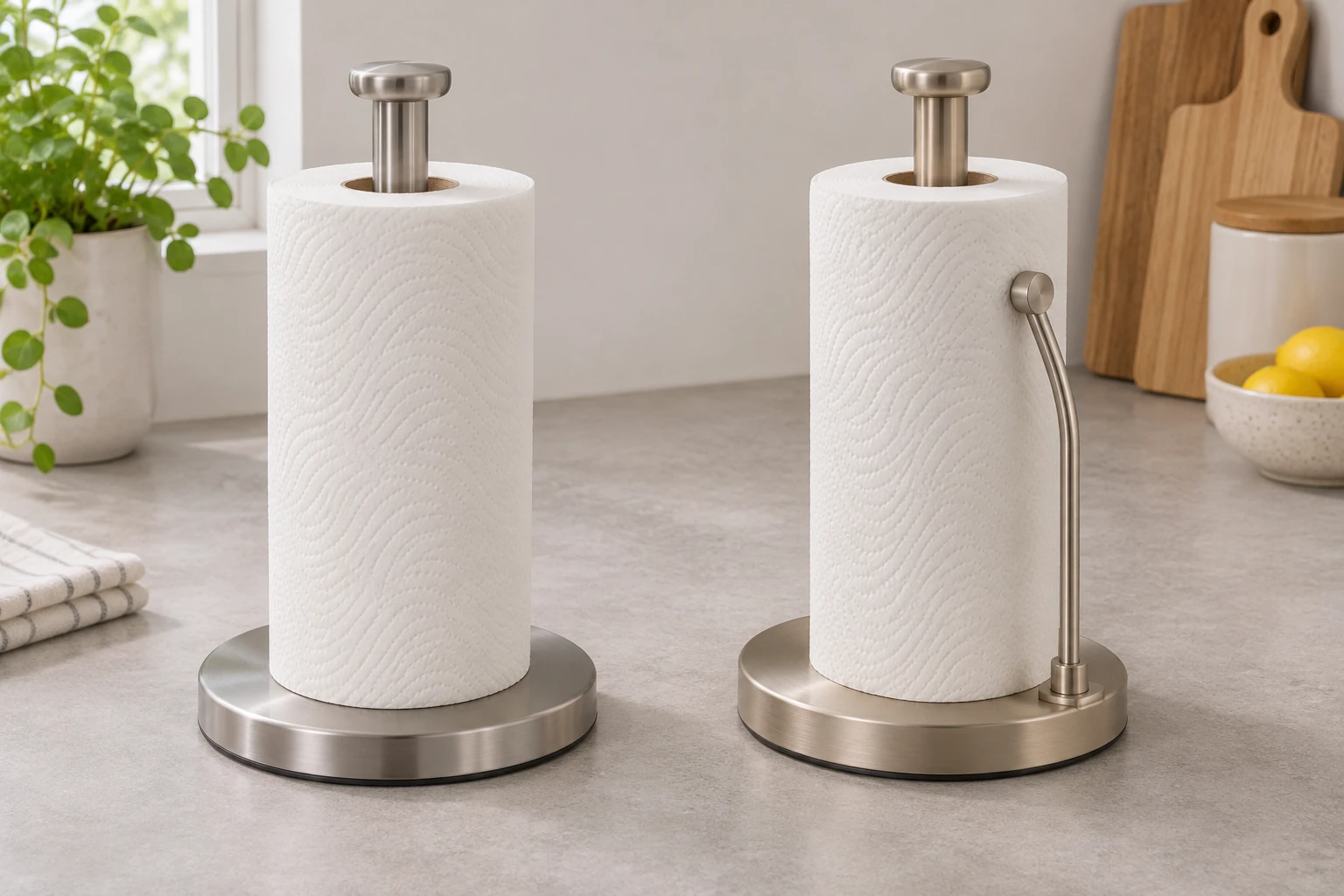
Understanding paper towel holder support begins with a precise question about the part being described. Are you asking what supports the complete holder, what locates the roll, or what controls the paper as it is dispensed? An answer to one question can leave the others open. A useful product explanation keeps those questions distinguishable throughout. The examples here concern the structures actually pictured or described in particular accounts. They give you a way to follow those accounts without treating a decorative shape, a familiar orientation or a broad product name as a complete explanation of the mechanism.
The retail pair shows two support arrangements
The SKYSONIC red-truck holder account shows an upright post rising behind a truck-and-tree decoration on a base. The paper roll is pictured around the post. The truck and tree belong to the holder's decorative form. The roll and surrounding room are staging. Its description's weighted-steel and intended-steadiness wording remains attributed, without an independent material or stability test.
The Handiwall-listed horizontal holder account shows a wire roll support connected to a mounting plate against a slatwall background. The pictured wall is separate from the holder. The description names particular compatible panels and exclusions. This account supplies no universal mounting permission, installation procedure or tested loading result. The bracket and roll-supporting structure belong to the complete holder pictured.
These accounts let you begin with the object each sentence concerns. Keep that object in view when a description moves from the overall holder to a particular feature. If a sentence concerns the complete unit, it should not silently become a statement about every element within it. If it concerns one named element, keep the rest of the explanation open until the account addresses it. This approach makes the evidence easier to read without requiring a new naming system. You can understand the particular relationship being described while leaving unsupported questions about a chosen purchase unanswered.
A spring arm has a different role from a base
OXO UK's SimplyTear account identifies a spring-activated arm and a weighted base in its named design. The maker describes the arm as keeping the roll secure and preventing unraveling, while its base description addresses stability. Those are two feature accounts within one product description. Reading only the base account would omit the stated roll-control feature. Reading only the arm account would omit how the maker describes the unit's support below it. The arm and base are therefore worth keeping separate in an explanation of that particular holder. OXO also makes broader ease-of-use, fit and material statements on the page. This guide does not turn them into tested results or apply them to either native offer. The useful distinction here is the maker's separate description of the arm and the base. It explains why a sentence about a stand's support is not a complete account of every feature involved in dispensing. Neither retail photograph establishes that its holder contains OXO's mechanism or uses OXO's particular construction.
A named control feature needs its own explanation
Simplehuman's paper-towel holder account similarly identifies a tension arm as a feature involved in dispensing. Its separate base description concerns keeping the holder in place, and it identifies a finger loop for carrying. These descriptions concern roll control, unit support and carrying within the named design. The finger loop does not become a second control arm merely because both are visible features of the holder. The maker's one-handed tearing description remains a claim about that product, without becoming a demonstrated result for the retail pair. This example gives a more specific explanation than assuming that every upright stand dispenses in the same way. It also keeps the support account separate from the additional control account. Where another product's description does not identify such a feature, this page supplies no missing internal mechanism for it. A reader can recognise what Simplehuman describes while retaining the identity of the product to which the description belongs. No adjustment or operating sequence is inferred from that account.
A supported base can be designed to rotate
US patent 7,232,090 describes a different arrangement. A base supports the roll, a spindle extends from that base into the roll's central passage, and wheels support the base above the surface beneath it. The roll spindle has a tapered portion described as engaging the passage. In that design, pulling material from the roll causes the product to spin around the spindle axis on its wheels. The wheel axes are described as radial to the spindle axis and perpendicular to it. The base is thus part of a deliberately rotating arrangement. Calling something a base does not, by itself, explain whether the described design intends that base to remain stationary. The patent's two claims retain the relationships between the base, spindle, taper and wheels, with a further claim concerning a spindle head that guides the central passage. This is a description of the patent's construction. Neither native account establishes a wheeled rotating base, and this guide assigns that feature to neither offer. It also leaves the patent's claimed cleanliness and space benefits outside the explanation, without reporting a retail implementation or a physical test.
A cover can participate in supporting the roll
US patent 5,763,984 describes a free-standing base and a cover enclosing a paper roll. One support sits on the base and another on the inside of the cover's top. They engage opposite open ends of the roll's tube. A channel in the base receives the cover's rim, and a slot in the cover provides a passage for the paper web. In this example, the cover has a relationship to both the upper roll support and the dispensing opening. It is more than a decorative shape placed beside an otherwise independent stand. The described base-to-cover connection is another relationship again. These features explain how this particular account distributes support and dispensing functions across the construction. The patent does not establish a hidden upper support, enclosing cover or paper slot in either native holder. Its four claims belong to the described invention. The explanation supplies no assembly steps, replacement-part match, universal paper size or verified tearing result, and it does not depend on reproducing the patent's drawings.
Opposed shafts offer another roll-supporting arrangement
US patent 5,950,961 describes support arms extending from a base support, with cylindrical shafts facing the roll's core. Springs and specified tension-adjustment assemblies are included in the construction. The shafts support the roll from its ends, rather than requiring one detachable spindle running through the entire core. The description also identifies flanges where the core contacts the shafts. This is a concrete example of a roll-supporting arrangement with its own specified resistance mechanism. The base support, arms, shafts and tension assemblies each belong to the same described design, but they name different structural features. The patent's four claims further identify those components and their relationships. Nothing here assigns its spring arrangement to the Handiwall-listed holder merely because both accounts describe horizontal roll support. Nothing assigns it to the SKYSONIC stand either. The account is used to explain a possible construction in a named primary source. Its background criticisms of other devices, claimed performance advantages and loading or adjustment instructions are outside this guide's scope.
Across these examples, keep the question as specific as the answer you want. A complete account of one design may discuss several relationships, while a short retail description may address only a few. That difference in detail does not justify supplying the omitted features from a more elaborate example. It gives you a reason to distinguish what has been explained from what has not. You can finish reading with a clear understanding of the described construction and still have an unresolved product question. There is no need to turn that uncertainty into either an endorsement or an invented fault.
Neighbouring decisions concern different evidence
The guide to matching paper-towel dispenser refills concerns the identified equipment and the roll core or folded-paper format it accepts. That supply-compatibility decision remains separate. Understanding a holder's described support arrangement does not establish a refill specification, an interchangeable paper product or how much stock a workplace should order.
The guide to wire food slicer parts explains cutting elements, carriers and supporting structures in specified kitchen-tool accounts. Its cutting paths and wire connections belong to those tools. Here, the subject is paper-roll support and separately described roll-control features. Neither explanation supplies replacement-part compatibility or an operating procedure for the other products.
Finish with a description that preserves the particular example. Name the feature you mean and the relationship the account actually establishes. Keep a broader purchasing question separate when the evidence has not answered it. You do not need a perfect drawing or an imagined internal mechanism to follow a clearly bounded explanation. You need to know which statement concerns the complete holder, which concerns the supported roll and which concerns an additional dispensing feature. Once those statements are intelligible, decide whether you have enough information for your own question. If something remains uncertain, retain the question in that precise form.
Consider a payment method only in an actual checkout
A decision to purchase a holder would introduce a separate question about payment. Consider crypto, including USDT, only if the actual checkout for the intended order presents that option. This explanation does not establish that republeq.com offers cryptocurrency payments for a particular product, seller, country or transaction. A product photograph and an account of its mechanism provide no evidence of the payment methods available to you. Read the current order and payment instructions before choosing an offered method. Identify the asset, network, recipient and amount required from those instructions, rather than treating a familiar token name as a complete payment destination. Check any displayed fees, conversion terms and refund or cancellation information relevant to the choice. If those details are missing, contradictory or unsuitable for you, leave the purchase incomplete while resolving the question. An instruction from a previous order should not silently become an instruction for a different order. You may also decide to stop because you do not understand the proposed method. No transfer, wallet connection or completed purchase is reported here. No address or network is supplied. Choosing how to pay would not authenticate a holder's material, prove a mounting fit or demonstrate one-handed tearing. Those product questions retain their own evidence requirements. Keep any eventual order confirmation with the transaction it actually identifies, without treating a payment response as a test of the product. The purchasing endpoint is a product decision and a payment decision that you understand separately. Neither an appealing mechanism nor an offered payment option requires you to proceed before the relevant information is clear.
Concept cover for paper towel holder support, distinguishing a supporting stand from an additional roll-control feature.