Office Supplies & Stationery
Check paper punch replacement head compatibility by exact model
Match the complete punch reference with documented replacement parts before treating a similar diameter or photograph as fit evidence.
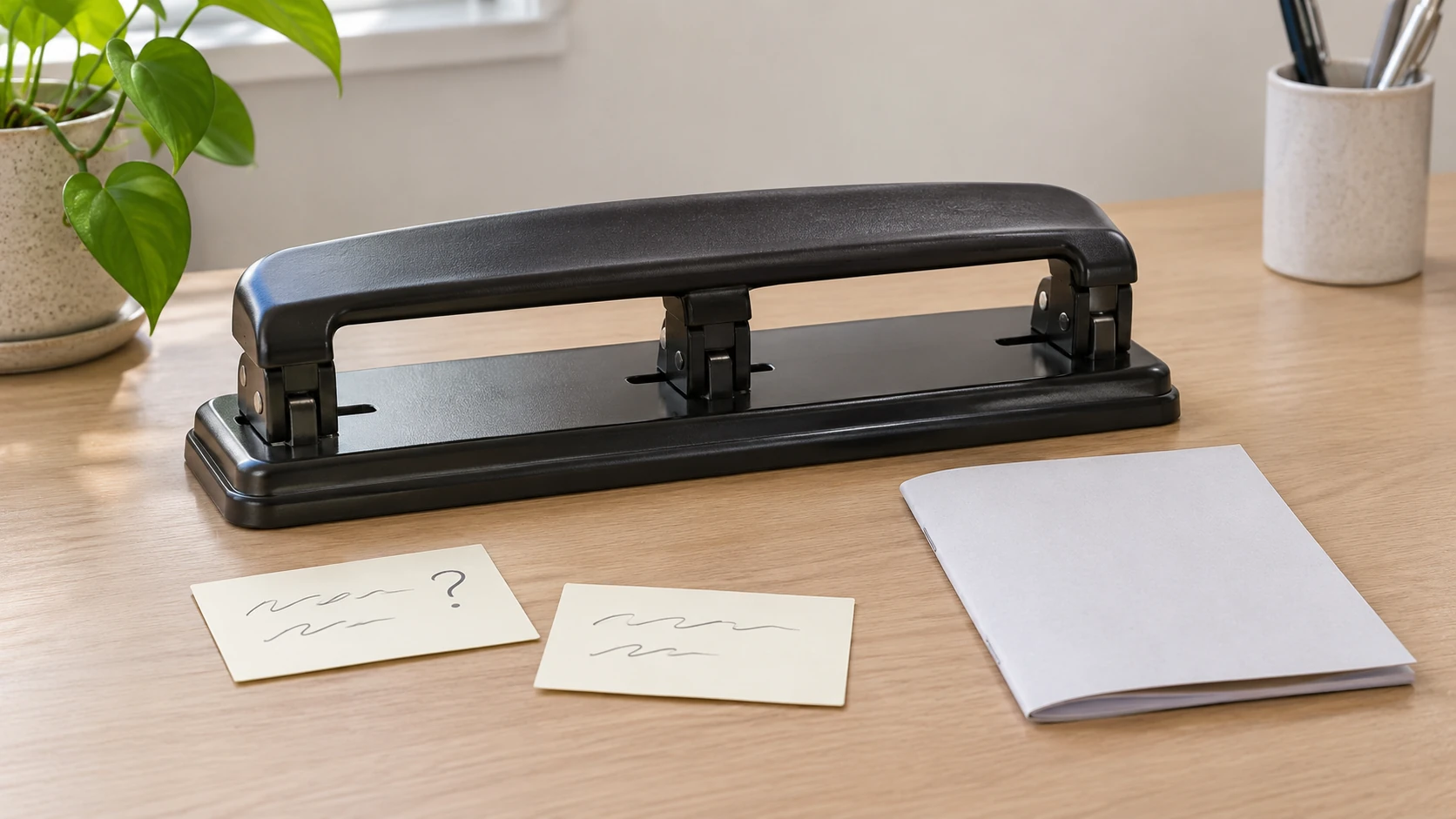
Identify the complete punch behind the parts question
Check paper punch replacement head compatibility against the complete tool that needs the part. The Cool Crafts extra heavy-duty punch listing presents an assembled manual punch, with a broad base, linked lever bars and three cutting-position assemblies in its sole original photograph. Those integral components do not establish a separately supplied spare kit.
Its native metadata names CO719672, SKU 579711971 and UPC 657248367718. The description states two-or-three-hole operation, a 160-sheet figure for 20 lb paper and a 9/32-inch hole. Retain the actual references when asking about parts. A capacity label or a product-title phrase cannot replace the model identity in that inquiry.
No readable factory plate in the image authenticates those catalogue identifiers. The native antimicrobial, effort and cleanliness claims also provide no tested replacement-part relationship. Ask which part documentation applies to this exact offer before treating a similar tool's kit as the answer. Neither the photograph nor the description establishes that a loose replacement head or disk comes with the item delivered.
Retain the item SKU as an offer reference. It does not by itself identify a replacement component in the manufacturer's parts system.
Keep the full model reference with the inquiry
The Swingline 74550 punch listing is another complete manual punch. Its original image shows three angular support and lever forms with two dark pads across the top. The title includes 74550, while native metadata records A7074550C, SKU 728312269 and UPC 013930625175. Keep those distinct fields together; shortening the reference can discard information that a parts inquiry needs.
The description declares a 75-sheet capacity and 9/32-inch holes. It also makes a claim about punch-pad adjustment extending head life. That wording supplies no installation instruction and names no replacement kit in this account. A pad-related feature is not evidence that any advertised head will mount in this assembly.
Its sole photograph contains no loose spare set or readable factory model plate. Preserve the catalogue identity as the identity needing confirmation, without presenting the picture as factory authentication. Ask for a documented connection between the actual offered tool and the proposed part, including any suffix or version that changes the answer.
A request for the part diagram should retain the complete catalogue reference, including its suffix, rather than only a capacity number.
A matching hole diameter leaves the model match open
Swingline's punch-head catalogue assigns different part references to specified punch models. For example, A7074866 is listed for A7074400 and A7074350, while A7074873 is listed for A7074357. Both are described with a 9/32-inch hole size. The shared output dimension has not made their stated model relationships interchangeable.
The same catalogue identifies A7074872 as a kit for A7074650 and A7074889 as a kit for A7074190. Treat the part reference and the named host model as a pair when recording the offer. A search filtered only by hole size can still return several different model-specific choices.
This gives a useful check for paper punch replacement head compatibility: read the supported-model wording on the proposed part, then compare it with the identified tool. If the tool is absent from that statement, leave the match unconfirmed. The catalogue's general replacement advice does not diagnose a particular unit or establish a service interval for an unidentified punch. Keep any question about wear separate from the stated part-to-model relationship.
Use an original sheet without erasing identifier differences
An original Swingline manufacturer sheet printed in May 2017 identifies A7074550 and names A7074871 as its replacement punch kit. It also carries the reference 74550C and an individual-unit UPC of 050505745500. The document connects a named punch reference to a named kit.
Keep its date and identifiers attached to the information. They must be reconciled with the selected native account rather than silently replacing the identifiers that account supplies. Similar title wording and a similar product photograph do not authenticate every suffix, UPC or offered version as the same factory item.
Use the sheet to ask a precise question: does this documented kit relationship apply to the exact unit being offered or already owned? A reply should establish that connection. Until that connection is established, leave fit unconfirmed. Its performance and warranty language also does not establish a present entitlement or successful repair for a particular retail purchase.
If the reply confirms a different version, preserve that version with its own part reference instead of quietly editing the earlier sheet.
Distinguish the disk reference from the cutting part
Carl's current No. 120 product page and the English panel of its original manual identify different references for different components. P-B01 names the punching disk, while P-120MD names the punching blade. The manual's part diagram distinguishes those pieces from the blade holder and the rest of the assembled tool. A punch disk reference therefore answers a different parts question from a blade reference.
The manual also distinguishes installed standard accessories from replacement-part quantities. Its diagram lists two disks and two blades installed in the product; its replacement table describes ten disks for one reference and one blade for the other. Keep the table's role with its quantity. An installed-component count is not automatically the contents of a replacement package.
These are No. 120 documents, not instructions for either selected native punch. Their warnings and component drawings do not authorize taking another model apart. Use the example to request the correct part diagram and replacement reference for the actual tool. Do not adopt a procedure merely because its diagram appears to show a familiar component.
A named kit still needs the named host tool
Bostitch's page for replacement set 03203 explicitly identifies the Xtreme Duty Adjustable Hole Punch model 03200 as its host and says replacement instructions are included. Its separate 03200 tool page lists two-or-three-hole adjustment and a 9/32-inch hole. Record the documented host reference with the kit; hole size alone leaves that relationship incomplete.
That relationship cannot be transferred to the Cool Crafts account from similar capacity language, a familiar appearance or a number embedded in a retail reference. The selected offer's factory identity remains unconfirmed. Obtain evidence connecting the actual item to the maker's model before treating 03203 as its replacement set.
Also distinguish a kit offer from permission to install it. Included model-specific instructions need to apply to the confirmed tool, and the maker's performance promises are not an observed result here. Retain the complete kit reference with the proposed host. If a seller instead offers a single component, ask which documented component it supplies and whether the original kit relationship still describes that different offer.
Separate spare-part fit from the binder pattern
The guide to hole punch binder compatibility addresses a separate interface: the holes in a page and the fastening arrangement that will hold it. Hole count, spacing and page placement belong to that output decision. They do not identify which replacement component mounts in the punch itself.
A parts answer can therefore leave the filing question open. Even if a supplier confirms a component for an identified punch model, that confirmation does not certify its output for every binder. Likewise, a page pattern already accepted by a filing system does not identify a spare head for the mechanism that produced it.
Keep the two results under separate questions in the same record. One concerns the component and its host tool; the other concerns the produced pattern and the filing destination. If the support reply discusses hole spacing while your inquiry concerns a replacement-head reference, ask for the missing component relationship explicitly. Do not turn a correct answer about the page into an assumed answer about the part.
A symptom is not a part number
The manual hole punch jam check addresses resistance, paper loading and visible conditions before a run continues. Its stopping points and model-specific instruction limits belong to that troubleshooting decision. It does not establish that a difficult stroke means a replacement head is the required remedy.
Preserve the symptom description when asking for help, but keep it distinct from the compatibility question. “This unit resists on ordinary paper” describes a reported condition. “This part is documented for this model” describes a proposed component relationship. Neither statement supplies the other, and a parts catalogue cannot resolve an unassessed mechanical condition merely by listing a spare.
If the tool needs further assessment, leave the purchasing decision open while obtaining the applicable instructions or support response. Do not perform another test stroke or dismantle the mechanism just to make a generic parts guide seem actionable. Give support the actual tool reference and observed symptom, with the replacement reference still marked unconfirmed.
Check the applicable remedy before buying parts
Swingline's general warranty page says the written warranty accompanying the product controls. It distinguishes covered defects from normal wear, misuse and modified or tampered-with products. Check the documentation for the actual purchase before assuming that a replacement part will be supplied or that a particular alteration is permitted. The general policy establishes no coverage decision for either selected offer, and this article has made no warranty claim or obtained a repair outcome.
Retain the purchase document with that inquiry. A parts listing and a purchase record supply different information when the applicable remedy is being assessed.
If you decide to buy a complete punch after reviewing the parts question, keep that choice separate from an unresolved repair. Record whether you are replacing the whole tool because it suits a new task, because a documented remedy has been confirmed, or because you prefer to stop pursuing an uncertain component. None of those choices proves that the old head was defective. On republeq.com, retain the exact complete-tool listing with the proposed order so that a later search result does not quietly become a different product in your notes. Before payment, check the item reference, quantity, current delivery information and terms shown for that order. If you want a spare kit with the order, record that as a separate requirement and obtain an explicit contents answer. If crypto is offered for your transaction, inspect the checkout instructions actually presented. If USDT appears among the options, confirm the supported network, recipient details and requested amount in that checkout before proceeding. Mentioning the currency here establishes no acceptance, available network or payment result for a future order. Keep the confirmation with the exact product identity after a completed transaction. If an earlier payment or order is uncertain, reconcile that existing action before making another payment. Keep the supplier's parts response separately with the tool record so that a payment confirmation is not mistaken for evidence of compatibility. You can also postpone buying while a necessary model or part reference remains unanswered. The purchase record should say what was selected and paid for; the parts record should say what relationship was actually documented. Retain any unanswered model or component question with those records.