Product Compatibility & Accessories
Hole punch binder compatibility: match the actual pattern
Compare hole count, centre spacing, diameter and page placement. Keep CARL XHC2100 and OfficeMate EZ Lever details tied to the actual filing requirement.
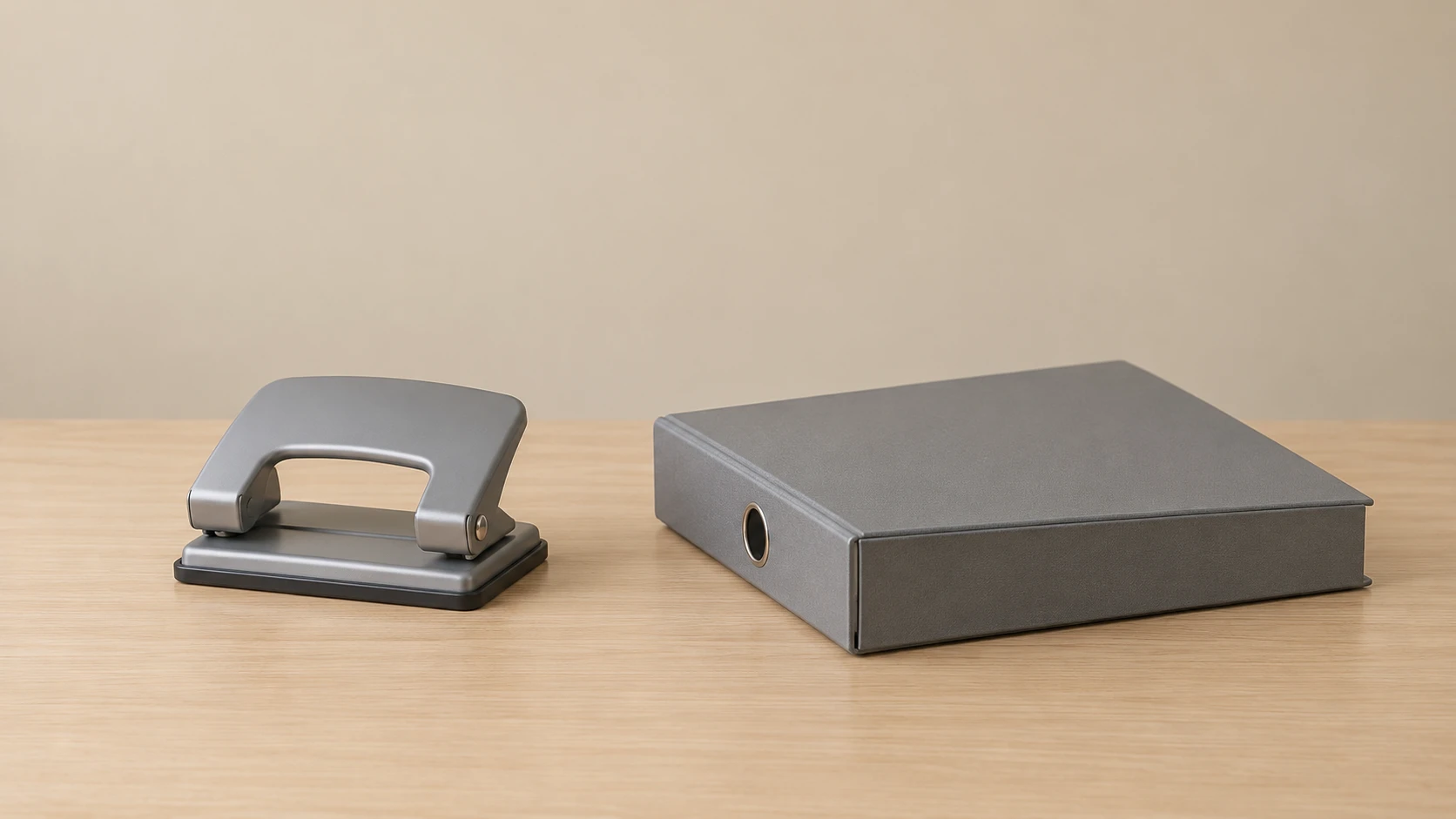
Hole punch binder compatibility depends on the pattern of holes the punch produces and the fastening arrangement the binder actually uses. Begin with hole count, centre-to-centre spacing and the position of that pattern on the page. A punch's stated sheet capacity answers a different question. It cannot establish that its output will fit a binder you have not identified.
This guide provides a documentation checklist for comparing the selected CARL and OfficeMate offers with an actual filing requirement. It gives no head-adjustment, punching, part-replacement or document-alteration procedure. Neither punch has been tested with a binder here, and no particular pairing is approved. Use matching product instructions before operating any tool.
Identify the binder before selecting the hole pattern
Record the binder or fastening system you intend to use, including its model when known. Count the fastening positions relevant to the page. Keep the count attached to the actual mechanism rather than inferring it from a cover size or a general product name. A binder marketed for a familiar paper size still needs its own pattern details.
Identify which page edge will carry the holes and how the page is intended to sit. A pattern along a long edge serves a different layout from one along a short edge. Keep the intended reading orientation with the compatibility record so a later answer about the holes does not leave the page turned the wrong way for the actual document.
Use the binder's applicable documentation or a sufficiently identified existing requirement to establish the needed pattern. A loose sheet found nearby is not automatically an authoritative sample. It may belong to another folder, have been modified or represent an earlier arrangement. Record why you consider a sample relevant before using it as evidence.
Leave an unidentified binder unresolved. You can gather its visible product reference or seek the missing specifications without choosing a punch first. Buying a tool because its hole count looks familiar can leave the important spacing question unanswered after the purchase.
Hole count and hole spacing are separate specifications
Hole count and hole spacing describe different parts of a pattern. Two holes can have different distances between their centres. Three holes can also be arranged with different centre distances. A matching count still leaves an unstated length unresolved.
Keep centre-to-centre spacing distinct from the gap between the nearest edges of two holes. Those reference points describe different distances. If a specification names one convention, compare it with the same convention on the other side of the proposed match. A bare number without its reference points is an incomplete compatibility note.
For a three-position pattern, identify which adjacent centres a stated spacing concerns. Do not assume that a number for the first pair also describes the second pair unless the specification establishes that relationship. Likewise, the overall span from the first centre to the last answers a different question from one adjacent interval.
Retain the units with every length. NIST's length guidance gives the exact relationship of one inch to 25.4 millimetres and explains metric length relationships. Converting a documented length changes its expression, without establishing the accuracy of a physical measurement or supplying an unstated spacing.
Hole diameter does not determine the pattern's spacing
A hole diameter describes the size of an individual opening. Centre spacing describes the relationship between openings. Keeping those fields separate prevents a listed punch size from becoming an assumed binder pattern. A diameter alone cannot identify where the holes will appear on the page.
The actual fastening component also has its own shape and dimensions. Obtain the applicable compatibility information rather than assuming that any opening larger than a visible metal part will produce a satisfactory page arrangement. This article establishes no fit tolerance, page-turning clearance or measured result for either selected punch.
Keep the distance from the page edge to the hole pattern in the same record. Even a matching count and centre spacing can leave the page's position unresolved. Identify the reference edge used by the punch's documentation and the page arrangement required by the filing system.
A paper guide and an adjustable punch head need not describe the same adjustment. One can concern where a sheet is positioned while the other concerns the punching arrangement. Read the actual instructions before treating the word adjustable as permission to change every dimension you need. No mechanism adjustment is prescribed here.
The CARL account supplies capacity and hole size
The CARL XHC2100 heavy-duty hole punch is described as blue and supplied with two punch heads and four punch disks. Its native description states one-quarter-inch holes through up to 100 sheets of 20 lb paper. Keep the paper condition with the capacity instead of turning the number into a rating for every sheet material.
The description names CARL Hollow-Core technology, Samurai Steel punch heads and dual self-centering guides. Those attributed features do not provide the centre-to-centre distance between the resulting holes. Self-centering wording also supplies no complete account of which page dimensions or guide settings the tool supports.
The metal body, large-capacity waste tray and nonskid base are listed construction features. No dimensions for every adjustment or a confirmed match with your binder appear in this native account. The supplied heads and disks do not establish that additional hole patterns can be created by rearranging them.
Keep SKU 692029985 and UPC 721678094237 with the exact model reference. Other listings using a similar model name may show different identifiers or hole-size wording. The selected account here states one-quarter inch. Obtain identity-bound clarification before replacing that statement with another listing's specification.
The OfficeMate offer names two or three holes
The OfficeMate EZ Lever adjustable two-to-three-hole punch is described as new and sold individually. Its native description identifies the adjustable hole-count wording, SKU 1345777251 and UPC 708603447481. It does not state the supported centre spacing, hole diameter, sheet capacity or exact adjustment procedure.
Keep those missing fields open. Two-to-three-hole wording identifies offered configurations, without proving that either configuration matches every binder with the same number of fastening positions. Ask which pattern dimensions the selected offer actually supports and request the matching instructions.
A manufacturer page for another EZ Lever reference can help locate further information, but a similar name does not bind its specifications to this offer. Retain the selected product's identifier while asking for that connection. Do not import another model's capacity or diameter merely because both pages show an adjustable lever punch.
Compare the two offers at the level their descriptions support. CARL supplies a stated hole diameter and a paper-specific capacity. OfficeMate supplies adjustable two-or-three-hole wording with fewer dimensions. That is a difference in available documentation, without a tested finding that either will fit your particular filing arrangement.
Sheet capacity cannot answer the binder question
Sheet capacity concerns a stated quantity of material that can be punched under the listed conditions. It does not name the spacing between holes. A larger capacity cannot compensate for a different pattern, and a familiar hole count cannot establish an unstated capacity.
Keep the paper specification with the capacity statement. CARL's figure concerns 20 lb paper. This guide provides no conversion from that claim to card, plastic sheets or another material. Seek the actual tool's instructions for permitted materials and use, rather than treating all sheets as interchangeable units.
The tape-measure discussion of labelled dimensions and quantities separates the feature a number describes from other instrument properties. Apply that distinction to hole punching: 100 sheets, two heads and a one-quarter-inch hole name different things. None supplies an absent centre-spacing figure.
The stapler pinning-option guide likewise distinguishes the intended output from other tool specifications. Its outward-staple discussion supplies no binder-hole pattern or operation for these punches. A tool's general fastening purpose cannot establish the geometry of a different filing method.
Record a proposed match without declaring an unverified fit
Write the required pattern beside the supported pattern of the selected punch. Include count, centre spacing, individual hole size and the relevant page-edge reference where the applicable specifications provide them. Mark an unanswered field as unanswered. Similar words in the remaining fields do not close that gap.
For one fictional comparison, imagine a person with a documented two-position filing requirement and a punch listing that says only two holes. The count agrees, while the centre spacing remains unstated. Their record therefore says count matched, spacing unconfirmed. It does not call the combination incompatible or compatible before that missing information is obtained.
If clarification supplies a spacing in another unit, retain the original value and its converted expression with the stated reference points. Compare the same features on both sides. Avoid adding unsupported decimal places to imply that a nominal dimension is a measured tolerance.
An answer should identify the actual product and configuration. An instruction for a three-hole setting may leave a two-hole setting unresolved. A statement about paper guides may leave punch-head spacing unresolved. Keep each answer attached to the field it establishes instead of treating a generally helpful reply as complete fit approval.
Paper size leaves the fastening geometry open
Record the actual page format separately from the hole pattern. A sheet's width and height describe its outline. They do not locate the hole centres or identify the fastening arrangement intended for that sheet. Two documents with the same outer dimensions can be prepared for different filing systems. Keep the paper-size label as one field in the comparison.
Page content creates another requirement. A pattern may concern where the sheet attaches while the document layout concerns what remains readable. Identify any existing margin or authorised filing specification before choosing an arrangement. This article provides no minimum margin or permission to remove part of a printed line. The document's purpose remains relevant even after a tool's dimensions have been confirmed.
If the binder or page format changes during the project, revisit the fields affected by that change. An answer about one identified system is evidence for that system. Retain the earlier comparison as its own version rather than applying it to a new combination whose pattern has not been checked.
Resolve the pattern before changing valuable paperwork
Keep the comparison separate from altering the documents you intend to file. A product description does not grant permission to modify an original record or establish that punching is appropriate for its condition and purpose. Obtain the relevant document-handling guidance as well as the actual tool instructions.
When the paperwork belongs to an organisation, retain its filing requirement rather than substituting your preferred pattern. A technically described option can still be the wrong choice for the system the records must enter. Identify who sets that requirement and keep their actual answer with the product comparison.
Keep the confirmed offer with the payment decision
A hole-punch purchase through republeq should identify the actual tool and the filing requirement it is intended to serve before payment is considered. If you prefer crypto such as USDT, retain the product reference and the supplier's answers about pattern dimensions with the proposed basket. CARL's capacity and hole-size statements belong to XHC2100's selected native account. OfficeMate's adjustable two-or-three-hole description leaves its actual pattern dimensions to be confirmed. An offered payment option cannot fill those missing compatibility fields. A confirmed package count concerns order contents, while a compatible pattern concerns output; keep both answers when reviewing an offer. Inspect the checkout methods presented for the chosen order. Cryptocurrency appears among the payment categories in the captured product records, without identifying every asset, network or complete arrangement that may be offered for a later transaction. A preference for USDT does not make an incomplete checkout instruction complete. Clarify any necessary detail before authorizing a transfer. No transfer address, network selection or payment procedure is supplied here. Read the current delivery and return information for the actual tool order, and retain the order confirmation with the confirmation supplied by the selected payment route. Keep any answer about included heads, disks or supported configurations with the exact item it identifies. No delivery date, return outcome or binder fit is promised by this guide. You can leave the purchase undecided while an important dimension or instruction remains unanswered. Payment approval would establish a transaction, without certifying the hole pattern produced by an untested instrument or the suitability of altering your documents.
Match the actual filing requirement with an identified punch configuration. Keep count, spacing, diameter and page placement separate, and leave absent specifications visible. Retain the actual product and configuration references. Confirm the necessary relationship before treating a familiar hole-count label as a complete compatibility answer.