Learning & Creative
Paper corner bookmark: fold and personalize the pocket
Choose a small personal mark for a paper corner bookmark, and try the finished piece gently on a loose practice page.
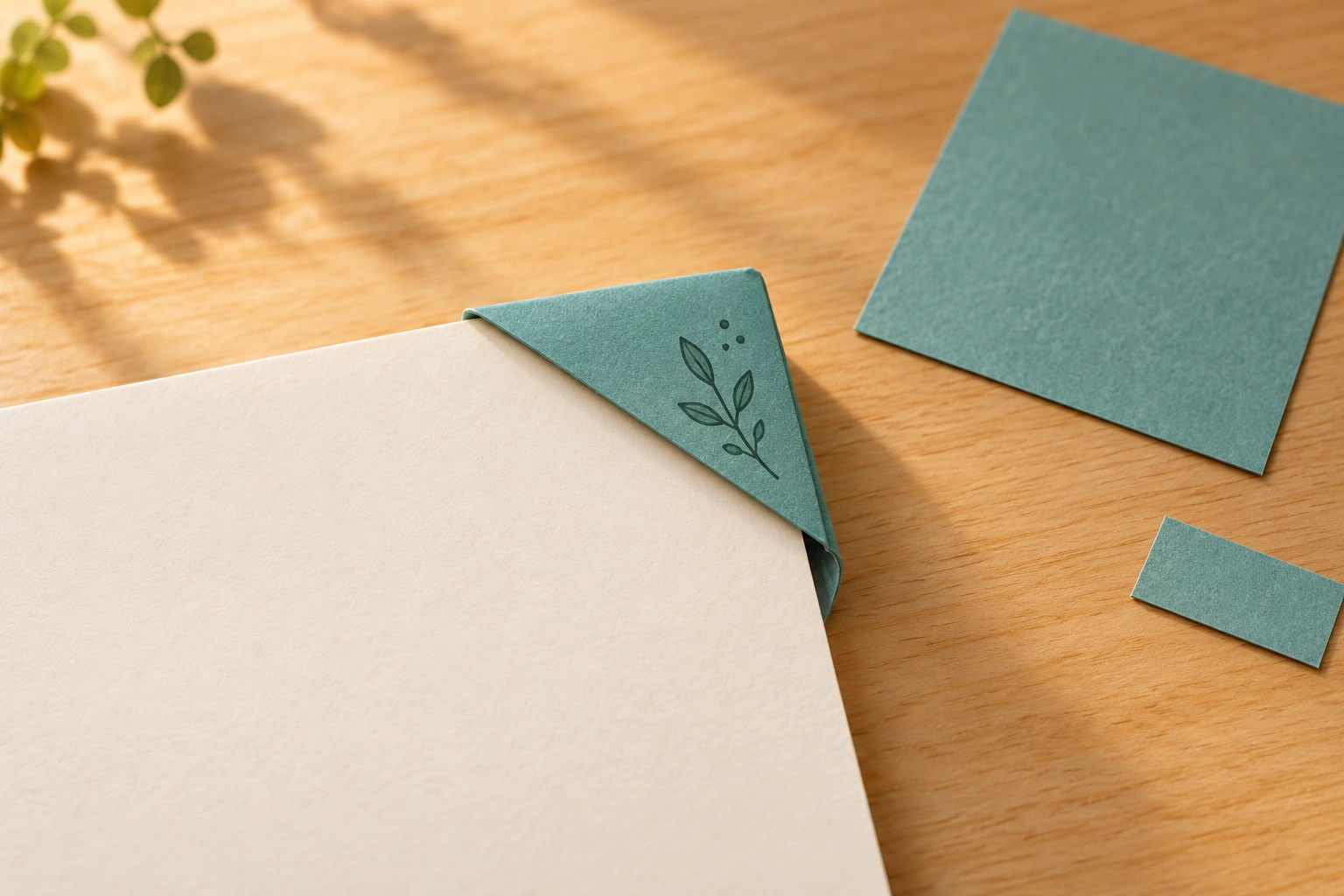
A paper corner bookmark is a small craft project with two parts: making the pocket and deciding what personal mark belongs on it. Work on a separate sheet throughout. The folding exercise happens away from the book, and the first fit check uses a loose practice page. You can finish with a plain piece if you prefer. A decorative mark is an optional choice, not a requirement for completing the model.
Two paper offers provide rectangular stock. The Ounona 22059630 origami paper kit lists assorted-color, double-sided sheets measuring 11.7 by 8.0 inches. The Roselle construction paper offer describes assorted-color 9-by-12 sheets. Its photograph is packaging with a fish craft illustration, not a supplied finished bookmark. Neither offer establishes that its paper has been tested for this project or for contact with a particular book.
Choose the starting square before the folding session
Origami.me's public bookmark tutorial presents Nick Robinson's design and recommends a four-inch or ten-centimeter square. Its diagrams begin with the white side up. Keep that reference beside your work, using the actual sheet's faces as orientation cues; neither retail offer promises that white reverse. The instructions below summarize that identified method.
DLTK's basic-origami reference shows how a rectangle becomes a square: fold a top corner across to form a triangle, cut away the surplus rectangle beneath it, then unfold. Its three illustrations show the alignment and cut. That preparation alone does not select the bookmark reference's recommended size. Both paper offers above start as rectangles, so confirm the square you intend to use before beginning the model.
If you already have an appropriate square, leave any cutting task out of this session. Otherwise use suitable tools under their own instructions and resolve the size before folding the bookmark. The project does not require opening a whole pack or preparing every sheet. Set aside the remaining stock so the piece you are working on stays easy to identify among the loose paper.
Fold the separate paper pocket
For Robinson's sequence, position the square as a diamond. Fold top corner to bottom and reopen. Crease the lower half vertically from left to right, then reopen.
Bring top and bottom corners to the horizontal center crease. Halve the model along the first crease. Fold the lower-left edge to the vertical reference, then repeat on the right.
Turn the model over. Bring the top corners to the bottom corner and reopen those folds. Tuck the two upper flaps into the pocket.
The tutorial author's clarification matters at the second step: only the lower half receives that vertical reference crease. Consult the diagram before continuing if that movement is unclear.
Pause before adding decoration
Set the completed piece on the work surface and look at it before reaching for a pen. Which exposed area would you like someone to see? Turn the loose piece in your hands and decide how you want your own mark to face. This is a design choice to make with the object you have, rather than an instruction to copy a decorative example from a shop photograph.
Keep the published folding diagrams as the reference for the model. Make any decorative drawing your own. A simple initial, a little wave or a small leaf-like outline gives you something to consider without reproducing the designer's diagrams or another artist's pattern. You can leave the mark abstract if you would rather avoid a recognizable picture. Choose something you actually want to look at.
Do not begin on the finished piece just because the drawing seems small. Try it on spare paper first, using a medium appropriate to that paper and following its guidance. That trial gives you a chance to change your idea without having to unfold or replace the model. It supplies no guarantee about every ink, coating or future contact surface.
Make two small sketch options
For this original design exercise, draw two possibilities on separate spare areas. One could be the first letter of your name. The other could be a short line motif with no lettering. Put them beside the folded piece and ask which better suits what you want to make. You are choosing the mark, so there is no need to declare one style more correct than the other.
An initial makes the piece feel personally identified. A small abstract mark can be a reminder of the making session without showing a name. Those are possible intentions, not promises about how another person will interpret the drawing. If you are making the piece for someone else, choose an intention you can explain plainly. You can also ask whether they would enjoy a mark or would prefer the paper left plain.
Look at each sketch from the ordinary distance at which you would pick the piece up. If you need to bring the spare sheet very close to understand the drawing, consider a simpler version. You might remove an extra line or make the initial less elaborate. This is your appearance judgment; it does not establish a print-resolution rule or a minimum marking size for everyone.
Keep the sketch next to the model while choosing where the mark will go. The empty area around it is part of the design. A small mark may look pleasant near an edge, or you may prefer it nearer the middle of the exposed face. Try the idea on another scrap if you are uncertain. You can compare positions without attaching anything to the finished piece.
Imagine Ada choosing between a small A and a wave drawn on spare paper. The initial makes the piece feel identified, while the wave recalls a beach visit she would like to remember. She prefers the wave for this piece and keeps the initial sketch for another time. This imagined choice does not make either mark better for other readers. It shows how one plain intention can help a maker choose between two drawings.
In that same example, Ada's first wave has several lines around it. She redraws the main curve alone on another spare area and places both sketches beside the model. She likes the simpler version and chooses it. You could make the opposite choice if you enjoy the fuller drawing. The exercise concerns an appearance you can inspect before marking the folded piece, rather than a rule that every small design must be minimal.
Give the mark a modest job
The personal mark can be as ordinary as a small cue that this is the piece you made today. It does not need to summarize a whole book or represent a reading goal. If you do want to connect it with a particular reading occasion, choose your own association: perhaps a wave for a story you remember beside the sea, without reproducing an illustration from that book.
A single initial may be enough when several people are making their own pieces at the same table. Let each person choose how to identify their work, or leave it unmarked. There is no need to assign everyone a matching design. Keep the spare sketches available until each maker has decided what to do with their own folded piece.
For a gift, a separate short note can explain the association if you want one. That keeps a long message from being squeezed into a small area. The note might simply say why you chose that little drawing. You need not describe the recipient as a particular kind of reader or make a claim about what the bookmark will help them achieve.
Apply the chosen medium under its own guidance
Once you have chosen a sketch, use only a marking method suitable for the actual paper. Keep any relevant drying or handling directions with that medium before bringing the piece near another surface. This project adds a small surface mark; it does not prescribe glued embellishments, thread, coatings or a protective treatment. Leave those as separate material projects if you want to investigate them later.
You can stop with the spare sketch if the paper or drawing tool does not give you enough information to proceed. The folding work remains complete. Another option is to keep the model plain and retain the drawing separately as an idea for a later piece. There is no need to add an uncertain medium merely to make the craft look finished in a photograph.
Check the opening on a loose practice page
Use a loose ordinary practice sheet for the first contact check, keeping the model separate from a real book. Bring the page corner toward the actual opening gently. If the piece does not accept it comfortably, stop rather than forcing the page into it. Look again at the model and reference before deciding whether to remake anything. An uncertain fit remains an uncertain fit.
Look at both the folded piece and the practice page after the check. Describe any catching, transfer or visible change you actually observe, without treating a single uneventful try as a preservation test. A loose-page trial does not establish suitability for every paper, print or binding, and it cannot certify the condition of a book you have not examined. Keep valuable, fragile, borrowed or historically significant items outside this exercise.
Decide whether this particular piece has a role with an ordinary personal copy only after considering the actual materials and contact. You may prefer to keep it as a completed paper model. That is a useful finish for a craft session too. The article does not certify archival safety, a book-care method or a universally suitable replacement for every other kind of page marker.
Choose what you would enjoy making next
If the folding sequence interested you more than the decorative choice, the origami practice-cup guide offers another identified model to follow. Keep its empty practice-model purpose with it. The cup has a different sequence, so return to that guide's own reference rather than trying to adapt this pocket from memory.
For a paper object that leads into a shared activity, the paper fortune-teller conversation guide combines a folded toy with original questions. That may suit another evening when you would enjoy both making and talking. Your finished corner piece can remain a separate project, with the mark and appearance you chose for it.
Keep the selected sketch if you want to revisit the design. On a later occasion, you might try a plainer mark or leave another piece entirely unmarked. Use the same identified folding reference when you want this model again, and reconsider material suitability with the actual sheet in front of you. A small craft can end with one completed piece and one idea you would enjoy returning to.
Keep any payment decision with the actual order
If you plan to purchase an item on republeq.com, check the particular offer and current checkout before ordering. This guide does not establish that any cryptocurrency payment option is available. If USDT is offered for the intended order, verify the requested asset, network, amount, receiving destination and order reference with the responsible service before authorizing a transfer. Review the actual product identity, selected variant, quantity, delivery details, total charge and applicable terms. Use the confirmed order details when checking the payment instructions. Confirm any fee, conversion term or exchange rate from the current transaction information. Determine the applicable cancellation, return and refund process, including how a refund would be handled for the selected payment method. Keep the relevant instructions and transaction records, with dates and confirmed references. If essential instructions change, ask the responsible service to confirm the change against the exact order. An acknowledgement should identify the order and the agreed details; it does not replace checking whether the selected product is the one you intended to buy. If payment or order status remains uncertain, reconcile that status before considering another transfer. Do not treat an unresolved transaction as evidence that nothing happened. This article supplies no wallet address, transfer guarantee, recovery procedure or assessment of a counterparty. A product enquiry does not authorize a payment or resolve an uncertain order. If support provides an answer, retain the exact question and response so a later reviewer can understand what was confirmed. Decide whether to proceed only when the conditions of the particular transaction are clear, and retain the confirmed transaction information with the exact order.