Office Supplies & Stationery
An orphaned footnote repair in an original studio notice
An original notice loses its note marker when the author cuts a paragraph. The repair preserves the remaining words and catalogue restriction while restoring their link.
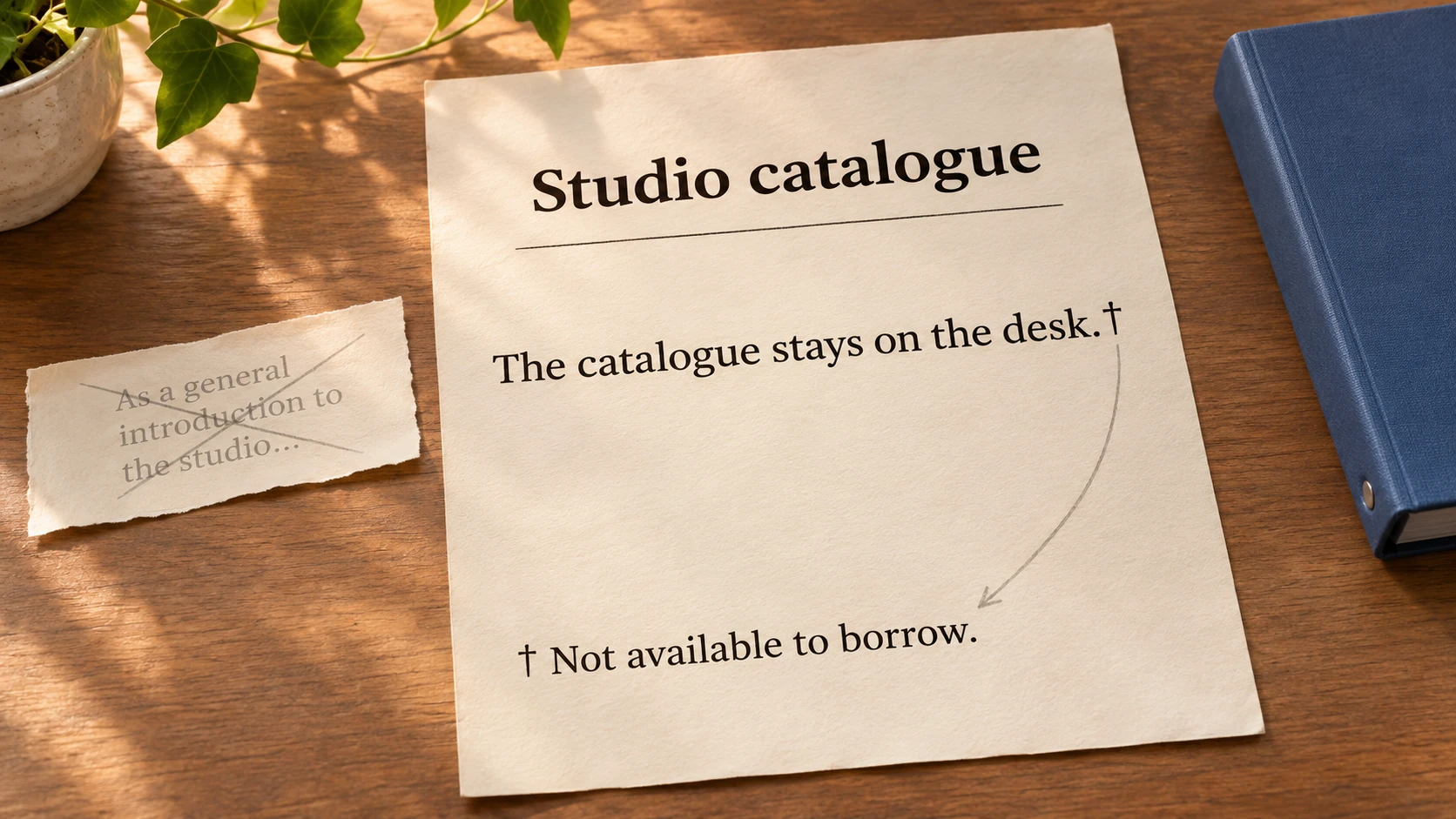
An orphaned footnote repair starts here with a small piece of my own writing: a notice for an invented studio. I have cut its opening paragraph, but the note that belonged to that paragraph remains at the bottom. I want the shorter notice to retain the same restriction on borrowing its catalogue. The repair needs to reconnect those words without giving the neighbouring blue binder a rule I never wrote for it.
Keep the author’s brief beside the notice
The studio, its catalogue and the blue binder are fictional. I wrote the notice and its note for this example. There is no real venue policy to infer, and none of the wording is a quotation from another author. My brief is modest: remove the introductory paragraph, keep the remaining sentences, and preserve the statement that this particular catalogue stays in the studio.
I have used a dagger, †, as the shared mark. It appears once beside a passage and once before the note belonging to that passage. These are literal characters in the example, so you can inspect the complete result on this page. I am not demonstrating how a particular word processor creates, deletes or renumbers footnotes. If you work in an application, its actual document behaviour is a separate thing to check.
The blue binder matters because it gives the repair a plausible wrong destination. Both objects appear on the same desk. A nearby noun alone will not settle which one the author meant the note to qualify. Here the brief and the actual wording supply that answer: the restriction names the catalogue. I will keep that object fixed while deciding where its mark belongs.
The complete notice before the cut
“The studio desk has a catalogue for visitors.† It was printed for our small display.”
“You can copy an entry onto your own paper from the catalogue on the studio desk.”
“The blue binder beside the catalogue holds the list of works to be ordered.”
“† The catalogue stays in the studio and is not available to borrow.”
That is the entire original notice, including its bottom note. The first paragraph introduces the catalogue and says why it was printed. The next paragraph gives a way to use it without taking the studio copy away. The third introduces a different object. Nothing in that last sentence says whether visitors may borrow the binder, and I have not supplied a separate author instruction about it.
I decide that the introduction can go. The remaining catalogue sentence already locates the copy on the studio desk, and I prefer the notice to open with what a visitor can do. This is an editorial choice for these words. It does not establish that introductory paragraphs should generally be removed or that information about a display is always dispensable.
Inspect the shorter notice before repairing it
“You can copy an entry onto your own paper from the catalogue on the studio desk.”
“The blue binder beside the catalogue holds the list of works to be ordered.”
“† The catalogue stays in the studio and is not available to borrow.”
The cut has removed the dagger beside the catalogue’s introduction. The dagger at the bottom remains. I can still understand the restriction because the note names its object, but the notice no longer presents the paired marks I intended. Calling this particular note orphaned identifies that local mismatch; it does not mean its sentence has become meaningless or that its catalogue has disappeared from the notice.
Before adding anything, I compare the shorter copy with the brief. The catalogue is still mentioned, and the copying instruction still concerns that same desk copy. The restriction is still required. Those conditions make relocation available in this example. A different cut could remove the catalogue entirely, or an author could decide to remove its restriction. Either change would give us a different piece to edit.
The surviving sentence
The surviving sentence I choose is the one about copying an entry from the catalogue. It contains the object named in the retained note and gives that object a current place in the notice. I put the dagger after its closing punctuation. That is the placement selected for this example; I am not claiming that every publisher uses the same punctuation convention.
Here is the complete repaired notice. The first two sentences retain their wording from the shorter copy. The bottom note retains its exact words. The addition is the dagger following the catalogue sentence.
“You can copy an entry onto your own paper from the catalogue on the studio desk.†”
“The blue binder beside the catalogue holds the list of works to be ordered.”
“† The catalogue stays in the studio and is not available to borrow.”
Read the surviving sentence together with that note. A visitor may copy an entry onto their own paper, while the catalogue itself stays in the studio. Those are the conditions I wanted this invented notice to communicate. The binder sentence can remain where it was without acquiring a new borrowing instruction through the repair.
I would save this complete version alongside the cut copy. The comparison then shows the actual change, rather than relying on a memory that the footnote was fixed. If I later change the catalogue sentence, I can return to these particular words and decide whether the same note still belongs there. That future revision has not happened in the notice printed above.
The note marker
Putting the note marker after the binder sentence is an alternative I reject. It would place the visual invitation to read the catalogue restriction beside the statement about the list of works. The note would still say “catalogue,” so the two passages would pull attention toward different objects. My brief gives me no reason to choose that arrangement when the catalogue sentence is still present.
I also reject changing the note’s first noun to “binder.” That would make the newly placed mark look more locally coherent, but it would create a restriction on the wrong object and remove the required statement about the catalogue. A tidy pair of daggers would not make that version satisfy the author’s brief. The words beside the marks need checking as well.
Deleting the bottom note would remove the visible mismatch in another way. It would also remove the catalogue’s no-borrow statement. That is a possible author decision in another version of the notice; it is excluded by the instruction I set for this one. I do not use deletion as a silent shortcut when the condition is meant to survive.
A final alternative is to fold the restriction into the catalogue paragraph and remove both daggers. I could write a complete continuous notice that way. I have left that approach for a separate revision because the current brief asks me to retain the existing bottom note and the remaining sentences. Choosing a different form would be easier to assess if I wrote out that whole alternative rather than mixing pieces of it into this repair.
Read the complete result once more
My last pass follows the catalogue through the repaired notice. It appears in the copying instruction, then in the binder’s location, then in the restriction. The dagger belongs to the first of those remaining sentences. I do not add a second dagger to the binder paragraph just because it also contains the word “catalogue.” That sentence’s subject is the binder, and the one existing connection already serves the author’s selected arrangement.
I also read the note by itself. Its object and its restriction are unchanged: this catalogue stays in the studio and is not available to borrow. No new rule about taking copies of entries, ordering works or using the binder has slipped into it. Those choices could be written later, but the repair does not need to invent answers to them.
The finished orphaned footnote repair is the complete three-paragraph notice above. I would hand over that copy with the preserved brief and before-state. Someone reviewing it can see the deleted introduction, the remaining catalogue sentence and the retained restriction. They can assess this exact decision without being asked to accept a general promise that every note in a longer document has been checked.
An orphaned footnote repair reconnects the catalogue sentence and its retained note after an introductory paragraph is cut.
Optional bookends remain outside the notice
The Business Source bookend account shows a terminal support beside staged books. Its description specifies twelve per box and ten boxes; the sole image cannot verify that inventory. Construction, finish and size remain listing claims.
The OfficeMate bookend account shows an arched support holding books. It describes one pair and a two-pair bundle, while the image shows one support. I have not authenticated the delivered count, material or nonskid performance. Neither product is required for the textual revision.
Two neighbouring manuscript decisions
The dialogue paragraph repair regroups a print-shop exchange while keeping its spoken lines and actions fixed. This notice has no conversation to regroup. Its retained note needs a connection after a deliberate paragraph deletion.
The reading-room modifier repair names the actor carrying a sign in an original scene. The catalogue notice already names its objects. Relocating its mark preserves a specific restriction without changing an actor or extending that separate story.
Purchasing is a separate decision
If you choose to order either bookend offer through republeq.com, resolve the intended quantity against the exact listing and current order before authorizing payment. A preference for cryptocurrency or USDT does not establish that either is available for that transaction. Read the payment choices actually offered by the responsible service. Ask the responsible service how the stated quantity relates to the selected order, and retain the answer beside the item reference. A photograph alone does not settle a delivered inventory. When choosing between these bookend offers, keep their references separate while asking. Check the selected item, variant, quantity, delivery information and full charge together. If a crypto option is actually offered, obtain the current asset, network, amount, receiving details and order reference through its supported process. This article supplies no address, network recommendation, fee estimate or processing promise. Review any stated conversion terms and applicable fees before proceeding. Read the cancellation, return and refund terms for the chosen payment method, including how the service says a refund would be handled. Retain the instructions and any resulting transaction reference with the order record. If the order or payment has uncertain status, reconcile the existing attempt before considering another payment. An unclear acknowledgement does not prove that nothing happened, and the wording on a bookend page cannot resolve an uncertain transfer. If a necessary detail remains unresolved, leave that decision open while seeking an answer through the verified order channel. The invented catalogue notice provides no authority for a real purchase, payment or borrowing arrangement. Its repaired dagger connects two passages of authored text; it does not certify the seller, the goods or the outcome of a transaction.