Office Supplies & Stationery
Repair dialogue paragraphs in an original closing scene
An original scene about closing a small print shop is revised through paragraph boundaries, with the spoken words, named speakers and outward actions held fixed.
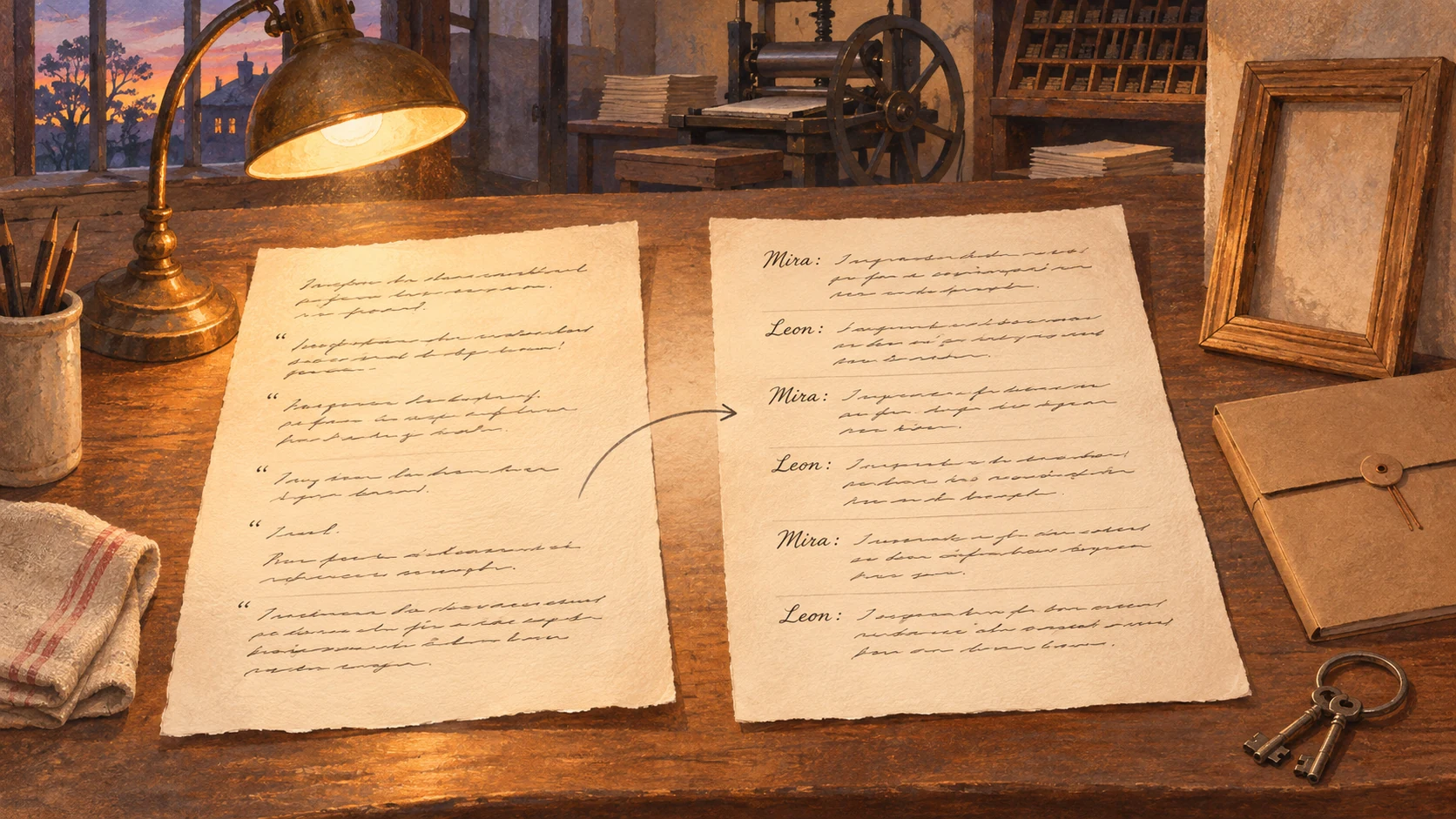
The dialogue paragraphs in this original scene need a different arrangement. Mira and Leon are closing a small print shop after finishing a window notice. Their names already identify every spoken line. I want each person’s small closing task to sit beside what that person says. In the first arrangement, the spaces on the page keep separating those companions. The repair below moves those spaces while leaving the scene’s sentences in their original order.
The first arrangement
This is the complete scene before the paragraph repair. Its slightly awkward joins are deliberate. Read through the whole exchange before deciding where you would put the spaces.
Mira slid the finished notice out of its folder.
“The window can wait until morning,” Mira said. “I want to see it in daylight.” Leon set the key ring beside the till.
“Then leave it on the long table,” Leon said. “I will move the empty frame away from it.” Mira laid the notice beside the folded cloth.
“I have marked the top edge on the back,” Mira said. “The front is finished.” Leon carried the empty frame to the wall.
“I can see the mark from here,” Leon said. “The table is clear now.” Mira closed the folder and put it on the shelf.
“Thank you for staying,” Mira said. “I thought the last line would take all evening.” Leon picked up the keys.
“It took the time it took,” Leon said. “Come on. I am ready.”
The first paragraph gives Mira a small entrance and immediately stops. The next one contains her request and Leon’s placement of the keys. I can still follow it: “Mira said” remains in the sentence, and the following action explicitly names Leon. My objection is the join itself. The key ring seems to arrive at the end of Mira’s turn, while Leon’s answer begins on the other side of a blank space. The page keeps making a little handoff before the exchange has actually handed over.
That pattern continues at the folder and the frame. A paragraph containing Leon’s answer ends with Mira laying down the notice. The next contains Mira’s assurance about the finished front and Leon carrying away the frame. The sentences describe an orderly evening. Their grouping gives me a different rhythm, with each person’s final line followed immediately by the other person taking over the room. I prefer a gentler departure for this particular scene.
Speaker actions
I read the speaker actions as part of the farewell. Mira handles the finished work and its folder; Leon clears the empty frame and collects the keys. Those are the two strands I want to see on the page. The gestures give their short replies something physical to lean against. Putting the frame movement beside Leon’s answer lets his agreement and his useful little task occupy the same paragraph.
The folded cloth is a good place to inspect the difference. Mira lays the notice beside it, then says that the top edge is marked on the back and the front is finished. I want to meet those sentences together. The notice arriving on the table provides a place for the remark about its back. When the action sits at the end of Leon’s previous paragraph, I feel a pause between the thing being placed and Mira speaking about it. In my revision, that pause disappears.
I would keep the repeated names for this demonstration. A later stylistic pass might substitute a pronoun or remove an attribution, but that would create a second revision with its own effects. Here, “Mira said” and “Leon said” let us hear the same exchange in both arrangements. The awkwardness is visible even with all that help. I do not need to make the first version confusing to give the paragraph repair a purpose.
The keys also change their place in my reading without moving within the story. Leon sets them beside the till near the beginning, then picks them up at the end. In the repaired arrangement, each of those actions opens a paragraph that contains his speech. I like the small enclosure this makes around his part in the scene. He puts the keys down while agreeing to wait; he takes them up when he is ready to leave. The repeated object earns its space through that return.
Paragraph breaks
These paragraph breaks collect each action with the speech that follows it. The sequence below keeps every sentence from the first version, including both speakers’ names and the short second sentence in each spoken turn. Only the paragraph boundaries move.
Mira slid the finished notice out of its folder. “The window can wait until morning,” Mira said. “I want to see it in daylight.”
Leon set the key ring beside the till. “Then leave it on the long table,” Leon said. “I will move the empty frame away from it.”
Mira laid the notice beside the folded cloth. “I have marked the top edge on the back,” Mira said. “The front is finished.”
Leon carried the empty frame to the wall. “I can see the mark from here,” Leon said. “The table is clear now.”
Mira closed the folder and put it on the shelf. “Thank you for staying,” Mira said. “I thought the last line would take all evening.”
Leon picked up the keys. “It took the time it took,” Leon said. “Come on. I am ready.”
I prefer the middle of this arrangement. Leon’s instruction to use the long table sits with his keys, then Mira gets a full paragraph to place the notice and describe its marked edge. When Leon moves the frame, his reply follows in the same space. The exchange now has room for each completed task. The blank lines land after a person has done something and spoken, which is the pace I wanted for these two tired people.
The last two paragraphs give the farewell a similarly plain shape. Mira closes the folder before thanking Leon for staying. The folder reaches its shelf within her paragraph, alongside her admission about the last line. Leon then picks up the keys and answers. I like leaving “I am ready” at the end of his own paragraph. The invitation to go follows his practical readiness, and the scene can finish there without another gesture.
The sentence about daylight remains Mira’s reason for waiting. A new blank line cannot supply a different reason, and I would dislike an explanation claiming that she secretly doubts the notice or wants to test Leon. Nothing in this scene states either idea. My interest is smaller: the finished sheet, empty frame and keys now appear in the same paragraph as the person using them. The closing tasks feel less scattered across the conversation.
A second arrangement I considered
I also tried giving each outward action a paragraph of its own, followed by a separate paragraph for the same person’s speech. That would make twelve paragraphs. The opening would show Mira sliding out the notice, pause, then give her two spoken sentences. Leon would put down the keys in another short paragraph before answering in the next. I can imagine wanting that much air in a more hesitant scene. In this one, the regular stops made the shop feel strangely still.
The action-only version especially weakened the empty frame for me. Leon’s promise to move it and the later movement already give the object enough attention. Isolating the movement on another little island asked me to linger over it again. I wanted it to remain ordinary closing work. The six-paragraph version lets Leon carry it away and make his short observation about the clear table without turning the frame into the scene’s main attraction.
There is a smaller choice inside Mira’s thanks. I could start a new paragraph at “Thank you for staying,” keeping the folder action separate while leaving the earlier turns grouped. That would give her thanks more visual weight. I decided against it because her line about the last sentence taking all evening already explains why the thanks belongs here. Keeping the folder and the two spoken sentences together gives me the modest, slightly weary ending I intended for her.
Those alternatives help me explain my preference. I am choosing the version that lets the practical work accompany the conversation with few interruptions. Another scene might need a conspicuous pause before a difficult answer. These six turns contain agreement, a short account of the finished notice and a farewell. I hear them as a continuous exchange while the two people put things away. The revised page follows that reading.
Read the two versions beside each other
For a close comparison, read Mira’s first two turns aloud from the original arrangement, then from the revision. Keep the same pace within each sentence. Let the paragraph spaces introduce only the pause you would naturally give a new paragraph. I hear the notice settling onto the table more clearly in the revised middle turn. You may hear a smaller difference. The exact passage gives us something to discuss beyond saying that one layout looks cleaner.
Two related examples make different changes. The direct and reported dialogue comparison changes the form of an exchange. The planning-scene reply repair changes a reply’s content. The print-shop revision keeps its direct speech intact, including the request to wait until morning. The chosen boundaries let the existing sentences stay together in a different way.
Optional paper for a comparison copy
You can make this revision in your current document. If you want separate paper copies, the Hotbar white cardstock listing shows a complete stack of loose white sheets. Its native account advertises 100 sheets; the photograph does not verify that total. I have not tested its printing or writing performance. The scene does not require a particular paper finish.
The Fuliko cardstock listing shows blue sheets with “180 GSM” and “200 SHEETS” on the image. Those are pictured label claims. The native account also uses “Multicolor” and conflicting weight wording; I would ask for clarification before relying on those details. The folded fish in the picture illustrate a use of paper. I am not treating them as supplied finished toys or a craft kit.
Ordering supplies through Republeq
This scene can be revised without buying supplies. If you decide to place an order through republeq.com, select the exact listing and read the information offered for that transaction. A preference for cryptocurrency or USDT does not establish that either is available at checkout. Use only the payment choices actually presented by the responsible service. Resolve the paper questions before authorizing an order if quantity, color or weight matters to your intended use. For the white sheets, the pictured stack does not establish a delivered total. For the blue sheets, a printed total on a photograph remains a label claim, and the conflicting native descriptions still need an answer. Keep any clarification with the order record so you can refer to the item and terms you selected. If a cryptocurrency payment option is actually offered, obtain its current asset, network, amount, receiving details and order reference from the instructions for that transaction. This article supplies no receiving address, network recommendation, fee estimate or processing promise. Check delivery, cancellation, return and refund terms before proceeding. Ask the responsible service about an instruction you cannot reconcile, using a channel you have checked. Retain acknowledgements identifying the order and any payment action you take. If an order or payment has uncertain status, reconcile that status before considering another payment. An incomplete record does not establish that no action occurred. When another person is ordering on your behalf, give them the selected item and the unresolved questions, and keep the actual order reference available for later correspondence about that transaction.