Home & Living
A dangling modifier repair in the reading room
A complete original reading room scene accompanies a preserved opening-phrase draft and a local repair that names its missing actor.
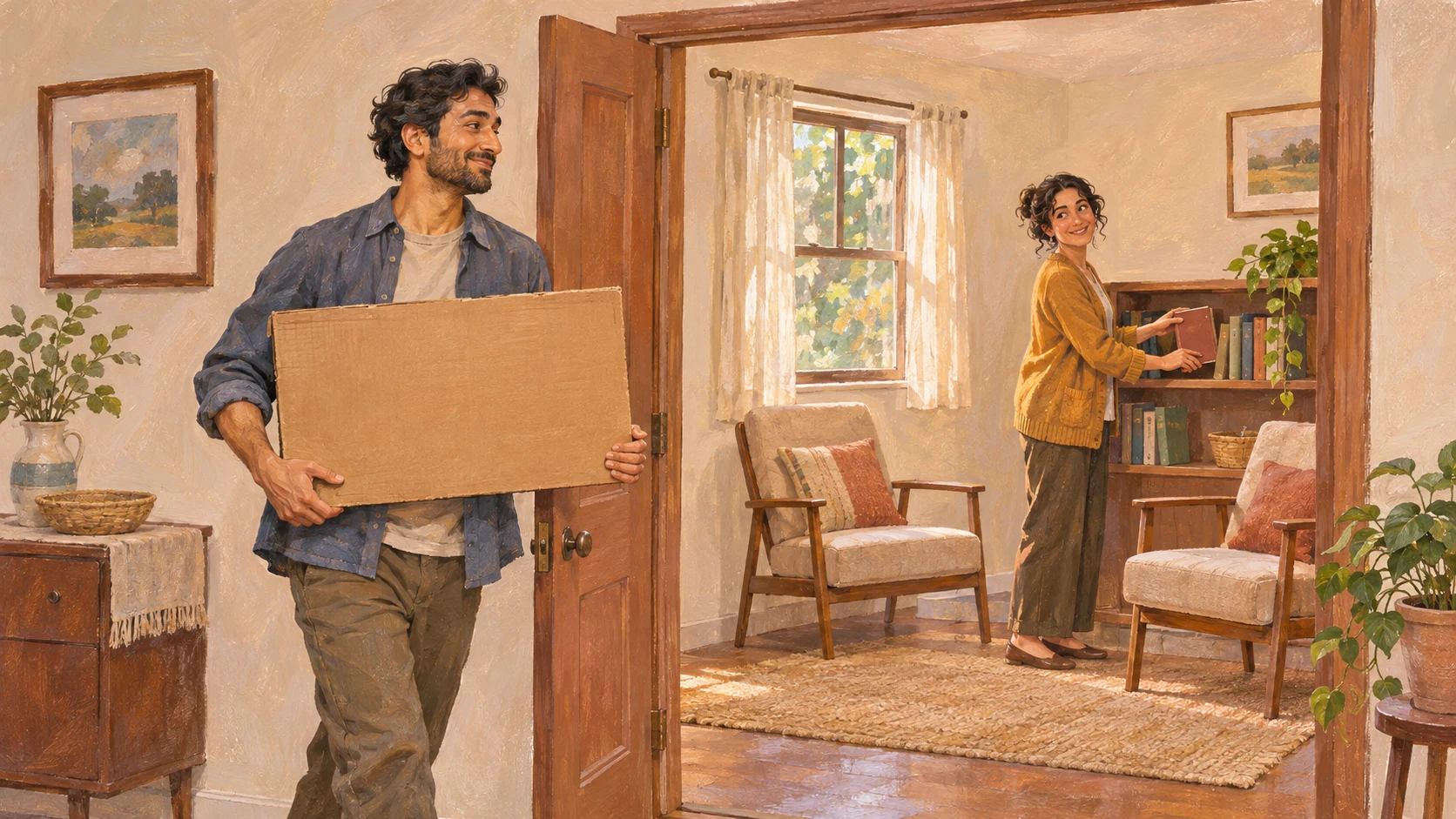
Rafi and Mina are preparing the reading room in his home for an informal reading afternoon. The complete selected scene below is original fiction. Its people, room and first visitor are invented. A short preserved draft gives this local edit a definite before-state; the finished scene keeps its own ending and does not report an actual gathering.
An opening phrase with its actor
Purdue OWL’s dangling-modifier guidance allows the missing doer to be named in a complete introductory clause. For this dangling modifier repair, keep the intended action fixed and make the opening phrase explicit. The chosen action is Rafi carrying the sign while the doorway seems narrower to him.
The working line is “Carrying the cardboard sign, the doorway seemed narrower.” My retained line is “As Rafi carried the cardboard sign, the doorway seemed narrower.” The doorway description stays in place.
The reading room opens
As Rafi carried the cardboard sign, the doorway seemed narrower. He turned the board a little and came through without touching the frame. Mina looked up from the low shelf and asked whether he wanted her to move. He said he was already in. She put the book she was holding into the space beside its neighbour, then took it out again because she had not finished looking at the cover.
The sign had been a box yesterday. Rafi had cut away the part with the address and kept the broadest plain side. He meant to write something welcoming on it. So far he had made a pencil mark near one corner and decided the board ought to face the other way. Mina had offered to hold it upright, but he had wanted to see it in the room first.
There were two chairs by the window and another beside the door. The third had come from the kitchen. Its seat was harder than the others, so Rafi had put a cushion on it. Mina moved the cushion to one side while she sat down to inspect her book. He asked whether she thought the chair looked temporary. She said it looked like a chair somebody could sit on.
He leaned the board against the wall. From there it covered the lower part of a photograph he had forgotten was hanging behind it. Only his aunt's hat remained visible. The photograph had been taken at a picnic where everyone except his aunt appeared to be watching something beyond the camera. She looked directly into it, as if she had been waiting for the photographer to finish making arrangements.
Rafi lifted the board and tried the space beside the shelf. Mina watched him without offering another position. He had already asked her about the window, the little table and the back of the open door. Every place had seemed suitable until he imagined somebody arriving and seeing it. He wanted the sign to answer whatever question would otherwise make a person hesitate on the landing.
“What will it say?” Mina asked. He told her he had not decided. She closed the book with one finger marking her place. “That may be why it's difficult to hang.” Rafi looked at the board. The pencil mark still occupied its one corner, an excellent beginning if he ever needed to label the corner. He put the board flat on the table and fetched a pen.
The room had belonged to his parents when they stayed with him. After they moved nearer his sister, he had kept the bed made for a while, then taken it down. The shelf had been there all along. He and Mina had spent yesterday moving the books he wanted to keep into the lower part, where somebody could reach them without asking him to bring a chair.
He had invited a few friends to come over with something to read. He had not called it a club. The word suggested that he ought to know what happened after people arrived. Mina had said she could bring a book and sit in a room without his having to invent a title for the afternoon. Now she was doing exactly that, with her finger still holding the unfinished page.
Rafi wrote READ HERE in the middle of the cardboard. The letters rose toward the right, though he had drawn a faint line for them to follow. He started to say he would turn the board over and try again. Mina stood behind his shoulder. “I could manage that,” she said. He asked whether she meant reading the sign or reading there. She said both.
They put it beside the open door. The lower edge rested against a small stack of books Rafi had not yet shelved. His aunt's photograph became visible again. He straightened its frame, noticed that the other picture beside it was now crooked, and left the second one alone. Mina returned to the kitchen chair. This time she settled the cushion behind her back before opening her book.
For a few minutes Rafi heard only the page turning and the ordinary noises from the kitchen. He had left a spoon in a cup there, and every time the washing machine moved into another part of its cycle the spoon made a faint sound. He went to take it out. When he returned, Mina had put a folded scrap of paper between the pages and was looking at the photograph.
“Was the picnic good?” she asked. Rafi said the photograph did not show the rain. They had packed everything into the car, then sat under a little shelter eating the food they had been about to take home. His aunt had insisted on cutting the cake before they left. The hat had stayed on throughout, even though the shelter's roof was low enough to brush its top.
Mina asked whether the cake had got wet. Rafi could not remember. He remembered his aunt holding the knife and somebody moving a plate away from the edge. The rest of the picnic had become the photograph and the story he usually told about it. He looked at the hat for a moment. Mina did not ask him to finish a detail he could no longer supply.
The doorbell rang before he had chosen anything to read himself. He went down the short hall and found Nadi standing outside with her coat over one arm. Her other hand was empty. “I forgot a book,” she said. Rafi started to tell her there were plenty in the room, then stopped because it sounded as if he had prepared a correction for her arrival.
“Come in,” he said. She looked past him at the open door and the cardboard. “I thought it might be a shop.” He laughed, and she explained that she had seen books on the windowsill from the street. He had left them there while clearing the shelf. Nadi took off her shoes and put them beside his, still holding her coat as though she might need it again.
Mina stood to greet her and moved the cushion from behind her back onto the spare chair. Nadi sat in the softer chair by the window. Rafi hung her coat in the hall, then came back carrying the book he had left on the kitchen counter. He had put it there that morning to make sure it would be easy to find. He was glad neither friend asked how long he had been looking for it.
Nadi noticed the picnic photograph. Mina said they had just been talking about the rain outside its frame. Nadi said her family had a photograph in which everybody appeared to be celebrating a cake that had fallen on the floor. Rafi asked whether they had eaten it. She said the picture did not answer that question. Mina laughed and moved her folded scrap farther into the book.
Rafi sat in the kitchen chair. The cushion had returned to it, and he found he did not need to think about whether the chair looked permanent. His book opened near the end, where he had left a postcard to mark a passage. He turned back to the beginning. Across the room, Nadi took a book from the shelf, read its first page and put it back before choosing another.
They did not start together. Mina was already reading, Nadi was deciding, and Rafi had paused over the postcard he had forgotten using. It showed a wide beach with one person so far away that he could not tell which direction they faced. He put it on the little table instead of describing it. The afternoon had acquired enough things to look at without his bringing every one of them into conversation.
At the door, the cardboard remained on its small stack. From Rafi's chair he could see the rising letters and the pale crease where the box had once folded. He had thought the room would look unfinished until he found a proper place for the sign. Now Mina turned a page, Nadi drew one foot beneath her chair, and he returned to the paragraph he wanted to read.
The local change I retained
I kept the aunt's photograph, the initial pencil mark and Nadi's empty hand in the selected copy. They give this afternoon particular objects and conversations. I did not add a formal welcome speech or turn the gathering into a plan for running a reading group. The scene ends while all three people are still in the room, at different places in their reading.
The discarded opening stays above as a before-state. I retained one complete story rather than printing nearly identical full copies around the small edit. The cardboard still comes through the same doorway; Mina still looks up from the shelf. The later sign placement, picnic recollection and first visitor remain the events I chose for this version.
Optional native hardware accounts outside the fiction
The strawberry-shaped dispenser account has four informative views of a red pump body and four uniform, noninformative gallery entries. A molded front pocket visibly holds a scrubber in one staged view, supporting the existing sink-caddy role alongside dispenser hardware. The scrubber is not enumerated as supplied. Material, capacity, dimensions, maker identity and delivered contents are not independently authenticated.
The HomewardBound HO4348364 catalog account depicts a manual pumping mechanism with coiled clear tubing and mounting pieces. Those remain source-generic dispenser components, not authenticated independent extra stock. Its catalog model and OEM wording do not establish maker, factory identity, reservoir completeness, replacement fit or dimensions. The fictional room contains neither identified offer and demonstrates no dispenser operation.
Two neighbouring manuscript repairs
The separate-actions timing repair restores Oren's departure before Nia's entrance after a draft puts them together. Its actors are already named. Rafi is carrying his sign during the moment retained here; the local change does not rearrange the afternoon or add an encounter.
The chair-description repair moves an existing property phrase from beside the table to beside the chair. Iris and Dev keep their display-removal visit. This draft keeps the doorway description in place, and Rafi and Mina prepare a different room for a different afternoon.
Conditional purchasing context
If a separate purchase follows your reading, inspect the current order on republeq.com rather than treating the fictional afternoon as information about checkout. The article establishes no cryptocurrency availability, supported token or payment network. Before choosing crypto, check whether the responsible service actually offers that method for the item and order you intend. If USDT is among the supported choices, obtain the required asset, network, amount, receiving destination and order reference from that supported process. A familiar token name does not confirm the remaining instructions. Review any applicable fee and conversion terms, and resolve conflicting details before authorizing a transfer. Keep the selected product, variant, quantity, delivery information and full charge visible while checking payment information. A transfer screen cannot answer every merchandise question, and a payment acknowledgement does not establish that a parcel has been dispatched or a return accepted. Read the actual cancellation, return and refund terms for the intended method, including any currency conditions the service states. Save the instructions, order reference and resulting transaction record together. When a result remains uncertain, investigate the existing attempt through the supported order channel before considering another transfer. Do not assume that an unclear status means nothing happened, and do not improvise a new route for a method the order does not support. If essential information cannot be confirmed, another offered method or leaving the order unfinished may remain available choices. This text supplies no address, payment guarantee, recovery promise, assessment of a specific token or financial recommendation. Rafi's sign and the objects in his fictional room give no authority for any real transaction.