Gift Wrap & Party Supplies
Arrange an offcut paper garland around irregular shapes
An original flat garland plan keeps separate paper offcuts recognizable while comparing their order, colors and spaces without making a picture.
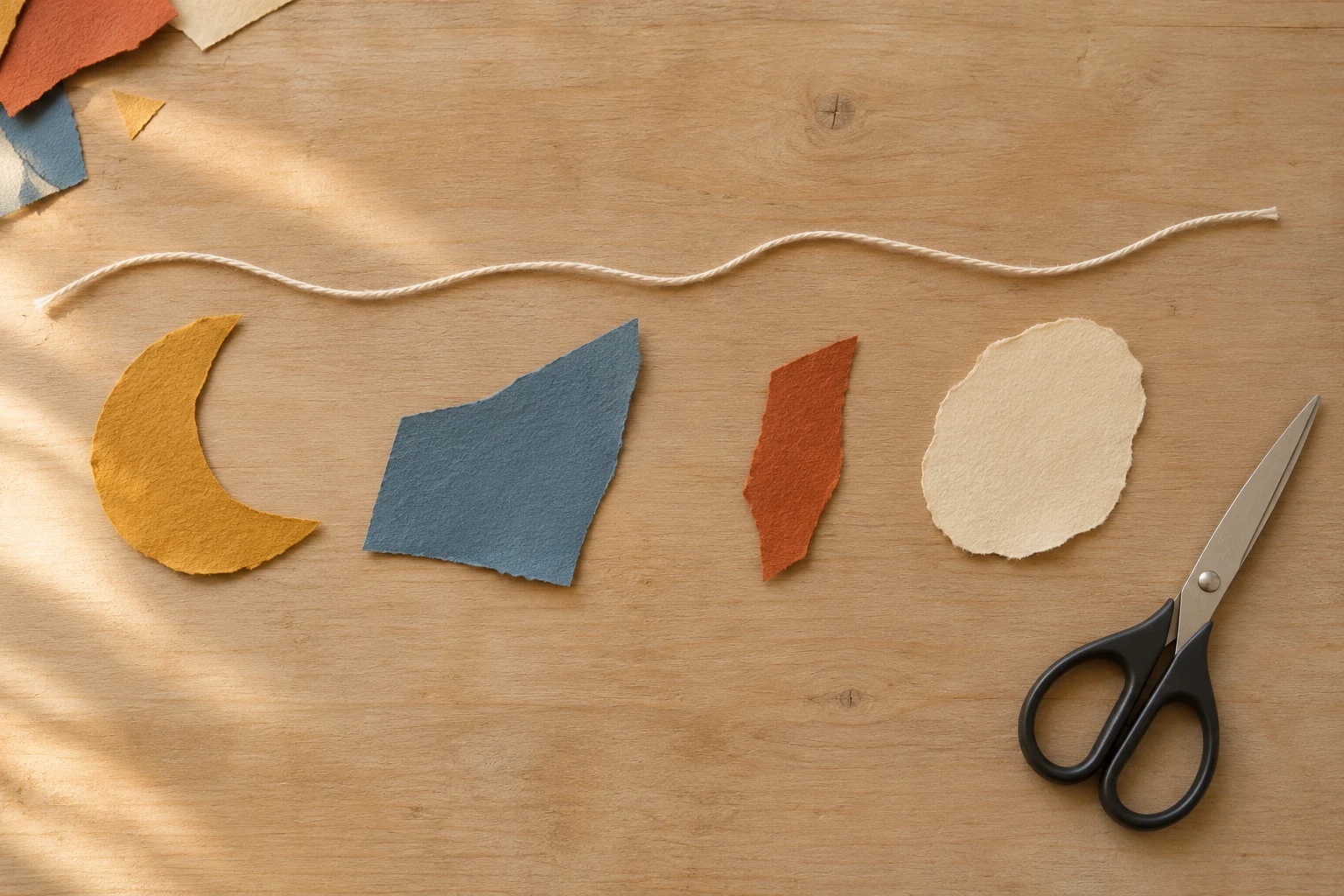
An offcut paper garland can begin with scraps you already like, rather than a template that makes them match. For this original plan, I choose an ochre crescent, a blue angular piece, a narrow rust-colored scrap and a cream torn oval. They remain separate in a loose line. The proposed arrangement is abstract: it depicts no landscape, character or written message.
Choose the scraps before choosing a repeated shape
Set the pieces on a plain surface where you can move them without fixing anything down. Keep the existing outlines visible. An offcut with an uneven shoulder does not need to become a neat flag before it belongs in the plan. Choose the pieces for the outlines and colors you want to keep.
The four pieces named here are an authored example, not a retail kit or a report of a finished craft session. Use the description to follow the choices, rather than assuming your scraps need identical dimensions. This article plans their order and open spaces. It supplies no cutting, fastening, adhesive, threading or hanging instructions.
Put aside a piece you do not want to use, even if it matches a favorite color. The line need not account for every scrap on the table. Starting with a smaller chosen group lets you see the relationship you are actually considering, instead of making the unused pile responsible for the design.
Let the irregular outlines remain recognizable
Turn the ochre crescent so its open side faces toward the blue piece. Place the blue angular scrap next, with its longest point directed slightly upward in the flat plan. The rust piece follows, narrow and upright relative to the line. The cream oval sits last, with its torn edge still visible.
These are the selected orientations for this version. They are not an instruction to reshape a piece that looks different. If your crescent opens another way or your blue scrap has several points, decide which outline you want to show. Let the actual paper supply the question instead of cutting away the difference just to reproduce this example.
Keep irregular paper shapes separate from an imagined picture. The crescent is not a moon in this plan, and the blue scrap is not water. No house, sky or figure is being assembled. The pieces belong beside one another as distinct colored forms, without needing a story to explain why they are there.
Lay a loose cord above the proposed line if it helps you imagine a garland. Leave it unattached. The cord marks the idea being considered; it does not establish a usable attachment, supported load or suitable installation. You can settle the visual order while those material and display questions remain separate.
Give the empty gaps a place in the composition
For the first version, leave a modest opening between ochre and blue, a more generous open stretch before rust, and a closer relationship between rust and cream. The description names the gaps in relation to one another. It assigns no measured spacing rule and does not turn the arrangement into a counting exercise.
Look along the whole line before moving a single piece. In this version, the blue angular outline interrupts the rounded ochre and cream forms, while the narrow rust shape sits near the pale oval. The larger gap before rust keeps that last pair from looking like a continuation of the first pair at the same interval.
When considering garland spacing, decide which pieces you want to read together. You might bring ochre and blue closer while leaving the last pair as they are. Or you might separate rust from cream. Make one of those changes visibly, then look at the complete line it creates. Do not describe every possible change as though all belong to the selected version.
Leave the paper flat while making that comparison. A future hanging arrangement would have its own questions about materials, attachment and orientation. This loose plan does not predict how a curved cord or moving pieces would behave. It identifies the order and gaps you want to carry into a later, properly supported material decision.
Compare a whole color-group alternative
For an alternative, put ochre beside rust at the left and blue beside cream at the right. Leave the largest gap between those two groups. Keep each piece's outline and orientation otherwise unchanged. The alternative now has a complete description of its own: a warmer-colored pair, an open middle and a blue-and-cream pair.
This is a different proposal, rather than the first line with something missing. It gives the color grouping a stronger role. You may prefer that intention. For this authored example, I choose the earlier ochre-blue-rust-cream order because I want the contrasting angular blue piece near the ochre curve, followed by a distinct pale-ending pair.
Restore the selected order before calling the comparison finished. Put blue back after ochre and return rust beside cream. Recreate the wider opening before rust. Otherwise, the table would still show the grouped-color alternative while the description claimed to retain the first line. The arrangement and the chosen description should refer to the same visible proposal.
A fictional discussion over one narrow scrap
Imagine Nora and Ivo making this plan together. Nora likes the narrow rust piece as it is. Ivo suggests trimming it into another crescent so the line looks more uniform. Their disagreement concerns the appearance they want, rather than which scissors are on the table. They pause before making a change to the paper.
Nora explains that the narrow piece gives the last part of the line a different outline. Ivo moves it closer to the cream oval without changing its shape. They can now discuss that relationship directly. Nora prefers the separate upright rust piece beside the rounded pale one, and Ivo can see the particular contrast she means.
They also try the grouped-color alternative described above. Ivo likes its open middle; Nora prefers the change of color within the earlier line. Neither version has to become a mistake before they choose. For this example, they return to ochre, blue, rust and cream, keeping the larger opening before the last pair.
Now suppose Ivo finds a small green scrap he wants to add. That would be another complete proposal. He can place it where he intends and show what it changes, rather than quietly adding it while continuing to call the arrangement settled. Nora can compare the new line or ask to keep the selected version for now.
The example ends with a visual choice, not with a claim that a garland has been cut, attached or hung. The rust scrap remains narrow, the cream piece remains irregular, and no repeated shape has been imposed on them. A later project could choose uniform shapes deliberately. That is simply not the design selected here.
Retain the complete loose plan
The selected line begins with the ochre crescent opening toward a blue angular scrap. A wider gap follows blue. The narrow rust piece and cream torn oval finish the line with a closer relationship. The cord remains loose above the pieces. Nothing overlaps into a depicted scene, and no extra green piece has been included.
If you put the paper away, keep that whole description or a photograph of the loose arrangement. Call it a plan. A photograph of pieces on a table does not establish that an attachment method works or that a finished display exists. You can preserve the visual choice without inventing a completion record.
On another day, you may prefer the grouped-color version. Make that version fully before selecting it. You can also remove a piece and develop a different line, rather than treating the missing paper as a defect to hide. The materials you want to use can change, while each chosen proposal remains understandable on its own.
Read the scissors offers as separate tool context
The Westcott offset shears offer names eight-inch scissors for light paper, ribbon and photo use. Its single image shows a complete closed pair with Westcott lettering. The stated bulk quantity is not independently shown.
The Craft Smart straight scissors offer names a yellow twenty-four pack. Its single image shows one packaged pair, not a verified delivered pack count. No cutting result is established here.
Neither offer supplies the loose scraps in this original plan. Read the actual tool's instructions and resolve any material question before a later cutting task. This composition does not require you to buy scissors, alter every edge or treat a retail photograph as proof that a particular tool produces the selected outlines.
The shoreline collage guide chooses a land-water boundary in a depicted bay. The holiday card edge guide separates a card perimeter from its inset. This garland plan concerns distinct abstract pieces and the gaps along their line.
Keep the purchase optional
If you consider a republeq order and prefer crypto or USDT, identify the exact scissors offer before authorizing payment. Keep its stated contents separate from the paper arrangement you have chosen. A purchase would not supply the ordinary offcuts named in this example or establish a finished garland. A payment preference also cannot resolve a question about the selected tool or delivered quantity. Read the methods presented for the actual order at checkout, and obtain clarification if the option you want is unclear. This paragraph provides no wallet address, token instruction or network recommendation. It does not promise that a particular token or transaction arrangement will be available for a later purchase. Review the current delivery and return information for the exact offer before committing. No arrival date, replacement result or refund outcome is promised here. Retain the product reference with any supplier response about the order contents. A reply about one pair should not silently become confirmation of a bulk pack. If you change the selected listing, revisit the relevant questions for that new offer. Keep an eventual order confirmation with the item it identifies. It records the purchase, rather than proving a cutting result or certifying a proposed hanging arrangement. You can leave the order undecided while obtaining information. You can also keep the visual plan using materials you already own. The useful choice is the garland arrangement you intend to pursue, with a separate, informed decision about any tool you actually need.
Begin again with the scraps that caught your attention. In the selected version, their unequal outlines remain visible and the wider gap before rust stays open. Keep that whole loose arrangement if it is the one you want. Matching every shape is an available design choice, but this plan deliberately leaves the differences intact.
Conceptual flat garland planning; no exact retail scissors, attached pieces or installed hanging display is depicted.