Office Supplies & Stationery
Checking notebook pen compatibility for writing on both sides
Separate paper specifications from two-sided writing results before choosing a notebook for the pen you intend to use.
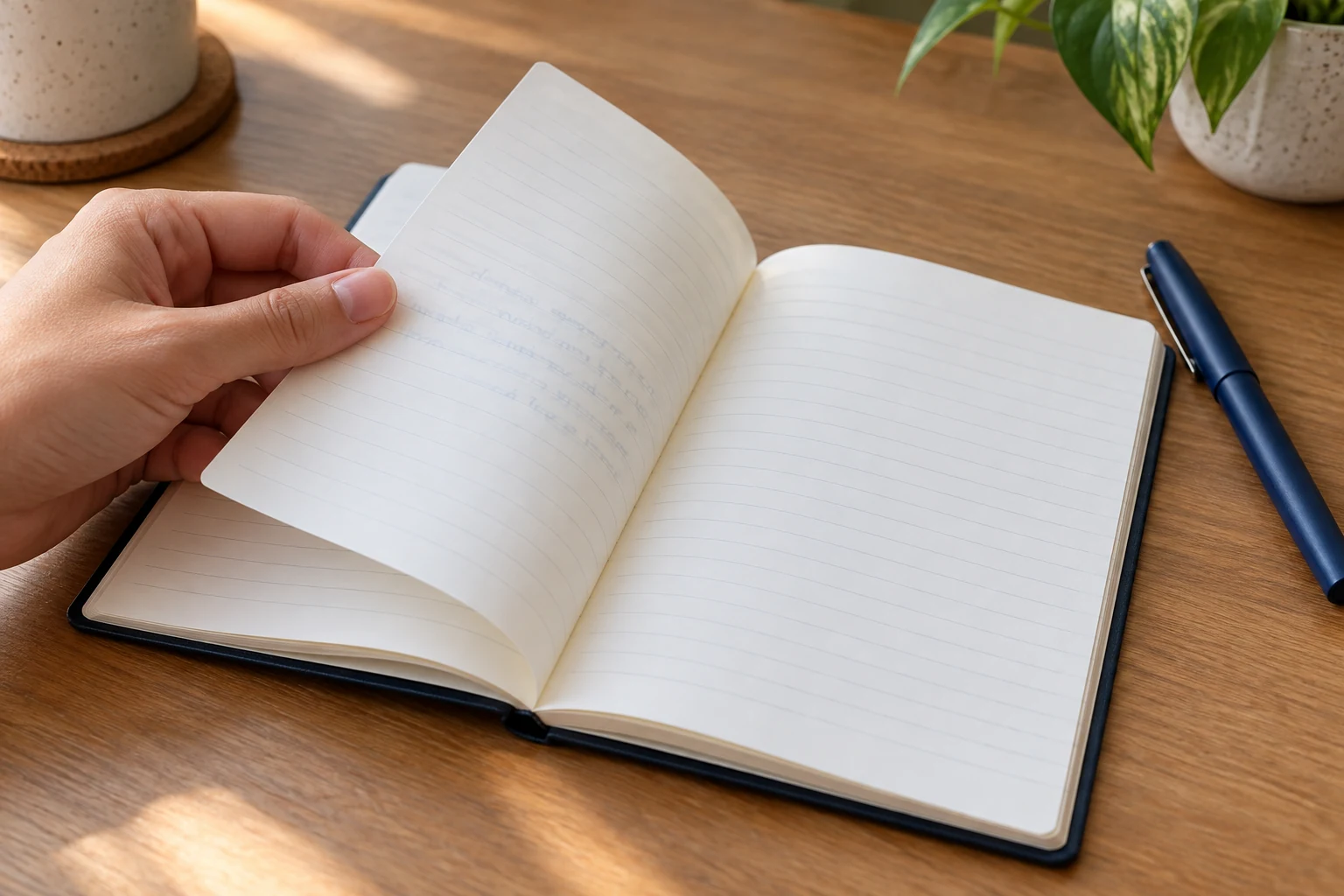
A notebook pen compatibility decision becomes more specific when you intend to write on both sides of each sheet. You may be willing to see a faint trace of an earlier entry, or you may want the next side to look almost clear. Decide which requirement matters for your notes before choosing a notebook from its cover or page count. This guide separates paper specifications from evidence about writing, then reads two notebook offers within those limits. It reports no writing test of either product. The cover is a generic illustration of inspecting a page, not a demonstrated result for the offered notebooks.
Give the reverse side a job
Imagine the entries you want on facing pages. Perhaps one side will hold a shopping list and the reverse a brief reminder; perhaps both sides will carry dense meeting notes you need to read later. Write down the intended use in ordinary words. “I want both sides comfortable to read” is a useful starting requirement, even before you can name every paper property. Keep your preference distinct from a product claim. You can accept a visible trace for one use and reject it for another without declaring the notebook defective or universally unsuitable.
Separate grammage, thickness, and opacity
Arctic Paper’s guide to choosing uncoated printing paper defines grammage as the mass in grams of one square metre of paper. It separately explains bulk as the relationship between thickness and grammage. Two papers with the same grammage can have different thicknesses. Consequently, a number expressed in grams per square metre does not directly give you the thickness of an individual notebook sheet.
The guide also discusses opacity in relation to reading text printed on the opposite side. That printing context helps distinguish the question from thickness alone: you may care about how much the earlier side visually interferes with the side you are reading. These are separate specification fields to ask about. Arctic Paper’s printing-press recommendations and numerical production thresholds are not handwriting instructions or acceptance limits for either notebook here. Use the definitions to read a specification accurately, then seek evidence for the actual paper and intended pen. This article prescribes no minimum grammage or opacity percentage for every writer.
Look at the fields on a real data sheet
Holmen’s BOOK technical data sheet lists grammage, bulk, caliper, and opacity in separate columns. In its main BOOK table, two entries share a grammage of 52 grams per square metre but have different bulk and caliper values. The listed caliper values are 81 and 90 micrometres. Reading the columns together gives a concrete example of why one weight figure cannot substitute for every other paper property.
The sheet identifies its material as paper developed for books and comics and warns that target values are subject to product variations. It is not a specification for E-Clips notebooks or the Horse Journal. No Holmen paper is attributed to either retail offer. Nor does a printed opacity value become a tested fountain-pen result merely because it is expressed precisely. When a notebook seller supplies a specification, identify the named paper and the field being reported. Keep an absent value absent. A useful request can ask whether the seller has the actual paper grade, grammage, and relevant writing evidence for the selected notebook.
Read a paper standard as its maker’s account
Oxford’s OPTIK PAPER+ page describes several qualities separately, including opacity, resistance to ink bleeding through, and clearly drawn writing without smudges. The maker explicitly relates its paper account to using both sides of a sheet. That is more specific than a notebook simply being described as good quality. It gives you identifiable claims to examine within that named paper system.
Oxford also describes the newer paper as having a lighter grammage while being thicker than its predecessor. That is the manufacturer’s account of a particular redesign, not a rule that lighter paper is always thicker or better. Keep the paper name and revision with the statement. Neither notebook selected below is established as containing OPTIK PAPER+. Its general claims therefore cannot certify their reverse-side legibility. If an offer names a branded paper standard, ask whether the actual selected edition uses it and what writing conditions its supporting evidence represents. Similar cover colors or the word notebook do not establish the same paper.
Keep low-transparency claims with the exact paper
LEUCHTTURM1917’s 120G Edition page attributes low transparency to the filler used in that edition’s paper. It states that writing and drawings are not visible from the back and describes clear stroke outlines with several writing instruments. These are the maker’s statements about a named notebook-paper edition. They do not apply automatically to every notebook bearing the brand or to an unrelated book with a substantial-looking cover.
For two-sided notes, the useful distinction is between a stated paper feature and evidence you can apply to your actual choice. Retain the edition name when asking about that feature. If you are shown a writing example, ask which paper and tool it represents rather than treating an attractive open-page photograph as a universal result. This guide has not independently reproduced the manufacturer’s claims. It supplies no ranking against the E-Clips or Horse offers. A reader can use the named claim to frame a precise enquiry while leaving the result on an untested notebook and pen unresolved.
Check the edition behind a paper description
The Hobonichi buying guide for its 2025 English Planner describes Tomoe River paper revised with the 2024 edition. Its account says the revised paper is more resistant to bleed-through, lighter despite retaining the same thickness, and smoother through adjustments to its fibres. This is an edition-specific account. The year and identified product matter when reading a statement about the paper.
An example or review of another edition can remain useful background while leaving your selected edition’s result open. Match the actual book and paper reference before relying on it. The cited guide concerns a dated planner, not either notebook offered here, and its description is not presented as a current-stock confirmation. It does not tell us which paper a differently branded notebook uses. When requesting evidence, preserve the edition or paper revision if the source supplies one. If the seller cannot connect the information to the selected item, describe that missing connection rather than quietly assuming that all books in a product family have identical pages.
Read medium recommendations with their qualification
The Moleskine Paper Guide distributed by Despec presents several paper types with different intended media. It separates ordinary notebook paper, thicker writing papers, sketch-grade papers, and a cotton-blend watercolor paper. Its entries pair paper descriptions with suggested tools. The guide also expressly qualifies those suggestions: they are illustrative, and the actual effect of artistic media on its paper may vary.
That qualification belongs with the recommendations. A suggested medium gives you a reason to investigate a combination; it does not show the result of your own pen on a sheet from an unidentified notebook. The inspected guide is an undated supplier-hosted document, so its product-range list is not used as a promise about today’s editions or availability. Nor are its listed paper weights assigned to the two native offers. For a practical enquiry, retain the actual paper description and the particular writing tool recommended, then identify what remains untested. A brand name by itself leaves more open than the guide’s specific paper-and-medium entries.
Notice the different writing properties a maker discusses
MIDORI’s original-paper page discusses ink feathering, drying, smoothness, and writing feel as distinct considerations in developing its papers. Its MD PAPER descriptions make resistance-to-smearing and bleed-through claims. The page also separates writing samples, reverse-side views, and translucency information. That organization gives the reader several different questions to bring to a paper comparison instead of asking only whether the sheet feels thick.
For two-sided notes, a clear-looking front stroke and a usable reverse side are requirements you can state separately. A manufacturer’s discussion of one property should not silently answer all the others. MIDORI’s claims concern its identified papers, not the notebooks below, and the image groupings are not a test conducted for this article. No drying time, degree of translucency, or resistance result is transferred to the selected products. If your preferred tool is a fountain pen, ballpoint, or another writing instrument, name the actual one when seeking a representative sample. Keep any sample’s paper identity with the result you are considering.
Read the notebook offers without adding a paper specification
The E-Clips college-ruled notebook offer describes a 36-pack of spiral notebooks with 80 sheets, a two-pocket divider, and a poly cover. Its original image depicts the notebooks and a carton marked 36 pack. The reviewed account does not supply a paper grammage, named paper grade, or writing test. A water-resistant cover statement concerns the cover; it does not establish how ink behaves on the pages.
The Kids Large Horse Journal offer identifies a wide-ruled hardcover notebook with 48 pages. Its single image supplies the horse cover artwork, without an interior writing sample. The native account supplies no paper weight or tested pen pairing. Keep the stated page count distinct from the first offer’s sheet count, and leave both products’ unreported two-sided writing results open.
Keep page layout and marker repair in their own scopes
The alcohol-marker bleed-through guide concerns an unwanted mark and protecting a separate sheet or finished work underneath. That problem and its backing arrangement differ from choosing whether ordinary notes will remain comfortable to read on both faces of one notebook sheet.
The bullet journal versus guided planner guide compares page-design work and printed prompts. A layout you like can still leave the paper-and-pen question unanswered. Decide the layout and two-sided writing requirements separately, using evidence that addresses each.
Ask for evidence of the writing use you intend
Before committing your notes, make the request specific: identify the selected notebook and the pen or ink you intend to use, and explain that you want both sides available for writing. Ask for a representative example or an opportunity to inspect an appropriate sample. If you obtain one, decide whether its reverse side meets the requirement you wrote down. Treat that as your observation of the identified example. Do not describe an unperformed trial as a completed test, or attribute a sample from one book to another merely because their covers look similar.
You can leave a purchase pending if the decisive evidence is missing. You can also decide that the notebook serves another use, such as notes on one side, without claiming that the original two-sided requirement was met. Keep the choice explicit when buying for somebody else: a notebook that suits your short reminders has not thereby been shown to suit their dense notes. Save the item reference and any actual paper information with the decision. The unanswered question should remain the one about your intended writing use, not disappear into a general adjective about quality.
Read the current checkout before ordering
If you plan to purchase an item on republeq.com, check the particular offer and current checkout before ordering. This guide does not establish that any cryptocurrency payment option is available. If USDT is offered for the intended order, verify the requested asset, network, amount, receiving destination and order reference with the responsible service before authorizing a transfer. Review the actual product identity, selected variant, quantity, delivery details, total charge and applicable terms. Use the confirmed order details when checking the payment instructions. Confirm any fee, conversion term or exchange rate from the current transaction information. Determine the applicable cancellation, return and refund process, including how a refund would be handled for the selected payment method. Keep the relevant instructions and transaction records, with dates and confirmed references. If essential instructions change, ask the responsible service to confirm the change against the exact order. An acknowledgement should identify the order and the agreed details; it does not replace checking whether the selected product is the one you intended to buy. If payment or order status remains uncertain, reconcile that status before considering another transfer. Do not treat an unresolved transaction as evidence that nothing happened. This article supplies no wallet address, transfer guarantee, recovery procedure or assessment of a counterparty. A product enquiry does not authorize a payment or resolve an uncertain order. If support provides an answer, retain the exact question and response so a later reviewer can understand what was confirmed. Decide whether to proceed only when the conditions of the particular transaction are clear, and retain the confirmed transaction information with the exact order.