Sewing & Crafts
Alcohol marker bleed-through: protect the next page
Locate unwanted marker ink on the working sheet or underneath, protect the next surface and assess a small expendable sample before changing the final project.
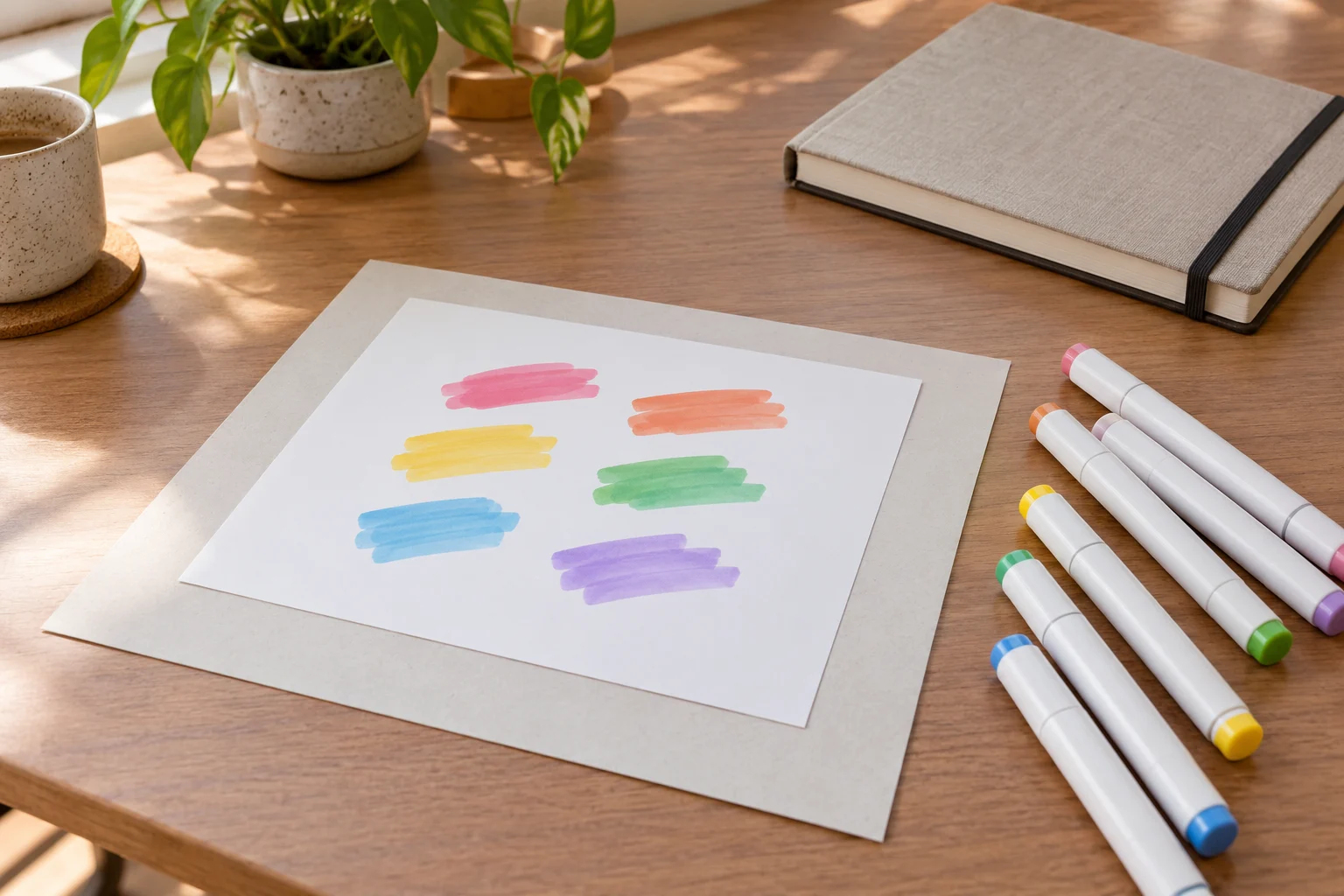
Alcohol marker bleed-through becomes a practical problem when the sheet underneath matters as much as the drawing on top. Before adding another stroke, move the finished work out of the troubleshooting area. Identify where the unwanted ink appears and which surface you are trying to preserve. A mark on the working sheet and a mark transferred onto the next page call for different observations.
Start with an expendable sample rather than another finished page. You do not need to replace a whole marker set merely because one paper-and-marker combination disappointed you. Nor should you assume that a larger color assortment, a different tip or an attractive carrying case will resolve the paper problem. The useful next decision concerns the actual materials and the way you intend to use them.
Locate the unwanted mark first
Look at the working face, the back of that sheet and the sheet or surface underneath as separate locations. Describe only what you can see. “The line spread outside my intended outline” says something different from “There is a colored mark on the next sheet.” If you have inspected only the front, leave the other locations unreported rather than filling them from expectation.
You can use those observations to narrow the immediate task. A next-sheet mark gives you a reason to change the arrangement beneath the working paper before continuing. An unwanted edge on the front leaves the visible shape as another question. Do not keep altering a finished drawing while trying to settle every possible cause at once. Keep the original result available for comparison without treating it as proof of a defective pen.
Use the maker's paper guidance within its limits
Ohuhu's FAQ describes dye ink soaking into paper, with bleed-through depending on thickness. It recommends thicker-GSM marker or mixed-media pads and an additional pad between coloring sheets when using regular paper. This is guidance, not a tested result for your sheet. Cap colors are only a rough guide in the same FAQ.
Keep the paper requirement attached to the project. If you want to preserve both sides of a particular book page, that is a more demanding use than making a disposable single-sided study. Decide which outcome you need before buying more supplies. You can change the project arrangement when the current paper has not been established as suitable for the use you want.
Read the actual sets without a performance promise
The Ohuhu Honolulu B 72-color offer names brush and fine tips, alcohol-based ink, a colorless blender and a carrying case. Its one original gallery shows the marker assortment in a fitted zippered case, plus an enlarged double-ended marker and its caps. Those enlarged details are not extra independent pens. The description's quick-drying, smudge-free and blending language supplies no demonstrated bleed-through result on your paper. The displayed assortment also does not independently authenticate the exact delivered count.
The Ohuhu Oahu 120-color offer names chisel and fine tips, alcohol-based ink, a colorless blender and a carrying case. Its one original gallery shows the assortment, the fitted case with carrying strap and an enlarged marker. The case and strap do not form a protective layer beneath the drawing. The stated color total and blending claims do not establish paper compatibility or a tested result. Neither native offer shows or lists a separate paper pad or protective sheet.
Ohuhu's general FAQ says its sets include a swatch card. Neither selected native gallery nor description independently confirms that card. Keep the exact package contents question open instead of assuming the general statement authenticates this basket.
A thick-sounding paper name is not the whole answer
Copic's own bleed-through FAQ provides an independent example of paper-specific limits. It explains that its dye ink soaks into paper, recommends scrap beneath the work and advises avoiding excessive pressure. The FAQ names Premium Bond and Custom Paper as basically bleed-proof within its range, while identifying Thick Marker Paper and Soft Watercolor Paper as readily bleeding surfaces useful for blending. Those are Copic's bounded product statements. They do not certify either Ohuhu set, an unidentified paper or a similarly named pad from another maker.
Read what the actual paper information establishes instead of ranking two pads from their names alone. If a package description leaves the intended marker use unanswered, ask about that combination or try an appropriate expendable sample under the applicable instructions. A sheet can remain useful for another task even when you choose not to use it for a two-sided finished piece.
Protect the next surface before a small check
Crayola's alcohol-marker support recommends marker or bleed-proof paper options, thick scrap paper beneath the artwork to protect surfaces and other pages, and light layers instead of oversaturating the paper. Treat these as general support directions, not a demonstrated result for either selected set. Use the instructions for your actual materials where they specify how to work. A proposed protective arrangement still needs to suit the task and surface you intend to preserve.
Keep finished sheets and valuable surfaces outside the first trial. Prepare the expendable working sheet with the recommended backing arrangement before making the sample. Use a small mark permitted by the actual marker directions, then examine the working sheet and what is underneath. This is a proposed reader check, not a test performed for this article. It establishes only the observations you actually make with those materials.
If you want to compare another paper, give it a separate expendable sample rather than adding unrelated marks to a finished page. Retain the first result and identify the changed material. There is no need to create a chart for the entire assortment or make a polished illustration. The immediate question is whether the proposed arrangement meets this project's requirement, not whether you have ranked every pen you own.
Leave an unclear result unclear. If the underlying sheet already had a mark, you cannot attribute that mark to the new sample without more information. If you changed the paper and the tool together, the comparison describes a changed combination. You can decide to use a different arrangement without inventing a single cause that the observations have not established.
Keep a blender out of an assumed repair
Ohuhu's FAQ assigns its No. 0 blender softening, small corrections, lightening and paper-wetting functions. It promises no restoration of every marked sheet. Follow the actual accessory directions; colorless does not authorize erasing damage. No solvent, coating or stain-removal method is supplied here.
Decide separately whether you want to preserve the affected page, continue on another surface or ask for product-specific help. You do not have to keep applying another material to justify the time already spent on the drawing. Put the unfinished piece aside if its next treatment is uncertain. An honest stopping point can preserve the question for someone who can assess the actual materials.
Choose the next use from what you observed
Imagine a fictional reader, Tessa, planning a small illustrated note. She notices a mark on the sheet below her first attempt and stops using that stack for practice. This is an invented situation, not a result obtained from either linked set. Tessa keeps the affected sheets aside and prepares an expendable sample under the applicable paper and marker guidance before deciding how to continue.
Suppose that her later sample does not satisfy the requirement she set for the finished note. She can choose another suitable surface, use a different project arrangement or leave the drawing unfinished while she asks for advice. She does not need to describe the marker as faulty or promise that every sheet from another pad will behave identically. Her decision concerns the result and requirement in this example.
If Tessa instead observes an arrangement she is willing to use for a small single-sided study, that does not automatically establish a two-sided book-page result. She can keep the uses separate. A limited study may be worthwhile while the original note project remains unresolved. The example gives no preservation treatment, guaranteed backing material or claimed successful repair of the first sheets.
Ask for help about the observation you actually have
Ohuhu's FAQ directs dried-out, bleeding or defective-marker questions to customer service. This is a support route, not a diagnosis or repair instruction. Use the seller or maker channel applicable to the actual purchase.
Make the question easy to understand without inventing a cause. Identify the actual pen or set, the paper information you have and the location of the unwanted mark. Say whether your concern is the drawing face, the back or a separate sheet underneath. If you have an expendable sample, describe what you did and what you observed. Do not describe an unperformed comparison as a completed test. A photograph can show the visible result, but an unidentified photograph cannot supply the missing paper or marker reference. Keep an unknown material unknown in the enquiry instead of borrowing a likely name from another package.
Set a boundary for the next session
Choose where finished work will wait before resuming practice. On a shared table, tell the other person which sheets are finished and which are expendable trials. Do not leave a valued page beneath a sample merely because both are the same size. Keep the capped tools beside the area where they will be used and move completed work away before rearranging that area. This is an ordinary project boundary, not proof of a protective material's performance. It helps prevent a known finished sheet from becoming an accidental part of the next comparison.
Finish the session by deciding what the observation lets you do next. Perhaps you have enough information to continue a small study on the arrangement you tried; perhaps the intended finished project still needs another paper choice. Keep those outcomes separate when explaining the work to someone else. You need not complete the original project to make the practice useful. Equally, a satisfying practice mark need not become a promise about a larger or differently arranged piece. Let the next project retain its own requirements instead of treating the first acceptable-looking sample as a universal approval.
Keep the project and paper decisions connected
For a bound notebook, the bullet journal versus guided planner guide compares page layout and the setup work each format asks of its owner. Its closed-cover galleries and stated paper details do not supply a demonstrated result with your pen. Check the actual page and intended medium when a planning book is also meant to hold drawings.
For a separate color reference, the watercolor brush pen color chart guide organizes small dry-mark and confirmed water-tool trials on an identified sheet. Those are watercolor-tool examples, not directions to add water to an alcohol marker. Keep a color-reference exercise separate from the immediate need to protect another page during the problem considered here.
Check an order only after the material question
If checkout on republeq.com offers USDT or another cryptocurrency for a selected marker order, read the actual transaction terms before authorizing payment. Confirm the exact series, stated contents and selected package in the final basket. A payment option cannot answer whether the paper you intend to use meets your project requirement. This article verifies no live asset availability, network requirement, conversion treatment, fee, settlement time, transaction protection or refund outcome. Review the displayed amount and any separate charges shown by the services involved, without assuming that a previous quotation still applies. Read the current delivery and return terms for the selected item. If an essential accessory or contents question remains unanswered, keep the order uncommitted while the responsible seller explains it. Follow the actual checkout instructions for the method you choose. Never send wallet private keys or recovery phrases in a product enquiry. Keep the item reference and any applicable written clarification with the resulting order confirmation according to the service's instructions. If the selected package changes, check that the clarification actually covers the changed selection. An unanswered request to amend an order does not automatically suspend fulfillment. If payment status is uncertain, reconcile it through the authorized channel before considering another payment. This conditional purchasing guidance recommends no digital asset and promises no saving, investment return, arrival date or drawing result. It supplies no transfer destination, wallet setup or financial projection. An unfamiliar charge can remain an open question while the service explains it. A completed transaction establishes a purchase record; it does not demonstrate paper compatibility, prevent ink transfer or repair a marked sheet.
Resume with an arrangement you can explain
Before returning to the finished project, state what you changed and what you still have not established. Keep the affected original separate from expendable trials, follow the actual materials' guidance and choose the next use against the requirement you intended. You can resume on a suitable arrangement, change the project or leave it pending. None requires pretending that a color total or a purchase confirmation solved the problem.