Skills & Planning
New Year parallel scenes: keep both in one minute
Two original fictional room scenes occupy the same declared New Year minute. Compare explicit time anchors, swapped page order and a revision that changes chronology.
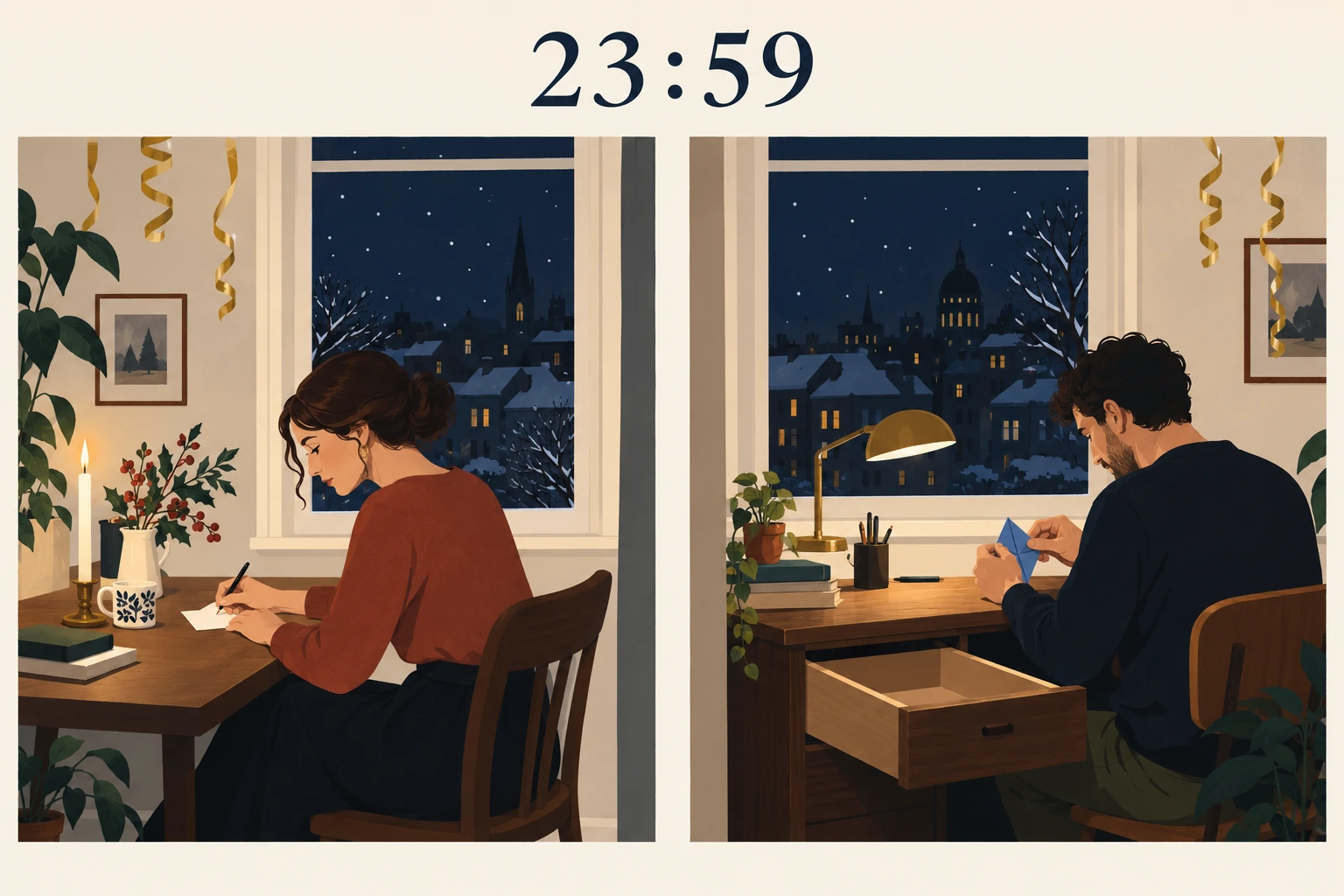
Give the two rooms one declared minute
New Year parallel scenes can occupy one declared minute even when the reader visits one room before another. In this original exercise, Mira is in the front room and Cal is in the back room of the same invented house. Both small sequences occur during 23:59. The prose will place their paragraphs one after the other without moving the second sequence past midnight.
The decision is how to announce the return to that shared minute. A paragraph break alone does not state the relationship. An explicit time phrase can do that work. Keep the local actions simple while comparing transitions, so a change in the words connecting the rooms does not get confused with a new event, a secret message or a different ending.
Read the optional clock accounts separately
The optional Bulova C5005 clock account names that model in the Clocks category. Its seven images show a round natural-toned case, white dial and Bulova wording, both isolated and in room settings. Those observations do not verify the native hardwood, automatic-setting or signal-reception claims, authenticate a delivered clock or establish its actual displayed time.
The optional La Crosse 404-1235UA-PL clock account supplies a different model. Seven images show a round silver-rimmed clock with La Crosse Technology wording, including a back label bearing that model. Reception, battery-life and lens-performance graphics remain promotional statements, rather than demonstrated results here. The illustrated battery requirements do not establish a separately supplied refill pack.
Neither clock account supplies these fictional rooms, people or events. Their pictures do not establish a shared minute or synchronized devices for this scene. The exercise requires no purchase or actual clock-setting procedure.
Fix the events before changing their page order
Here are the private facts for the miniature. During the declared 23:59 minute, Mira writes her own name on a blank card and then sets the card on the front-room windowsill. During that same minute, Cal folds a blue sheet once and then puts it into an empty drawer in the back room. The next minute begins after both short sequences have finished.
Neither person sees the other in this version. Neither action answers the other person’s action. The card and blue paper have no declared shared message, and no later meeting is promised. The narrator can visit both rooms, but each character stays within the knowledge the fiction provides. These are stipulated conditions of the exercise, rather than facts observed in an actual house.
Do not assign exact seconds to the four actions. Their order within each room is fixed, but the example does not say whether Mira’s pen stops before or after Cal makes his fold. That comparison remains unknown. Sharing a named minute does not require all actions to occur at one instant, and this draft does not supply enough detail to put every movement into a single complete order. Both action groups could occur one after the other within that minute; this version leaves that question open.
Read a complete version with a return anchor
The first room reads: “At 23:59 on New Year’s Eve, Mira wrote her name on the card. She waited for the last stroke to dry, then set the card on the windowsill. The rest of the room stayed beyond the small patch of light on the table.” This paragraph gives her two declared actions in their local order.
The second room reads: “During that same 23:59 minute, Cal folded the blue sheet once in the back room. He opened the empty drawer and laid the paper inside. His hand remained on the drawer’s edge for a moment.” The opening phrase returns the narrative to the minute already named. It does not say that Cal waited until Mira had finished before beginning.
The ending can be one plain sentence: “Then midnight began, with the card on the sill and the blue paper in the drawer.” In this invented version, that sentence places the new minute after both small sequences. It does not add a chime, an outside countdown or a communication between the rooms. Those would be additional fictional events, each needing its own place in the writing.
Read the three pieces together without the explanations between them. The narrator first visits Mira, returns to the declared minute with Cal, then moves beyond both scenes. The page advances continuously while the narrative briefly returns to a time already under discussion. That distinction is the particular formal choice being tested here, without claiming that every alternating scene needs a printed time.
Compare an anchor that changes the chronology
Now replace the second opening with “After midnight, Cal folded the blue sheet once in the back room.” That sentence no longer keeps both sequences within 23:59. It moves Cal’s folding into a later minute. The change is a possible new story choice, but it does not preserve the fixed events and timing of this exercise. Keep it as a separate alternative rather than silently treating it as equivalent.
The difference cannot be repaired by leaving the original ending unchanged. A passage that first puts Cal’s folding after midnight and then announces midnight after his paper is in the drawer has introduced conflicting temporal instructions. Decide which chronology you want, then write the transitions and ending to support it. For the selected version here, restore “During that same 23:59 minute.”
An opening such as “Later, in the back room” would create another problem for this comparison. Later than what: the start of Mira’s paragraph, her final action or an earlier event outside the excerpt? The word does not identify the return this draft needs. You can use an imprecise transition deliberately elsewhere, but an exercise about retaining a declared shared minute benefits from stating the relationship it actually means.
Swap the paragraphs without changing the minute
Try printing Cal first. Begin his paragraph “At 23:59 on New Year’s Eve” and give Mira’s paragraph the return phrase “During that same 23:59 minute.” Retain folding before placing in Cal’s room and writing before placing in Mira’s room. Keep the midnight ending after both paragraphs. You have changed which room the reader visits first while preserving the declared temporal limits.
That reversal does not prove the versions have identical emphasis. One begins with the folded paper and the other with a written name. You may prefer one opening for this small piece. The narrower claim is about what the passages establish: neither ordering requires the second room’s actions to happen after the first room’s actions. The time anchors and stipulated limits support that conclusion, rather than the mere presence of two paragraphs.
Keep the objects in their own rooms during the swap. Moving the blue sheet onto Mira’s sill would change the events, as would putting the named card into Cal’s drawer. If a revision accidentally trades those objects while rearranging paragraphs, restore the original local sequences before comparing the versions. Otherwise, you will be judging a changed plot along with a changed order of presentation.
Keep the narrator’s access distinct from the characters’ access
A narrator who describes both rooms does not automatically give Mira knowledge of Cal’s drawer. In the selected miniature she does not mention him or respond to his folding. Cal likewise makes no claim about the card. If you add a sentence saying he folds because he has seen her write, you have supplied a new connection that the current fictional conditions do not contain.
A shared New Year occasion does not supply that connection by itself. Two people can appear in the same invented house and still have independent actions in the chosen passage. Leave their relationship unspecified if the short formal exercise does not need it. A later story may establish why both objects matter, but this excerpt can finish without assigning them a hidden common purpose.
Also keep the narrator’s minute declaration separate from a character reading a dial. The selected prose does not show either person checking a device. Adding two dial readings would raise another fictional question about what those readings establish. Here, the narrator simply supplies one timeline for the miniature. No actual equipment observation or synchronization result is needed to make that authored condition explicit.
Use nearby writing choices for their own questions
The related sound-led arrival scene chooses whether an arrival is heard before it becomes visible. That is a question about the order in which a character receives information about one event. The two-room example instead states how separate action groups share a declared minute, without an arrival or uncertain sound source.
The related dialogue-interruption scene compares a delay that preserves a question with an interruption that changes the next question. This miniature contains no spoken exchange to resume. Keep its temporal anchor separate from a conversation’s return line, even though both are sentences connecting parts of a passage.
Check the selected version before its final sentence
Make a private four-item check of the written miniature: Mira writes before she places; Cal folds before he places; both groups remain within the declared minute; midnight comes afterward. The first two checks concern local order. The third concerns their shared interval. The last concerns the next boundary. None establishes which person completes a particular movement first across the two rooms.
If you want to add an exact cross-room comparison, write it as a new fictional condition. For example, saying Cal finishes folding before Mira lifts her card would supply an ordering the current version leaves open. Save that as another draft. The selected exercise can retain its narrower account and still give both rooms a clear beginning and completed local action.
Keep a separate order enquiry conditional
If you separately consider a clock order on republeq.com, ask the seller which payment methods apply to that exact order before making any transfer. If cryptocurrency is offered, ask whether USDT is accepted and which network, amount, recipient address and confirmation requirements apply. A familiar token name alone does not answer those questions. Obtain the relevant instructions through a channel you have independently checked, then compare the instructions with the order you intend to place. Ask how any shipping charge, tax, conversion, refund or cancellation would be handled before agreeing to proceed. If a payment provider is involved, ask which party is responsible for confirming receipt and which record you should retain. These are questions to resolve, rather than statements that a particular option exists for either offer. Do not infer a transfer destination from a product photograph or from a detail in the fictional rooms. Resolve material product and package questions separately from the payment discussion. Information about one package does not automatically describe another quantity or account, and a changed order may require reviewing the resulting terms again. Keep the agreed terms, the order identity and any instructions together so that you can check what you were actually asked to authorize. If the instructions remain unclear or contradictory, stop and obtain clarification rather than filling in the missing details yourself. You can finish the scene exercise without placing an order. The miniature cannot authenticate payment instructions, establish a checkout method or verify supplied stock. Treat the fictional timing as a writing choice, with no bearing on whether a proposed purchase or transfer is appropriate for you.
Let the new minute follow both rooms
Keep Mira first in this selected version, then explicitly return to the same minute for Cal. The last sentence can leave the two objects where their owners placed them. New Year parallel scenes here finish with a declared boundary after both small sequences. The page has visited the rooms in order without requiring the second room to wait for the first.