Writing & Documents
Writing dialogue interruptions in fiction that change a scene
Compare dialogue interruptions in fiction with original Neri and Tomas scenes, choosing the return line that preserves an invitation or follows a new subject.
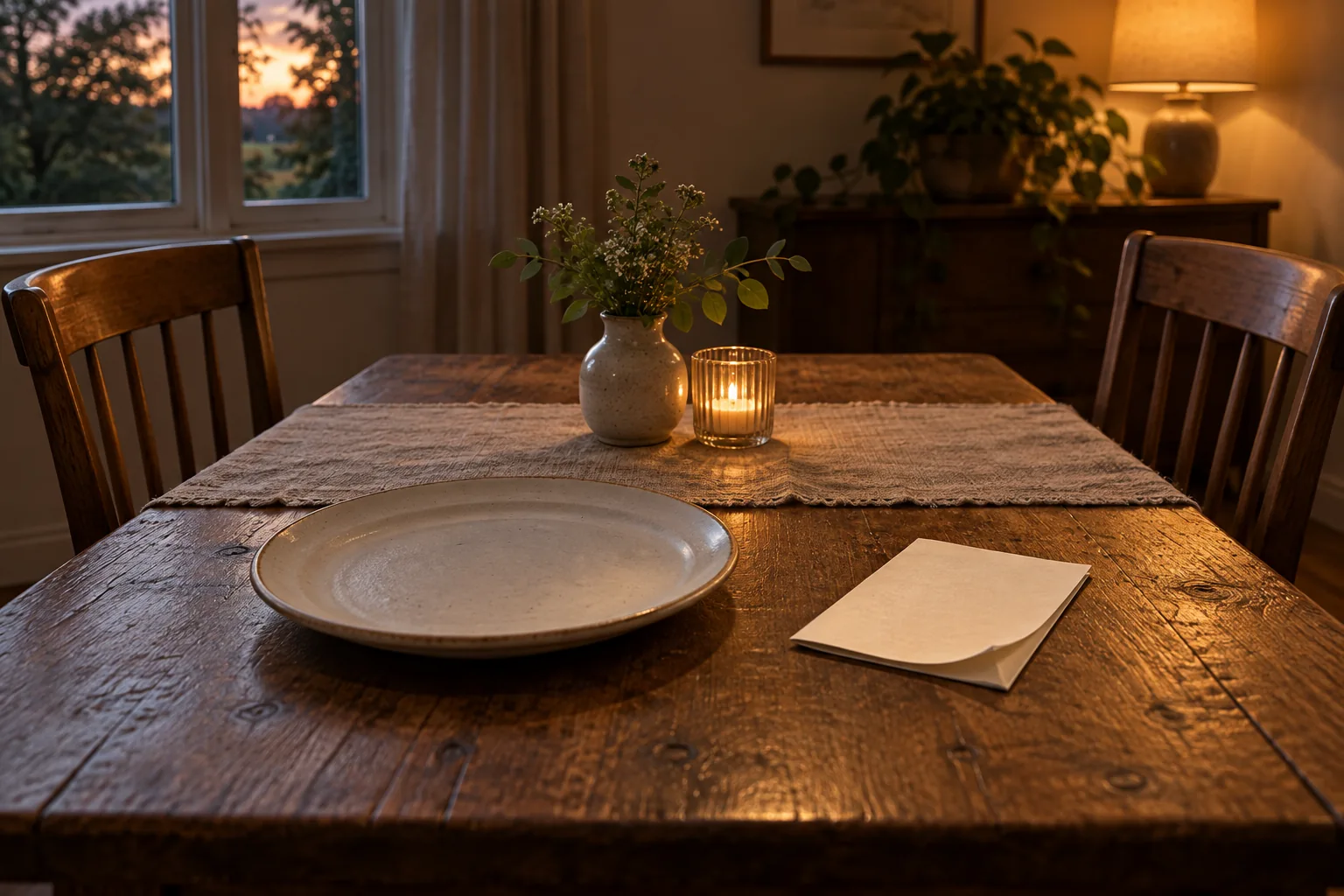
Writing dialogue interruptions in fiction gives you a choice about what happens when the conversation resumes. A small action can delay an answer and leave the original question waiting. It can also give a character something new to ask, changing the exchange. Write the actual return line before deciding which interruption belongs in your scene.
The original example here uses two fictional adults, Neri and Tomas, sitting at a table after an unspecified meal. An empty plate stands between them, and a folded program lies beside Tomas's hand. Neri wants to know whether he will return for the next amateur performance. Tomas has not answered. This is an invented conversation, without a real interview, a recipe, a serving suggestion or advice for handling someone else's actual hesitation.
Give the unanswered question a clear place
Start with the exchange before adding an interruption: “Will you come next time?” Neri asked. Tomas touched the folded program. “I haven't decided.” She waited while he opened it to the middle page. “I could keep you a seat,” she said. He looked at the empty plate between them, then back at her. “Let me think until tomorrow.”
That short passage already contains a question, an uncertain answer and a request for more time. The program is present, but nothing about it changes the subject. Tomas's glance at the plate does not establish what he feels or why he has not decided. You can leave those matters outside this scene. If you want to explain them, you need to write the explanation rather than assume the glance supplies it.
For the first revision, place a brief interruption after Neri's opening question. Keep the other declared conditions unchanged. The characters have finished an unspecified meal; they are not discussing cooking or evaluating a particular product. The purpose is to see whether the exchange returns to the performance invitation or moves toward a different subject.
Let an action delay the answer
Here is one version: “Will you come next time?” Neri asked. The folded program slipped from Tomas's hand and opened on the floor. He pushed his chair back, reached for it and smoothed the corner against his knee. When he sat forward again, Neri was still looking at him. “I haven't decided,” he said. She left her hand beside the empty plate.
The dropped program interrupts the exchange through a new action. Tomas retrieves it, then answers the same question Neri asked. That return makes the delay visible in the written sequence. The paragraph does not tell you whether he dropped it accidentally or used the movement to gain time. Either could become a separate story choice, but the version here does not establish a hidden intention.
You can change the length of the interruption by changing what Tomas does with the program. If he simply picks it up, the action occupies less prose. If he notices a torn edge and begins to repair it, you have added another activity with its own possible significance. For this draft, keep the smoothing gesture. It extends the action slightly without making repair a second subject.
Now write the continuation: “You don't need to decide tonight,” Neri said. Tomas folded the program along its old crease. “Tomorrow,” he said. “I'll tell you tomorrow.” She drew the empty plate toward her side of the table, leaving the space between them clear. This continuation gives him a stated time to answer while keeping the performance question unresolved.
Keep the fictional meal separate from real food claims
The De Cecco Fusilli Corti Bucati account describes twelve sixteen-ounce boxes, with model ZY-ghm-20200908-2-63 and UPC 024094001316. Its gallery identifies No. 98 on the box. The selected Fusilli Corti Bucati offer supplies bounded pantry context. It does not identify what Neri and Tomas ate or establish a result for their entirely fictional meal.
The De Cecco Farfalle account describes twelve packages of sixteen ounces each, with UPC 732623623419. Its gallery identifies No. 93 and includes a twelve-pack graphic. The selected Farfalle offer is a different named shape and offer. The conversation does not require either package or compare the two products as ingredients, dietary choices or finished dishes.
Neither selected account establishes the fictional meal's contents, its preparation or anyone's dietary requirements. Nutrition, cooking times, certification and promotional taste or cooking-performance statements are outside this prose exercise. Cheese and nuts pictured with the fusilli are presentation context, without a declaration that those foods are supplied in the pasta offer. None of those images provides a recipe or a meal result for this scene.
Try an interruption that changes the next question
For a return line after an interruption, write the words the character actually uses. In the first version, Tomas says he has not decided, directly answering Neri's invitation. In the second version below, the fallen program reveals something Neri notices. She asks about that detail instead. The interruption now changes the immediate conversation rather than merely delaying an existing reply.
Try this alternative: “Will you come next time?” Neri asked. The program slipped from Tomas's hand and opened on the floor. He reached for it, but she saw the small penciled star beside her name before he closed it. “You marked my part?” she asked. He set the folded sheet on the table. “I wanted to remember where you came in.”
This new passage adds a star that was not in the first version. Its appearance gives Neri a different question. It does not answer whether Tomas will return. The marked name could lead toward a conversation about the performance they have already seen, while the invitation remains unfinished. Keep both questions visible in your notes so the new topic does not silently count as an answer to the old one.
A continuation could read: Neri turned the program toward herself. “I missed that entrance in the rehearsal,” she said. Tomas moved his finger to the following line. “This was the part I meant.” She leaned closer, and for a moment they looked at the same small patch of paper instead of looking across the table at each other.
The second continuation moves into their attention to the marked program. It does not promise that the changed subject resolves tension or brings real people closer. It describes the positions and words of these invented characters. If you choose this version, its interest is the turn away from a future invitation toward a detail from an earlier event.
Return line after an interruption
Compare the two complete alternatives. Both begin with the same invitation and a dropped program. The first returns to a decision about coming next time. The second introduces a penciled star, then follows Neri's new question. Calling both passages a pause would conceal that difference. One delays a reply; the other changes the immediate subject through a newly written detail.
For this scene, choose the first version. Neri's invitation is the question the opening gives her, and Tomas's request for time is the response this draft keeps. Leave the star out. Otherwise, the selected scene would retain a conspicuous detail whose conversation you had decided not to follow. You can save the star version separately without treating its marked program as an established object in the chosen draft.
There is also a possible combined version. Neri could ask about the star and then repeat her invitation. To use that version, write both turns and decide how Tomas answers the repeated question. It would be a longer conversation with an explicit return, rather than proof that every interruption must eventually lead back to its opening line.
Check what each character has actually answered
The wordless comic drawing session guide considers visible action across panels and a first reader's account of what happened. These prose alternatives instead compare spoken return lines after the same initial action. No reader test, picture sequence or uncaptioned interpretation has been carried into Neri and Tomas's fictional conversation.
The Crayola Air-Dry Clay gift guide changes a proposed object's role through recipient preference and material limits. This example changes or retains the subject of a fictional exchange. The folded program is not a proposed gift, and the scene supplies no making brief or claim about materials suitable for a recipient.
Write down what the selected conversation establishes. Neri asked whether Tomas would come again. He said he had not decided and would tell her tomorrow. She said he did not need to decide that night. Those statements leave the future answer open. The plate moving and the program being folded are actions alongside the exchange, without substituting for a spoken yes or no.
If the next scene begins tomorrow, you can write the answer Tomas gives then. Do not make an arrival at another place silently resolve this question unless the new passage establishes that connection. A fictional character can change their mind, forget, decline or agree. Each possibility would belong to the next piece of writing rather than to an unwritten conclusion supplied on behalf of this one.
A small revision can make the unfinished answer more definite than you intend. If Tomas says I will be there tomorrow instead of I will tell you tomorrow, he has made a different statement. The selected scene promises a later answer, not attendance at the performance. Retain tell in this version. The difference belongs to the actual words on the page, even if both sentences sound like a way of ending the evening. Comparing them beside Neri's original question gives you a concrete editorial choice without needing to infer an answer from the coat, the plate or the raised hand.
Choosing a conversation turn to keep
For choosing a conversation turn, read the question immediately before the interruption and the first spoken line after it. In the selected version, they still concern the same decision. That gives you a specific reason to keep the fallen program as a delay. The star version remains an available alternative if you later want the scene to follow the earlier performance instead.
End the chosen draft with an action that does not add a new answer: Tomas put the program inside his coat pocket. Neri stood with the empty plate in her hand. At the doorway he turned as though he had remembered another sentence, then only lifted his hand. She returned the gesture and stayed beside the table until he had gone.
That ending supplies a departure and a returned gesture. It does not convert his uncertainty into agreement or explain the sentence he did not say. The scene can finish while the invitation remains open. Whether you prefer that effect is a choice about this written draft, without a rule that every fictional conversation needs an unresolved promise.
The dialogue interruptions in fiction in these alternatives do different work because their return lines follow different questions. Keep the complete version you want: the delay that preserves the invitation, or the changed subject that follows a marked program. The unused passage can remain another draft, with its own details and consequences intact.