Networking
Network clock synchronization: offset and unequal path delays
Network clock synchronization combines clock offset with path delay. Trace identical timestamp records, offset bounds, asymmetry and independent evidence.
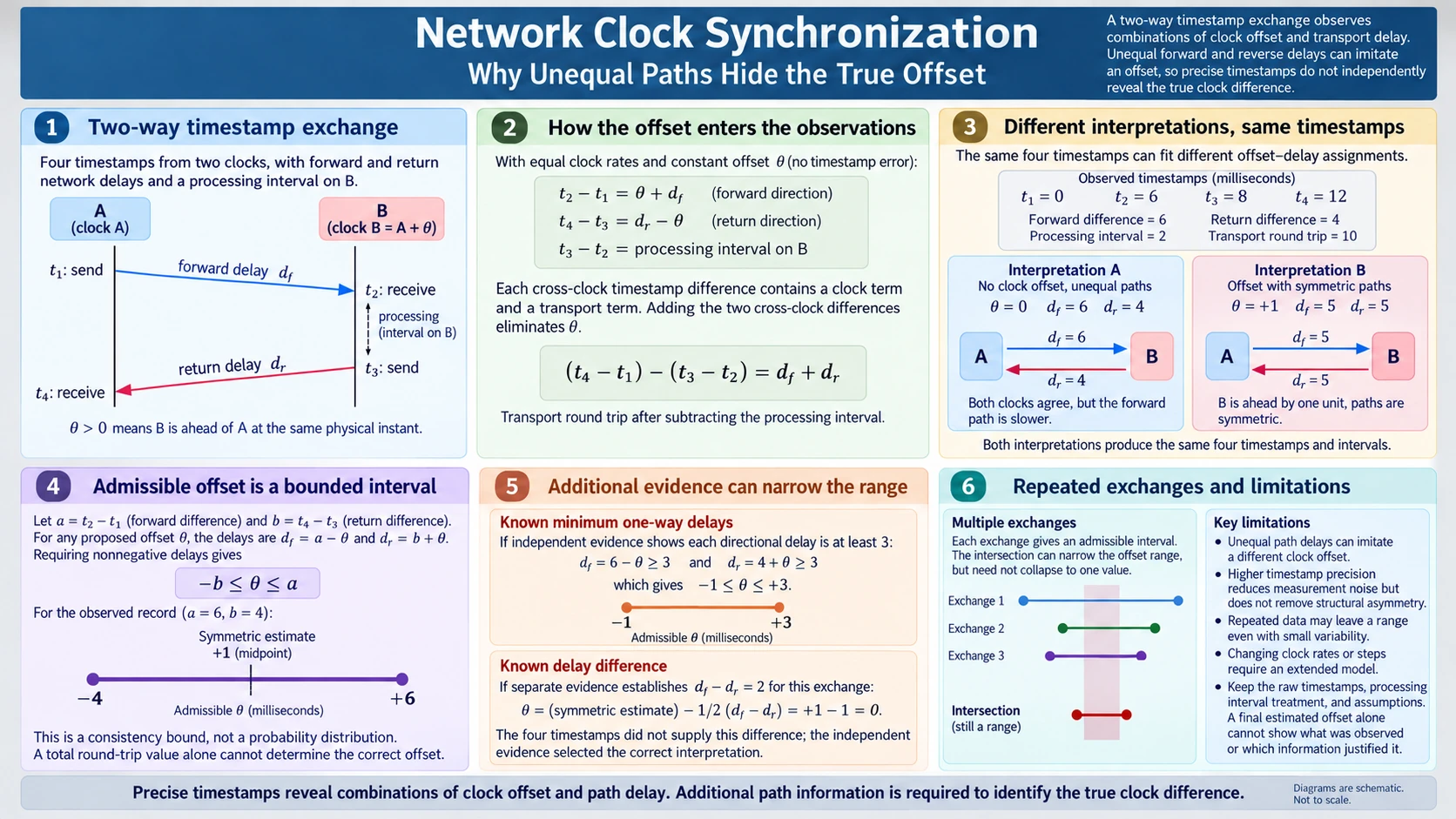
A precise two-way timestamp exchange does not necessarily reveal the true difference between two clocks. The observations combine that difference with the time taken in each direction. If the forward and return paths have unequal unknown delays, several clock differences can satisfy exactly the same record.
Network clock synchronization therefore depends on assumptions or additional evidence about the path, alongside timestamp precision. Reducing measurement noise can make an estimate more repeatable while leaving a systematic ambiguity unresolved.
Four declared timestamps are enough to show the distinction. The worked model uses clocks with equal rates during a short exchange and a constant relative offset. It excludes timestamp error initially so that path ambiguity cannot be attributed to imprecise measurement.
Clock offset enters the two directional observations
Let clock B read θ more than clock A at the same physical instant. Positive θ means B is ahead. Let df be the forward transport delay from A to B and dr the return delay from B to A. Both are nonnegative in the declared model.
A sends a message at its timestamp t1. B receives it at its timestamp t2, then sends a reply at t3. A receives that reply at t4. The interval t3 minus t2 is the processing interval measured entirely on B's clock.
Under equal clock rates and constant θ, the forward timestamp difference t2 minus t1 equals θ plus df. The return difference t4 minus t3 equals dr minus θ. A cross-clock difference therefore contains a clock term as well as a transport term.
The sampling-clock-jitter guide explains how acquisition instants vary around their intended positions and how waveform slope affects the measured value. Distinguish that uncertainty from clock offset, which is a difference between time origins at the same physical instant in this model. Monotonic progress alone does not place two origins on a shared scale. Precise timestamps still leave the directional path terms inside the cross-clock observations.
Clock-rate mismatch would add another effect over the exchange. The equal-rate premise is stated to isolate offset and asymmetry. A longer observation with significant relative drift would require an extended model rather than the same constant θ equation.
Symmetric delay produces a conditional estimate
Adding the two directional differences eliminates θ. The result is df plus dr, equal to the quantity t4 minus t1 minus the quantity t3 minus t2. This is the transport round trip after subtracting the declared processing interval.
If df equals dr, subtracting the return difference from the forward difference leaves twice θ. The symmetric-delay estimate is therefore half the quantity t2 minus t1 minus the quantity t4 minus t3.
Without symmetry, that same expression becomes θ plus half the quantity df minus dr. The estimate includes a bias equal to half the directional-delay difference. Timestamp precision has not removed the extra term.
A known two-millisecond excess in the forward delay would create a plus one-millisecond estimate bias under this convention. An excess in the reverse direction would create the opposite sign. The direction matters, so a total round-trip number alone cannot supply the correction.
The symmetry assumption may be useful under justified conditions. Its role should remain visible: it supplies information that the four timestamps do not independently contain. Calling the resulting value an offset estimate does not turn the assumption into a measurement of one-way equality.
Path asymmetry can imitate a different clock
Take hypothetical timestamps, all expressed in milliseconds relative to the chosen origins: t1 equals zero, t2 equals 6, t3 equals 8, and t4 equals 12. The forward timestamp difference is 6 and the return difference is 4.
B's processing interval is 2 milliseconds. The transport round trip is 12 minus 2, or 10 milliseconds. The symmetric-delay offset estimate is half of 6 minus 4, giving plus one millisecond.
One physical interpretation has true θ equal to zero, df equal to 6, and dr equal to 4. Both clocks agree, but the forward path is two milliseconds slower. The observed estimate is biased by plus one millisecond.
Another interpretation has true θ equal to plus one, df equal to 5, and dr equal to 5. B is ahead by one millisecond and the paths are symmetric. It gives the same forward difference of 6, return difference of 4, and processing interval of 2.
The acknowledgment-clocking guide shows how a return-path queue can bunch arriving reports while the sender's total data allowance stays fixed. That example makes path asymmetry relevant when interpreting recorded return timing. The related guide does not derive a clock-offset equation. The ambiguity here follows from two distinct offset-delay assignments producing the same timestamp record.
The first interpretation cannot be rejected because the timestamps have more decimal places. The data in this example are already exact. The uncertainty comes from different hidden quantities yielding the same observations, rather than from inadequate numeric resolution.
The admissible offset has a bounded interval
Let a be the forward timestamp difference and b the return difference. For any proposed θ, the delays required by the observations are df equal to a minus θ and dr equal to b plus θ. Requiring both to be nonnegative gives θ no greater than a and no less than minus b.
For the numerical record, θ can lie anywhere from minus 4 to plus 6 milliseconds under only those delay constraints. The symmetric estimate plus one is the midpoint of that interval. Its maximum deviation from an admissible offset is 5 milliseconds, half the measured transport round trip.
This is a worst-case consistency bound under the stated assumptions, not a probability distribution. It does not imply every value is equally likely. Additional justified lower or upper bounds on one-way delay could narrow the interval.
The ambiguity can also be seen by a transformation. Increase θ by an amount c, reduce df by c, and increase dr by c. Both directional timestamp differences remain unchanged. As long as the transformed delays remain admissible, the record cannot choose between the two assignments.
A measured one-way relationship, a justified symmetry model, or other independent timing information can constrain c. Repeating the same unchanged assumption with a more confident label cannot supply that missing information.
Suppose independent evidence establishes that each directional delay is at least 3 milliseconds. The numerical record then requires df equal to 6 minus θ to be at least 3, and dr equal to 4 plus θ to be at least 3. The admissible offset narrows to the interval from minus 1 to plus 3 milliseconds. Both earlier interpretations still fit.
If separate evidence instead establishes df minus dr equal to 2 milliseconds for this exchange, subtracting half that difference from the symmetric estimate yields true θ equal to zero. The four timestamps did not supply the extra difference; its independent evidentiary source is what selected the first interpretation.
Bounded timestamp errors would also widen or otherwise alter the consistency calculation. The exact interval derived here assumes error-free directional differences. Applying it unchanged to a noisy record would treat measurement uncertainty as if it had already been eliminated.
Repeated exchanges reduce some uncertainty
With several exchanges and a constant θ, each record provides an admissible interval from its own nonnegative delay constraints. Their intersection can narrow the set of offsets consistent with every record. That is a meaningful use of repeated evidence.
The intersection need not collapse to one value. Persistent unequal minimum delays can leave a range even when variable delay becomes small. A short round trip is evidence about the sum of delays, while equality of their two components remains a separate premise.
Likewise, averaging repeated symmetric estimates can reduce random timestamp or delay fluctuations under an appropriate model. A stable directional bias can remain in every estimate and survive the averaging. Repeatability alone is therefore insufficient evidence of absolute offset accuracy.
A sequence of changing θ values requires explicit handling of relative clock rate or correction events. Assuming θ constant while either clock changes its rate or steps can produce an incorrect intersection. The observation model must match the lifecycle of the clocks being compared.
The relevant evidence should retain the four timestamps, clock identities, processing interval treatment, and any assumptions about directional delay. Saving only the final estimated offset loses the record needed to evaluate an alternative path model.
The ZT-703S handheld oscilloscope, multimeter and waveform generator offers an electrical-event observation context, including listed waveform capture storage and export. An electrical trace still needs a justified relationship to the endpoint timestamps and its time reference. The listing does not supply network timestamp access or the independent one-way delay information missing from this exchange.
External electrical event records could supply additional evidence only if their relationship to endpoint timestamps and references is justified. Two stored traces with unrelated time origins do not automatically measure df and dr separately. The added observation must actually break the ambiguity rather than reproduce it in another form.
Compatible audio events provide another possible recording context. The Focusrite Scarlett 4i4 fourth-generation recording bundle is listed with a four-input USB-C interface and recording accessories. Those functions do not establish a shared network time origin, separate directional delays or a trace-to-endpoint mapping. Any recording used as extra timing evidence must justify that relationship independently.
For the declared record, an evidence report can retain the symmetric estimate of plus 1 millisecond beside the offset interval from minus 4 to plus 6. If an independent delay constraint is used, the report can show the narrowed interval and that constraint. Keeping those quantities separate exposes what was observed and what information admitted the final offset.