Networking
How TCP acknowledgment clocking can release a burst
TCP acknowledgment clocking turns new delivery progress into replacement opportunities. Compare evenly spaced and compressed feedback with a fixed allowance and a separate pacer.
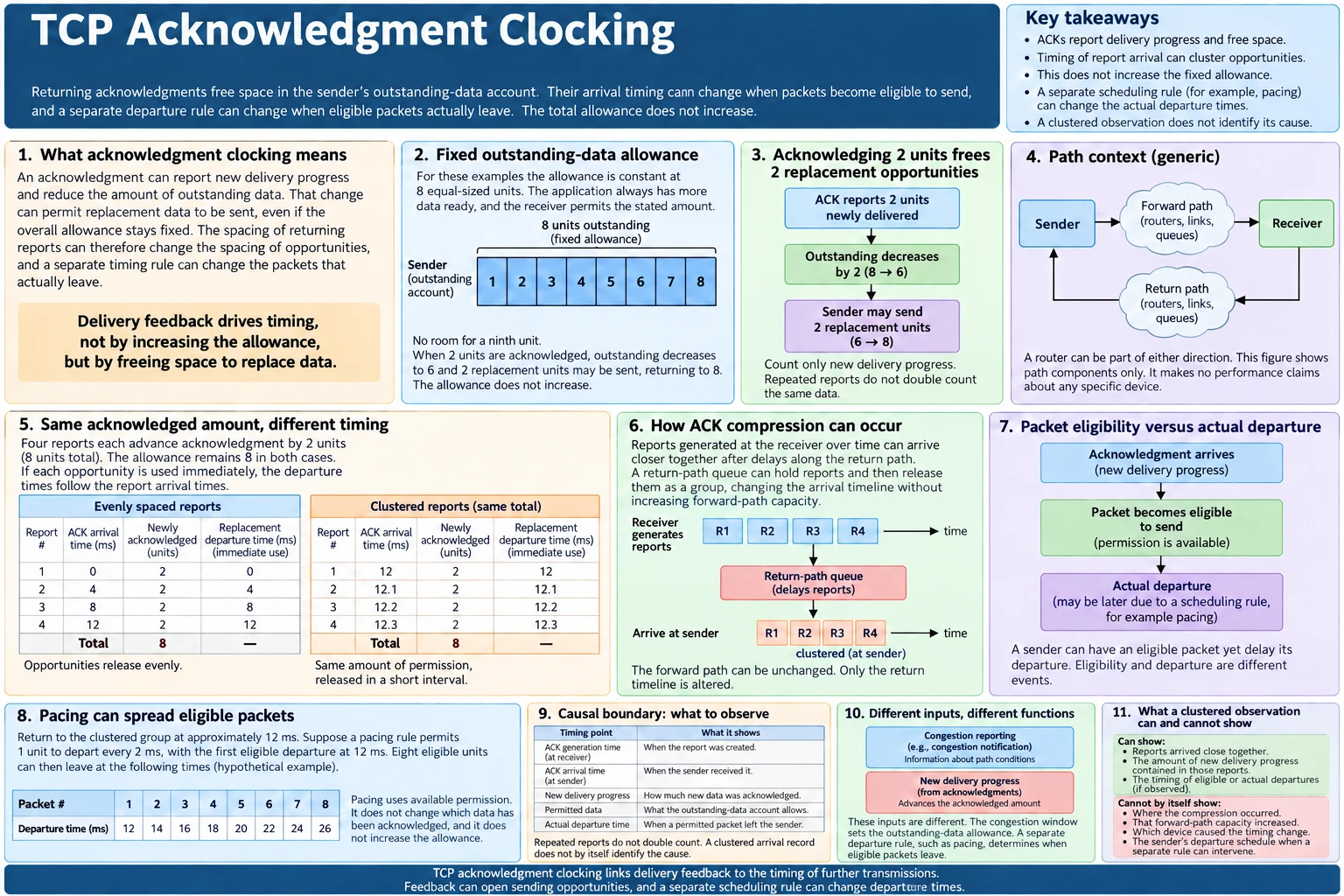
A sender can transmit the same amount of data over the same path and still release its next packets at very different times. Returning acknowledgments can change that timing. When delivery reports arrive evenly, they can open sending opportunities evenly. When those reports arrive close together, the sender may acquire several opportunities within a short interval.
TCP acknowledgment clocking connects delivery feedback to the timing of further transmissions. An acknowledgment can report progress through the data stream and reduce the amount counted as outstanding. That change can permit replacement data to be sent, even if the overall outstanding-data allowance has stayed fixed.
Hold the sending allowance constant to isolate the effect in the following examples. The application always has more data ready, and the receiver permits the stated amount. The question is how the spacing of returning feedback changes the spacing of opportunities, then how a separate timing rule can change the packets that actually leave.
Separate outstanding data from a sending opportunity
Outstanding data consists of bytes that have been sent but have not yet been acknowledged as delivered. A sender's allowance limits how much of that data it may keep outstanding under the stipulated control model. The difference between the allowance and the outstanding amount is available permission, provided the other applicable constraints also allow sending.
Suppose the fixed allowance is eight equal-sized data units, and all eight are outstanding. There is no room for a ninth unit in this account. A report that newly acknowledges two units reduces the outstanding total to six. The sender may now replace those two units and return the outstanding total to eight.
Count only delivery progress that has not already been acknowledged. Another report of delivery already counted does not remove the same two units a second time. For this illustration, track the advancement in acknowledged data, rather than treating every arriving acknowledgment packet as identical new credit.
Transmission eligibility is the permission to send under the relevant constraints. An actual departure is the moment a permitted packet leaves the sender. A sender may have an eligible packet yet delay its departure because of a timing rule or another scheduling constraint. Keeping these events distinct prevents an allowance calculation from becoming an unsupported claim about wire timing.
An increase in the overall allowance is another separate event. It can create additional permission without newly acknowledged data. We exclude such increases from the examples so that the effect of feedback spacing can be observed by itself.
Match the amount of feedback and change its spacing
Begin with eight units already outstanding. Assume that four returning reports each advance acknowledgment by two of those original units. In the first example, the reports arrive at times zero, four, eight, and twelve milliseconds. These are hypothetical timestamps used for the comparison.
If the sender uses each opportunity immediately, the first report permits two replacement units at time zero. The next report permits another two at four milliseconds, and the remaining reports do the same at eight and twelve. The fixed eight-unit allowance has not grown. Each report frees space that the sender refills.
For the second example, keep the same original data and the same four advances in acknowledged amount. Let the reports arrive at twelve, twelve point one, twelve point two, and twelve point three milliseconds. The sender receives all eight units' worth of progress within a much shorter interval.
Under the same immediate-use rule, the opportunities now release four pairs of replacement units close together. The total replacement amount remains eight. What changed is the interval over which its permission became available. A burst can therefore appear without any increase in the fixed allowance.
These assumed departures do not describe a particular implementation's exact scheduling. A real sender can have additional constraints on how it consumes the opportunities. The immediate-use rule is explicit so that a difference in departure pattern can be traced to the changed arrival pattern.
How ACK compression changes the return timeline
ACK compression describes a contraction in the spacing of acknowledgments reaching a sender. Reports that were generated farther apart can arrive closer together after delays along their return path. The sender then sees a timing pattern that differs from the pattern at which the receiver produced them.
The second example could result from a temporary return-path delay. The receiver generates the four reports over an interval, but competing traffic or a temporary service interruption holds them in a return-path queue. When that service becomes available, the accumulated reports leave close together and reach the sender as a group.
This history changes the return timeline without requiring a change in forward-path capacity. The original payload may have crossed the forward path under the same service conditions as in the evenly spaced case. Feedback about that payload has simply taken a different timing path back.
The explicit-congestion-notification guide follows a marked packet to its receiver and the resulting congestion report back to the sender. That return path provides context for ACK compression: feedback timing can change between generation and receipt, while the meaning of the report depends on its transport contract. Newly acknowledged delivery progress and reported congestion are different inputs to the sender; their arrival times alone do not establish the history that produced them.
A sender observing a group of reports does not have a complete record of this history. Their arrival times show the timing it received. Establishing where the contraction occurred requires additional observations or assumptions about generation, queuing, and delivery along the return path.
Trace the effect back onto forward traffic
The reports travel in one direction, but the newly permitted data travels in the other. A return-path delay can therefore change forward departure timing through the sender's feedback-driven account. The sender sits at the point where the two directions interact.
Before the compressed group arrives, our sender's original eight units remain counted as outstanding. It waits under the fixed allowance because it has not yet received the specified delivery progress. Once the reports arrive, it can replace the newly acknowledged portions. The waiting interval and subsequent burst follow from its information state.
That burst can create a short period of concentrated arrivals at a downstream queue. Whether a backlog forms depends on the departures that actually occur and the service available there. The acknowledgment timing alone does not determine every queue's response.
The burst does not establish that the sender learned a larger forward transmission capacity. In the matched examples, its permitted outstanding amount never increased. The sender acquired several replacement opportunities close together because the delivery reports arrived close together.
The receiver's acknowledgment-generation times do not determine the sender's departure schedule. The intervening return path changes what timing the sender observes, and a departure rule can further change how it acts on that timing.
What packet pacing adds to window permission
A stipulated pacing rule limits how quickly eligible packets may depart. It can spread transmissions after a compressed feedback group has made several packets eligible at once. The rule addresses the use of available permission; it does not rewrite which data has already been acknowledged.
Return to the compressed group at approximately twelve milliseconds. Suppose a separate rule permits one equal-sized unit to depart every two milliseconds, and its first eligible departure is at twelve. Under that rule, eight eligible units can leave at twelve, fourteen, sixteen, eighteen, twenty, twenty-two, twenty-four, and twenty-six milliseconds.
The example assumes that no new limiting event changes those opportunities during the sequence. It also assumes the pacing rule has the stated initial timing. These assumptions explain the illustrative schedule; they do not establish a universal scheduling pattern for TCP senders.
The departure rule must still respect the sender's account. Pacing permission does not authorize a packet that the outstanding-data constraint forbids. Conversely, newly available outstanding-data space need not result in an immediate departure if the pacing rule requires waiting. Both conditions must be satisfied.
The TCP-congestion-control guide explains how delivery progress and qualifying congestion evidence change a sender’s allowance for outstanding data. Its separation of that allowance from the departure schedule supplies the context for packet pacing. Growing or reducing permission changes how much may be outstanding; a pacing rule determines when eligible packets leave. An account of an acknowledgment-driven burst needs both the available permission and the rule used to consume it.
A pacing rule can reduce the concentration produced by this specific opportunity pattern. It does not guarantee that every downstream queue remains empty or that all congestion disappears. Other traffic, bottlenecks, and changes in the applicable rate can still affect the path.
A clustered observation does not identify its cause
The sender's arrival record can reveal that reports were closely spaced. It cannot by itself establish that a particular queue compressed a previously regular pattern. The generation pattern at the receiver might already have differed, or the observation might omit parts of the timing history.
For a causal claim about compression, compare appropriate timing points. If reports left the receiver evenly and reached the sender in a contracted interval, something between those observations altered their spacing. Even then, identifying a specific device requires evidence that separates it from the rest of the return path.
Record the amount of new acknowledgment progress alongside arrival timing. Four closely spaced reports can represent four advances in delivery information, repeated information, or another feedback pattern governed by the transport contract. The amount of new progress determines which opportunities the outstanding-data account actually opens.
Finally, observe departures if the claim concerns a data burst. A group of arriving reports establishes a group of inputs to the sender. It does not establish the outgoing timing when an additional scheduler or pacing rule can intervene. These records answer different parts of the causal question.
Place hardware descriptions beside the right question
Networking equipment can form part of either traffic direction. In the MSI RADIXAXE6600 Black Networking Router sku-1976725445 product description, WiFi 6E and three wireless bands characterize the advertised router. They do not describe the spacing of a particular receiver's reports or the departure rule used by an endpoint.
Similarly, NOBRAND 1 Nighthawk RS200 Networking sku-18604559110 is presented as a WiFi 7 device using two bands, with cable-modem functionality outside the unit. Those listing facts cannot identify the cause of a clustered acknowledgment record. That diagnosis needs observations of the actual traffic and relevant timing boundaries.
The matched examples hold the outstanding allowance and acknowledged amount fixed while varying report timing. That controlled change shows how TCP acknowledgment clocking can release a burst, and why a separate departure constraint can change the result without enlarging the allowance.