Networking
How explicit congestion notification signals congestion
Explicit congestion notification lets a delivered packet carry congestion evidence. Follow the marking, receiver feedback and sender response needed to complete the loop.
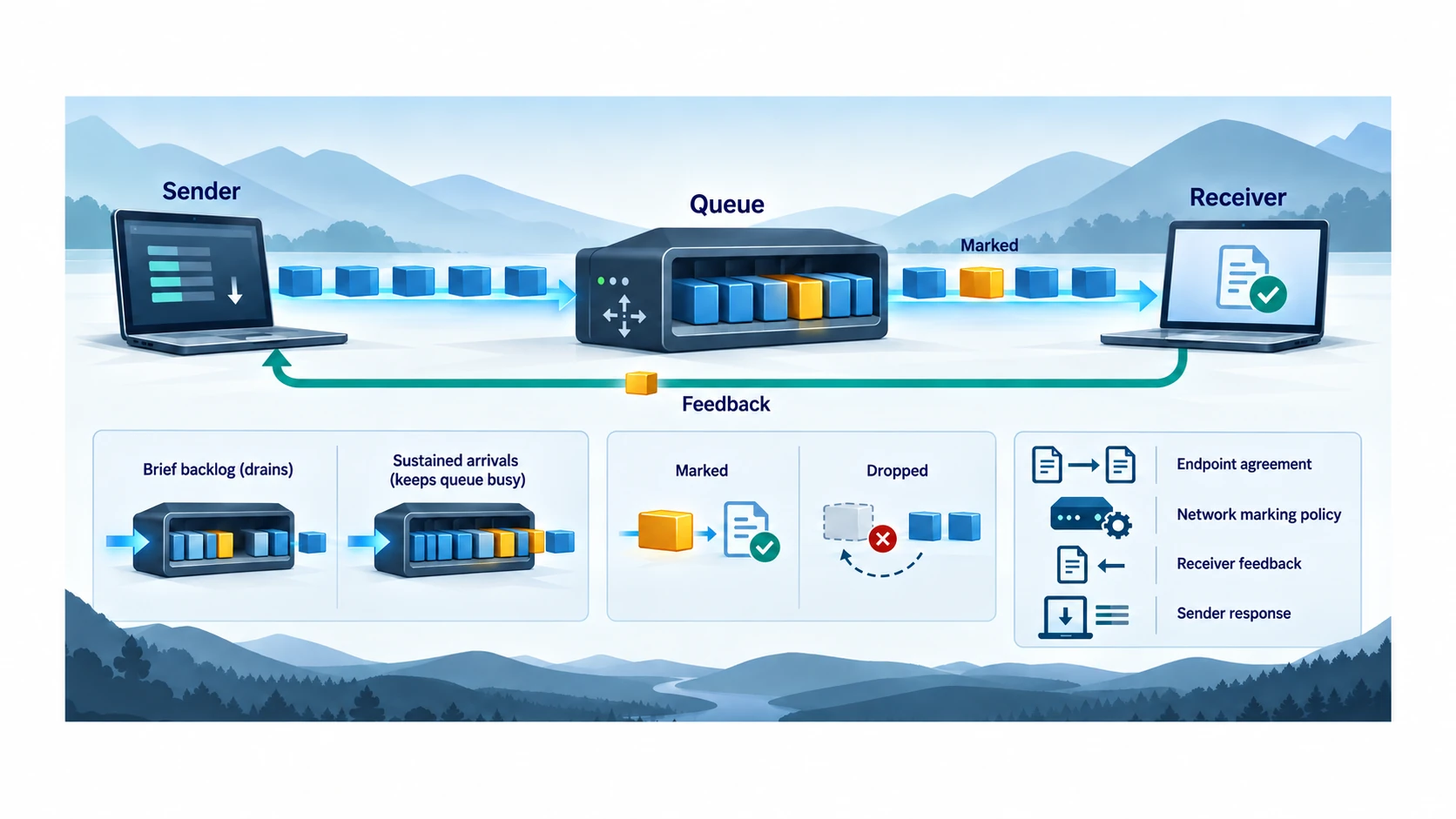
A packet can arrive intact after waiting behind a long queue of other packets. Its arrival tells the receiver that those bytes survived the journey. It says much less about how comfortably the network carried them. A congested queue may still have room for the packet, and the packet may eventually leave that queue without being dropped.
explicit congestion notification, usually shortened to ECN, gives a network a way to attach congestion information to traffic that it continues to deliver. The sender can use that information when the receiver reports it and the sender changes its behavior. A mark left in a packet header cannot reduce traffic by itself.
Follow the complete trip: a sender transmits a packet, a network device marks it, the receiver reports that signal, and the sender applies an agreed congestion response. Each boundary has its own requirements. The trip connects a delivered packet's warning to a change in traffic; marks seen at one point cannot establish that the whole system is working.
Delivery, backlog, and congestion are separate observations
A queue temporarily holds packets when they arrive faster than the next link can serve them. A brief group of arrivals can create a backlog even when the longer-term traffic rate is manageable. If excess arrivals continue, the backlog can persist or grow. Packets wait in both cases, but a backlog that drains has a different history from one that keeps growing.
Queue occupancy describes how much data is waiting at a particular observation time. A packet's residence time describes how long that packet spends there. Packet delivery describes whether it eventually reaches its destination. None of these observations completely determines the others. A large buffer can accommodate substantial waiting without losing packets, while a short burst can briefly increase occupancy and then drain.
The rule that generates a congestion signal determines what the signal means. A device might react to a queue measure or another condition specified by its queue-management policy. The signal indicates that the condition was met; it does not automatically report an exact spare capacity, a precise queue length, or the amount by which a sender should reduce its rate.
Consider a stipulated link that can forward ten equal-sized packets during each observation interval. Twelve packets arrive during one interval, then eight during the next. The first interval leaves a backlog, and the next interval offers an opportunity to clear it. If twelve keep arriving every interval, the same service rate cannot clear the accumulating excess. The numbers are assumptions for this example; they describe no measured network.
Both histories can deliver every packet for a while if enough buffer space is available. A receiver that observes successful delivery therefore needs additional evidence to distinguish an accommodating queue from a persistently overloaded one. The fact that a packet was delivered is compatible with congestion along its path.
How congestion marking preserves the packet
In an ECN-capable exchange, packets can carry an indication that they are eligible for congestion notification. A participating network device can change the relevant header indication when its signaling rule calls for a congestion signal. This is congestion marking: the device preserves the packet for forwarding while recording that it encountered a condition the sender should learn about.
Marking and forwarding are separate actions. The packet still needs a place in the queue and an opportunity to be transmitted. If a queue cannot admit more data, a marking mechanism does not create space for it. Packets can still be dropped on an ECN-capable path, and losses can still require recovery by the transport.
For a concrete journey, suppose a sender and receiver have agreed to an ECN contract, and the sender emits an eligible packet. The packet enters a participating device whose stipulated rule marks packets when its congestion condition is met. After changing the congestion indication, the device forwards the packet when its turn comes. The destination receives the original payload together with evidence that the packet was marked somewhere along the route.
The receiver usually cannot identify the specific queue from this indication alone. The signal is also too small to describe every detail of the congestion event. The network and endpoints need a shared interpretation that turns this limited evidence into feedback the sender can use.
The queue-side decision connects to congestion marking in active queue management. That topic examines why a queue manager may signal persistent excess demand before a buffer fills, while allowing some temporary buffering. ECN supplies a possible signaling mechanism; the rule deciding when to use it remains a separate part of the system.
The receiver has to return the signal
The marked packet travels toward the receiver, but the sender needs information travelling in the opposite direction. A transport using ECN must therefore define how the receiver reports the indications it observes. An acknowledgment can carry congestion feedback as well as information about which data arrived.
Delivery of the payload can succeed even if the receiver fails to report its congestion indication. A receiver that delivers the payload to an application but omits the required feedback leaves the sender unaware of the mark. Likewise, the sender cannot act on feedback that has not yet reached it. Successful delivery at the receiver does not remove the need for this return path.
The transport contract specifies how reports describe marks. Some contracts summarize events, while others provide different forms of feedback. The sender must interpret the report using the contract that was negotiated, rather than assume that every reported indication corresponds to one newly marked packet or demands an identical adjustment. Treating every ECN variant as interchangeable would hide these differences.
Feedback also takes time. Between the queue's marking decision and the sender's receipt of a report, more packets can enter the network. A sender can continue using its previous transmission allowance during that interval because it has not yet received the new evidence. A larger delay in the feedback path extends this interval; it does not show that the sender ignored a signal it had already received.
Suppose a queue begins marking during one group of arrivals, but the corresponding reports reach the sender only after several more groups have been transmitted. The queue may remain busy during that delay even if the sender will respond correctly. To judge the response, put the marking event and feedback arrival on the same timeline as the sender's subsequent transmissions.
What a sender congestion response must change
Once feedback arrives, the sender needs a congestion-control rule that uses it. That rule might reduce the amount of data allowed to remain outstanding or otherwise constrain the sender's offered traffic. Its precise behavior depends on the transport and congestion-control contract. ECN does not prescribe one universal reduction for every sender.
A sender congestion response changes the control state from which future transmissions are permitted. An application may have less data to send than the allowance permits. Reducing that allowance can then leave its observed traffic rate unchanged. Conversely, an application with a continuous backlog can expose the effect more clearly because it keeps asking to send.
The receiving application's ability to accept data is a separate constraint. A sender can be limited by its peer's advertised receive capacity even when the network congestion allowance is larger. Keeping these limits distinct prevents an observer from attributing every pause in transmission to an ECN signal.
The related topic of sender congestion response concerns how TCP adjusts its sending allowance as it learns from delivery and congestion evidence. It examines the sender's control rule and its limitations. The ECN discussion here follows the evidence into that rule without assuming that a mark identifies the available link capacity or selects a particular implementation.
Even a correctly implemented response needs time to affect a queue. Packets already in flight can continue to arrive after the sender changes its allowance. Other senders may still contribute traffic. A reduction by one participant can therefore be genuine while the aggregate arrival rate remains above the queue's service rate.
Compare marking and dropping under the same workload
A useful comparison holds the traffic history and service assumptions fixed. Suppose a shared queue receives a sustained workload greater than it can forward. In one stipulated policy, it signals selected congestion events by dropping packets. In another, it marks eligible packets and forwards them when space permits. Assume that the relevant senders recognize each signal and apply their defined responses.
The dropped packet's missing payload must be recovered if the transport promises reliable delivery. A successfully delivered marked packet has no missing payload to recover solely because of that mark. The marked packet supplies congestion evidence while its payload reaches the receiver. It does not remove the need to handle other losses.
Both policies still depend on responsive traffic. If senders fail to reduce what they offer, marking does not change the queue's service rate or stop the arrivals. A drop policy also cannot make an unresponsive source cooperate simply by notifying it. When space runs out, admission losses may continue regardless of whether earlier congestion signals were marked or dropped.
The comparison also needs an explicit response model. Marking more frequently under one policy and dropping less frequently under another does not isolate the effect of preserving payload. Different signal rates or sender reactions change the experiment. For the comparison to be useful, specify the signaling rule and the path back to the sender, then trace the sender's response.
There is no guaranteed outcome for delay, fairness, or throughput from the existence of ECN alone. Those outcomes depend on the queue's signaling policy, the mixture of traffic, and the endpoints' responses. explicit congestion notification provides a path for congestion evidence; the resulting operating point belongs to the larger feedback system.
A router listing cannot establish the complete ECN contract
A router listing identifies equipment that can occupy part of a packet's route. It may say little about how that equipment handles ECN. The MSI RADIXAXE6600 Black Networking Router sku-1976725445 is described in its listing as a WiFi 6E tri-band gaming router. That identifies the kind of network equipment being discussed. The listing does not establish a particular ECN marking rule, firmware configuration, or compatible endpoint response.
The NOBRAND 1 Nighthawk RS200 Networking sku-18604559110 listing describes a dual-band WiFi 7 router and says that it has no built-in cable modem. This is another concrete example of a router occupying part of a packet's route. Its wireless generation and product category do not confirm that an ECN feedback loop operates across the route as a whole.
The ECN loop crosses both equipment and endpoint boundaries. A suitable forwarding device does not supply a missing receiver feedback mechanism. An ECN-capable transport does not establish that an intervening queue has a suitable marking policy. A claim about a particular deployed path would need evidence about the relevant participants and their actual behavior.
Check the boundaries of the hypothetical loop
Start with capability and agreement. The endpoints must use a compatible congestion-notification contract, and a packet must be treated according to that contract as it crosses the network. Observing an ECN-related field in isolation does not prove that these prerequisites were satisfied.
Next, check signal production. A participating device needs to mark under its defined policy while preserving the packet for delivery when it can. A packet that is never marked tells the observer little without information about the queue's conditions and policy. The absence of marks could reflect an absence of the triggering condition, or a path that did not produce the signal.
Feedback must reach the sender in a form it can interpret correctly. Delayed reports, missing reports, or a mismatch between the receiver's reporting scheme and the sender's interpretation can prevent the evidence from affecting control. Validation requirements belong to the particular contract and should be checked there.
Finally, examine the sender's behavior after it receives that evidence. The sender needs to apply its response rule, and the observation must account for application limits and traffic already in flight. A complete account follows a mark from its production to an actual change in permitted sending. With the complete loop in place, explicit congestion notification lets a delivered packet give its sender a reason to ease the traffic that follows.