Networking
Why active queue management can drop packets before a network buffer is full
Active queue management signals persistent congestion before a buffer fills. Compare transient bursts, queue observations, feedback delays and responsive traffic.
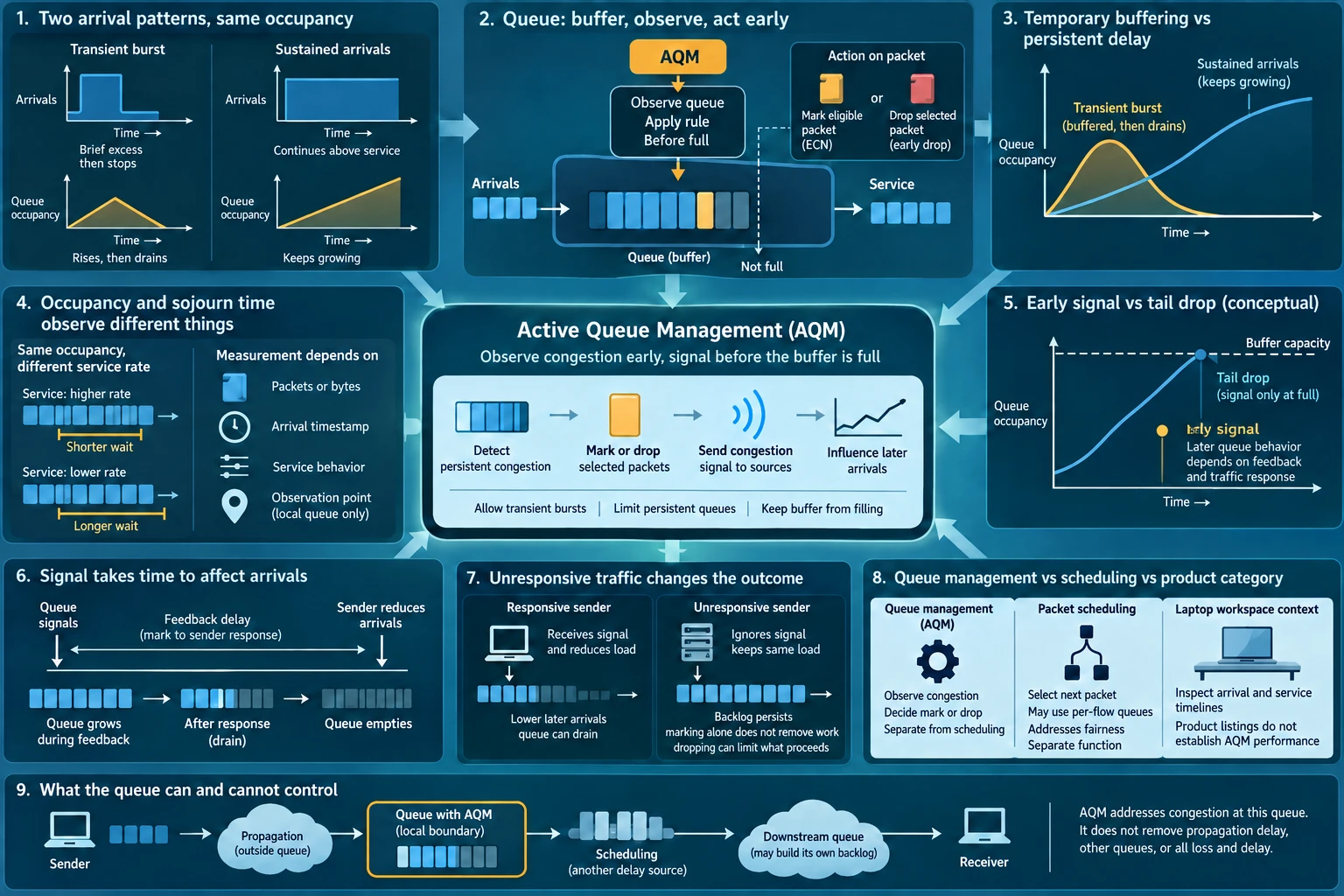
A network buffer can have spare space while packets already wait longer than the service intends. Filling that remaining space would admit more work, but it would also extend the wait. active queue management uses an explicit congestion observation and signaling rule to act before exhaustion. Depending on the rule and packet capabilities, that action can mark a packet or discard it.
The difficult distinction is between a burst that the queue can absorb and a backlog that persists because offered traffic continues to exceed service. A short queue at one instant may be growing rapidly. A large queue may already be draining after a brief burst. To explain early intervention, the arrival history and the service history need to be considered together.
A temporary backlog and a persistent backlog
Use a deliberately simple fluid model: all work is measured in equal packet-sized units, the queue starts empty, and service removes ten units per millisecond whenever work is available. Ignore propagation and processing outside this queue. The fluid assumption lets us calculate backlog without deciding the exact ordering of individual packet arrivals within a millisecond.
First, arrivals supply twenty units per millisecond for two milliseconds and then stop for two milliseconds. During the initial burst, arrivals exceed service by ten units per millisecond. The backlog reaches twenty units. It then drains at the service rate, returning to zero after two milliseconds without arrivals. The buffer has absorbed a transient excess.
Now supply fifteen units per millisecond continuously. Service still removes ten. The backlog grows by five units each millisecond as long as admission allows it. At four milliseconds, it has reached the same twenty units as the temporary burst. The instantaneous occupancy is identical, while the future arrival pattern is different. One queue is about to drain; the other continues to grow.
An observation available to a real queue cannot know future traffic in advance. It can examine current or historical conditions and apply a specified rule. This is why an active rule needs a treatment of time and persistence. Rejecting every brief rise would remove some of the burst absorption that buffering is meant to provide.
Occupancy and queue sojourn time observe different things
Occupancy records the queued amount of work. Depending on the implementation, that amount may be measured in packets or bytes. queue sojourn time records how long a particular packet resides in the queue, using a defined arrival and observation or departure boundary. Equal occupancy does not imply equal waiting time when service rates differ.
In the fluid example, a backlog of twenty units corresponds to two milliseconds of service at ten units per millisecond. At two units per millisecond, clearing the same backlog takes ten milliseconds if no new work arrives. The ratio of backlog to service rate gives a simplified waiting-work estimate. It is not an exact packet residence measurement when service varies or the packet's position is unknown.
Variable packet sizes also change the interpretation. Twenty short packets require a different amount of transmission work from twenty long packets on the same link. Measuring bytes can describe that work more directly, but it still needs the relevant service behavior to translate work into time. An arrival timestamp supplies information about a packet's actual wait that a count alone cannot provide.
The chosen observation point matters. A packet may wait in several queues along its path, and a local queue's timestamps cover only its own boundary. A delay controlled at one queue does not include an unrelated downstream queue or the time spent propagating over a link. A claim about residence should identify where the clock starts and stops.
Tail drop and an explicit early packet dropping rule
Give the example queue a capacity of one hundred units. Under tail drop, it accepts arrivals while sufficient capacity remains and rejects arriving work when capacity is exhausted. With continuous arrivals of fifteen units per millisecond and service of ten, backlog grows by five units per millisecond. In the fluid approximation, it reaches capacity after twenty milliseconds. Before that point, the capacity check supplies no congestion drop.
For comparison, stipulate a coarse early-signaling rule: if estimated waiting work remains above two milliseconds for four continuous milliseconds, issue a congestion signal on the next eligible packet and then follow a separately specified signal interval. Reset the persistence timer when the estimate falls to or below two milliseconds. This is a teaching rule, not a claim about a named deployed algorithm or recommended parameters.
Under the continuous-arrival history, the backlog reaches twenty units at four milliseconds. It exceeds that threshold afterward. By roughly eight milliseconds, the condition has persisted for the stipulated period and backlog is around forty units. The rule can therefore signal while substantially less than one hundred units are queued. Exact packet timing would depend on how a discrete implementation samples and applies the rule.
The two-millisecond burst reaches twenty units and then drains. Under the stated rule, its estimate does not remain above the threshold for four milliseconds, so it does not trigger the early signal. The persistence test distinguishes these stipulated histories without claiming that it classifies every burst or every congestion episode correctly.
early packet dropping implements a signal by discarding a selected packet before capacity exhaustion. An ECN-capable path can instead mark an eligible packet under its applicable contract. The explicit congestion notification guide explains the feedback path relevant to early packet dropping: a congestion indication can be carried by a delivered packet, while the receiver and sender must convey and act on it. Marking and discarding have different delivery consequences even when they serve the same local signaling purpose.
A congestion signal takes time to affect arrivals
The queue's decision cannot instantly change traffic already in flight. A mark must reach a receiver, feedback must reach the sender, and the sender's response must influence traffic that later arrives at the queue. A loss indication also depends on the transport's detection and response behavior. The queue continues to admit and service work during that feedback interval.
Suppose the teaching rule signals while forty units are queued, and suppose it takes another six milliseconds before a responsive sender's reduced load reaches this queue. If arrivals remain fifteen units per millisecond during that interval, backlog increases by another thirty units. It reaches seventy even though the early signal occurred well before capacity. An earlier signal reduces neither the feedback travel time nor work that has already been offered.
After the response, assume offered arrivals become eight units per millisecond. With service at ten, backlog drains by two units per millisecond. A packet at the queue can still experience waiting while that older work clears. The rate change and the queue's recovery are related but occur at different times.
A long queue sojourn time can persist while transport feedback is still taking effect. The TCP congestion-control guide explains how a sender adjusts allowed outstanding work in response to congestion information. That sender mechanism provides context for the recovery interval here; it does not turn a local residence observation into a complete diagnosis of the path or guarantee that backlog disappears immediately.
Unresponsive traffic changes the outcome
Now assume part of the offered traffic ignores congestion information. The queue can continue marking eligible packets, but a sender that keeps the same offered load will not reduce arrivals because of those marks. If the total admitted rate remains above service, a persistent backlog still needs treatment. A mark alone does not remove queued work.
Discarding packets can limit what reaches a downstream service, but that is different from making an unresponsive sender offer less traffic upstream. A queue that drops enough incoming work to match available service may still spend resources receiving and discarding the excess. The other traffic sharing the boundary can also experience losses or delays.
Fairness requires its own model. A common queue-management rule does not establish how bandwidth is divided between flows. A packet scheduler can select which queued packet receives the next service opportunity, potentially using per-flow organization. Queue management determines marking or dropping according to its congestion rule. The mechanisms can be combined, but one should not receive credit for the other's guarantees.
RFC 7567 distinguishes queue management from scheduling and discusses the problem of traffic that is insufficiently responsive to congestion indications. Its recommendations concern AQM as a class of mechanisms. They do not make the teaching threshold above a standard algorithm or supply a universal fairness guarantee.
Use a timeline to inspect the service boundary
A table with columns for arrivals, service, backlog, and signal time is enough to test the arithmetic in these examples. A reader considering a computer for writing that table can inspect the Lenovo IdeaPad FHD Touch listing. The listed 15.6-inch display accompanies 512GB PCIe storage and 16GB DDR4 memory, with an Intel Core i5-1334U identified as the processor. The product facts describe a possible workspace. They do not measure queue behavior or establish a network device's AQM implementation.
Keep the queue capacity as a separate column. Capacity establishes when a particular admission boundary is exhausted; it does not define the acceptable steady-state waiting time. A larger buffer may absorb a larger burst under the same service conditions while also allowing a larger sustained backlog. The desired burst accommodation and the desired congestion signaling policy need separate justification.
The ASUS Blue 14 FHD laptop product page identifies the item by that title. It is another workspace reference for inspecting the arrival and departure history. No queue algorithm, measured latency, or congestion-response performance follows from the listing title. For this exercise, vary the service column while keeping the occupancy sample fixed to see why a packet count cannot independently determine a wait.
Finally, identify which delay the queue could affect. Propagation continues even when the queue is empty. Scheduling can delay a packet behind other eligible work. A downstream bottleneck can build its own backlog after this queue releases a packet. Active queue management at the selected boundary addresses congestion observations there, and its effect depends on the signals, traffic response, and service available.
The early decision is justified when its specified observation and rule identify a condition worth signaling before the capacity boundary is reached. To assess a result, trace the condition's persistence, the packet selected for a signal, and the later arrival change. A queue that signals early can still grow during feedback delay, recover gradually, or remain congested under unresponsive offered load. Those histories describe the mechanism's outcome more precisely than the buffer's percentage full.