Audio & Video
Music stand page snag: identify the contact point
Record which edge catches and where it touches before changing the stand or replacing a score. Stop at resistance and preserve uncertain causes.
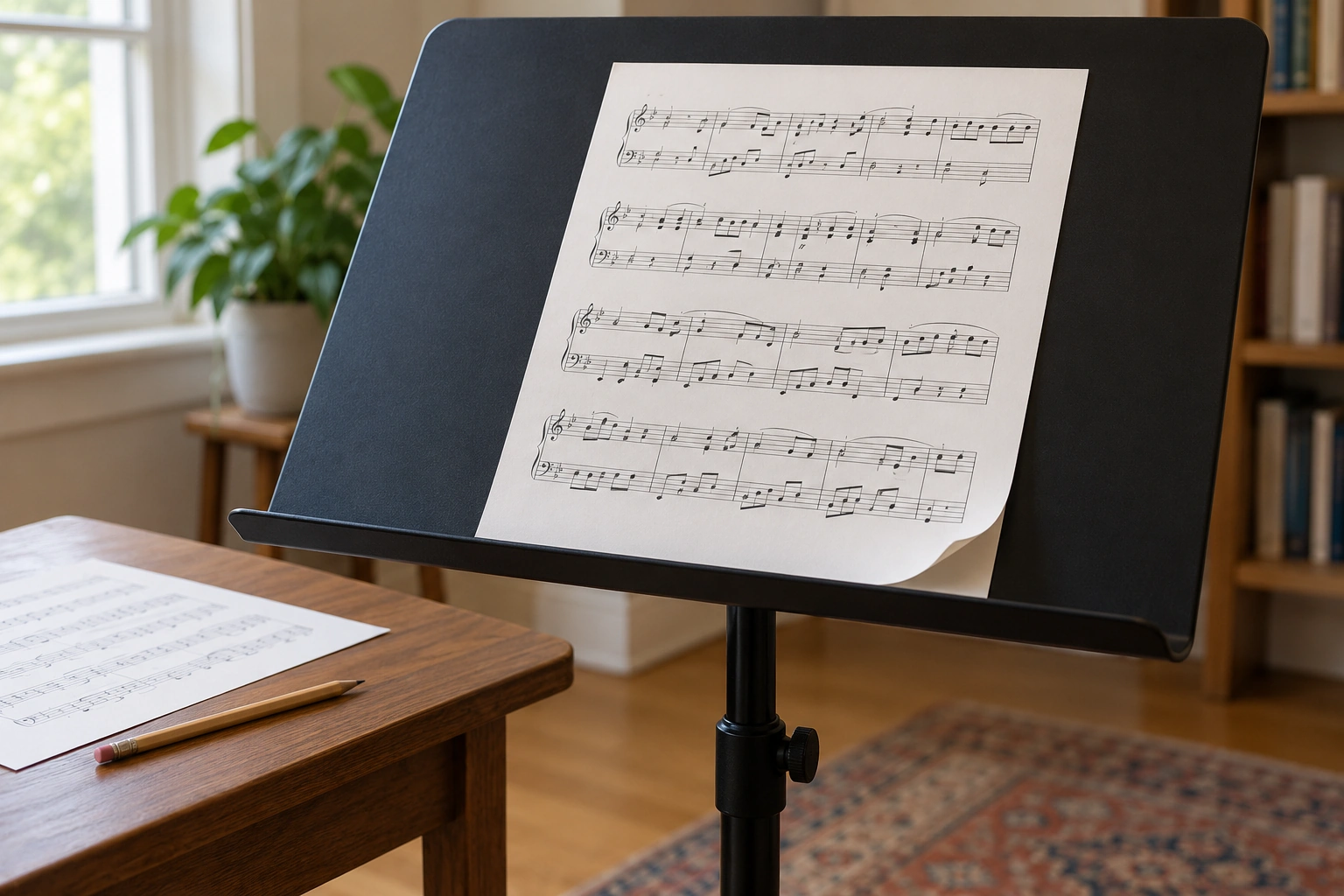
A music stand page snag can begin with an ordinary turn: one edge stops moving while the rest of the sheet follows your hand. Stop there. Pulling harder would change the paper and could destroy the small detail you need to understand. First record which sheet edge met which visible surface. An observation that specific is more useful than deciding immediately that the stand is defective.
This guide concerns an individual loose sheet catching during an intended page movement. A book springing closed, a score sliding off its support, an unreadable line and a whole stand shifting are different observations. If the stand itself moves or feels insecure, remove the material as its instructions allow and resolve that support issue before investigating a page. No paper check should depend on an uncertain stand staying upright.
Keep the stopped arrangement long enough to describe it
Before clearing an ordinary, noncritical sheet, look at its orientation. Which side faces you? Which edge is at the bottom? Were you moving it to the left, to the right or upward? Describe the movement you intended rather than repeating the movement to obtain a more dramatic snag. If a second sheet hides the contact, say that the contact was hidden. An honest gap in the account is better than an invented explanation.
Use a simple sketch beside the score, without marking the music itself. Draw a rectangle for the page and put a small mark at the edge that stopped. Add an arrow for the intended movement. A note such as “lower right corner, moving left, contact not visible” preserves useful information. It does not assert that the corner was bent, the lip was sharp or a particular part needed adjustment.
Keep the page's identity with that note. A page number may be enough for a disposable working copy; an edition or arrangement reference may matter when several versions share a title. Distinguish the affected sheet from the sheet you meant to uncover. Otherwise, someone reviewing the problem later could inspect an undamaged neighboring page and reasonably fail to find the feature you saw.
Describe contact separately from a cause
A visible corner resting against a lip is an observed relationship. “The lip caused the snag” is a stronger conclusion. Your view may not show whether another sheet, a fold or an object behind the page also participated. Record only what you can actually see. If the movement stopped before you could locate the contact, retain the narrower description: the sheet met resistance during that movement.
Do not put a finger, pencil or improvised probe into a trapped gap to discover what is holding the sheet. Follow the actual stand's directions for removing material. If those directions do not resolve a trapped page, stop and obtain applicable help. A valuable original, fragile score or borrowed document deserves its owner's handling instructions. The remaining checks are for ordinary noncritical paper that can be removed without further damage.
Once the paper is safely removed, keep its original orientation in the note. Lay it on a clear, dry surface without pressing it flat or trying to improve its edge. Look at the part you marked. Is there a visible fold, torn area, attached tab or another sheet lying across it? Describe that feature if present. Its presence on the removed sheet still does not establish that it produced the earlier resistance.
Look at the empty support without changing it
With the score removed, inspect the accessible surface from your normal viewing position. Locate the place named in your sketch, if you can. Record whether it is an exposed page-rest edge, another permitted paper-contact surface or an area you cannot identify. Do not dismantle the desk, loosen a fitting or reach around an unseen edge to complete the map. A contact note can remain incomplete.
If you notice a loose component, obvious damage or an unexpected exposed object, leave the support out of use and ask for model-specific guidance. This article supplies no filing, sanding, bending, taping or tightening procedure. Altering a surface would replace the evidence with a different surface. It could also create another question about whether the stand remains suitable for its intended use.
The Manhasset Model #48 orange offer identifies that music stand. Its two gallery images show an orange solid score desk with a lower lip, upright support and three-foot base. The short description provides no page-snag test or remedy.
The Vio music stand offer states an adjustable height of 30–54 inches and uses “double-deck” in its title. Its sole image shows one visible score desk. That wording does not establish a second usable shelf, a paper-clearance measurement or a snag remedy.
Keep a useful comparison small
If a question remains about the paper itself, compare the affected ordinary sheet with an unaffected sheet on the clear table. Keep them separate and identify which is which. Look at the same edge on both. A folded corner on one and a straight corner on the other is a difference you can report. Do not trim the first corner to make the sheets match or call the second sheet proof that the stand is sound.
A blank duplicate can help someone understand the paper's size and intended orientation without handling the score. It is not automatically an equivalent test specimen: its surface, stiffness and previous handling may differ. Label it as a size reference. Do not repeatedly drag it across a suspected obstruction or load several sheets to see when something fails. The purpose is to communicate the observed arrangement, not to invent an endurance test.
If a photograph can be made without touching the stopped arrangement, use the view you actually had. Include enough of the sheet to show its orientation and keep the contact area visible where possible. Do not recreate the resistance for a clearer picture. A photograph made after removal should be labelled that way, because it cannot show where the page was when it stopped. Avoid including private annotations or another person's material without their permission.
Keep three kinds of statement distinct in the note: what you observed, what another person reported and what remains unknown. For example, you may have seen the lower corner stop, while a player reports that the same page caught yesterday. Those are two accounts, not two identical verified events. Ask whether yesterday's sheet, direction and stand were actually the same before combining them into a claim about repeated failure.
For a shared score, leave the observation where the next person can understand it before they use that sheet. Name the page and the unresolved handling question without attaching anything to the suspected contact area. If the owner provides a replacement working copy, identify it separately. A replacement changes the paper under review; it does not erase the original observation or establish that an unseen support surface was harmless.
Consider a hypothetical report: “Page four stopped at its lower left edge while I moved it right. I could see that edge beside the lower rest, but another sheet obscured the exact contact. After removal, a pre-existing fold remained visible.” This report gives the next reader a place to inspect and clearly states the missing view. It supplies neither a confirmed mechanical cause nor permission to flatten, cut or replace anything.
Ask the question the evidence can support
Send the model identity, your short sketch and the observation to the appropriate maker, seller or document owner when guidance is needed. Ask which documented handling step applies to that exact arrangement. If the reply refers to a clip or other feature you do not have, clarify that difference before acting. An answer about another stand cannot fill a missing instruction merely because both products hold music.
If you cannot name the support surface, the music stand parts guide separates the desk, joint, column and base. Its parts map does not identify a snag cause or authorize an adjustment. Use the actual model's instructions for any permitted change.
If the issue instead involves reaching around another player's score, the two music stand positions guide handles sightlines, walking routes and a shared rehearsal trial. That room-layout decision remains separate from locating one sheet's contact point.
Record any response beside the original observation, preserving which part was seen and which part was uncertain. If someone later changes the arrangement under applicable instructions, keep that as a new state. A turn that works afterward is a result for that arrangement; it does not retrospectively prove the cause of the earlier snag. The original note should remain readable without being rewritten into a success story.
Keep any purchase attached to the unresolved question
If you consider a music stand through republeq.com and prefer crypto such as USDT, preserve the exact offer and the page-contact question before discussing payment. A payment preference cannot establish a desk's clearance or explain why a sheet stopped during a turn. Obtain current instructions for the actual basket and confirm any required asset, network, destination and order reference before authorizing a transaction. This passage establishes no available payment method or present route for a particular order. A helper should receive the model identity and the specific observation, including any part of the contact that remained hidden. Replacing that account with a request for a better stand would remove information needed to assess whether a different support would address the problem. If an offer or selected variant changes, keep the new identity separate from the earlier enquiry. A photograph of another configuration cannot silently become evidence for the item in the basket. Retain applicable supplier guidance with the product it actually names, and distinguish a proposed handling step from one already performed. If a payment or order attempt has an uncertain result, reconcile that exact attempt before authorizing another one. An unanswered confirmation remains an open transaction question until the destination establishes what occurred. An order receipt also supplies no demonstration of page-turn performance. Keep transaction evidence separate from the observation note so neither is asked to prove the other's subject. You can leave a purchase undecided while seeking the missing instruction or dimension. The immediate result can be a precise question about the actual sheet and support, without a new order or a claim that a replacement will eliminate the snag.
Finish with the observation you actually have: the sheet, its orientation, the intended movement, the visible contact and any missing view. Leave an unresolved cause unresolved. That record gives the next person a concrete question while keeping both the paper and the stand free from an improvised repair.