Kitchen & Appliances
Build a measuring set storage map you can use again
Make a measuring set storage map from actual tool markings, then rehearse selecting and returning each piece with another household user.
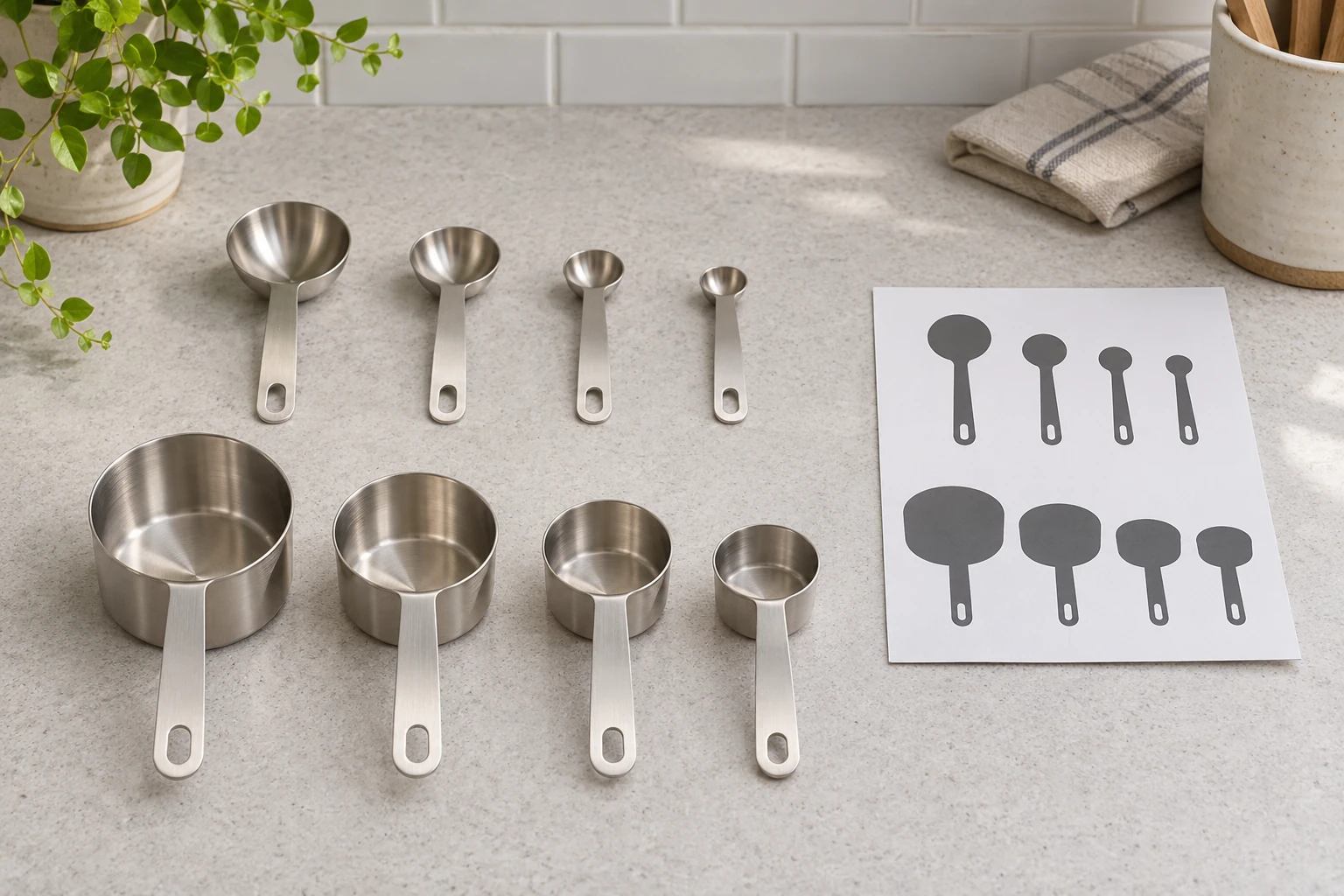
A measuring set storage map can give each marked spoon or cup a recognizable place to return. Start with the tools actually in your kitchen and a separate reference sheet. The practical test is whether another person can find the piece you mean, check its own marking and put it back in the agreed position. You can rehearse that sequence with unused tools before preparing any ingredients.
Choose a small group you want to organize together. Keep the work to identifying pieces and arranging their return positions. A map can record what a handle says without proving the amount the tool holds. Leave recipe interpretation, measuring technique and any uncertainty about a tool’s suitability with their applicable instructions. This tutorial creates a household storage reference from your observations.
Look at the actual set before drawing the map
The Novex five-piece measuring cup offer describes stainless steel cups under SKU 18077710869. Its three original gallery images show handled metal cups, nesting and a ring detail. A staged image also includes a partly visible spoon bundle whose supplied status is unconfirmed. Keep that pictured addition outside the confirmed cup account. The listing and photographs provide no independent calibration result.
The six-cup and six-spoon measuring set offer is cataloged as Unbranded, SKU 18225767186. Its stainless-steel wording conflicts with six galleries showing red plastic-looking, Tupperware-marked cups and spoons. Retain that discrepancy for clarification before an order. Staged appliances, utensils and ingredients do not establish supplied extras. Neither material, maker relationship nor care permissions are authenticated here.
For the household exercise, set aside shopping photographs and work with the pieces you actually have. Lay them where each can be inspected separately. Keep tools from a different set identifiable while you make the first reference. If you cannot tell whether a loose piece belongs to this group, leave that membership question open. Giving it an attractive position on the page would not answer where it came from.
Copy each marking beside its own piece
Read the measuring spoon labels one piece at a time. On the sheet, give each piece a simple location name, such as the spoon beside the left edge of your drawing. Copy its readable marking exactly beside that reference. Keep any abbreviation with the characters it accompanies. If part of the marking is uncertain, record that uncertainty instead of completing it from memory or a neighboring spoon.
A small outline or your own reference photograph can help you connect a note to a particular handle. Keep the marking visible in the reference where possible. An overview may show where a spoon sits while a closer view records its writing. Give those views the same piece reference so someone reading the sheet can follow the connection. An unconnected close-up leaves another identification problem for the next user.
Write what you can actually read before deciding how to present the sheet neatly. Avoid replacing different printed abbreviations with one household shorthand during this pass. That would make it harder for another person to compare the note directly with the tool. You can discuss unclear wording later while keeping the original observation available. The map needs a traceable connection to the piece in hand.
Choose return positions with the markings in mind
Give measuring cup labels the same attention as the spoon markings. Sketch the proposed storage arrangement and connect each position to its piece reference. The drawing can be rough. What matters is that the return position is identifiable when a cup is absent. Use the actual storage space you have chosen, subject to its own appropriate placement and care instructions.
Try the arrangement without adding ingredients. Can you take out a piece, read its marking and return it without having to reconstruct the whole drawing? If nesting hides the marks, your map may need a separate overview showing the assembled group and a second view with the pieces spread out. Follow the actual organizer’s intended design. This exercise supplies no procedure for forcing a clip, opening an unfamiliar ring or modifying a holder.
Keep the reference sheet near enough to consult while leaving it separate from the utensils and preparation area. You can choose an existing household place for it, such as the inside of a nearby storage door where appropriate. Check that the proposed location works for the people who use the set. A beautifully arranged page inside an unrelated cupboard will be difficult to find when someone needs to return a spoon.
Rehearse a selection with another user
Consider a fictional shared kitchen. Mae makes a map for the measuring tools she and Jo already own. She asks Jo to select a piece by the marking recorded on the sheet, without placing anything in it. Jo follows the piece reference, lifts the tool and compares its actual marking with the note. These invented actions illustrate the proposed rehearsal. They report no test of either retail set.
Suppose Jo can recognize the drawn cup but cannot see its handle marking until several nested pieces are moved. Mae can revise the drawing to show that access sequence, or reconsider the storage arrangement within the actual set’s design. She should then ask Jo to try again. The useful observation is where identification became unclear, so the revision addresses that point.
Ask the other person what they used to recognize the piece. A familiar color or the apparent size of a bowl may have led them to the right place on this occasion. Finish the rehearsal by checking the actual marking against the sheet. If two pieces look similar, make their references more explicit. Keep this as an identification exercise with the empty tools, without turning a successful selection into a capacity or cooking claim.
Rehearse the return as a separate action
Continue the fictional example after Jo has selected a spoon. Mae sets the reference sheet back in its intended place, and Jo returns the unused tool using the map. A gap in a neat arrangement may look obvious to its creator while giving someone else little information. Ask whether Jo can connect the piece reference to its return position without Mae pointing at the answer.
If the spoon can be returned in an orientation that covers the marking, note which orientation the household has chosen. Use a small drawing or an actual reference view. Keep the direction connected to the real handle rather than a vague reminder to put it back properly. The agreed position should be understandable when the person who designed the map is away from the kitchen.
An empty position can remain identified without an explanation for the absence. A piece might be elsewhere in the household, awaiting attention under its care instructions, or simply unaccounted for. Record only what you know. Avoid filling the space with a similar-looking tool just to complete the arrangement. Recheck the piece reference when the original returns, then decide whether the map needs a real change.
Update the map when the set changes
When a different piece joins the group, give it its own identification pass. Read the actual marking and decide its return position before treating an old reference as applicable. Keep a dated note of the revision if several people use the sheet. The note can say which piece reference changed. That lets a later user distinguish an updated arrangement from a tool that has merely been put in an unexpected place.
Replace an unclear reference view when you can make a clearer observation. Preserve an unresolved marking as unresolved until an appropriate source establishes it. A drawing can improve recognition, but it should not silently supply missing characters. Keep annotations on the separate reference sheet instead of improvising labels or alterations on food-contact surfaces. Use the actual product’s instructions for any permitted marking or care method.
Have another household user repeat a selection and return after the revision. They should be able to connect the sheet, the piece and the agreed position. If the map depends on an explanation you must deliver every time, simplify the reference at that specific point. You do not need to redesign the entire kitchen because one handle is difficult to match to its drawing.
Use the map alongside the right preparation guidance
The measuring baking ingredients guide discusses ingredient-specific measuring actions, including liquid, dry-cup and spoon methods. That is a different task from making this storage reference. Finding a marked tool leaves the applicable recipe and measuring method to be followed. This map supplies no filling, packing or leveling instruction.
The waffle batter overflow guide keeps a particular appliance’s loading instructions separate from a bowl’s serving plan. A recognizable stored cup cannot establish what an unidentified machine should receive. Keep the selected tool’s identity with the map and the actual appliance instruction with the cooking task.
Finish by putting the reference where the household agreed it would live. Leave any unreadable marking or uncertain group membership visible on the sheet. The arrangement is ready to use when a person can identify a piece, check its marking and return it through the agreed route. Review the map again when the actual tools or their storage positions change.
Keep a proposed purchase separate from the rehearsal
If you later consider buying measuring tools through republeq.com and want to use USDT, begin with the exact proposed order. Ask whether the merchant currently offers that payment choice for the goods and destination you have selected. Keep an unanswered question visible while you decide whether to proceed. Your household storage map can remain useful with the tools already present while a purchase is undecided. Share the actual offer reference with anyone helping you choose, together with any clarification still needed. A convenient space on your reference sheet should not become a reason to order an unidentified replacement. If the merchant offers a cryptocurrency payment route you choose to use, read the instructions for that transaction before authorizing it. Resolve unclear asset, network, amount or receiving details through the merchant’s published process. Leave the transfer pending while an essential instruction remains uncertain. Another household member who handles the payment needs the agreed order version, including a clear account of what has and has not been settled. Keep their role distinct from the person who made the storage drawing. After an authorized transaction, retain the acknowledgement actually returned and the associated order reference. If an acknowledgement is absent, preserve that uncertainty instead of recording a completed payment. Review the current delivery and cryptocurrency purchase conditions before committing. When goods arrive, compare the actual items with the retained order and use their applicable instructions before introducing them into the household routine. Update the map from those actual pieces. A payment record does not establish a tool’s marking, delivered contents, care permissions or measurement performance.
Conceptual illustration of separate measuring tools and a simple storage reference. It depicts no delivered retail set or calibration result.