Kitchen & Appliances
Manual coffee grinder handle checks before repair
Identify the part that moved, record what happened and ask for a supported next step before attempting a repair.
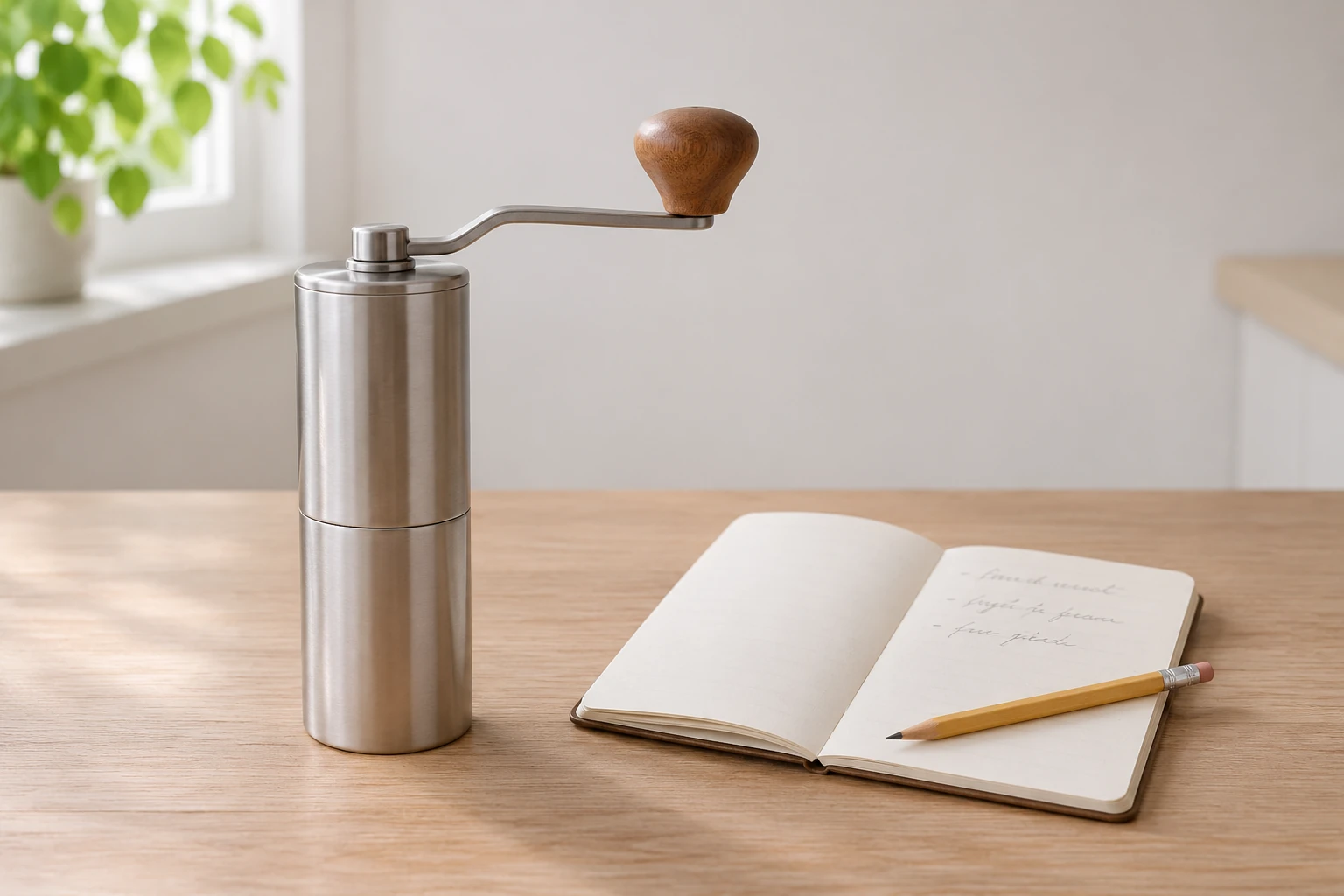
Manual coffee grinder handle trouble deserves a precise description before a repair attempt. Begin with the part you mean and the movement you observed. Did the wooden knob feel fixed in your palm, did the crank stop moving around the body, or did the whole grinder turn in your other hand? Keep those observations separate. This guide helps you prepare a useful account and ask for an applicable next step while the grinder rests on the table.
You can make that account without naming a broken internal component. Leave an uncertain detail open. A clear grinder symptom report records what happened, what you had already changed and which question still needs an answer. The worked example below is invented. It demonstrates how to describe a problem and makes no claim that a particular grinder was tested or repaired.
Identify the part you are calling the handle
Start with a stationary view of your own grinder. In your notes, distinguish the knob you hold, the arm extending across the top, the point where that arm meets the grinder and the body you support. Use the names in your actual instructions when they are available. If a name is missing, describe the location plainly. A photograph can accompany the words without supplying an explanation of the fault.
A sentence about the knob should say what the knob did. A sentence about the crank should describe its movement around the grinder. For example, “the knob remained in the same position in my fingers while the arm moved” describes something different from “the arm stopped partway around.” Neither sentence establishes the cause. Keep the distinction visible when asking which part needs attention.
Include what you were holding at the time. If the body slipped in your hand, say so. If you cannot remember whether the knob or arm stopped first, write that uncertainty down. You do not need to repeat the event to improve the wording. Retain the first account and add a clarification if you later remember a detail.
Choose a consistent viewing direction for the photograph and the note. You could describe the grinder standing upright, with its top assembly visible, then identify a detail by its position in that view. If you add a second photograph, say which view the sentence refers to. This is a way to make your wording easier to follow. It gives no permission to remove a part for a better angle. A visible exterior detail and a plain description are enough to begin a question about the place you mean.
Keep the model and its information together
The i Cafilas GM2213 offer identifies a Silver manual grinder and says its package includes one grinder. Its gallery shows a top crank, separate lower cup and bottom adjustment control. The native account names a 420 stainless steel core, while one graphic calls the pictured core black ceramic. That material discrepancy remains unresolved here.
The AKIRAKOKI A-15B offer presents a wooden cylindrical mill with a top crank. Its description places adjustment beneath the base, while its gallery illustrates a star-shaped adjuster beneath the crank at the top. Keep that conflict with your enquiry. This guide supplies no settled adjustment procedure for that offer.
For a grinder already at home, collect the identity printed on its label, packaging or supplied paperwork. Preserve the order reference separately. An online title can help locate an offer, while the item in front of you may require further identification. Ask whether the proposed model-specific instructions cover that exact item and the control shown in your photograph.
If you have two documents, keep both names and editions in the record. Note which diagram resembles the visible arrangement and where the accounts disagree. Avoid filling a gap with instructions for a similar-looking grinder. An unresolved location or identity question belongs at the beginning of the support request, before any proposed adjustment.
Write down the event before changing the grinder
Give the event a short sequence. Describe what you were trying to do, what you moved and what you noticed next. Include an earlier adjustment, a recent cleaning session or a change of parts if it actually happened. Leave out a step you only considered. The record should let another person follow the order without having to reconstruct your afternoon from several messages.
Describe the state you remember at the beginning. Was the handle attached in the arrangement shown by the supplied instructions? Had you already put beans into the grinder? Had you removed the lower cup? These are questions for your recollection and paperwork. They are not a request to recreate a troublesome event or to run a new grinding trial.
Keep a suspected explanation in its own sentence. You might have thought the burr was jammed, but the observation could simply be that the crank stopped during one attempted turn. Mark the explanation as your suspicion. This leaves the person assessing the report room to ask about the actual movement before deciding which component or instruction applies.
Record the last change with enough detail to identify it later. “Adjusted it” leaves the reader guessing which control moved. “Turned the lower control before attaching the handle” gives a location and an order. If the amount or direction is unknown, say so. An honest blank can become a specific follow-up question.
Build a short report from an invented example
Imagine Leena writes, “The handle is broken and the grinder needs a new burr.” This fictional first message combines an observation she has not described with two conclusions. She decides to leave the grinder at rest and rewrite the account from what she remembers. She has no confirmed diagnosis and does not claim that a replacement part will solve the problem.
Her revised note says, “Yesterday the arm stopped during my first attempted turn after I changed a control under the grinder. I do not know how far I moved that control. I held the wooden knob and supported the body with my other hand. I have left the grinder as it was afterward. The attached photograph shows the top assembly and the control I changed.”
Leena then adds the exact identity she can find and asks which instructions apply to that arrangement. She asks how the named control should be identified before attempting another action. Her question gives support a defined place to begin. The example ends with a request for guidance, without inventing a reply, an approved procedure or a successful repair.
Your own note may need fewer details. Keep only the facts relevant to the reported event and label anything uncertain. Read the account once while looking at your photograph. Check that “top,” “bottom,” “knob” and “arm” refer to the same places in both. You can revise the wording while preserving the earlier version in your records.
Ask for one applicable next step
Washington State's Attorney General advises consumers to have the item identity and relevant purchase records available, give a brief account of the problem, describe earlier efforts and explain the resolution they want. Its complaint guidance also says to send copies of related documents and keep originals. Those general reporting points help organize an enquiry. They do not establish a mechanical remedy or promise a particular outcome.
Keep your immediate request narrow. You might ask the seller to identify the photographed control, confirm the correct document or explain whether the reported condition needs service assessment. A request for the next applicable step can remain separate from a later question about replacement or return terms. Retain the reply with the question that produced it.
Check that any reply addresses your actual uncertainty. A general video may show a different control position, handle arrangement or model name. Ask about that difference before treating the demonstration as applicable. If the reply requests information you have not recorded, add it truthfully. A requested detail can remain unknown when you cannot establish it without an unsupported action.
The Capresso and Ode grinder cleaning guide concerns model-bound component care and cleaning permissions. Keep that subject separate from an unexplained handle symptom. Its procedures belong to the equipment it discusses and supply no cleaning, removal or repair sequence for the two manual offers considered here.
Keep a replacement decision separate from the symptom
The whole-bean input and grinder budget guide asks whether a coffee-input change creates a need for another purchase. That decision can wait beside the support record. A proposed replacement does not explain the event you observed, and this guide makes no comparison of grinding performance or repair cost.
If you decide to order a grinder or a confirmed replacement item using cryptocurrency such as USDT when offered, finish the product question before authorizing payment. At republeq.com, read the current checkout for the exact order and establish which payment options it actually offers. Keep the selected product identity, confirmed contents and applicable instructions beside that checkout. An unresolved handle question should remain in your notes even if you decide to buy something else. Check the merchant's current terms for your order, including delivery information and any exchange or refund conditions that matter to your decision. Do not treat a previous order's wording as the current agreement. If the checkout offers a cryptocurrency transfer, take the asset, network, destination and amount from that exact checkout and compare them with the transaction your wallet proposes. Leave a mismatch unresolved until the merchant's published support channel provides a clear answer. A familiar token name in a wallet does not establish the network the order requires. Retain the order reference and the transaction reference as separate records after an authorized transfer. Keep any later shipping or delivery message with the order it identifies. When asking about a product problem, explain which stage you have reached and include only the references needed for that enquiry through the appropriate private support channel. Payment records, product identification and the symptom account each answer a different question. Keep the original problem note alongside the new order details so the reason for the purchase stays clear. Before using anything delivered, compare its actual identity and supplied documentation with the item you intended to obtain. Ask about a discrepancy while preserving the order and the earlier support exchange.
Leave a record that can support the next conversation
Finish with the part, the observed movement, the preceding change and the question that remains. Keep the grinder's identity with the photographs and preserve earlier messages. When support supplies a documented next step, retain the version you received and the item it covers. You can then decide what information or authorized action is needed without losing the starting account.
Manual coffee grinder handle checks can begin with a careful description while the grinder rests. Name the knob, crank and body distinctly, retain the actual model information and preserve gaps in your recollection. A concise grinder symptom report gives you a specific question to resolve through model-specific instructions or support. The next decision can follow that answer.