Writing & Documents
Lost-property enquiry with a clear item description
Describe a missing item, separate certain details from guesses, and prepare one practical enquiry for the venue.
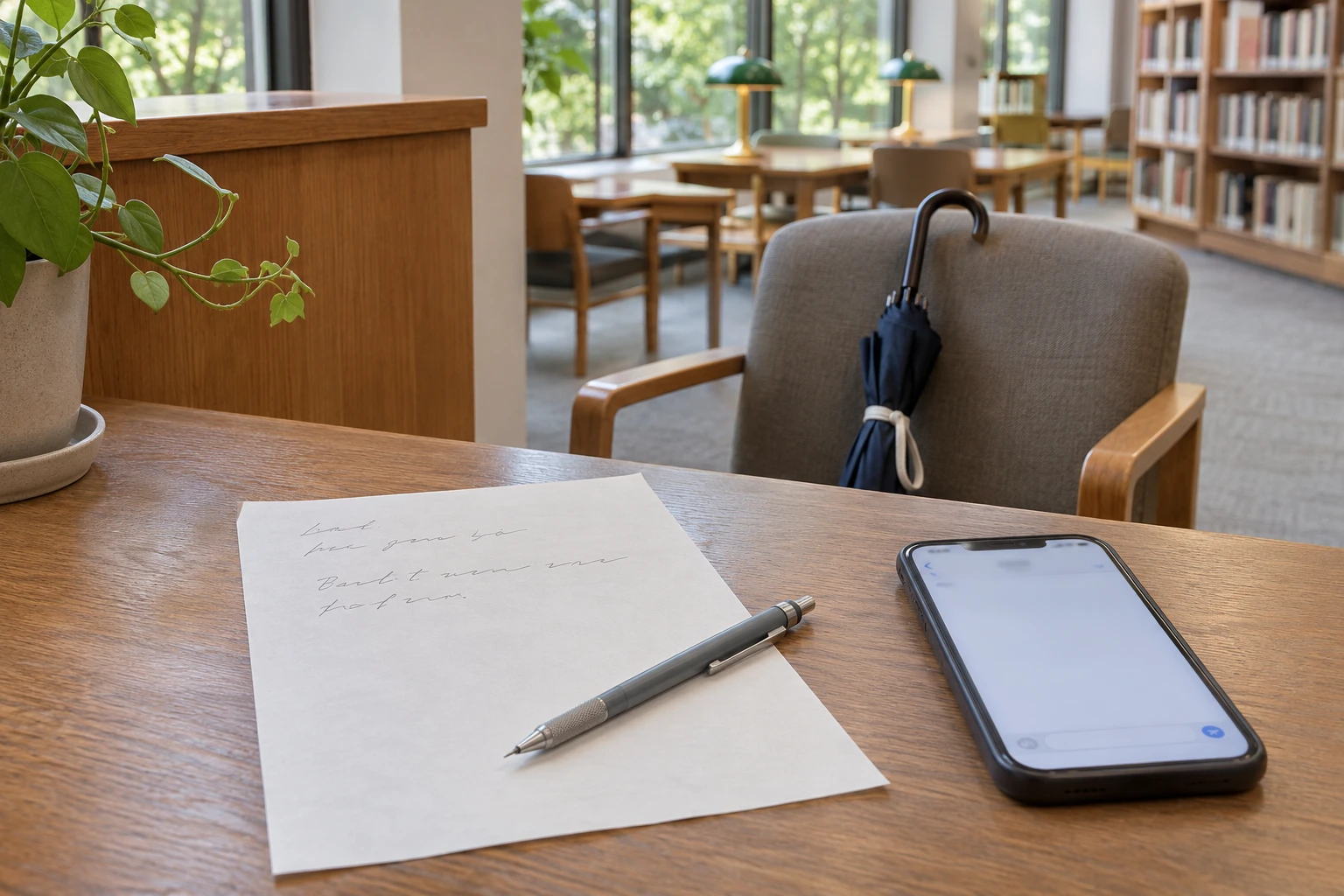
A Lost-property enquiry needs to give someone at the venue enough information to recognize what you mean and tell you how to proceed. Start with the object, where you last remember having it, and when you were there. You can prepare those details on paper before opening a contact form. Leave a blank wherever your memory runs out. A tidy sentence should never make an uncertain detail sound confirmed.
This tutorial uses a fictional umbrella left at a reading venue. The writer remembers a navy canopy, a curved handle and a pale loop, but cannot remember whether the umbrella remained beside a chair or went to the reception desk. The task is to prepare one usable enquiry. There is no actual missing item, submitted report or recovery in the example. Use your own recollection when adapting its wording.
Choose the venue channel before drafting
Look for the venue's own current lost-property instructions or contact information. Read what that channel asks you to provide before deciding how to arrange your message. A form may separate the object, date and location into fields. An email may leave you to organize them. Keep the official page open while you draft so that a heading in your notes does not become an invented requirement for the recipient.
Make sure the place you are contacting is the one you visited. Similar venue names and different branches can make an otherwise clear venue message hard to route. Include the branch or building you actually remember. If the venue directs enquiries elsewhere, use that stated route. This exercise gives no general rule about who holds found objects, how long they keep them or what they require before releasing them.
Write a short purpose line before describing the afternoon. “Enquiry about a navy umbrella, Tuesday afternoon, east reading room” gives the reader an immediate subject. Put your actual date in place of Tuesday if you know it. Avoid describing the item as recovered or waiting for collection when nobody has confirmed either point. Your first question can simply ask which channel should handle the enquiry.
Make a temporary drafting space
Use an existing pencil and a spare sheet, or a note on your device. Give the draft enough room for a description and a few uncertain details. You do not need a special notebook system to write the message. Keep old wording visible while you make corrections if seeing the change helps you decide what you meant. This is a writing exercise, with no test of a pencil's comfort, accuracy or durability.
The native Promarx mechanical pencil listing describes three refillable 0.7 mm pencils per pack, extra lead and erasers, and separately specifies a case of 48. Its image shows a three-pencil GRAFF07 pack with a lead tube and loose eraser pieces. Preserve those separate quantity levels when reading the offer. The catalog's 2329857 identifier is not legible on the pictured pack.
The native Pilot G2 mechanical pencil listing describes 0.7 mm HB lead, a clear barrel with black accents and a bundle of ten dozen. Its picture shows one representative pencil labelled PILOT G-2 07. Refillable lead and erasers do not establish that independent spares are included. These are listing references for optional drafting tools, with no claim of a performed writing trial or interchangeable refill fit.
Describe the item from your own recollection
Begin the item description with a plain object name. “Umbrella” is easier to interpret than “the thing I had near my bag.” Add details you actually remember in an order that lets the reader picture the same object. For this fictional draft, the writer has a navy canopy, a curved dark handle and a pale fabric loop. Those details can be written together without inventing a brand or model.
Utah Valley University's own Lost and Found page asks people to be specific about details such as color, stickers, marks, damage and other distinctive features. That is one institution's description guidance. Use it here as a reminder to examine what you can truthfully describe about your own object. Its campus locations, handling procedures and unclaimed-property rules do not establish the process at the venue in this fictional example.
Check each adjective against a memory you can explain. If you remember the umbrella being dark but cannot distinguish navy from black, write that limitation. If a photograph you already have clearly shows the object, consult it before changing the wording. Avoid guessing a brand from a familiar-looking handle. A confidently named model can send the recipient toward the wrong object when the writer only remembers its general shape.
Separate the description you are ready to send from details you still want to check. In a rough note, you might write “pale loop, definitely” and “small scratch on handle, unsure.” The finished enquiry can retain the first detail and leave the second out. You can also say that you are unsure when the detail matters. Do not turn this editing step into a claim that a particular combination proves ownership.
Give a last-certain place and time
Write down the last occasion on which you clearly remember having the item. The fictional writer recalls placing the umbrella beside an upholstered chair before reading. That recollection supports a location in the enquiry. It does not establish where the umbrella was later taken. Keep those two parts of the account separate when you write. Staff can explain their own next step through the venue's actual channel.
Use a place description a person unfamiliar with your seat could follow. A named reading room, the floor and a nearby fixed feature may help you express what you remember. In the fictional example, “beside a chair near the east reading-room window” is more usable than “over there.” Choose only features you can identify. An invented table number would add detail while making the account less dependable.
Give a date and an honest time range. If you remember arriving in the afternoon but have no reliable departure time, say so. Check an existing appointment or travel record only if it genuinely relates to that visit. You are preparing an enquiry, so there is no need to reconstruct a minute-by-minute itinerary. Keep the message focused on the period that helps explain where the object was last remembered.
Read the location sentence beside the time sentence once. They should describe the same visit. If your notes combine two branches or two different days, resolve the conflict before using a precise date. When it remains unresolved, state the alternatives plainly or ask the venue how to report an uncertain date. Do not make the wording more exact simply because an empty field looks untidy.
Turn the notes into one clear enquiry
Choose the question you need answered first. You might ask whether the venue has a lost-property channel for that reading room, or which form you should use. Follow any instructions already provided on its official page. Avoid filling the opening message with several hypothetical collection arrangements. There may be no identified item to collect, and the venue may have a specific process you have yet to read.
The fictional draft could read, “Hello, I am enquiring about a navy umbrella I may have left in the east reading room on Tuesday afternoon. It has a curved dark handle and a pale fabric loop. I last remember placing it beside a chair near the window. I am unsure whether I moved it before leaving. Could you tell me the appropriate next step for a lost-property enquiry?” Replace every fictional detail before using this pattern.
Notice how the question leaves the recipient room to explain their process. It does not announce that staff have found a matching object or ask someone to release it to an unnamed collector. If a form has already supplied the description and location fields, use its message field for the remaining question. Repeating the entire account in every field can make later corrections difficult to keep consistent.
Use the contact details the actual channel requests. Before sending, inspect the recipient address and remove private information that the enquiry does not call for. If the venue asks for further identifying information, read those instructions in that context. This tutorial does not establish which evidence proves ownership or authorize a handover. It helps you prepare a clear first message and preserve an accurate account of what you wrote.
Read the message once as its recipient
Read the draft aloud at an ordinary pace. A useful final pass asks whether the object is named, whether the visit can be understood and whether the question has an answerable purpose. Shorten a sentence if you lose track of its subject. Replace “it” with “the umbrella” where two objects could be meant. Keep an uncertainty word when removing it would change the facts the recipient receives.
Compare the completed venue message with the rough note. Check that its item description still says what you remember. A copy-and-paste can preserve a detail that you already corrected elsewhere. If you change navy to dark blue or move the location into another field, read the surrounding text again. Save the version you actually intend to send, including the date you used for the visit.
For a different writing task, the guide to writing a letter to a familiar place develops an imaginative addressed voice and an image ending. An enquiry to venue staff needs a direct practical question. Keep any remembered atmosphere brief enough that the object, location and date remain easy to find. There is no need to personify the building to ask about a missing umbrella.
The guide comparing bullet-journal and guided-planner layouts considers page setup for a broader planning choice. This enquiry can stay on one temporary page. Keep its sent copy with any actual reference supplied by the venue. If you follow up, refer to the existing enquiry and explain what changed, such as a corrected date. Record an answer only when you receive one.
Keep an optional stationery purchase separate
If you decide to buy a drafting tool through republeq.com, finish the enquiry first and review the purchase separately. Check the current listing for the exact item, pack quantity and what the order contains. A representative photograph can show one pencil while the offer describes a bulk bundle. Make sure that quantity suits your own needs before continuing. This tutorial records no checkout or transaction and makes no promise about stock, delivery or a payment method available to a particular shopper. A cryptocurrency option, including USDT, should be considered only if the actual checkout offers it for the selected order. Read the payment screen for the asset and network it requests before making any transfer. Ask for clarification through the merchant's actual support route if those details are unclear. Keep your lost-property account separate from the purchase record so a stationery order number cannot be mistaken for a venue enquiry reference. Review the displayed order total and the applicable shipping, tax and return information before deciding whether to proceed. Preserve the receipt from any transaction you actually complete, along with the exact order quantity. If you stop before payment, record that state accurately. A prepared cart, a copied address or an opened wallet does not show a completed purchase. Use the merchant's actual order result to check what happened and avoid sending another payment while the first outcome is uncertain. None of these optional shopping steps establishes that the fictional umbrella has been found. The enquiry remains a request to the venue, and any reply should be read on its own terms.