Cleaning & Vacuums
Laundry detergent cost per load: read sheet and powder counts carefully
Use the package counts as starting points, then estimate actual household loads and current outlay before comparing detergent sheets with powder.
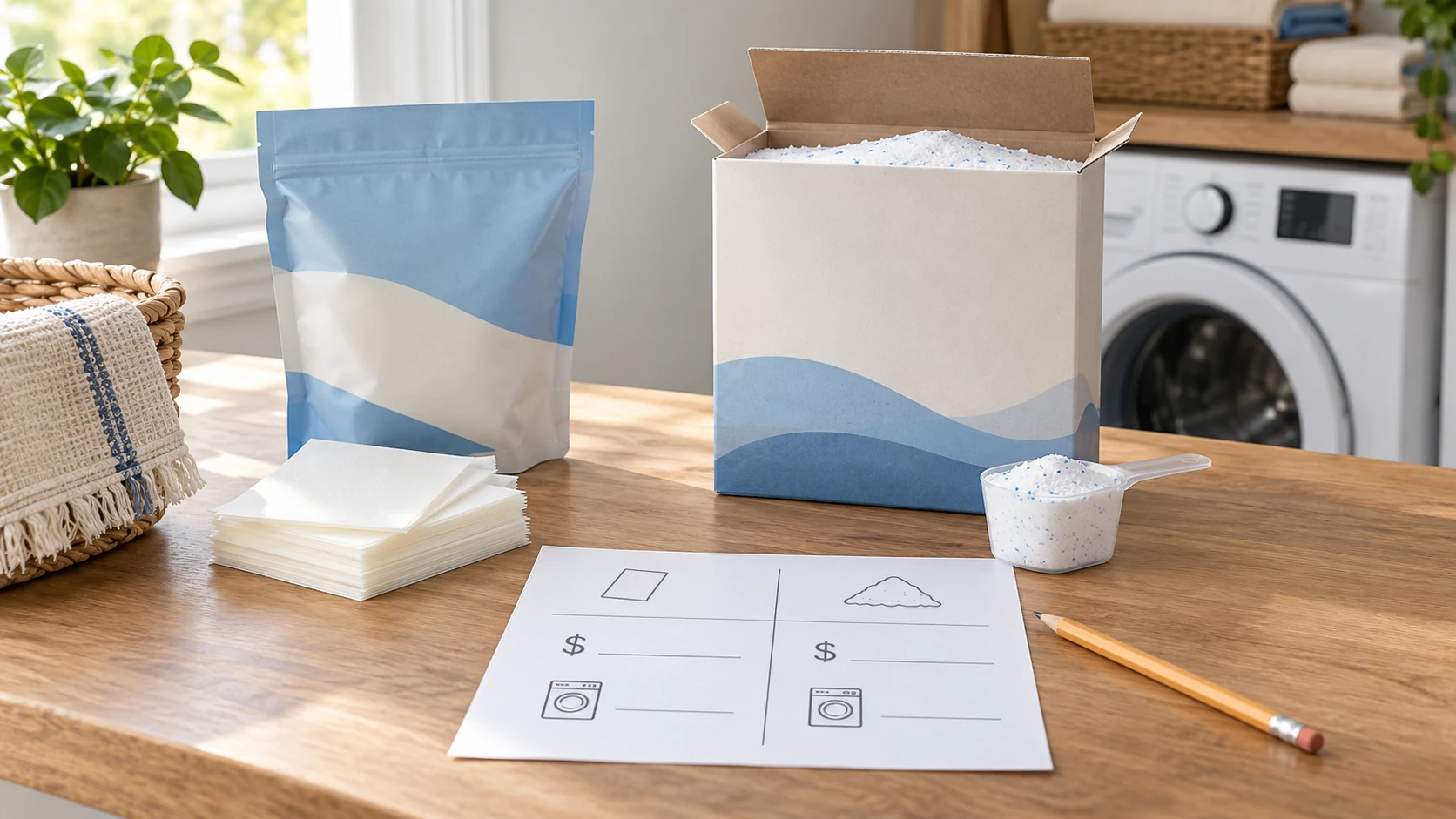
Laundry detergent cost per load depends on what you pay and how many washes a package covers in your routine. The 64-strip sheet pack says “up to 128 loads,” with a small-load qualification on the package image and a one-strip-per-load description. The Persil powder carton is labeled 100 loads. These labels do not settle either actual yield. Record the checkout amount and your comparable actual-load count for each package. Without those inputs, neither label establishes a cheaper choice.
This worksheet calculates cost. The captured product pages identify a sheet pack and a powder carton; they give no current checkout price here or evidence that either cleans better. Household load size, the selected instructions, and actual dosing can change the count. If those inputs are unknown, leave the result open rather than choosing the more impressive number printed on a title.
Start with what the two listings actually say
The sheet listing gives three statements that must be kept separate. The title identifies a 64-count pack and says “up to 128 loads.” The front package image qualifies the upper number as “up to 128 small loads.” The page description says “1 strip equals 1 load.” Those statements do not support an unqualified claim that this pack will wash 128 of your normal loads. Nor does their difference establish a safe half-strip instruction for your machine, laundry size, or chosen wash. A buyer should use the current directions for the selected pack, then record what happens in actual use.
The powder listing names Persil Professional Universal laundry powder detergent and calls it a 100-load carton. The captured page description repeats the 100-load label but gives little detail about your household's selected dose. A label count is useful for identifying the carton and for an initial estimate. It does not tell you how much powder you will use in every cycle. Read the current container directions before dosing, especially if you change load size or wash conditions. We are comparing a complete sheet package with a complete powder package, not detergent ingredients, machine suitability, skin effects, or measured cleaning results.
For a quick first pass, write “64 strips; up to 128 small loads; page description says one strip per load” on one line. On the next line write “powder carton labeled 100 loads.” The first line deliberately retains the internal difference. The second line is a label count, not a promise about your own yield. Keeping those qualifications visible prevents a tidy spreadsheet from laundering uncertainty into a false fact.
Use actual loads as the denominator
Cost per actual load is package outlay divided by actual loads obtained from that package. The numerator is the price you would pay for the exact pack, including any relevant checkout charge you choose to count. The denominator is the number of your laundry loads that pack supplies when used according to its current directions. Both inputs belong to the buyer and the selected transaction. This page does not quote a price, discount, shipping charge, or tax, and it does not predict a household's final load count.
A simple worksheet has four columns: exact pack, current selected outlay, observed or responsibly estimated actual loads, and outlay divided by actual loads. Use the same cost boundary for both products. If you include delivery or tax for one, include the corresponding cost for the other when it applies. If one package is part of a promotion or bulk order, note that condition beside the figure. Otherwise the resulting cents-per-load comparison can reflect two different shopping situations rather than the detergent choice.
For the sheet pack, do not automatically enter 128 in the actual-load column. That is an “up to” count qualified as small loads by the package image. Do not automatically enter 64 either if your real use and current directions suggest a different count. The one-strip-per-load statement is a useful visible starting point, but the conflicting presentation means a buyer should verify the selected package's instructions and track the number of washes it actually covers. A blank or range is more honest than an invented exact count.
For the powder carton, 100 is the stated load count on the listing, not a measured result from your laundry room. A powder dose is something you measure; a household that uses a different permitted amount per wash will get a different yield. Use the current label's dosing directions and, if available, a record of how many loads the carton has supplied in your setting. Do not assume a larger scoop is better or that a smaller scoop delivers equivalent cleaning. This worksheet handles cost arithmetic only.
How to compare without inventing a price
Suppose the sheet pack's current checkout price is S and the powder carton's current checkout price is P. Let Ls be the number of actual loads the sheets cover under your use, and Lp the number the powder covers. The conditional costs are S ÷ Ls and P ÷ Lp. The less costly option on this measure is whichever quotient is lower, provided the inputs describe comparable loads and the products are suitable for the wash you intend. No winner follows from the letters alone.
You can also calculate a break-even count without publishing a guessed price. If the sheet price and powder cost per actual load are known, divide the sheet price by that powder cost. That result is the number of sheet-served loads needed for the sheet pack to match the powder's unit cost. If the required count is beyond what your actual sheet use can provide, the sheet pack cannot match on this one measure at those prices. Reverse the calculation for powder. A changed sale price or dose changes the answer.
For an initial range, take care with the sheet listing. Its “up to 128 small loads” statement can be kept as a labeled upper claim for small loads, while the description's one-strip-per-load statement remains visible beside 64 strips. Those are not two verified outcomes that can simply be averaged. If you have not observed the pack's yield or confirmed instructions for the loads you wash, show both source statements and say the denominator is unresolved. A range should be based on actual feasible use, not on a guessed fractional-strip practice.
A recurring household purchase makes small arithmetic differences matter over time, but frequency alone does not prove savings. If you estimate a month's total, multiply a supported cost per actual load by the number of comparable loads you expect to wash. Keep that expected load count separate from the package's label count. If the household's wash volume changes, recalculate. Avoid converting an uncertain pack yield into a confident annual savings claim.
What to check at the store or on the current product page
First, confirm that you are looking at the same sheet pack and the same powder carton named here. Size and variant changes alter the count. The sheet source is a 64-strip pack, and the powder source is a Persil Professional Universal product listed as 100 loads. A similarly named fragrance, concentration, or pack size may be a different offer. Use the current product title and package image together rather than carrying an old title's count over to a new cart.
Second, record the selected price at the point where you will buy. The visible product evidence used for this guide does not establish a durable price, so any example amount would age quickly and could mislead. If the store offers a bundle, coupon, subscription, or delivery threshold, write down the actual terms and the total that applies to the exact quantity. Comparing one temporary promotion with another product's regular price answers a narrower question than the general one.
Third, read the current usage directions on the physical pack or the seller's complete image set. Note which load sizes any stated counts cover. For the sheets, the small-load qualifier is material. For the powder, check the amount indicated for the wash you intend. If you cannot confirm an instruction, do not substitute an assumed fraction of a strip or scoop merely to make the two advertised load counts line up.
Fourth, keep a short record during use. Write the date the pack was opened, how many washes it served, and whether any wash used a different permitted dose. A tally is more useful than a vague memory of how long a package lasted. When it is empty, divide the actual outlay by the tally. If one pack spans an unusual season of larger or smaller loads, note that before applying its result to a future purchase.
Finally, keep the cost decision within its limits. The arithmetic cannot establish cleaning performance, fabric care, washer compatibility, residue, skin response, or environmental impact. Those questions need their own relevant evidence and instructions. If one product is unsuitable for your use, a lower calculated cost per load would not make it the right purchase.
A worksheet you can copy
Make one row for the 64-strip sheet pack and one row for the 100-load powder carton. Put the exact package link or a photo of the label beside each row so you do not later confuse variants. In a “source statement” cell, copy the sheet listing's three statements separately. In the powder row, write “100 loads stated on title/carton.” In a different “my actual load count” cell, leave a blank until you can support a number with current directions and your own usage. The source-statement and actual-use columns should never be silently merged.
Next enter the selected checkout outlay for each pack. If your goal is a product-only comparison, use product prices for both. If your goal is what leaves your account, include applicable charges for both and make the treatment explicit. Divide each amount by its actual-load entry only after the entry is supported. If either denominator is still blank, mark the comparison pending. A blank result tells you which fact to check next.
If you have a supported low and high actual-load estimate from your own prior packs, calculate cost per load at both ends. Because the package outlay is fixed for that purchase, fewer actual loads means a higher cost per load; more loads means a lower cost per load. State the assumptions that generated the range. For a new pack with no observed history, an advertised “up to” figure is a claim about a limited condition, not a guaranteed high endpoint for your ordinary loads.
When comparing the two rows, ask whether both represent the same type of laundry load. A small-load count for sheets and a different assumed powder load size are not directly interchangeable. You can compare them only after defining a common household load standard or using actual records for the loads you wash. If the wash mix varies substantially, divide it into comparable groups or keep the result descriptive. Do not force unlike washes into a single precise figure.
Common mistakes that change the answer
The most tempting shortcut is to divide the sheet price by 128 and the powder price by 100. That treats the sheet's upper small-load phrase as if it were a guarantee for every wash and treats the powder's stated count as your observed yield. It also hides the sheet page's one-strip-per-load wording. Those assumptions can swing the result before any price is considered. Write the source qualifications beside the numbers instead.
Another mistake is to infer that 64 strips must be split to reach 128 loads. The visible statements do not establish a universal half-strip dosing instruction. The pack's actual directions, selected load, and user's practice control whether any fraction is appropriate. If you cannot verify that, leave the fraction out of the calculation. The arithmetic alone gives no dosing instruction.
A third mistake is to compare one pack's sale price with another pack's full price without saying so. That may be the right decision for a purchase today, but it is not a stable claim that one format always costs less. Record the date and offer. Recalculate when the promotion changes, the package size changes, or the usual dose changes.
A fourth mistake is to treat a unit-cost figure as a product recommendation by itself. A detergent must fit the current label directions and the wash. This guide does not test either product. The calculation answers what each actual wash would cost under the recorded conditions. Cleaning and suitability need separate evidence.
Keep this decision separate from other laundry costs
If your problem is where to store and share detergent in a laundry room, the shared detergent station guide addresses package access and handling. That is a different decision from dividing a detergent purchase by actual washes. Likewise, the hamper cost per collection spot guide treats a durable laundry item and the collection places it serves. A hamper's useful spots are not a detergent pack's load count. Keep those denominators apart even if all three purchases appear on the same household budget.
Before the next purchase, check which numbers you can actually support. Confirm the exact sheet and powder packages, record current prices, follow current directions, and use actual comparable loads for the denominator. The sheet source's 64 strips, “up to 128 small loads,” and one-strip-per-load language should remain visible until you can resolve what applies to your use. The powder's 100-load label should remain a label until your dose and yield are known. Then the arithmetic is straightforward, and the conclusion is limited to the conditions you actually measured.