Skills & Planning
Before laminating original documents, identify what must stay uncoated
Decide whether a finishing task should proceed at all before applying adhesive film to an important original paper or book.
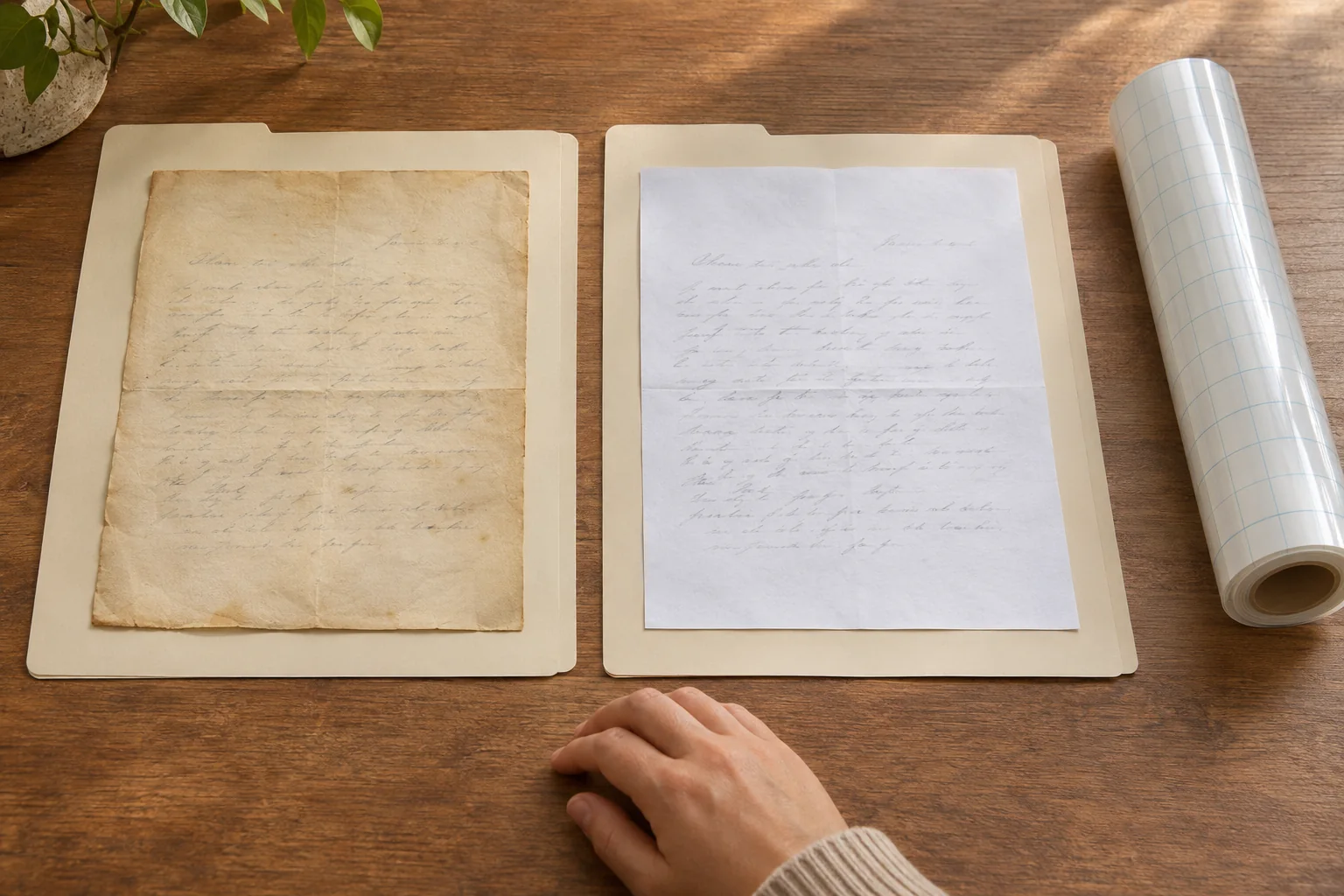
Before laminating original documents, decide whether the paper itself needs to remain unchanged. The University of Illinois Library's Preservation FAQs does not consider lamination a safe conservation technique. Its explanation includes possible damage during processing, the stability of the materials added and whether treatment changes an item irreversibly. A clear covering can therefore answer a finishing question while leaving the preservation question unresolved. Start with the original and its purpose before selecting a film.
Identify the original before choosing a finish
Imagine two envelopes on a table. One contains the only handwritten letter from a relative; the other contains a recent printout of its text for a family gathering. Both can be read, but the intended jobs differ. You may want people to handle the printout freely while keeping the letter available for careful viewing. Write those jobs separately. A wish for a convenient display copy does not require the original to receive the same finish.
For this hypothetical project, give each item a short description on a separate planning note: what it is, who owns it, why it matters and what you want to do with it. Record uncertainty plainly. “Possibly the original letter” should remain a question until someone can establish more. Do not write a new label onto the paper merely to resolve your planning problem. The note should help another person understand the decision without changing the object under discussion.
The Library of Congress Books FAQ places preventive storage and handling ahead of treatment. It says a collector's book that is infrequently used may be left as it is, boxed and kept under better storage conditions. Its discussion of personally meaningful books also warns against self-stick tape, including products described as archival. These are conservation boundaries for the items discussed there, rather than approval of a retail coating for another object. An important paper or book deserves an appropriate preservation assessment before adhesive is added.
Define what the working copy must do
A useful project brief can be as ordinary as “a copy for the reunion table” or “a reference sheet that can be replaced when its content changes.” Keep the original's location in that brief. If the copy becomes smudged or the layout proves awkward, the next decision concerns another copy. The exercise should never depend on discovering that the item on the table was the only surviving original after it has been altered.
Ask everyone involved to agree which sheet is available for an experiment and which must stay untouched. A folder marked in your separate notes can make that distinction clear during planning. This is a proposed household arrangement, not a conservation enclosure specification. If another person owns the item, leave the finishing decision with them. A request to make the information easier to share does not, by itself, tell you that they want the physical original coated.
Keep two unresolved questions on the note if necessary: whether a working copy would meet the immediate purpose, and what protection the original actually needs. They can have different answers. You might settle the first question today while awaiting qualified advice about the second. There is no need to convert that wait into a shopping deadline or to choose a coating simply because other project supplies have already arrived.
Read adhesive film labels within their limits
The BAZIC clear self-adhesive book-cover roll listing describes film for books, papers, posters and documents, with an easy-peel liner and measuring guidelines. Its native account makes protective and installation claims. The whole original gallery shows BAZIC packaging, a multiroll display and an unrolled example. Those observations identify the kind of retail material being discussed. They do not authenticate a delivered pack count, its chemistry or its suitability for preserving the letter in the hypothetical example.
The Scotch Self-Seal single-sided laminating roll listing describes clear film, patterned backing and no machine requirement. Its sole original gallery shows one rolled product with Scotch and Self-Seal branding. The account's pack quantity is not independently counted from that image. Photo-safe wording in the description is also a product claim, not a conservation assessment of a particular original. Neither listing establishes that an applied covering can later be removed without damage.
In your project note, separate the description of the supply from the question about the item. “Self-adhesive film roll” identifies the supply you are considering. “Appropriate for this original” is a further conclusion that these short accounts do not establish. If you cannot answer the latter question, leave it open. Changing from a machine process to a hand-applied product does not supply the missing assessment.
The Illinois FAQ discusses chemically stable materials and reversibility as well as the heat and pressure that may be involved in lamination. Its reasoning cannot be reduced to “avoid heat and every other method is safe.” For adhesive lamination, the added material and the consequence of attaching it still need consideration. The FAQ also distinguishes appropriate plastic enclosures from unsuitable plastics. A retail film description alone does not establish that it is the enclosure described by that preservation guidance.
Keep an enclosure question separate from an adhesive question
The National Archives' Paper-Based Records guidance describes polyester L-sleeves for certain fragile records needing support, with important limitations. It warns against plastic sleeves for loosely adhered, flaking, waxy or oily media because the media can be displaced or transferred. Even a separate enclosure therefore needs to suit the actual item. This institutional guidance does not certify either retail adhesive roll as a polyester sleeve. Do not treat the common word “clear” as evidence that two materials perform the same preservation job.
Suppose the owner wants to view both sides of the hypothetical letter. Add that requirement to the enquiry rather than improvising a construction around it. Explain whether the writing is on both sides and whether the paper appears fragile. You can describe what you observe without naming an adhesive or identifying an ink from appearance. A photograph may help explain the question, but it does not turn your description into a professional condition assessment.
Florida's Division of Library and Information Services warns that adhesives and fasteners can damage paper, books and photographs. It also notes that even sticky notes can leave residue that attracts dirt. That page contains a conditional mending-tape suggestion, while the Library of Congress gives a stricter warning for the books it discusses. This article adopts no tape repair procedure from either account. For original document protection, ask about the actual object and proposed materials instead of borrowing one isolated instruction from a different preservation context.
Decide when the question needs conservation advice
The Library of Congress Repairing Your Books guide says trained professionals should perform conservation treatment. It suggests consulting a conservator for an item of particular value, worsening damage, frequent handling or a complicated condition. The guide also states that the Library does not provide conservation services to the public. Use the appropriate professional enquiry for your item rather than assuming that reading an institutional guide means the institution has accepted it for treatment.
Prepare that enquiry with the same distinction you made at the beginning: the original, its owner and the immediate purpose. You might explain that you want a readable copy for a gathering and ask what handling or housing would be appropriate for the original. State what has already been attached, if anything, and which details you do not know. Do not try a treatment to make the question easier to describe.
The National Archives warns that pressure-sensitive tape can stain and embrittle records, and that removing it can be difficult or impossible even for conservators. Its instructions say not to attempt removal of existing tape. That is a reason to keep an adhesive decision unresolved before application. If an original already has an attached layer, this article supplies no peeling, solvent, heating or separation method. Seek advice about the existing condition instead of turning a preventive planning discussion into a removal experiment.
Use related guides for their own decisions
The published laminator width and pouch thickness guide explains equipment specifications and keeps document suitability as a separate question. Its discussion of width, thickness, speed and readiness does not approve a valued original for finishing. Resolve the original's preservation needs before using equipment specifications to choose a process. A product that fits a page is still a product whose intended use needs confirmation.
The published photos stuck to album pages guide concerns contents already attached inside an album. It emphasizes protecting that existing object before attempted separation. The present decision comes earlier: whether adhesive covering should be applied to an original at all. A family project can involve both questions, but a plan for a new working copy gives no permission to detach old photographs or alter the album holding them.
Return to the two-envelope example before buying anything. If the gathering needs only the text, write that result into the brief and keep the original's preservation question separate. If people need to see the original itself, make that requirement clear when seeking advice. The decision should describe what you have agreed to protect and what you are still trying to learn. It should not imply that a product has been tested on the object.
Keep an optional purchase separate from the original
If you later consider buying a supply through republeq.com and prefer USDT, check whether that payment option is actually offered for the transaction you are reviewing. A preference for cryptocurrency does not establish acceptance for an order, identify a supported asset or network, or settle the purchase conditions. Read the options shown for that specific checkout before choosing how to pay. This article provides no wallet setup, address entry, transfer or network selection procedure. Keep the purchase optional while any question important to your intended project remains unresolved. You can ask for the missing information without completing an order first. If you decide to order, review the exact item identity, the stated package contents, delivery information and the terms actually presented. Do not infer a discount, faster dispatch, guaranteed arrival or a particular refund arrangement from the payment method. Keep a record of the offer and confirmation if a transaction occurs. Someone helping with the purchase should see the same item and terms you are considering rather than a photograph of a vaguely similar supply. An order confirmation would record a purchase; it would not certify the proposed use or establish that the project has succeeded. A payment preference can remain undecided while the practical decision stays open. If the displayed option or any transaction detail is unclear, stop before sending funds and seek clarification through the relevant checkout support route. There is no need to make a transfer to test whether an uncertain option works. Choose an offered payment method only after you understand the transaction you intend to complete.
Before laminating original documents, leave a clear planning result: which item must remain uncoated, what a replaceable working copy is meant to do and what still needs advice. In the hypothetical family project, the old letter remains separate from the copy and the unused film. That arrangement records a decision to wait for the missing answer. It makes no claim about successful preservation, a tested covering or a completed treatment.