Troubleshooting & Repairs
Photos stuck to album pages: preserve the album before removal
Use National Archives guidance for attached and loose photographs, fragile bindings and conservation decisions; keep new album offers separate from old-photo repair.
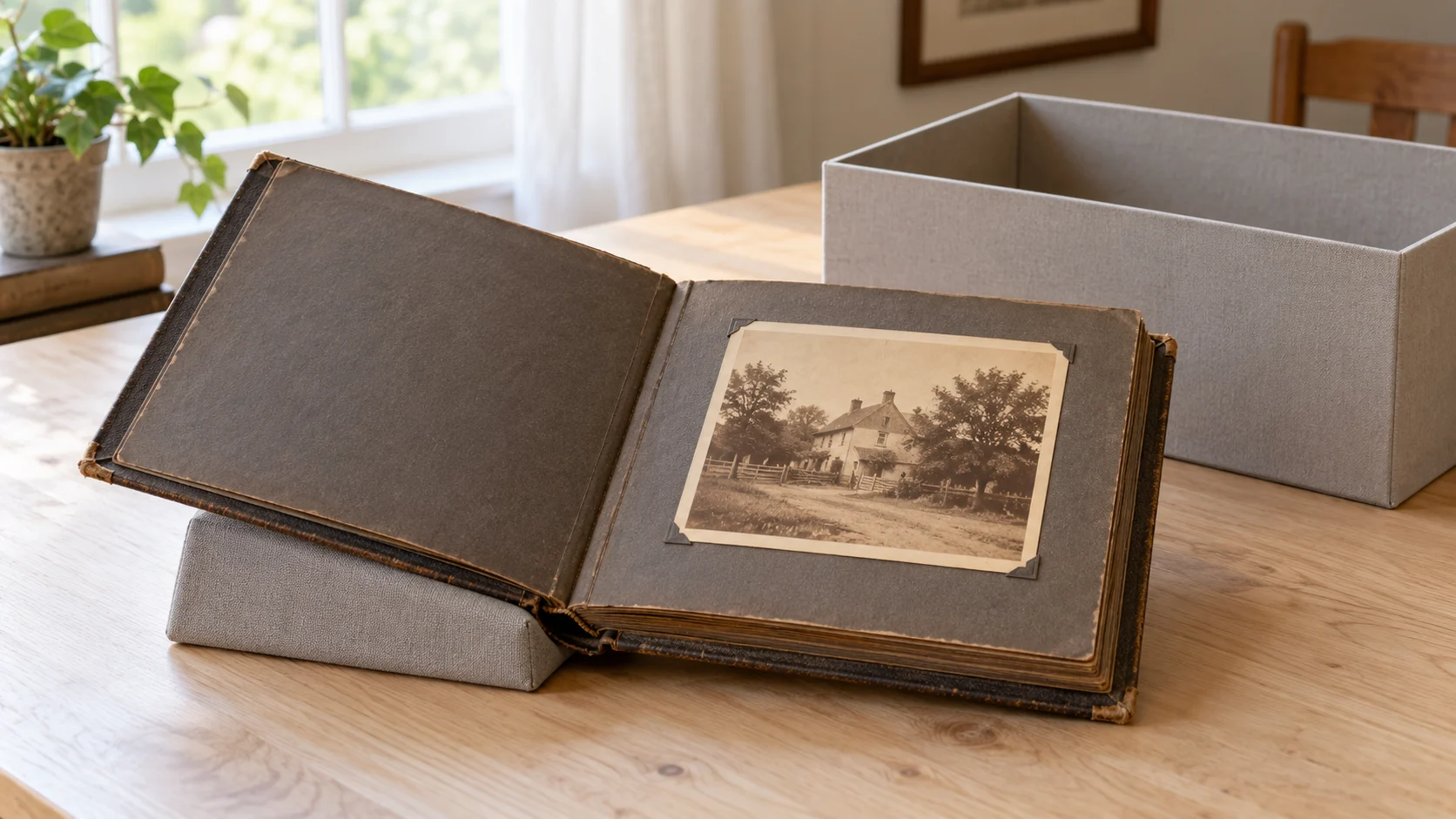
Finding photos stuck to album pages does not mean the next step is to pull harder. The National Archives advises leaving photographs and other records in place when removal risks tearing them or damaging their image layer. A replacement album cannot make that removal safe.
First consider how to protect the existing album, then whether a new album suits a different project. The preservation guidance below concerns the first. The two actual retail offers identify products you might investigate, without supplying a treatment for photographs already attached elsewhere.
Leave the stuck photograph in place
The National Archives' Bound Materials guidance has a specific section for scrapbooks and albums. It explains that removing their contents without damage can be difficult. If a conservator is unavailable to assist, its instruction is to leave the contents where they are and house the album flat in a box. That is a supported next action when the apparent repair would require separating an attached photograph.
The same account explains why an old album can become troublesome. Pages may be acidic and brittle. Tapes and other attachment methods can deteriorate, damage contents or fail. The tacky adhesive in self-stick pages, often called magnetic pages, can stain contents and hold them more permanently. These are problems described by the reference, not a diagnosis of the album in front of you.
A photograph that resists removal gives you a reason to stop that operation. It does not identify the adhesive or establish which photographic process produced the print. This article offers no solvent, heat, soaking, scraping or peeling method. Keep the actual object available for a qualified assessment instead of choosing a household treatment from its appearance alone.
Supporting a fragile photo album includes its binding
For supporting a fragile photo album, the National Archives calls for full support during handling and care when turning pages. The attachment between a page and the covers may be weak. Items can also be loose on the reverse of a page, where a person concentrating on the front may not notice them.
Its broader bound-volume advice says never to force a volume open beyond its natural flex. The weight of an opened cover and pages needs support, such as an appropriate cradle or foam wedge. The support protects the binding while you view the contents. It is no instruction to press an album flat so every photograph becomes visible at once.
Keep the support requirement in mind when showing someone a damaged page. An album can remain only partly open while you explain the problem. A request for a better view does not make it appropriate to force the spine or lift an attached photograph. If the object cannot be viewed without stressing it, tell the conservator about that limitation before attempting more handling.
Detached pages need care too. In its bound-volume account, the Archives advises gently aligning loose pages individually, rather than tapping or fanning a group to straighten it. Brittle edges and folded overhangs are vulnerable to that action. Keep the discussion attached to support and handling; it supplies no household rebinding or page-reattachment procedure.
Store the existing album flat with its contents protected
The scrapbook-and-album section recommends flat storage in boxes. It says an album may be too bulky to close tightly, while a custom box protects contents from dust and light and helps keep loose items from falling out. Flat storage remains its recommendation whether an album is boxed or not.
A box supplied with a new retail album answers a different question. Its presence does not establish that it is a suitable custom enclosure for an older, damaged album. The old object's size, condition and contents still matter. Ask about appropriate housing for that actual album rather than treating any gift box as a conservation product.
Likewise, do not force a bulky album closed to make it fit a convenient container. The Archives' support guidance and its description of bulky scrapbooks belong together. Keep the problem of housing the whole object open if the available box would require compressing it or leaving part unsupported. This guide gives no box-cutting, padding or binding-tie construction method.
If a cover or binding is already damaged, name that condition when seeking advice. The Archives recommends conservation treatment or custom housing for bound records that need it. Buying a pristine new cover or another complete album does not establish that the old contents can be removed or rebound without harm.
Keep loose photographs and original page order connected
For loose photographs and original page order, the Archives gives an explicit boundary: do not re-adhere loose items. Its album guidance rules out glue, glue sticks, pressure-sensitive tape, mounting corners and other adhesives or fasteners for that reattachment. A piece that has come free presents a preservation question, rather than permission to repair the layout with another adhesive.
The account conditionally allows detached items in polyester sleeves at their original location in a scrapbook or album, but only when the added sleeves will not stress or damage the binding. If they cannot be inserted safely, it describes appropriate enclosures kept with the associated contents, including in the same box, or a documented cross-filing arrangement.
Read that condition alongside the page's separate bound-volume section. The latter warns against inserting sleeves, folders and envelopes into bound volumes because added thickness and sharp edges can damage them. The scrapbook exception is conditional, not a general instruction to add plastic sleeves to every fragile book. If you cannot establish the condition, ask about separate housing.
The association matters even when an item is already detached. A photograph's place among surrounding material can help explain the collection. Keep the question of where it belongs with the question of how to protect it. Do not infer that a loose print was originally attached to the nearest empty patch or use new adhesive to make that guess permanent.
A family member may remember an earlier arrangement. Treat that as information to explain to the person advising on the album. The preservation account's aim of keeping associated contents together does not turn an uncertain memory into an established original position. Distinguish the place where the item was found from a position someone believes it once occupied.
Keep identification separate from a new attachment
The Archives' bound-volume guidance advises against adhesive labels on a volume. It suggests identifying the storage box where feasible or using an archival-quality bookmark between the front cover and text block. That is separate from marking a photographic surface or attaching a loose original to a page. The supplied album descriptions establish no suitable labeling material for the existing object.
When asking about the collection, distinguish an album's known owner, a written date already present and an estimate supplied by a relative. These are different kinds of information. A note saying that an album was found in a particular cupboard records its recent location; it does not establish when every photograph was taken. Keep uncertain dates described as uncertain instead of turning them into permanent captions during a repair.
The Unbranded leather-album offer describes a new product
The Unbranded Brown photo-album offer has SKU 17371456293 and UPC 111233334913. Its description uses the name Rustic Ridge Leather and calls the album handmade genuine leather. Keep that wording with the actual catalog brand, Unbranded, rather than silently changing the recorded brand.
The account names a wrap-tie closure, acid-free cardstock pages and a semi-transparent sheet between pages. Photo mounts are required. It states sixty pages, or thirty sheets, with capacity for sixty photographs sized four by six or five by seven inches. The album measures 8.25 inches long by six wide; its pages are 7.5 inches long by 5.5 wide.
Those are attributed product specifications. The acid-free-page wording is no independently verified archival guarantee for the complete album, every attachment or a particular photographic process. The gift box is included, but the description supplies no conservation assessment of that box. It also does not establish that mounts are supplied merely because they are required.
Keep a new project separate from the damaged object. These page and print dimensions may help frame a question about new materials. They provide no reason to peel an old photograph from another album, trim an original to fit or attach a detached historic item with a new mount. Resolve the preservation question before proposing a transfer.
The Disney listing has a different unresolved identity detail
The Disney Parks Up photo-album offer records the catalog brand Disney, SKU 5513275612 and UPC 400971418352. Its description lists dimensions of H23.5 by W30 by D6 centimetres, made-in-U.S.A. wording and a new-with-tags condition statement.
The same description also lists Universal Studio. Preserve that inconsistency when asking about the actual item. This article cannot settle it by treating one name as a typo, authenticating the object or establishing licensing. The pet- and smoke-free-environment wording is another source claim, without an independent inspection here.
The brief account supplies no page count, page materials, mount inventory or archival-performance statement. Do not transfer the Unbranded album's cardstock or interleaf description to it. Neither the Disney catalog brand nor a new-with-tags statement establishes suitability for holding a particular old photograph.
Decide when preservation advice needs to be prompt
The Archives' Repairing Existing Damage to Family Papers and Photographs advises contacting a conservator when correct storage and handling cannot safely solve the problem. It distinguishes wet or currently pest-infested materials, which need quick action to prevent further damage, from many other cases where there is time to consider treatment or continued storage in damaged condition.
Do not apply that less-urgent discussion to a wet or actively infested album. Tell the person advising you what condition is present. This article concerns attached contents and protective handling; it supplies no flood-salvage, mold-cleaning or pest-treatment procedure. A routine album-storage choice cannot settle those different problems.
The Archives lists stuck original documents, mold, items in pieces and damaged bindings among situations where a conservator may provide treatment. Seeking advice does not guarantee that every item can be restored. Explain which operation seems unsafe and which contents matter most, while keeping guesses about the material separate from observations.
Let new-print guides keep their different purpose
The actual Canon SELPHY CP1500 and Kodak small-print guide discusses new print formats, media and attributed durability claims. A future replacement print and an existing original have different preservation questions. That printer discussion supplies no separation treatment for an image already attached to an old page.
The actual Canon QX20 and HP scrapbook-sticker guide concerns new adhesive print media and craft projects. Its sticker workflow is no reason to reattach loose original photographs in a damaged album. Keep new crafting decisions with their intended materials and the Archives' preservation guidance with the existing collection.
With photos stuck to album pages, leave the risky removal unresolved, support the album and seek advice about the actual object. A new retail album remains a separate purchase.
Conceptual photos stuck to album pages cover showing a generic resting album without a photograph-removal, repair or archival-performance demonstration.