Kitchen & Appliances
When a kettle stops, check its documented state
A kettle stop needs a description of the event and the actual appliance instructions. Named manual examples do not diagnose either native retail kettle.
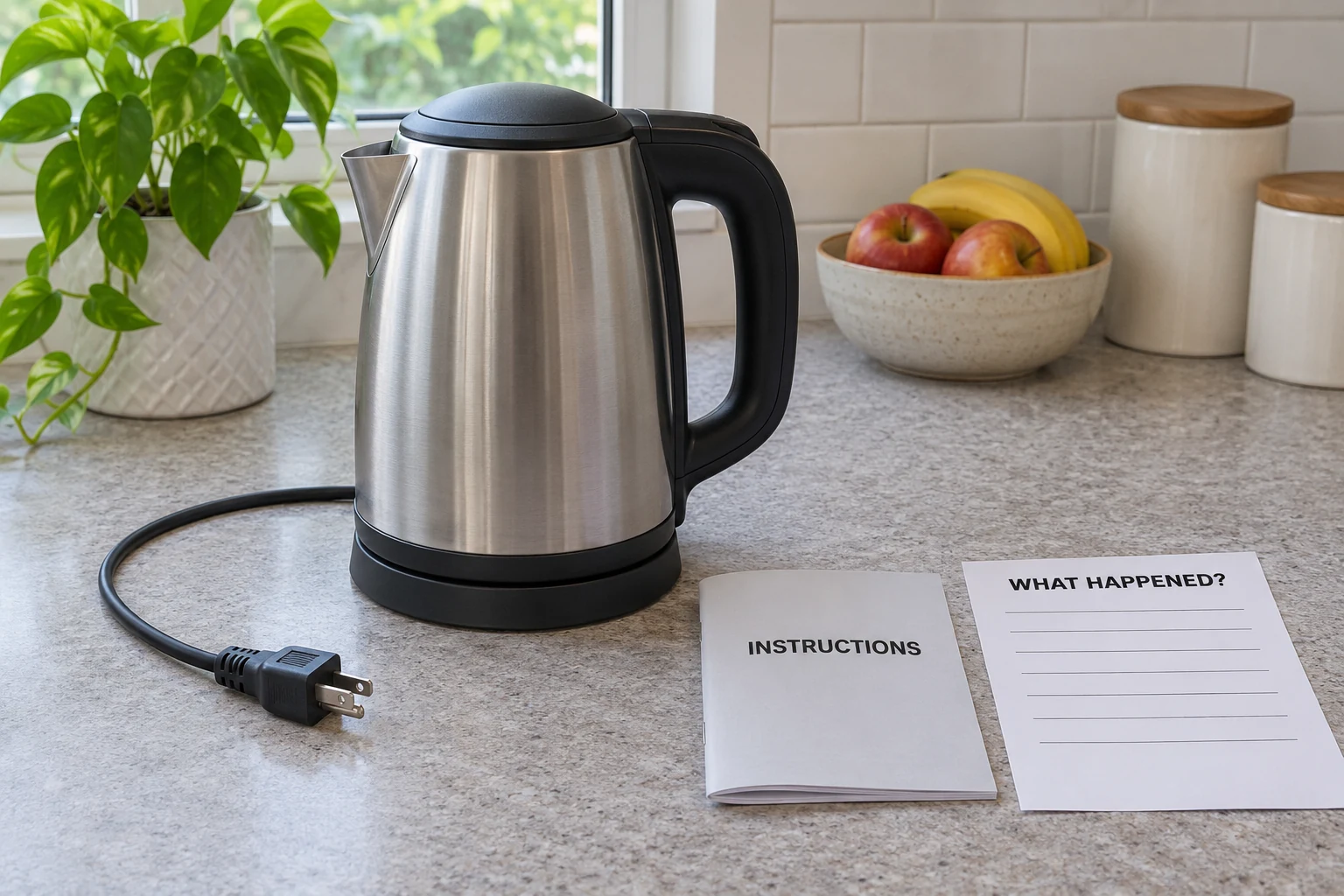
When a kettle stops, describe the event before deciding which part has failed. Did it stop after the water boiled, after somebody lifted it, or during an unfinished preparation? Keep the sequence you actually observed. Then find the instructions for that exact appliance. A stop described by its manual and an unexplained malfunction call for different next decisions.
This guide uses one named manual to show why that distinction matters. It does not diagnose the two retail kettles discussed below or supply a universal restart procedure. Work from your own model's instructions and service information. Do not deliberately run a kettle dry, force a switch, exchange bases or open the appliance to reproduce a problem.
Write what happened before adding a cause
Consider a fictional morning in which Ellis says, “The kettle has stopped working.” Morgan asks what happened immediately before that statement. Ellis remembers the switch changing position, but cannot remember whether anyone had just lifted the kettle. That missing part of the sequence matters to their enquiry. They leave it unknown instead of choosing whichever explanation seems easiest.
Ellis rewrites the note as an observation: the appliance stopped during the preparation they remember, and the preceding handling is uncertain. They have not identified a failed heater, switch or base. They also have no reason to describe a protection feature as having activated. Those would be conclusions requiring information they do not yet have.
For your own incident, distinguish what you saw from what another person reported. If somebody else was using the appliance, let that person describe the sequence in ordinary language. A second-hand account can still help, but mark the parts you did not observe. There is no need to repeat the event merely to produce a tidier explanation for support.
For a kettle restart question, keep any photograph you already have attached to the event it actually shows. A picture taken on another morning should not quietly become evidence of this incident. If support requests a new image, follow its applicable directions and the appliance instructions. Leave a requested detail unanswered when you cannot obtain it appropriately; explaining that limitation is more useful than sending an unrelated picture with an invented history.
A named manual describes distinct stop states
The Chef'sChoice model 681 manual describes a steam-activated automatic switch-off after boiling and says a fully closed lid is necessary for that device to work properly. It separately describes self-resetting boil-dry protection and model-specific recovery instructions. Its service section states that there are no user-serviceable parts inside. These are instructions for model 681, not either retail kettle here. Its minimum fill, cooling, switching and electrical directions must remain with that model.
Read the relevant sections in your own appliance's documentation together when investigating automatic kettle shutoff. A heading about automatic operation may answer a different question from a protection or service section. If you only have a promotional feature list, obtain the actual instructions instead of treating that list as a complete account of the appliance's states.
Morgan finds a manual for a kettle with a similar appearance, then checks its model heading. It is not the appliance Ellis described. They keep it out of the incident enquiry. A clear explanation for another machine can make a useful example while still leaving their own question unanswered. The next action is to identify the applicable document, rather than borrow the other machine's steps.
Read retail protection claims within their limits
The 0.8-liter electric kettle listing states automatic shutoff at boiling and protection when water is insufficient. Its catalogue brand field is Unbranded, while the description and pictured body use DEZIN; that does not independently authenticate a factory identity. The 0.6-liter dual-voltage kettle listing names dry-burn protection, and its gallery advertises automatic shutoff. Neither account establishes the applicable restart instructions for a reader's appliance.
The galleries show complete kettles with integral parts and kitchen or travel staging. Cups, food, luggage and personal items are context, without a supplied-goods claim here. Promotional pictures of handling, protective features or voltage controls provide no powered test, electrical setup instruction or verified fault diagnosis.
If you are considering a replacement purchase, those feature statements can help you form questions for the seller. They cannot establish why your existing appliance stopped. Keep the incident decision separate from the comparison of new products. Buying another kettle would be a purchasing choice, not a finding that a particular component in the old one failed.
Use existing observations without making a new test
Write down the ordinary context you already know: who was preparing the drink, which appliance was involved and where the sequence became unclear. Include any visible indication you actually noticed. Leave an unread display or unobserved switch position unreported. Do not supply a likely value from memory of a different kettle.
Ellis remembers hearing the end of a conversation while preparing breakfast, but cannot connect that moment confidently to the appliance's stop. Morgan leaves the timing out of the technical description. Their note can mention uncertainty without turning an approximate recollection into a measured interval. A service enquiry does not require a stopwatch result nobody obtained.
Suppose another person says the appliance behaved normally later. Record that as their report and retain the earlier unanswered event. The later account may be relevant to support, but it does not retrospectively identify what Ellis saw. Likewise, an unexplained stop does not prove every subsequent preparation would have the same outcome.
Follow the exact appliance's instructions for any handling or next action. If the applicable guidance is missing, unclear or does not cover the observed problem, use the maker's service route. This article supplies no live connector check, dismantling instruction, improvised reset or reason to override a protective feature.
Keep the next drink separate from the incident enquiry
Ellis still wants a drink before leaving home. They can make another ordinary arrangement using equipment they already know how to use under its own instructions. That choice need not settle the kettle question. A short-term change to breakfast plans can create room to seek the right information instead of rushing an uncertain diagnosis.
Tell another user what remains unresolved. “I have asked about this event” is a different message from “I repaired it.” Keep the wording faithful to what has happened, and follow the actual appliance's handling and storage guidance while arranging service. An informal note records status; it does not establish that the equipment is ready for use.
If one person contacts support and another would arrange a purchase, share the incident description first. Otherwise the second person might start ordering parts for a cause nobody established. A request for advice and an instruction to buy a component should remain separate decisions, even when the same household member could eventually handle both.
Ask support to address the exact event
Use the model information available through the appliance's accessible markings and existing paperwork, following its instructions for handling. Keep any uncertainty visible. A clear order reference can help explain which item you mean without filling a missing model suffix from a similar-looking online offer. Do not remove covers to obtain an identifier.
Send the description of what happened, the parts of the sequence that remain unknown and the relevant instructions you already found. Ask what next action applies to that appliance and event. If the reply concerns another model, point out the mismatch before relying on it. Keep the actual response with the incident description.
Read a partial answer narrowly. A reply confirming which manual applies may settle the document question while leaving the stop unexplained. A service referral may identify whom to contact without proving an internal cause. Follow up on the remaining question instead of rewriting the response as a completed repair.
Before ending the enquiry, decide what would count as its next useful outcome. It might be an applicable instruction, a service assessment or a deliberate replacement decision. An unanswered message can remain pending. Preserve the question so another person can continue it without having to recreate the incident from scattered recollections.
Separate the surrounding drink routine
The crowded-counter kettle tea corner guide concerns the appliance's place, cup and kitchen movements. The loose-leaf tea at a desk guide concerns containing leaves and managing the wet infuser. Those workflow decisions do not diagnose a kettle stop or provide another model's restart permission.
Morgan can still improve the drink routine after the incident has an appropriate next action. They might put the tea supplies somewhere easier to find, for example. Keep that household change separate from the technical enquiry. A more convenient counter arrangement would not show that the reported stop has been explained.
Read the actual order if you choose a replacement
If you decide to buy a complete replacement kettle and a seller offers cryptocurrency at checkout, assess the actual goods and transaction before authorizing payment. This is a conditional purchasing example, not a statement that either linked offer accepts cryptocurrency or that an order has been placed. Confirm the selected item reference and the contents the seller says the offer supplies. Read its current delivery and return terms, and ask about any unresolved order detail through the contact route provided. A payment method cannot establish why the previous kettle stopped or supply the operating instructions for the new appliance. If the basket changes to another item, reconsider the goods decision before continuing. Keep any relevant written clarification with the offer it actually addresses. You may choose another available payment method or leave the order unfinished while an important question remains open. Neither option establishes a network fee, exchange rate, settlement time, refund entitlement or wallet-security result. Check those matters through the responsible provider and the terms for the proposed transaction. At confirmation, read the final item reference, delivery information and any displayed charges. Save the order record if you proceed, together with the seller's relevant response. If payment status is uncertain, reconcile it through the appropriate authorized channel before considering another payment. An order confirmation can document what you purchased; it cannot confirm that a protection feature operated correctly or that an unresolved appliance fault has been repaired. Keep the old incident description available if service still needs it, even after a replacement purchase changes how the household prepares drinks.
Close the enquiry with an accurate status
Ellis and Morgan finish with an identified appliance, a description of the event and an appropriate next action. They leave unsupported component diagnoses out of their note. Whether the outcome is an applicable instruction, a pending service question or a replacement purchase, the record should say what was actually established. The next person can then pick up the question without mistaking a plausible explanation for a completed repair.
Conceptual instruction check; no powered test, protection bypass, electrical inspection or completed repair is depicted.