Cooking & Food Prep
Holiday cookie storage: keep crisp and soft batches apart
A seasonal cookie-storage explanation separating pre-event holding from a shared serving idea, with attributed baking guidance and a fictional household plan.
Holiday cookie storage needs a different plan from the picture you hope to put on the table. A colorful assortment can be the idea for an occasion while its different batches remain separately held beforehand. Begin with the actual cookies and their recipe requirements, then choose the containers. A festive photograph does not supply those requirements for you.
This article explains one texture distinction from a baking reference and applies it to a fictional household plan. It reports no baking or storage trial. It gives no food-storage duration, freezing method or assurance about perishable fillings. Follow the complete recipe and applicable food-handling guidance for the actual food, including any requirements this narrow explanation does not address.
Crisp and soft cookies need separate holding
In King Arthur Baking's December 2024 article, Rossi Anastopoulo advises against storing crispy and chewy cookies together. The explanation is moisture transfer: crisp cookies absorb moisture from chewy ones and soften, while the chewy cookies dry out. The article groups similar textures together and also recommends separating strongly flavored varieties. Keep that guidance attached to the food rather than treating a container's appearance as permission to ignore it.
The reference discusses other storage ideas as well. Those are not adopted here. This guide provides no bread-slice addition, humidity-stone method or shipping procedure. Its present lesson about crisp and soft cookies is deliberately narrower. A recipe with a separate handling requirement still needs its own instructions; a texture description is not a complete food-safety assessment.
A mixed cookie assortment can remain a serving idea
Imagine Evan planning a small winter gathering at home. Evan has selected two recipes whose own descriptions identify different intended textures. No real recipe result is being asserted in this example. Evan's first drawing shows a platter with several varieties arranged around its rim. The drawing communicates what guests might be offered, without establishing how anything has been made or held.
Evan initially calls that drawing “the cookie plan.” On looking at it again, the name feels too broad. It contains a presentation idea but says nothing about the work before guests arrive. Evan renames the sketch “table idea” and keeps the actual recipe references available separately. The change is in the fictional plan, not in any observed food.
The attributed distinction above means the proposed mixed cookie assortment should not silently become one shared storage batch. Evan gives the earlier holding stage its own place in the plan. The imagined platter remains an idea for the occasion. Neither part of that plan certifies a particular container or establishes how long the food may wait.
This also leaves room to change the gathering. Suppose fewer people can come and Evan chooses to make only one recipe. The abandoned drawing need not dictate the shopping list. An assortment is an option, rather than a commitment created by a decorative plate already in the cupboard. Evan can keep the first sketch as an unused idea and plan around what is actually selected.
Keep the food decision ahead of the matching set
A coordinated set can be appealing when supplies are arranged for an occasion. In Evan's invented kitchen, that preference comes after the intended food and its requirements. Choosing everything to look alike is a design wish. It does not show that the selected goods have the properties the project needs, or that a particular catalog photograph records a successful storage result.
Suppose Evan already owns a suitable container with applicable instructions and is considering another purchase. That existing item can remain part of the discussion. There is no need to replace it just because a new set would look more coordinated. Equally, familiarity alone does not document an unidentified container's instructions. This article has not inspected anything in Evan's fictional cupboard.
A helper might offer to bring a spare box. Evan can welcome the offer without immediately assigning it a food task. The useful information is the actual item and its applicable use information. The helper's generosity is real within the story, while the proposed use is still a separate decision. A photograph sent in a message can identify a question without completing that decision.
The plan can also become simpler. If the necessary information is unavailable, Evan may choose a different menu or leave a proposed purchase unplaced. That is a revision to an event idea, with no claim that a product failed. Keeping that distinction visible avoids turning an unanswered question into an invented account of damaged or spoiled food.
Read the HUBERT food box without adding a seal claim
The HUBERT food storage box offer names an eight-gallon box; its metadata identifies model 12337, SKU sku-947342259 and UPC191538043178. The brief description says the boxes are stackable. Its five original views show a white or translucent rectangular body, open in some views and covered in others. Those views do not establish the delivered package inventory or an airtight seal.
No readable identity label is established. The covered view alone cannot document a supplied-lid inventory that the brief description does not explain. Treat the account as a specific offer to investigate, rather than an approval for Evan's recipes or a measured usable capacity.
Keep the Unbranded jar's catalog conflict visible
The Unbranded candy and cookie jar offer has UPC739396439193 and SKU sku-18273352819. Its headline says 2.5 gallons and plastic, while its color field says Blue. Seven original views depict a clear jar with a domed knobbed lid. Its description gives generic modular-storage wording. Retain those differences rather than normalizing them into a verified specification.
The pictured sweets, bottles, candles and party decorations are demonstration props. They are not established supplied contents. No material, food-contact, seal, delivered quantity or freshness test is reported here. A photograph containing different cookies does not supply storage instructions or authenticate their textures.
Give the conceptual cover its limited job
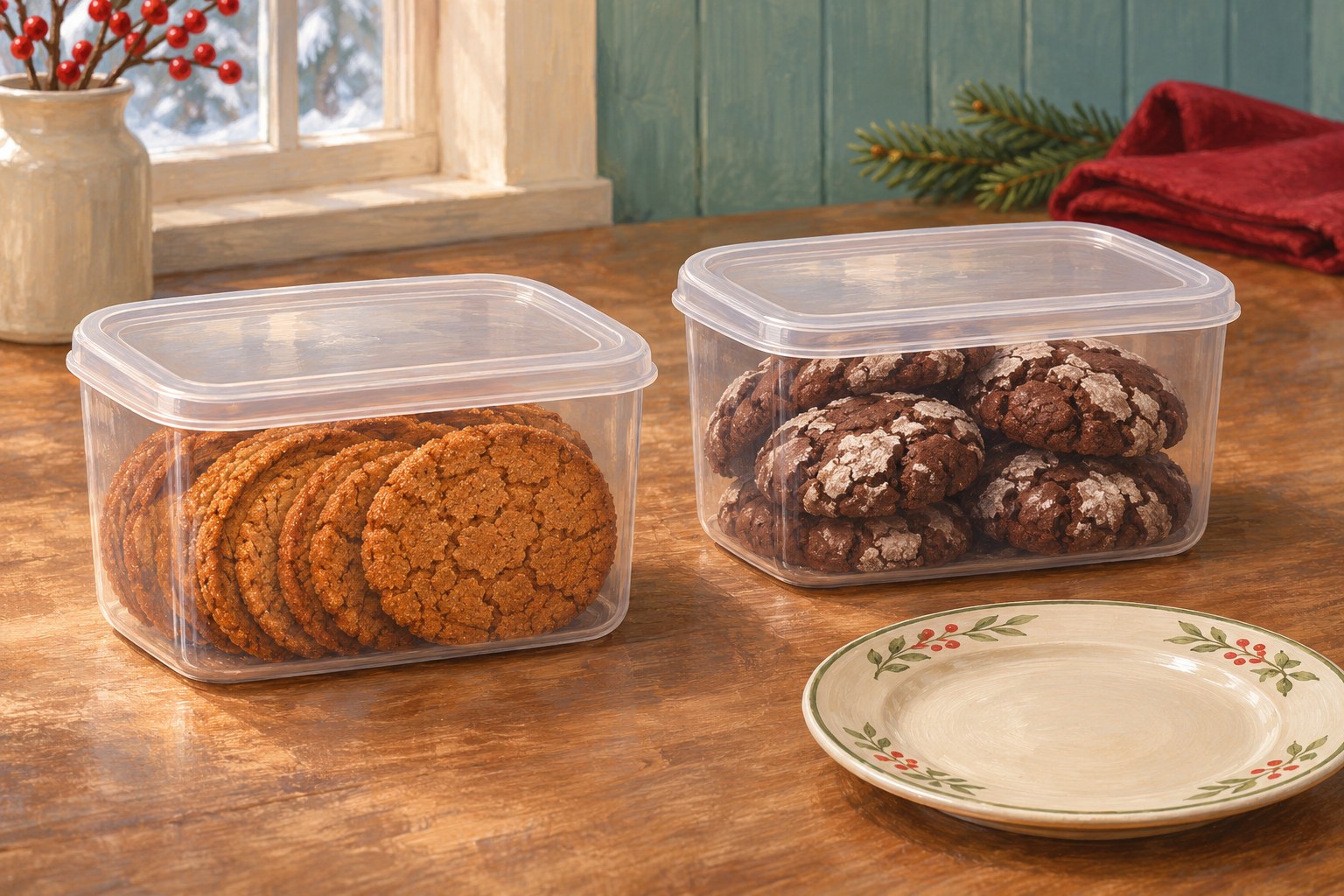
The original illustration for this article shows two closed containers, each containing a visually different batch, with an empty serving plate nearby. The red cloth and winter setting identify the intended seasonal context. They do not identify retail goods. The picture is a conceptual explanation commissioned for the article, with no real cookies placed into storage and no elapsed-time observation behind it.
Evan could point to that empty plate when explaining the table idea. It leaves the presentation unfinished on purpose. A photograph or drawing does not have to show every stage at once to be useful. Here the objects help distinguish two parts of a plan, while the actual recipe and product requirements remain matters for the real project.
The illustration cannot resolve a product question about the HUBERT box or the Unbranded jar. Its generic containers are different visual objects. Their orderly lids and clean surfaces do not certify the material, condition or performance of something delivered to a buyer. Keep the conceptual image with the explanation and the actual product information with the goods being considered.
Leave pan preparation and gift handoff with their own guides
The holiday cookie pan preparation guide keeps each chosen recipe connected to its own pan instructions and actual paper or mat information. That concerns preparation before baking. It does not establish the holding environment for finished batches or approve a storage container.
The holiday cookie tin handoff guide assigns contents and recipients, keeps lids matched and retains accurate accompanying notes. That is a gift-allocation task. A recipient label cannot establish a food's storage requirements, just as this texture explanation cannot assign the gifts for your household.
These different questions can occur in the same seasonal project without becoming one instruction. A person helping with the gathering may be responsible for only one part. Evan can explain the intended contribution in ordinary terms and leave the rest with the person doing that work. Someone asked to choose a serving plate has not agreed to verify a recipe or investigate a container offer.
If the gathering changes to a gift exchange, Evan should recognize that as a different brief. A previous plan for guests to choose something at home does not establish a recipient, a delivery arrangement or an appropriate gift package. The relevant handoff guidance can then be considered in its own scope. No result from the earlier fictional plan needs to be invented to justify the change.
Keep the invitation from becoming a storage instruction
In the fictional plan, the invitation says that the gathering is in the evening. That calendar detail tells guests when Evan hopes to see them. It does not establish when any food was made, what happened beforehand or whether a particular holding period is appropriate. Evan should not turn an event time into a freshness statement. The actual recipes and food-handling requirements still govern those questions.
Suppose a guest offers another variety and sends a picture from an earlier celebration. Evan can discuss whether the idea suits the occasion while recognizing what the picture leaves unknown. It is not a current ingredient record or a description of the food that might arrive. A welcoming conversation need not contain an assurance that nobody can support. The invitation can remain clear about the proposed gathering while the actual food information comes from the people and instructions responsible for it.
Keep a proposed purchase and payment separate
If you decide to buy containers on republeq.com, keep the payment decision attached to the particular order. An interest in crypto does not establish that a selected item meets a recipe's requirements. If you prefer USDT, first confirm whether the actual seller and current checkout offer it for that transaction. This article establishes no acceptance. Check the selected item, variation, stated package, delivery details, total and terms through the responsible service's current information. Obtain any applicable asset, network, amount and receiving destination from that service for the specific order. Do not copy payment instructions from a product image, a previous purchase or an informal message discussing a gathering. Keep an unclear instruction unresolved while seeking clarification. Retain the actual order reference and what was confirmed, without treating an acknowledgement as proof of material, capacity or successful storage. If payment status becomes uncertain, reconcile that status before considering another transfer. Uncertainty does not establish that nothing happened. This paragraph gives no wallet address, fee estimate, transfer guarantee or recovery procedure. A completed payment cannot authenticate a delivered package, demonstrate an airtight seal or document how food was handled. You can leave an order unplaced while a real product question is answered. If someone else is ordering for you, give that person the exact selected reference and any remaining limitation so an unresolved assumption is not silently carried into the transaction. Keep a later product enquiry attached to the item actually selected, rather than to another size or a remembered photograph. Record the information supplied by the responsible service and retain the distinction between a proposed purchase and a confirmed transaction.
Return to the occasion with the present plan clear. Evan's fictional table idea can stay flexible while the actual food and product requirements govern the work that might follow. Holiday cookie storage begins with understanding the batches, rather than asking a festive container photograph to complete the whole decision.
Conceptual holiday cookie illustration showing separate batches; no retail container, storage trial or food-preservation result is authenticated.