Cooking & Food Prep
Plan holiday cookie pan preparation for each recipe
Read each holiday cookie recipe before assigning a pan surface; keep the recipe instruction separate from a paper or mat listing.
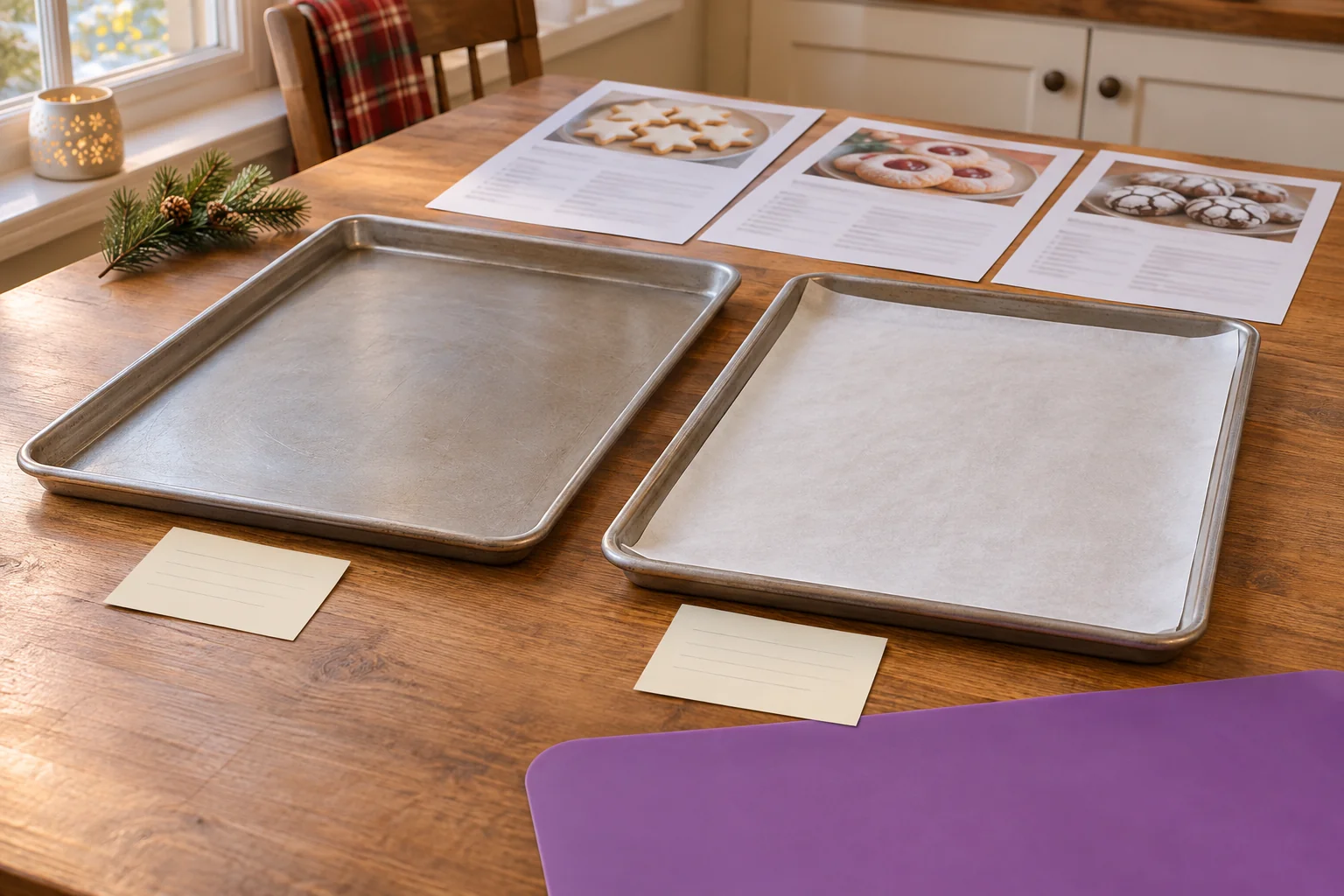
Put the recipes on the table before setting out one lining arrangement for a holiday cookie session. In an imagined afternoon, Mara has chosen a pressed cookie and a gingerbread crinkle cookie. She wants a short note beside each pan so she can return to the right instruction when changing recipes. Her holiday cookie pan preparation starts with those complete recipes, rather than a decision that every tray should look alike. This is an organization example, not a baking trial. The notes point back to the instructions; they do not replace them or approve a paper or mat for use.
Keep the alternatives in the spritz instruction
Sally McKenney's My Favorite Spritz Cookies gives a specific choice: line the baking sheets with silicone baking mats, or use nonstick baking sheets without a liner. It explicitly excludes parchment because the pressed dough will not adhere to it. The recipe also describes chilling the lined sheets while the oven preheats if refrigerator or freezer room is available. Preserve both the alternative and that qualification in a holiday baking pan note. A note saying only “spritz: bare tray” would omit one of this author's options. A note saying “all cookies: parchment” would contradict the instruction. Keep the actual recipe available for the dough, press directions and remaining steps. Its allowance for a silicone baking mat does not identify an unfamiliar mat, authenticate its material or establish the instructions for an offered product. Reader comments describing another surface are separate from the author's recipe and do not become an approved substitution here.
Read what the other spritz recipe actually says
King Arthur Baking's Sparkling Spice Spritz Cookies says to get out two cookie sheets that do not need greasing. For shaped cookies made with a press, it says to chill the sheets while making the dough. It then directs the reader to follow the instructions supplied with the press. Those are the statements to retain for this recipe. “Does not need greasing” is not an explicit statement that every possible liner is forbidden. Do not strengthen it into that claim when shortening the note. Likewise, keep the sheet-chilling instruction attached to the press-cookie context rather than turning it into a requirement for every cookie on the holiday list. If this is the recipe Mara chooses, its own complete instructions replace the note for her other spritz candidate. Having the same familiar cookie name does not make two authors' instructions interchangeable. Resolve any equipment question with the applicable recipe and press information before proceeding.
Give the crinkle recipe its own lined sheets
King Arthur Baking's Gingerbread Crinkle Cookies explicitly calls for lining two baking sheets with parchment. Its instructions include refrigerating the covered dough before preparing to bake, and cooling the baked cookies completely on the sheets. These details belong to that complete recipe. They should not be combined with the pan preparation from either spritz recipe to create a new hybrid method. Write the recipe's name beside the parchment instruction in the cookie recipe pan instructions note. That identifies which batch the note concerns when several recipes are open together. A holiday theme does not erase the different preparation instructions. Nor does a listed parchment product become approved for the recipe merely because its catalog uses the same material name. Keep the actual paper's applicable instructions and the equipment requirements available alongside the recipe. This guide supplies no alternative temperature, ingredient change, dough treatment or shortened version of the recipe.
Keep paper instructions with the actual paper
Reynolds' Tips for Baking with Parchment Paper discusses its own parchment products and their uses. Its advice keeps paper from hanging over the pan edges or touching oven walls. The same work gives an oven limit for its parchment and excludes contact with flames, oven sides or bottom, broiling units and toaster ovens. Those statements do not establish a limit or permission for another supplier's paper. Its reuse statement also concerns its products, not every loose sheet in a kitchen. Read the whole applicable instruction for the paper actually being considered. If an essential product answer is missing, retain the question instead of borrowing the Reynolds number or reuse allowance. The recipe and product information address different parts of the setup. A recipe that calls for parchment has not supplied the maker, identity or operating restrictions of an unidentified sheet placed beside it. Keep those unresolved details visible before assigning that material to the batch.
Read the precut paper offer as an offer
The lowpricesupply coated parchment paper offer names a white, twelve-by-sixteen-inch, half-size pan liner and a thousand-piece package. Its photograph shows overlapping white rectangular sheets on a wooden surface. That view does not authenticate the stated package count, dimensions, coating or maker. Keep lowpricesupply as the catalog brand rather than identifying an unseen manufacturer. The offer is a concrete paper candidate to investigate, not evidence that the received material has been tested in either recipe. Ask for the applicable product instructions and confirmation of the actual selected package before relying on it. A large package count cannot answer a missing heat or use question. If the seller identifies another product in response, review that product's own information instead of carrying this offer's description across to it. Leave the holiday pan assignment open until the required product answer is available.
The purple mat leaves product questions open
The Unbranded purple baking mat offer describes one purple mat for rolling dough and baking pastry or cookies. Its complete gallery shows a purple rectangular surface with numbered edge rulers and circular markings; one image states one piece. The numbered edges are a real measurement feature, although no calibration or accuracy test is established. No printed maker or exact model was authenticated. Promotional food-grade and flexibility captions do not supply independent certification. Neither the pictures nor the brief native description establishes an oven rating or approval for the spritz recipe. Keep the demonstration rolling pin, bowls and food separate from the supplied mat. Before choosing this offer for a particular task, obtain the applicable directions for the actual mat. A recipe allowing silicone mats cannot resolve missing information about this offered object. Its purple color and printed circles are not substitutes for that answer.
Resolve an owned mat's condition separately
The published guide to checking a sticky silicone baking mat after washing addresses identification, applicable care instructions and reported condition. It keeps different makers' cleaning advice with their respective products and does not approve an unfamiliar treatment for an unidentified mat. That is a separate decision from reading a cookie recipe's pan preparation. If the mat already in your cupboard raises a condition question, resolve that through its own instructions or supplier before assigning it to the afternoon. A completed recipe note cannot diagnose the surface. Equally, an answer about washing does not rewrite the chosen cookie recipe. Retain the product identity with any care response so the person setting out the equipment knows which object the answer covers. Return to the recipe-specific pan note once the actual product question has been addressed.
Leave the finished-cookie handoff for its own stage
The holiday cookie tin handoff guide begins with assigning containers, recipients and contents before closing lids. Its matching-lid and contents-note decisions concern finished baking being prepared for gifting. They do not choose the surface used for a recipe. Keep the pan note with the preparation materials and the eventual recipient note with the appropriate gift container. Neither note can supply missing ingredient or handling information. The handoff guide also keeps actual recipe and food-handling requirements separate from the decorative tin. That boundary remains useful when the same holiday afternoon includes baking and packing. A patterned lid does not identify the recipe that produced its contents, while a lined tray does not assign a recipient. Finish the actual preparation under its relevant instructions before using the separate handoff plan for the completed gifts.
Try the notes before the afternoon begins
Return to Mara's imagined table. She writes the chosen recipe's full name at the top of a small card and leaves the complete source beside it. Under that name she records where to find its pan preparation, rather than copying a few remembered words into a new recipe. She gives the second recipe another card. When a family member asks which instruction belongs to the next batch, she can point to the named source. The card contains no promise that the offered supplies have been received or approved. An unanswered product question stays on the card as a question. If she changes the recipe selection, she replaces its companion note deliberately and keeps the abandoned candidate out of the active arrangement. This fictional rehearsal makes no prediction about the baking result.
A short record is enough for this planning task. Keep the chosen recipe name, the location of its complete instructions and the actual product information together. Add the question you still need answered, with the person you intend to ask. Do not mark an answer complete because a similar photograph looks reassuring. When all the necessary information is available, revisit the setup for that particular recipe. When it is not, leave that part of the plan uncommitted. For holiday cookie pan preparation, the useful outcome is a clear connection between a selected recipe and the instructions you will actually follow. You can carry that connection into another holiday session without treating today's paper, mat or remembered shorthand as a universal rule.
Keep any proposed purchase identifiable
A possible order on republeq.com can wait while the pan questions are answered. If you decide to investigate payment with crypto, including USDT, begin by identifying the particular offer and the package you mean to buy. Write that reference beside your unresolved product questions so a response about a different item does not quietly become part of this order. This article does not verify a currently available payment method or tell you which asset to send. Read the options and terms actually presented for your proposed order. When a necessary payment detail is absent, obtain an answer through the order's documented contact route before committing funds. Keep that answer with the item reference, rather than relying on the recollection of an earlier purchase. A quoted amount and a transaction record concern the payment; they do not authenticate the paper's material, the mat's instructions or a delivery date for your holiday. If the selected item changes while you are considering the order, review the applicable product and payment information for that changed selection. You can also leave the transaction uncommitted and revise the shopping plan. Should you proceed, retain the order record, the terms you accepted and any payment acknowledgement. Keep a later dispatch message or delivery observation as its own event instead of inferring it from a transfer. None of these administrative records certifies that the received supply suits a recipe. Check the actual product information when it arrives, preserve any unresolved discrepancy, and return to the recipe-specific decision before assigning the item to a pan. A payment preference cannot complete that practical check on your behalf.