Garden Care & Watering
Garden hose holder setup: choose wall or ground placement
Map where the hose rests, compare wall and ground sites, then test coiling access and the exact holder instructions.
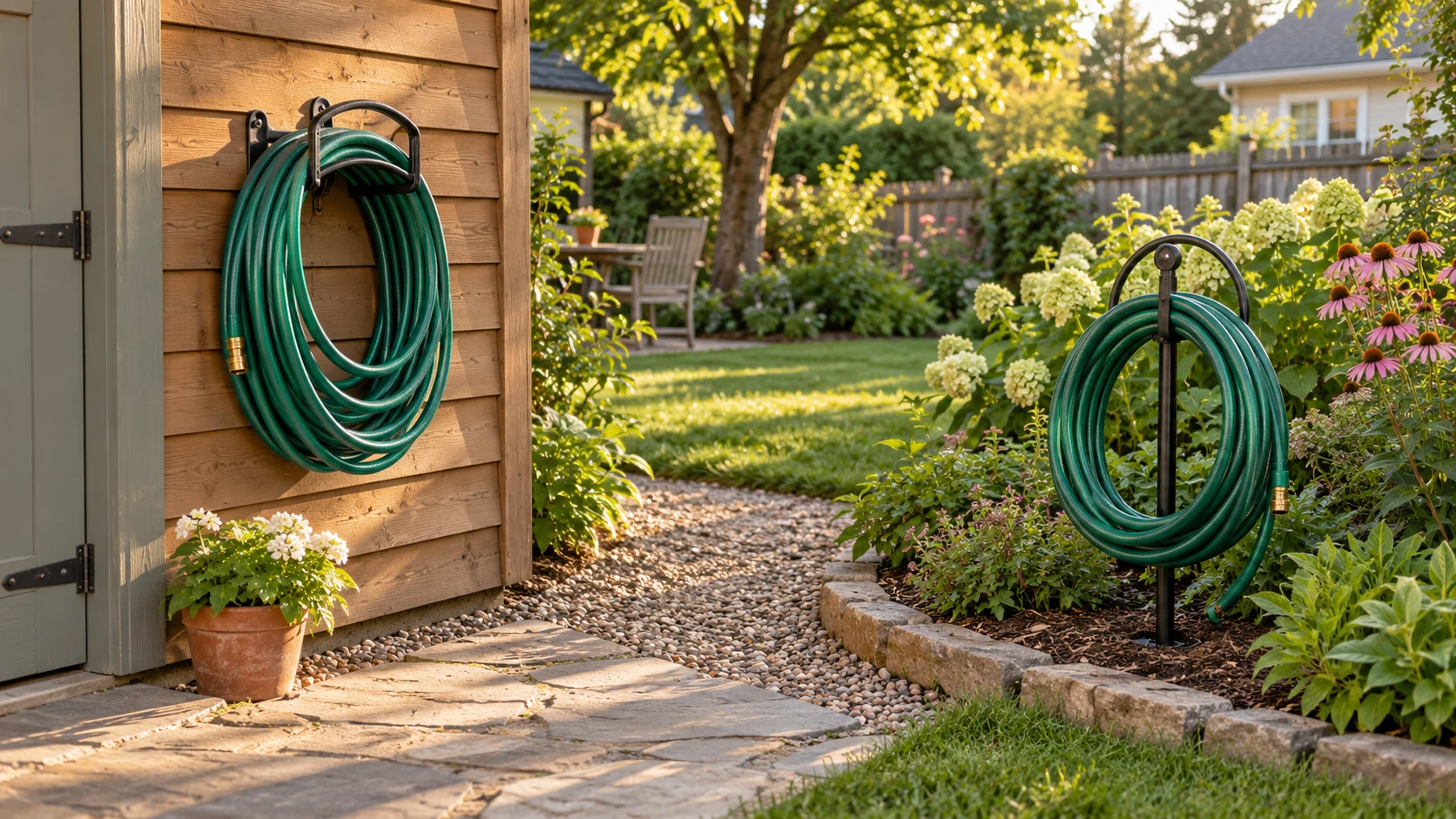
Garden hose holder setup begins with the place where the hose will rest between uses. A wall hanger keeps the coil against a structure. A freestanding stake can put storage closer to a bed without drilling into the house. Neither style tells you where a loose hose will travel while you water, how easily you can coil it, or whether its stated capacity matches your actual hose. Make a short route sketch before choosing a site, then check the exact holder and its installation instructions.
Two current product pages show the distinction. The Starlight wall hose hanger is listed as a hanger with a stated 150-foot capacity. Its gallery shows a curved wall-hanging form with a mounting plate. The unbranded hose-holder stake is listed for up to 125 feet of five-eighths-inch hose, with the hose excluded. Its first gallery is an assembly diagram showing a holder, vertical sections, and a ground anchor. Those are examples of two storage arrangements, not proof that either will fit every wall, soil, or hose.
Mark the storage site before choosing a holder
Put the tap, usual watering area, gate, door, and walking paths on a sketch. Then mark one possible wall position and one possible ground position. Carry your hose to each spot without fastening anything. See where the loose length would lie as you use it and where the coil would sit afterward. A position close to the tap may leave fewer feet to carry after watering. A position nearer the beds may reduce the walk to your usual starting point. Keep the decision tied to the route you actually take.
Check everyday access. Can you reach the holder while holding several loops of hose? Will a full coil block a door, a window, a gate latch, or a route for bins and tools? Is there room to lift a loop off without scraping a plant or a sharp edge? A holder may be easy to install at eye level but awkward for a shorter household member to use. Try the action at a temporary mark on the wall or with a stake position marked in the ground before committing.
Leave the water connection out of the storage-capacity estimate. The hose may remain connected to the tap, or you may disconnect it and carry it to the holder; either habit changes the path you need to manage. If the stored hose must bend sharply around a corner to remain connected, try another position. If you plan to disconnect it, decide where the open end will rest so it does not drag through soil while you coil. Check any maker guidance for draining and storage rather than assuming every hose behaves the same way.
A passive holder is distinct from the wall-mounted retractable reel discussed in the published retractable garden hose reel fit guide. That guide tests a reel's lead connection, swivel clearance, and main-hose reach. Here, you supply the coiling motion and choose a resting place for an ordinary loose hose. If you are weighing a holder against a reel, draw both storage positions on the same yard sketch, then compare the tasks you would perform after every use.
Check hose length and the shape of the coil
Read the length and diameter printed on your actual hose or its retained packaging. If you no longer know them, do not assign a size from appearance alone. Measure the loose hose when practical, or identify the model from a reliable label. The Starlight listing states a 150-foot capacity but does not establish that every hose of that length will form the same size coil. The stake listing ties its 125-foot statement to five-eighths-inch hose. Treat those as offer-specific claims and check the selected variant before buying.
Try a few broad loops on the ground to see the space your hose naturally takes. Avoid forcing a tight circle merely to make the coil look compact. A hose that resists a small bend may need more room on the holder, especially if it is cold or stiff. The available wall width or stake clearance can matter as much as a length number. Note whether the coil would touch the ground, a plant, or a walkway once it hangs at the intended height.
Think about how you will put the hose away, not just how the finished coil looks. Set the nozzle down safely, walk the hose toward the holder, and make a trial loop. If the route passes under a bench or around a gate, you may have to pull the entire hose back through it before storing. That step can dominate the routine even when the holder is well placed. Move the tentative holder site if you can remove an unnecessary corner from the path.
If several people use the hose, ask each to try the proposed motion. One person may carry the coil from the tap; another may make loops on the holder itself. A high wall location can be inconvenient when the hose is full of water. A stake behind a dense bed can be awkward to approach with a long coil. Choose a site that works for the ordinary user and leave enough space for the way the hose is actually handled.
Test a wall hanger against the actual wall
A wall hanger needs a suitable supporting surface. Identify what is behind any siding or finish, and read the selected maker's instructions for fasteners and allowed mounting material. The first Starlight gallery shows a mounting plate, but the image alone cannot tell you the correct anchor, load, or wall construction. Do not select screws only because they appear in a product photo. If the supporting structure is uncertain, ask a qualified installer to assess it before drilling.
Mark the proposed hanger outline and hold a sample hose loop at that height. Check that the coil clears the ground and any wall opening. Look for a downspout, faucet, exterior outlet, or trim that would sit behind the loops. A wall can look spacious when bare and crowded once a hose is draped across it. The holder should remain reachable even when seasonal furniture or stored tools return to their usual positions.
Check the selected offer's package list and current installation instructions. The product title, structured listing, and photo may use different brand or model wording, so bind your decision to the exact page and seller offer rather than inferring a manufacturer's specification from a familiar name. The Starlight page mentions Suncast MHH150B in its description; that wording does not independently prove a particular manufacturer's hardware or instructions are supplied. Verify the actual included parts before planning holes.
After mounting according to the applicable instructions, place the hose onto the hanger gradually. Watch whether the mounting point stays stable and whether the coil rests where expected. If the hose's own weight or the way you lift loops makes the position feel awkward, stop and reassess it. This is a usability check, not a substitute for structural installation guidance. Keep the hose away from sharp trim or moving doors where repeated contact could wear it.
Test a ground stake against soil and traffic
The unbranded stake listing describes three anchor prongs and a detachable holder that can be moved around the yard. Its gallery diagram shows a small number of sections to assemble; it is an illustration of the offered form, not a measured installation test. Follow the selected package instructions for assembly and placement. Check the location for buried services or irrigation before driving any anchor into the ground, and do not force a stake into a site where you cannot establish what is below.
Choose ground that gives the stake a level, accessible resting place and enough room for the expected coil. Soft, saturated, rocky, or recently disturbed soil may behave differently from the conditions assumed by a listing. The product page cannot verify your soil. Try an allowed placement and check that the holder remains upright when you add loops. If it leans or moves, do not treat the advertised hose capacity as a guarantee of site stability.
Keep the coil clear of a lawn-mower route and places where people regularly step. The stake may be easy to move when a bed changes, but that flexibility helps only if the new position still has safe access and enough room. Mark a second possible location on the sketch. Before relocating the holder, remove the hose and follow the maker's disassembly or moving directions rather than pulling a loaded assembly through the yard.
Consider what happens during a season when the hose is used less often. The stake page says the holder can be taken apart for winter storage, but it does not supply a universal winter-care rule for every hose or climate. Check the exact instructions for your hose and holder. If a wall hanger will stay in place, make sure storage boxes or a cover will not trap the hose behind it. An accessible off-season arrangement prevents an easy summer setup from becoming a nuisance later.
Make a small use test and revisit the placement
At the proposed site, rehearse the sequence you would follow after watering: stop water flow, manage any remaining pressure as your equipment instructions direct, bring the hose back, and form broad loops on the holder. Notice where the end and nozzle land. If they drag through a walkway, adjust the location or the way you secure the end. The useful test is the full routine, including the walk back, rather than a single photograph of a tidy coil.
Storage convenience should not change how you decide to water. The published plant-watering needs guide explains how to check whether plants need water. A hose holder makes the equipment easier to put away; it does not indicate how much water to apply. Keep the watering decision tied to the plants and conditions, then use the holder to make cleanup repeatable.
After several ordinary uses, look at the route again. A new planter, bin, or bench may change the path; a hose may also sit differently after being coiled many times. Check whether loops are crowding a door, dragging on the ground, or repeatedly scraping an edge. A movable stake can be repositioned within its instructions. A wall hanger is less flexible, which makes the initial location test especially valuable. If the setup is inconvenient, identify the specific obstruction before changing products.
For the final selection, confirm the actual hose's length and diameter, the proposed storage route, the holder's stated capacity, the wall or soil requirements, and the included hardware or sections for the exact offer. A wall hanger suits a verified support location that is easy to reach. A ground stake suits an allowed, stable site where a loose coil can sit clear of traffic. Use the product claims as inputs to that site test, then follow the selected maker's installation instructions.