Home & Living
Front-opening frame budget for changing photos and artwork
Plan one rotating photo or artwork display by item size, swap frequency, storage routine and live checkout costs before adding frames.
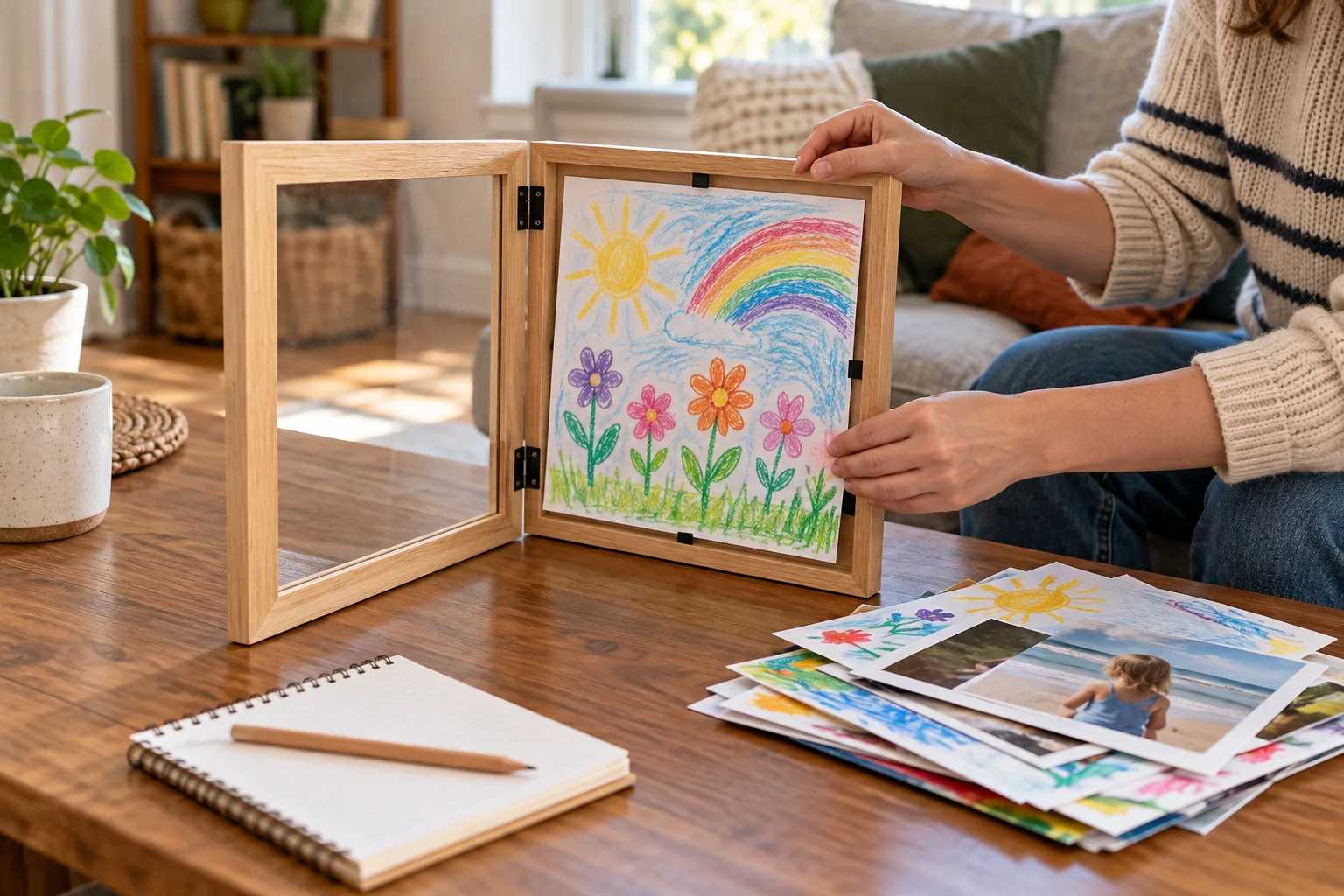
A front-opening frame budget starts with a question about use: will one display place show a succession of drawings or photographs, or will several pictures stay visible at once? A frame that opens at the front can make a change without taking the display off the wall, but that convenience matters only if you expect to use it. Set aside the pictures you actually plan to rotate. Mark the one table or wall position you have in mind, then decide how the remaining work will be stored. That simple inventory is more useful than a claim that one style saves money for every household.
Two current offers illustrate different rotation jobs. The FANRUINA front-opening artwork frame is listed as a brown picture-frame pack for changing 8.5-by-11-inch children's work. The Dynamic Frames front-open photo frame is described for 8-by-10-inch or 5-by-7-inch items, with a front opening and room for a stack of prints behind the displayed picture. These are examples of complete frames, not interchangeable sizes or a promise that either holds every drawing safely. Read the live offer and the item you own before choosing.
Define the rotating display place
Choose the exact spot first. A child's latest drawing on the kitchen wall is one display station even if twenty drawings are waiting in a folder. A hallway with four pictures visible together is four stations. The distinction controls how many frames you need now. Count the places that will be occupied on an ordinary day, not the number of pieces you hope to keep. Write the number beside the location and the size of the item most likely to appear there. If the wall, shelf, or tabletop is not ready, do not count a speculative future position as an immediate purchase.
Next, estimate the change rhythm from the pictures in hand. If one drawing comes home each week and the display gets updated often, access to the front may be useful. If the same portrait will stay for a year, a changeable mechanism may receive little use. These are planning examples, not predicted household behavior. Look at the last few changes you actually made. Was the old picture removed promptly, or did new work pile beside the frame? Your answer reveals whether the obstacle is the frame opening, the storage plan, or simply the time to sort the stack.
Place the candidate artwork on a clean surface and separate it by size. School sheets, small photographs, and prints cut at home do not all share a footprint. Keep an irregular or fragile original in its existing safe storage if handling it repeatedly would be unwise. You can use a copy for a trial display. A frame's listing may name a nominal item size, but the actual sheet, its border, and the part you need to see must be checked at the display. This article budgets the rotation station; detailed visible-opening and mat measurements belong to the separate compatibility guide.
Give the display one owner and one simple routine. Decide who chooses the next piece, where the current piece goes after removal, and how often the stack gets reviewed. A front opening solves the physical access step only. It will not automatically sort drawings, identify dates, or protect loose prints left on a counter. A folder or box you already use may be enough for the pieces that are not on view. Avoid buying extra frames merely because the rotation pile lacks a designated home.
Read the two opening and size claims
The FANRUINA offer names picture frames with a front-opening design for children's artwork. Its current native title describes an eight-pack option, while the product wording refers to other pack choices. Confirm the exact selected variant and supplied quantity at checkout instead of using a gallery image as a final count. The first gallery shows an open, hinged wood-look frame around colorful drawings. That picture supports the intended opening concept; it does not prove the hinge will fit your wall clearance, that a particular sheet can be inserted without trimming, or that every pictured accessory ships with the selected option.
The Dynamic Frames offer names a front-open frame for either 8-by-10-inch or 5-by-7-inch items. The listing describes opening the front to change a picture and storing up to fifty prints behind the displayed one. Treat that capacity as the seller's description, not a guarantee for a thick stack, mounted artwork, or fragile original. A first gallery image shows one dark frame with a sample photograph; it does not establish your print's visible crop. The offer also describes wall and tabletop placement. Check current package contents and mounting instructions before you plan around a particular hanging piece.
These two offers serve different paper sizes and presentation styles. An 8.5-by-11-inch school drawing does not become a 5-by-7-inch photograph by choosing a convenient front latch. If your rotation set mixes sizes, make a size row for each group and decide whether one frame can handle the intended group under its actual instructions. Do not assume the larger artwork frame supplies a photo mat, or that a photo frame accepts full letter-size paper. A single well-matched station may be cheaper in effort than a group of mismatched frames, but any actual price decision needs current checkout totals.
Before purchase, imagine the frame in its planned place with the front open. A door, nearby shelf, plant, or another frame may obstruct a swing or a front panel. Measure the free space around the intended station and read the maker's opening directions. If you cannot reach the front comfortably, the changeable feature is less useful there. You may choose a tabletop location where the piece can be lifted and opened safely. Do not install a frame where children will pull on it; follow the supplied mounting directions and use appropriate support for the actual surface.
Test the change routine before multiplying frames
Make a dry run with an ordinary copy of the size you expect to display. Lay the copy against a paper outline of the frame's advertised item dimensions. Note any important line, signature, or face near an edge. A front opening tells you how to reach the picture; it does not guarantee the full image is visible behind the frame lip. If the crop matters, use a same-size template and inspect the actual frame before committing an irreplaceable piece. Keep the copy and its source separate from the product listing so you do not mistake a seller's sample photo for a fit test.
Plan the removed piece's next stop before you make the first swap. A neat stack behind the display may work for ordinary prints only if the exact frame supports that use and the papers fit without pressure. A separate labeled folder may be clearer for mixed sizes or artwork that should not be compressed. Do not infer archival protection from a storage-capacity phrase. Keep valuable or delicate originals under care suitable for those items, and use display copies when frequent handling would cause damage. The budget should include the storage approach you will actually follow.
Write a short rotation rule, such as “choose one new drawing on Sunday, date the old one, place it in the school folder.” A rule is useful because it closes the loop between the frame and the stack. If you cannot see yourself doing the date and folder step, a larger internal storage claim may simply hide an unsorted pile. Conversely, if a front-opening frame makes the weekly swap easy enough to maintain, that practical value may justify it for the selected station. Do not convert convenience into an invented numeric saving.
Try the same rule for photographs. If portraits are updated only when a new school picture arrives, a front-open display may still be pleasant but may not need a large stored stack. If several family photos rotate during the year, write down which print sizes are already available. Include printing or copying costs only when you know them from your own order. A frame that accepts two named photo sizes still requires the appropriate insert or setup described for each size; do not assume that simply dropping in a smaller print will center it correctly.
Build a purchase budget from the actual station
Make four columns: display stations ready now, item sizes, expected swaps, and storage plan. A line might read “one hallway spot; 8-by-10-inch prints; four changes a year; labeled folder.” Another might read “one child's drawing spot; letter-size copies; weekly changes; school portfolio.” These are sample records, not advice to buy either exact offer. The columns expose whether you need a changeable opening, a different frame size, better storage, or no new frame at all. Keep optional future stations on a separate line so they do not inflate today's quantity.
For each suitable offer, capture the live selected variant and total checkout amount when you are ready to buy. Include any shipping, tax, mounting hardware, printing, or storage material you must actually purchase for this station. Do not use a saved article price as a current quote. If you already own a compatible folder, count its additional cost as zero in your personal plan. If a kit truly supplies hardware for your surface, avoid adding a duplicate item. Verify that inclusion on the current selected offer rather than assuming a generic gallery photograph is a packing list.
Compare cost per useful display station, not cost per paper kept. An eight-pack can be appropriate if eight separate places are ready and the selected variant really contains eight frames. It can be excess stock if you only intend to rotate art in one place. A single storage-capable photo frame can be useful for one changing display, yet it is still only one visible station. The decision should use current totals and actual intended use; pack arithmetic alone cannot establish savings when the sizes, opening mechanisms, and locations differ.
Keep a return and fit checkpoint in the plan. Check the delivered quantity and condition, the opening action, your sheet size, and the visible crop before putting packaging away. Use an ordinary print for the first change. Follow the seller's current return terms if a problem appears. A wrong size or inaccessible opening can cost time even when a return is possible. Record that as a practical consideration without assigning a made-up value. If you already have a frame that opens easily enough for your actual schedule, using it may be the simplest budget choice.
The 8-by-10 picture-frame cost guide handles the separate question of one decorative frame versus a four-frame set for fixed display places. It counts locations and compares current checkout totals for that arrangement. This guide starts with one place whose contents change repeatedly. It does not recommend buying an eight-pack merely because the artwork stack is large, and it does not score a single ornate accent against a wall set.
The picture mat size guide handles the separate fit chain among paper, visible opening, outer mat, and frame space. Use it when a mat or crop is part of your plan. The two current front-opening listings give nominal item sizes and opening concepts; they do not settle all print-edge and backing measurements. A rotation budget remains provisional until your actual print can be displayed without hiding an important part or forcing the frame closed.
Choose for the next real rotation
Choose the front-opening artwork option if its exact selected pack, letter-size use, opening route, and available display places match the drawings you will actually change. Choose the photo option if its stated photo sizes and single display station match the prints you rotate, and its storage arrangement suits ordinary pieces you are comfortable keeping there. Those are conditional examples, not universal rankings. If neither fits the intended paper or the available place, wait and seek a frame that does. Buying a mechanism you cannot use is not a saving.
After the first month or two, look at what happened. Did the picture change on the planned rhythm? Did removed work reach its folder, or collect beside the frame? Did you use all the stations you counted? Keep the answer with your purchase note. It will tell you whether a second frame serves a real place, whether the storage routine needs work, or whether the one display is enough. A front-opening frame budget works when quantity, paper size, and repeated access are tied to observed use rather than a large stack of future possibilities.
Count the display place, check the item size, and plan where each removed print will go before buying another frame.