Appliance Care & Buying
Food dehydrator running costs: count energy and usable batch yield
A four-line ledger for comparing dehydrator batches using actual kilowatt-hours and food you will use, without treating watts or tray counts as savings.
Food dehydrator running costs are easy to guess and hard to know from a product headline. A watt rating tells you something about possible electrical demand, but it does not tell you how long a batch will take, how often the heater cycles, how much usable food remains, or whether the batch replaces something you would otherwise buy. The practical answer is a small batch ledger. Record the input food, actual electricity used, finished usable amount, and any supplies you consumed. Then compare like with like. This guide uses two current dehydrator listings as examples of why tray counts and power labels are starting points rather than a savings promise.
Decide what one useful batch means in your kitchen
Start with a food you already buy or prepare, not an attractive maximum-tray picture. Write down the amount of fresh ingredient you would normally use, the finished quantity you need, and when you expect to eat it. A household making a few fruit portions has a different cost question from one trying to fill many trays every week. Include food that you actually discard because it spoils, but do not credit a dehydrator with preventing waste that your household does not have. Savings begin with a specific alternative, not with the appliance’s capacity.
Define the unit of comparison before calculating. “One tray” can hold very different amounts depending on cut size and spacing, so it is not a reliable household serving. A better unit might be one sealed container of dried apples you will eat or a measured quantity of herbs used over a month. Weigh or count the ingredient before and after a real batch if you can. Keep moisture loss separate from edible yield: fresh food becomes lighter as water leaves, but that change alone does not create more servings. Also note any pieces you reject or fail to store properly.
Make two columns for the alternatives you genuinely use. In one, record what the home batch consumes: ingredients, electricity, packaging and any separately purchased liner or sheet. In the other, record the packaged product or other preservation method it might replace, including the quantity you would actually consume. Do not compare a large homemade batch with a tiny retail package while ignoring leftover portions. If your aim is simply to enjoy a new activity, write that honestly; the ledger can still tell you the cost without forcing a savings claim.
Turn watt labels into a question you can measure
Watts describe a rate of power at a particular stated condition. Electricity used over a batch is energy, usually recorded in kilowatt-hours. To make a rough upper-bound illustration, divide the appliance’s rated watts by 1,000 and multiply by hours. That result assumes the appliance draws its rated power continuously, which a temperature-controlled unit may not do. It is an estimate for planning measurement, not an actual bill. A plug-in energy meter used according to its instructions can record the real energy of a normal batch. Check that the meter is suitable for the appliance’s plug and rating before using it.
The Aihome food dehydrator listing names an 800W rating and an 18-tray cabinet. The listing also describes a timer and adjustable temperature controls. Those details show what to put on a comparison sheet; they do not prove a lower operating cost than another model. The energy for a real batch depends on settings, loading, starting moisture, room conditions and actual cycling. Record the delivered model’s nameplate and manual before doing an electrical calculation. Treat the listing’s performance language as seller claims, not measured results.
The large eight-tray dehydrator listing names 1200W in its title. Its stated usable-area and tray-dimension claims should not be combined into a precise area calculation without checking the delivered trays, because the listing’s figures are not a consistent basis for that conclusion. A 1200W label is not evidence that every batch costs more than an 800W-labeled unit: the higher-rated machine might cycle differently, finish at a different time, or hold a different amount of food. You need measured kilowatt-hours and usable finished yield for the same food and goal.
Keep the electricity rate separate from product claims. Your utility bill or account provides the rate that applies to your household, and that rate can include components or time periods the seller cannot know. Multiply measured kilowatt-hours by the applicable rate to estimate one batch’s energy charge. If you are unsure how your tariff works, record kilowatt-hours first and leave the money field blank until you check the bill. This prevents a generic article from pretending to know your local cost. It also lets you revisit the calculation when the rate changes without rewriting the batch record.
Divide by usable output, not the advertised tray count
A large cabinet may help if you consistently have enough food to load it appropriately. If it sits mostly empty, the extra nominal tray capacity may not produce a lower cost per portion. Conversely, forcing food tightly into every space can change drying behavior and does not validate a cost shortcut. Follow the appliance and food-preparation instructions for loading and food safety. Record how many trays you actually used, how much edible dried food you stored, and whether the result met the purpose of the batch. That is the denominator for a practical cost calculation.
Compute the batch’s total recorded cost, then divide by the usable finished amount. Keep ingredient cost, energy charge and supplies as separate lines so you can see which one drives the result. An unusually expensive ingredient can swamp a small difference in electricity. A spoiled or discarded batch also changes the cost per usable portion, even if the appliance consumed the same energy. Avoid assuming that an 18-tray cabinet automatically improves the denominator; the required household batch size and actual yield decide that.
Repeat a few comparable batches rather than treating the first as a universal result. The same appliance can use a different amount of energy for wetter fruit, thicker pieces, or a different load. Use the same ingredient and a similar preparation when comparing models, and note any changed conditions. The goal is a household estimate with visible assumptions, not a laboratory efficiency ranking. If a machine’s documentation or delivered controls differ from the listing, use the actual unit for your records and correct the model identity before applying earlier notes.
Include the costs that are easy to leave out
Ingredients, electricity and packaging are only the obvious lines. You may also use cleaning supplies, replacement trays, liners or storage containers. Record a supply only when it is actually needed for your chosen process, and spread a reusable item’s cost across the batches in which you use it. Do not invent a replacement interval for a tray or seal. The related tray and sheet compatibility guide handles the separate decision of whether a named accessory fits a specific model. This cost worksheet should carry its verified purchase and lifespan only after that fit question is resolved.
Time and space matter even when they are not simple currency amounts. A large appliance needs a place to operate, cool, clean and store under the manufacturer’s instructions. A batch may require preparation, tray loading, monitoring and packing. If you would otherwise use that time for another task, record it as a household constraint. Do not turn it into a universal hourly wage or a guaranteed payback period. For some households, convenience or control over ingredients is worth the effort; for others, the same effort is the reason a purchase will go unused.
Storage losses belong in the ledger too. Finished food that is not stored as directed may fail to replace a future purchase. Choose containers and storage conditions appropriate to the food and follow authoritative food-safety instructions, especially for meat. This article does not provide a drying recipe, safe endpoint, or shelf-life guarantee. The related small-batch freezer storage guide describes a different preservation plan; compare actual household quantities and instructions before assuming one method is cheaper or safer.
Use a simple four-line batch record
Line one is input: the food, amount bought or harvested, and the portion placed in the dehydrator. Line two is process: exact appliance model, approved settings used, start and stop times, and measured kilowatt-hours. Line three is output: usable dried quantity after cooling and packing, plus rejected or uneaten quantity. Line four is cost: ingredient share, energy charge from your actual tariff, packaging and other supplies. Keep receipts or notes only as detailed as you need to make the next decision. A short, repeatable record beats a complicated spreadsheet no one updates.
For the first test, choose a modest batch you will actually eat. Measure energy from start to finish rather than estimating it from the timer display. Do not leave an appliance operating contrary to its manual merely to complete an experiment. Label the finished container and record the usable amount. On the next comparable batch, note what changed. If you used a different food, thickness, load or setting, do not attribute the entire cost difference to the appliance. A clear change log keeps the calculation honest.
When shopping, put the two example listings in separate rows. The Aihome row can carry its listed 800W and cabinet description; the large eight-tray row can carry its listed 1200W. Leave actual energy and yield blank until observed. Their titles and promotional images cannot fill those cells. Keep model-specific operating and electrical requirements in another column. If the supplied plug, voltage or manual is unclear, resolve that before buying or running a batch. The earlier accessory guide is useful for tray questions, but it does not certify an appliance’s connection or operating setup.
A cost comparison can end with “unknown” and still help. It may reveal that ingredient price is the main variable, that you rarely have enough food for a large load, or that your household would need several batches to use a new appliance regularly. It may also show a real reduction in bought snacks after you have measured repeated usable output. Either result is stronger than a claim based on wattage alone. Do not forecast a payback date until you have the actual appliance price, batch frequency, measured operating costs and the alternative purchases you genuinely replace.
Do not let an attractive modeled result erase uncertainty in the source listings. One page describes an 18-tray cabinet and an 800W rating; another names an eight-tray 1200W machine, yet its usable-area figures need confirmation. The gallery images are examples of the offered equipment, not proof of measured output. If the delivered unit has a different label, tray inventory or manual from the online page, stop using the online row as a specification and revise the worksheet from the actual unit. This is especially important when comparing batches months apart.
Food dehydrator running costs become clearer when the unit is a usable batch rather than a tray or marketing promise. Record the food that goes in, actual kilowatt-hours, supplies and finished food you will use. Then compare the same household need across options. The Aihome and large eight-tray listings provide two model-specific starting rows, but neither listing supplies your utility rate, actual run pattern or edible yield. Keep those cells open until you measure them. That is how a cost worksheet supports a purchase without manufacturing savings.
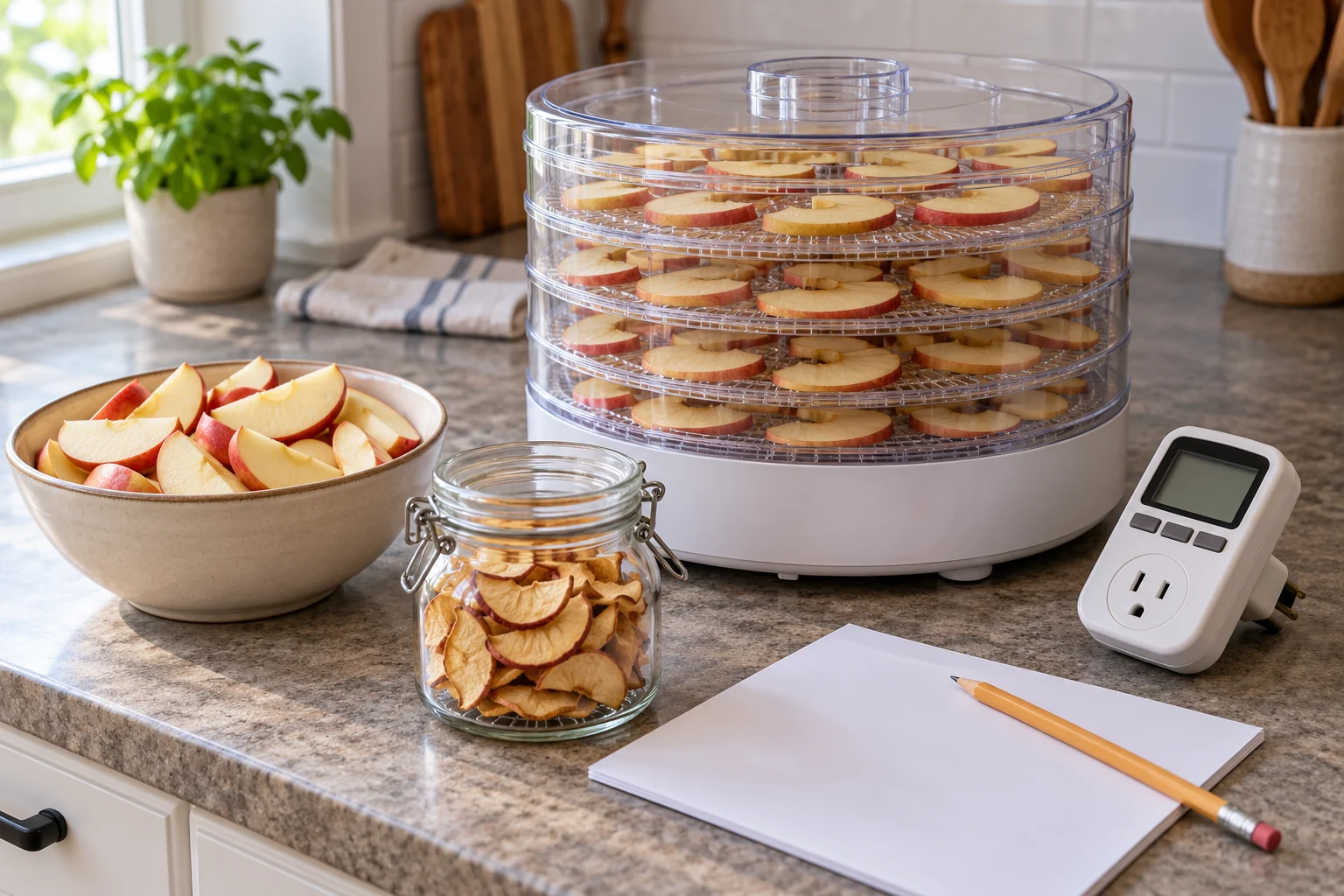
Illustrative food dehydrator batch-cost worksheet with measured energy, ingredient input and usable dried yield; confirm the delivered appliance and food-safety instructions.