Information Theory & Coding
Finite-blocklength coding: error targets, variation and delay
Define finite-blocklength coding error targets, calculate information-density variation, and account for framing, message size and transmission time.
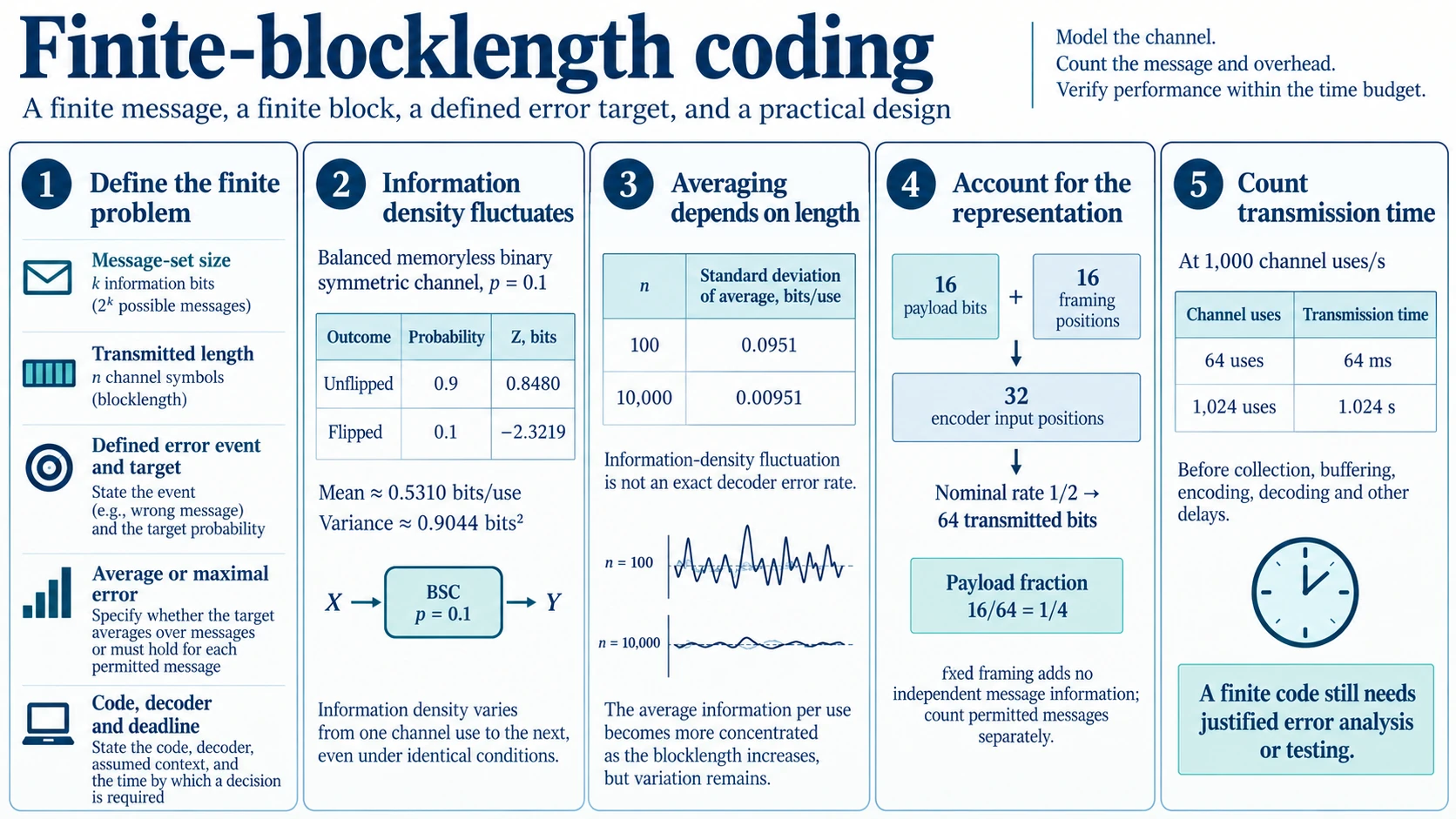
A capacity result for long transmissions does not establish the reliability of a short message. A finite block contains only a limited number of channel observations. Their particular realization can provide less useful evidence than the long-run average, while headers and timing constraints can consume a substantial part of a small message’s budget.
Finite-blocklength coding treats the message size, transmitted blocklength, and allowed failure probability as explicit parts of the problem. A rate below a channel’s asymptotic capacity is relevant, but it does not identify a working short code or prove that a decoder meets a chosen error target.
The useful assessment states the channel model and error event, then accounts for statistical variation, code and decoder behavior, overhead, and delay. The discussion below uses a hypothetical binary channel to make the variation concrete. It does not claim a numerical reliability guarantee for an unspecified real link.
Specify the target error probability and its event
Let a message contain k information bits and be represented by n transmitted channel symbols under a stated code. Its information rate is k/n bits per channel use if the message set contains 2k possibilities. A payload can be smaller than k if those information bits also include required headers or control fields.
Choose the error event separately. It might be failure to recover the complete message, any wrong payload bit, or a decoder-declared failure. These events can have different probabilities. A decoder may return the wrong message without declaring failure, so its flag rate cannot automatically substitute for message error probability.
The target must also specify whether it averages over messages or must cover each permitted message under the stated model. A favorable average can conceal weaker cases. Likewise, known framing, initial decoder state, and other supplied context are assumptions that should appear in the contract.
Define the event behind a target error probability before counting failures. The linked multiple-description guide reconstructs source level eleven as 10.5 when its first description arrives alone; receiving both descriptions recovers eleven exactly. A test demanding the original level counts the side reconstruction as incorrect, whereas a test allowing sufficient distortion can accept it. Those decoder outcomes specify what to count. Calculating their frequency would also require a reception distribution, which the example does not supply as a short-code reliability target.
Without k, n, the channel, and the error event, a statement that a short code is “near capacity” is incomplete. It describes proximity to a rate limit while leaving the required operational outcome unspecified.
Repeated observations reduce relative variation without removing it
Consider a stipulated memoryless binary symmetric channel that flips each input bit independently with probability 0.1. Use equally likely inputs. Its asymptotic capacity is about 0.5310 information bits per channel use under this model.
A long block contains many observations of the channel rule. The average information supplied by those observations tends to become more concentrated under the independence and stationarity assumptions. A short block has fewer opportunities for that averaging, so its actual observation sequence can differ substantially from the mean.
The code and decoder determine whether a particular observation sequence produces the original message. Statistical concentration describes the variation in an information quantity over the stipulated channel. It leaves the finite implementation’s decision behavior to a separate analysis or experiment.
A one-time control message with a fixed transmission budget must be assessed with the observations available by its deadline. Using an arbitrarily long code would require a different budget. Any additional averaging benefit must be considered together with the time needed to collect those observations.
Yury Polyanskiy, H. Vincent Poor, and Sergio Verdú’s author-hosted 2010 draft, Channel Coding Rate in the Finite Blocklength Regime, defines achievable message-set size for a specified blocklength and error probability, distinguishing average and maximal error. It defines information density through the conditional-to-marginal output ratio and describes its variance under a capacity-achieving input in finite-length analysis. Its binary symmetric channel treatment also separates a bound for a code’s error probability from the distribution of information density. The calculations here illustrate that random information quantity and representation accounting; they do not compute a bound for an implemented code.
Channel dispersion describes variation around information delivery
For the chosen input and channel, define a per-use information density Z = log2[P(Y | X)/P(Y)]. It measures how the observed input-output pair compares with the marginal output model. Its expectation equals the shared information for that distribution.
In the stipulated balanced-input binary channel, an unflipped output has Z = log21.8, about 0.8480 bits, with probability 0.9. A flipped output has Z = log20.2, about −2.3219 bits, with probability 0.1. The weighted mean is approximately 0.5310 bits.
The flipped case contributes a negative log ratio because its conditional output probability is smaller than its marginal output probability. The channel still transmits one binary symbol on that use. The random information-density contribution and its mean describe evidence under the model, with different values for different realized pairs.
The variance in this example is 0.9 × 0.1 × [log29]², approximately 0.9044 squared bits. For this stipulated capacity-achieving input and channel, that variance supplies the dispersion quantity. Its role is to describe fluctuation, while the capacity describes the optimized average rate.
The filter-bank guide provides a distribution prerequisite comparison for channel dispersion. Its average and difference equations define how input pairs are represented and jointly recovered. Those equations alone assign no probabilities to the pairs and therefore supply no variance for an information-density random variable. Here the balanced input and stipulated conditional flip probabilities define the distribution first. The dispersion calculation belongs to that particular probabilistic channel, not merely to a representation equation.
A finite information budget is sensitive to tail behavior
Under the stipulated independent channel uses, the sum of n information-density contributions has mean n times the per-use mean and variance n times the per-use variance. Its average has standard deviation equal to the per-use standard deviation divided by the square root of n.
For n = 100 in this hypothetical model, the standard deviation of that average is about 0.0951 bits per use. At n = 10,000, it is about 0.00951. The mean is unchanged, but the average becomes more concentrated. Those numbers describe this random information quantity, not measured decoder success rates.
An error target concerned with infrequent unfavorable observations requires attention to the distribution’s tail, not just its mean. A lower allowed failure probability can demand a larger operating margin or another design change. The appropriate finite-length analysis depends on the channel, code, and definition of failure.
Large-block approximations require their stated range of blocklengths and error targets. Very short blocks or extreme targets can fall outside a useful approximation range. Evaluate the applicable finite-length bounds or code behavior before using an approximate penalty as a numerical reliability claim.
Suppose a hypothetical record contains sixteen payload bits and sixteen required framing positions. An encoder with nominal rate one half maps those thirty-two input positions to sixty-four transmitted coded bits. Its nominal code-input rate is 32/64, while the payload fraction is 16/64, or one quarter.
Headers and framing matter more when the payload is small
These counts describe different layers. Omitting the framing doubles the apparent payload fraction from one quarter to one half. For a capacity or finite-message-set calculation, count the permitted messages: fixed framing values do not add sixteen independent information bits. The nominal encoder rate can remain one half even when the allowable input set is restricted. State which framing values vary and which are supplied or fixed before identifying k with the logarithm of the message-set size.
The probability that the information-density sum falls below a chosen threshold does not by itself equal a decoder’s exact message-error probability. Finite-length bounds relate such random information quantities to code limits under their stated conditions. The implemented code and decision rule still require their own justified error analysis or experiment.
Fixed overhead can be amortized across a larger message or a group of messages if the surrounding contract allows it. Doing so can change delay, access, or state dependencies. It should not be assumed available to a short isolated message without stating how the decoder obtains the needed framing.
Termination and known initial states can likewise consume symbols or rely on shared context. Different choices affect both the code behavior and the complete representation size. A short-block assessment must include those choices rather than treating the payload as the only transmitted information.
Longer blocks can conflict with a delay budget
At a stipulated rate of 1,000 channel uses per second, transmitting sixty-four uses takes 64 milliseconds. Transmitting 1,024 uses takes 1.024 seconds. These are transmission-time calculations under a constant-use-rate assumption, before adding data collection, buffering, encoding, decoding, or other delays.
A longer block can offer more statistical averaging or a more capable code under suitable design. The application may nevertheless reject its elapsed time. A reliability claim that meets its target only after increasing the delay beyond the requirement does not satisfy the original operating contract.
Processing effort also matters. An existence result for a good code does not establish that the permitted decoder can run within its resource and timing limits. Complexity, stored state, and the available observation representation are implementation facts that must be assessed.
Compare message size, transmitted length, defined error event, and total timing under the same channel and accounting assumptions. Several designs can satisfy those conditions with different margins. Their rates and predicted outcomes should refer to the same operating requirements.
Verify the finite code and its decoder
A concrete evaluation identifies the code, decoder, message set, channel conditions, and failure criterion. It retains known original messages and recovered outputs, including miscorrections and declared failures. A passing parity check or a plausible decoder score does not replace that comparison.
Testing a rare error target requires an appropriate evidential plan. Observing no failures in a limited sample does not establish an arbitrarily small underlying probability. Dependence between trials can also change what the sample supports. State the evidence and uncertainty rather than rounding a favorable run up to a universal guarantee.
The model must remain part of the report. A bound proved under a fixed memoryless channel and a measured result under changing conditions are different forms of evidence. Agreement can be investigated, but the assumptions cannot be silently exchanged.
Defining a finite experiment for captured data
An image-file test could begin with the listed storage and export function for waveform images on the Unbranded ZT-703S Electrical Testing instrument (SKU 18623303850). A separate coding experiment could represent an exported image file as bytes and retain that original file for comparison after decoding. This is an image-file experiment; the listing does not establish numerical sample export. Its channel, code length, decoder, and target error event must be specified by the experiment; the listing supplies none of those reliability assumptions.
The Focusrite AMZFCS4I4CR3X Red 4i4 Kit, SKU 1894010824, pairs its four-input USB-C interface with Mackie CR3-X monitors and recording accessories, including a condenser microphone and headphones. Its four balanced outputs support monitor routing. A separately defined transfer of captured audio supplies a context for a coding study. A verified short-message result would additionally need the finite code, statistical model, recovered-message comparison, and complete delay accounting.
Keep an experiment record that separates the permitted message set from the encoder input positions and lists each source message beside its decoded output. Report the observed error event and the elapsed time under the stated channel assumptions. If framing is fixed, retain that decoder context without counting it as freely selectable message information. These records let another reader check the rate, the failure count, and the complete time budget for the finite design.