Audio Production
Multiple-description coding: side and central reconstruction
Multiple-description coding defines side reconstruction and central reconstruction separately. Trace repeated bits, payload cost and joint reception outcomes.
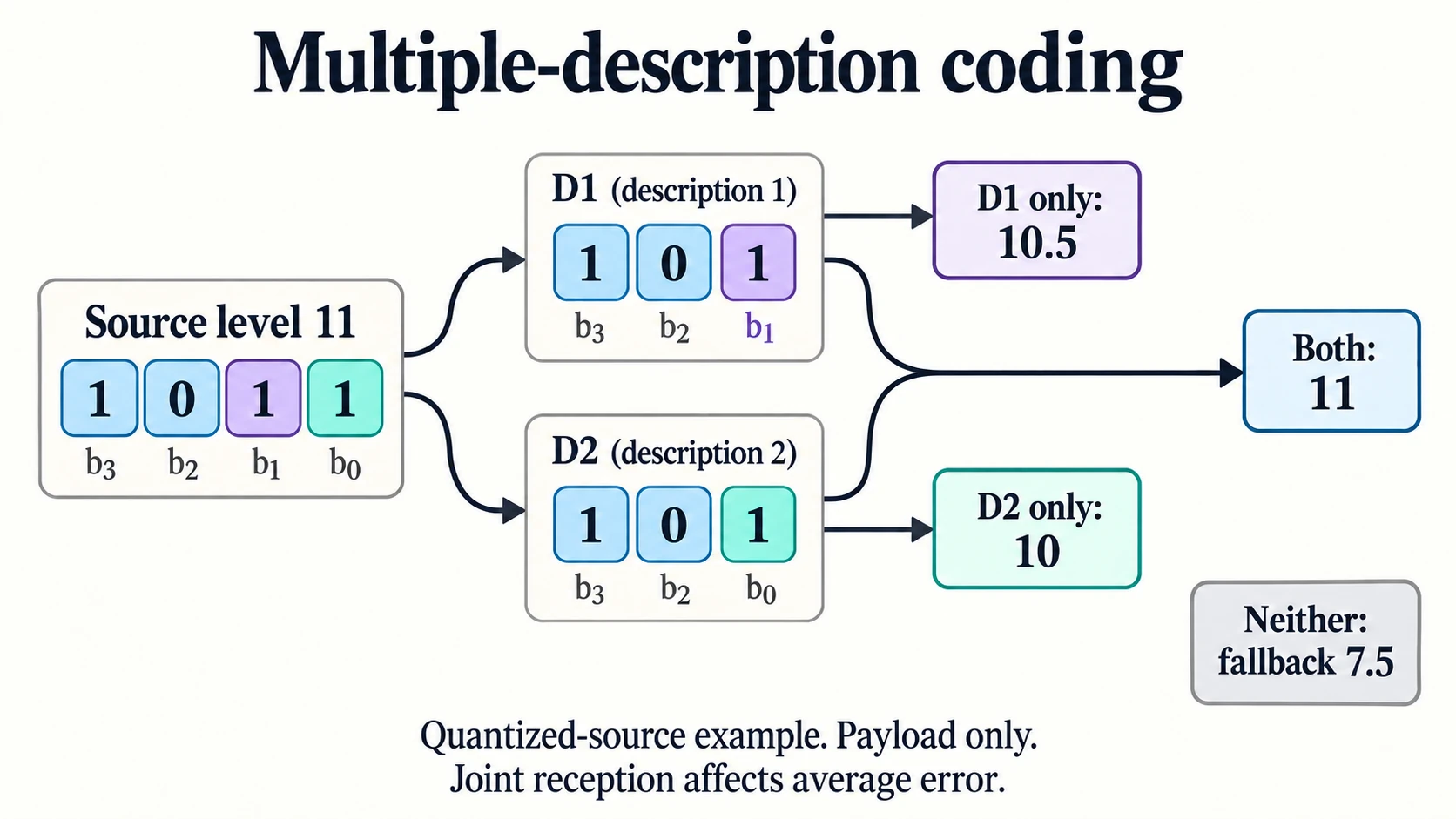
Two representations can each support a useful reconstruction while their combination supplies finer information. multiple-description coding designs those representations jointly for several reception outcomes. It spends some rate on repeated information for standalone usefulness and some on complementary information for the joint result.
Use a source already quantized to integer levels zero through fifteen. Its four binary bits are b3, b2, b1, and b0, from most significant to least significant. The example compares exact toy reconstructions of those levels, not a measured audio or video codec.
Specify three reconstruction obligations
The first decoder receives description D1 alone. The second receives D2 alone. The central decoder receives both descriptions. Each outcome needs its own distortion requirement rather than a single undefined label such as good quality.
Use squared numeric error for this example. D1's standalone requirement is error at most 0.25; D2's is at most one; and the joint requirement is zero error relative to the quantized source level. The asymmetry is deliberate and will follow from the bits assigned to each stream.
The no-description outcome has no side information from these streams and is evaluated separately when reception probabilities are introduced. It cannot inherit the guarantee of a decoder that received one complete description.
Jing, Zheng and Médard's Layered Source-Channel Coding: A Distortion-Diversity Perspective defines two side reconstructors and a central reconstructor, with separate rates and distortions. The bit allocation here is an independent teaching construction, not a claim that it reaches an optimal rate-distortion region.
Construct two descriptions with repeated and complementary bits
Let D1 carry b3, b2, and b1. Let D2 carry b3, b2, and b0. Each description is three bits. The two high bits repeat, while the third bit differs between descriptions.
D1 identifies an adjacent pair of source levels because only b0 is missing. Reconstruct at the pair's midpoint. If its three-bit integer is k, the estimate is 2*k+0.5. Each possible source level is half a unit from that estimate, giving squared error 0.25.
D2 identifies the high-bit block and the low-bit parity while missing b1. If the two-bit prefix represents P and the supplied low bit is r, possible source levels are 4*P+r and 4*P+2+r. Their midpoint is 4*P+r+1, with squared error one.
A side reconstruction therefore uses only its own complete stream. D2 does not need D1 to interpret its prefix or choose that midpoint. Its lower precision is a defined standalone result rather than a decoding failure caused by a missing base layer.
Trace side reconstruction and central reconstruction for level eleven
Source eleven has bits 1011. D1 is 101, identifying ten or eleven and reconstructing 10.5. D2 is also written 101 under its different field contract: prefix 10 and low bit one identify nine or eleven, reconstructing ten.
The two identical displayed three-bit strings have different meanings because their layouts differ. D1's final bit is b1, while D2's is b0. Stream identity and format are necessary to interpret the payload.
With both descriptions, the central decoder retains the common prefix, takes b1 from D1 and b0 from D2, and recovers 1011, or eleven. Every source level in this toy model can be reconstructed exactly that way.
central reconstruction here has zero error relative to the already quantized integer. That does not claim zero distortion relative to an earlier continuous signal or a real media source. Those would require another stated source and distortion boundary.
A side reconstruction contract cannot be assumed merely because a representation has two streams. The I/Q sampling guide shows that opposite complex rotation directions share the same cosine component while their quadrature signs differ. The ordered pair retains that distinction, which the cosine alone does not. This electrical representation is not a multiple-description codec. The coding example here instead repeats high-bit context so each complete description supports its specified source-level estimate.
Repeated information costs rate but supports standalone use
The descriptions use six transmitted bits in total for a source level represented by four bits. Two prefix bits are repeated. That cost buys a coarse location in the source range for either surviving stream, while each complementary bit improves the joint estimate.
Simply splitting the original four bits into disjoint halves would use four total bits, but a low-bit half alone would not provide the same coarse location. Avoiding all repetition changes the side-decoder obligations rather than automatically meeting them more efficiently.
Conversely, transmitting the entire four-bit level twice would make either stream exact but spend eight bits. The six-bit construction illustrates an intermediate choice with unequal side precision. It is not a proof that six is the minimum rate for the stipulated requirements.
The six-bit number counts only description payload in this toy layout. A complete transmitted representation can also need item identity, framing, and integrity information. Those fields must be included before making a real size comparison. Their omission from the teaching arithmetic is explicit and supplies no claim that a particular media format uses exactly six bits per sample.
Keep stream layouts beside the three decoder estimates when checking a source item. For level eleven, those estimates are 10.5, ten and eleven. The Lenovo IdeaPad touch laptop is described with 512GB PCIe storage and 16GB DDR4 memory, alongside its 15.6-inch FHD Touch display. That computing workspace can show the layouts and estimates in separate columns. The listing supplies no measured media-coding quality.
Compare a dependent enhancement layer and exact erasure recovery
An alternative base description can contain b3, b2, and b1, while a one-bit enhancement contains only b0. Together they recover the four-bit level at four total bits. The enhancement alone lacks the high-bit context and does not supply D2's standalone reconstruction.
That dependency contract differs from the two complete side descriptions. This article does not explain an ordinary layered media delivery system. It uses the comparison to identify which decoder can operate without the other stream.
Joint branch inversion supplies a comparison for central reconstruction. The filter-bank guide forms an average and a difference for each input pair, then combines them to recover both values. Pairs(3,1) and(1,3) share average two but have differences one and minus one. Their joint invertibility does not make the average branch alone identify the pair. The two bit descriptions here use another combination rule and additionally require defined standalone distortion for each side.
An exact erasure code asks whether enough surviving encoded data reconstruct the original packets exactly under its rule. Multiple-description design can instead promise a nonzero-distortion result when only one description survives and a better result when both survive. This comparison does not construct an erasure decoder or claim the objectives are interchangeable.
Reception probabilities must retain all outcomes
Assume a uniformly distributed source level, and reception independent of that level. The toy side mean squared errors are 0.25 and one, and the joint error is zero. If no description arrives, choose fixed estimate 7.5, whose average squared error across levels zero through fifteen is 21.25.
Give each stream a reception probability of 0.75 and first stipulate independent reception. Both arrive with probability 0.5625, D1 alone with 0.1875, D2 alone with 0.1875, and neither with 0.0625. Weighting the four outcome distortions gives average error 1.5625.
Now keep the same individual reception probabilities but make receptions fully correlated: both arrive with probability 0.75 and neither with 0.25. No single-description outcome occurs. The average error becomes 5.3125 under the same fallback.
An average over only successfully received items is another metric. In the independent table, excluding the no-description outcome gives a conditional mean of 0.25 after dividing the received-outcome error total by 0.9375. In the fully correlated table, every received item gets both streams and has zero distortion. Those conditional means can look attractive while the full outcome averages still include the large losses reported above.
A quality report must therefore state whether missing items were excluded, assigned a fallback, or treated as a failure outcome. Removing them from the denominator does not improve what was reconstructed for those items. The side guarantees apply when their corresponding descriptions arrived; they do not establish delivery or a useful estimate when neither arrived.
The different totals come from different joint loss structure, not different marginal stream reliability. Assuming independent paths would misstate the second scenario's reception outcomes. A claim about path diversity needs evidence about that dependence.
Unequal reception favors a separately stated design objective
If D1 survives much more often than D2, its side quality can receive a different priority in the design problem. Another application may care about the worse side guarantee or the best joint quality. Those objectives can justify different repeated and complementary allocations.
The example supplies outcome requirements and arithmetic but does not optimize them for every probability table. A single quality label cannot explain whether a design improved D1-only reception, D2-only reception, or the both-stream result.
Joint reception outcomes need their own table, with probabilities beside the corresponding distortions. The ASUS Vivobook 14 product page describes a laptop with a 14-inch FHD display that can show those four rows together. Equal reception probabilities for the individual streams leave their joint relationship unspecified. The equipment description establishes neither path independence nor measured codec performance.
Verify stream identity, agreement, and distortion separately
The central decoder must receive descriptions for the same source item under the same layout convention. D1 for one item and D2 for another cannot be combined merely because both have three bits. Retain the frame or item identity with each stream.
The repeated prefix should agree when both valid descriptions correspond to the same toy source. A disagreement is not another refinement bit; it is inconsistent evidence that requires the format's error handling. The loss-only example does not correct arbitrary corrupted descriptions.
For the defined levels, test every D1-only estimate, every D2-only estimate, and the joint reconstruction. The three distortion obligations pass under the stated arithmetic. The different reception tables then weight those already defined outcomes.
The construction repeats the high-bit context needed by each side and combines the different low bits for exact recovery of the quantized level. At level eleven, the side estimates are 10.5 and ten and the joint estimate is eleven. Interpret their quality under the specified decoder contracts, payload costs and joint reception table. An enhancement-only dependency and a different loss relationship require their own outcome accounting.