Office Supplies & Stationery
Desk mat evening reset: make room for one personal project
A modest end-of-work desk transition using an existing mat as a boundary for a postcard, sketchbook or other one-task personal project.
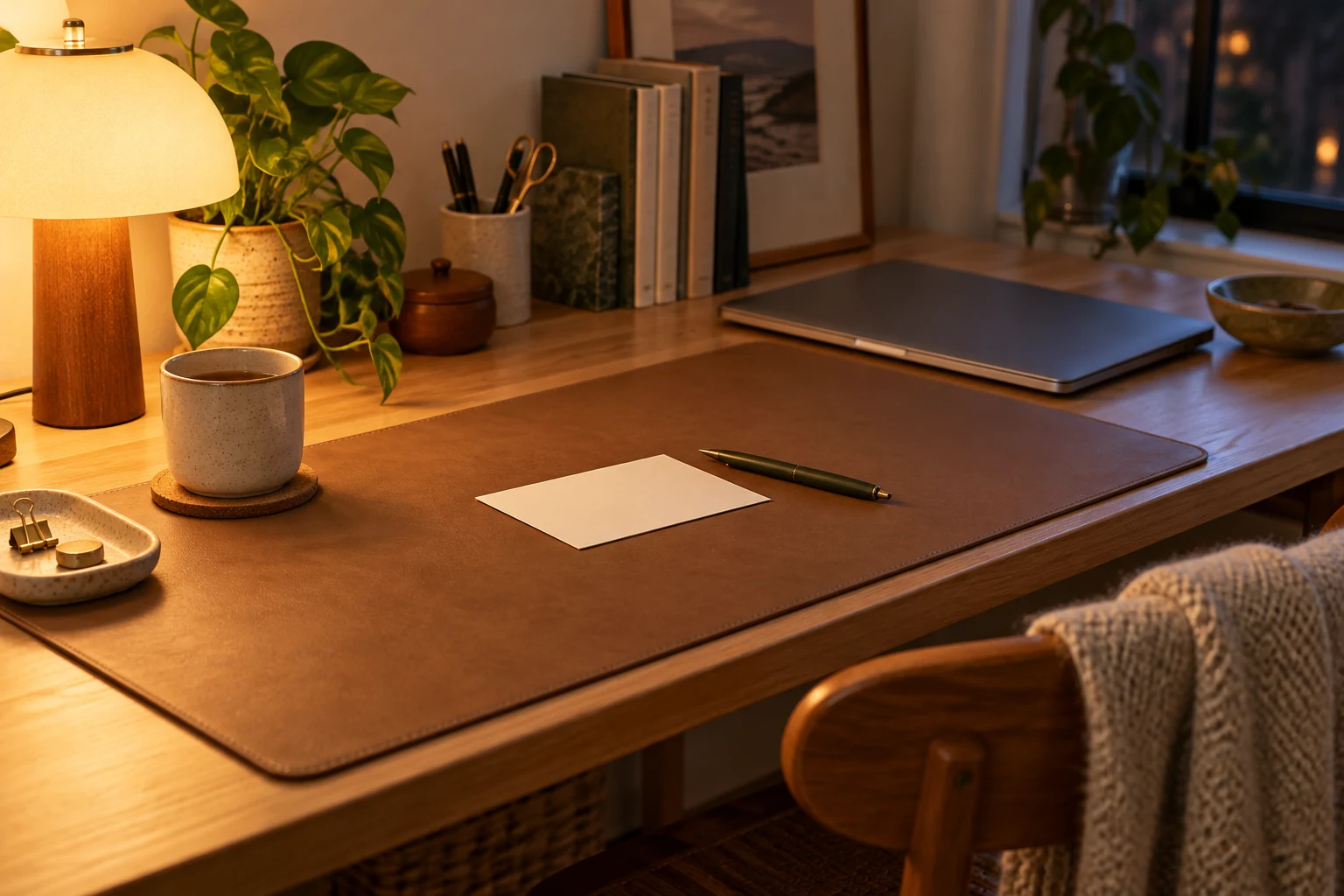
A Desk mat evening reset can be as modest as closing your laptop, moving work papers off the mat, and putting one personal project in their place. The mat you already have supplies a visible edge for that exchange. It does not have to create a mood or deliver a better evening. You are simply deciding that, for a little while, this portion of the desk will hold something you chose outside work. A postcard, a small sketchbook, or a few pieces of an unfinished model can be enough.
This is especially useful as a practical arrangement when your work desk is also your only personal table. You may not have a spare room, an empty drawer, or an evening without interruptions. The aim is not to disguise those circumstances with an elaborate ritual. It is to make a specific change you can see: work is put away as far as tonight allows, and one other activity has a place. The mat marks that place without making the rest of the room part of the assignment.
Give the boundary a small, clear job
Start by deciding what the mat’s edge will mean tonight. For example, anything placed on it after work belongs to your postcard-writing session, while unfinished work stays in its folder elsewhere. This is a household arrangement, not a rule the material enforces. A work notebook can cross the edge whenever you move it. What matters is that you have chosen a use for the space and made the objects on it match that choice.
Keep the boundary narrower than “my whole evening is now personal time.” That might be unrealistic if you are on call, sharing childcare, or expecting an important message. A more accurate version could be, “Until dinner, this mat holds my postcard and pen.” Another could be, “I will assemble one part of this model before putting it away.” These descriptions name an activity and a stopping point without asking a patch of desk to settle every competing demand.
You also do not need to make the mat look empty before you begin. A monitor stand may occupy its back edge, or a keyboard may have nowhere else to go. Choose an available section and give that section the job. Perhaps the front half will hold a card, with the keyboard pushed safely behind it. Leave equipment stable and cables unstrained. The arrangement should fit the desk you actually use, including the objects that cannot conveniently disappear.
Begin by leaving work somewhere definite
The beginning of the sequence is a work closing, not a personal-project setup. Save the document you are using, follow any required sign-out procedure, and leave yourself a brief note about the next work action. “Check the figures in the second table” is more useful here than “finish report.” The note gives tomorrow’s task a specific location in your work materials. It does not need to become a review of everything you accomplished or failed to accomplish today.
Next, gather the loose work items occupying the space you intend to use. Put papers in their existing folder, return the work notebook to its usual shelf, and move the laptop to a stable place if it can be moved. If it must remain, close it when your work requirements allow. Do not balance it on a chair arm or pile it under craft supplies just to produce a clear-looking surface. A workable closing leaves your equipment somewhere you can retrieve it safely.
Some evenings require a more qualified ending. If you must check a message later, decide where that check will happen and what will prompt it. You might leave your phone beside the work folder and return to it at an agreed time. If the situation is too unsettled for a genuine break, acknowledge that rather than staging a complete shutdown. You can still make room for a small personal activity, but the arrangement should reflect your actual responsibilities.
Make the transition an exchange of objects
Once the work closing is done, change what occupies the mat. Remove the items you have finished using and bring out only what the chosen project needs for its first step. For a postcard, that might mean one card, a pen, and an address reference. For sketching, it could be a notebook and one pencil. Leave the larger collection put away. This keeps the setup proportionate to the small piece of evening you intend to use.
Let the edge answer a concrete placement question: what belongs in this session, and what can remain outside it? A stack of unrelated mail can stay in its usual tray. Tomorrow’s meeting notes can stay with the closed laptop. The mat does not need to contain every object associated with your life outside work. Its purpose tonight is more particular. You are giving one selected project enough room to begin, rather than converting the desk into a display of all your interests.
Choose the first action before expanding the setup. “Write the address on this postcard” is an action; “get back into correspondence” is a much larger undertaking. “Open the sketchbook to the unfinished page” is similarly manageable as a starting instruction. You are free to continue after that action, but you do not owe the setup a substantial result. If you discover that you would rather stop, the materials can go away without needing to justify the time spent taking them out.
A laptop-to-postcard evening in practice
Imagine that you finish laptop work shortly before making dinner. Your mat holds the laptop, a work notebook, and a sheet of handwritten figures. You save the file and write one next-action line in the notebook. The figures go inside it, and both move to the shelf where you keep work materials. You close the laptop and place it on its usual stand. Nothing about the desk has become decorative; you have simply finished using those particular objects.
You then take a postcard from a small stationery box and place it near the front of the mat. A pen sits beside it, with the address available on a separate slip. You leave the rest of the postcards in the box. The change from laptop to card makes the new use of the space visible. You do not need a different chair, an accompanying drink, or a photograph of the arrangement. You need enough usable room to put pen to card.
Suppose you write the address and begin the message, then stop because dinner needs attention. That is a legitimate end to this session. Put the card with its address slip in the stationery box, keeping it apart from completed cards awaiting postage. If you finish instead, move it to the place you use for outgoing mail. Either outcome gives the card a definite next location. It need not remain on the mat as a reminder that you should have done more.
This article’s concern is the exchange of work materials for postcard materials, not what the message should say. If you want to take the correspondence itself further, the guide to writing a postcard to someone you miss is a separate next step. You can make that decision once the card is in front of you. Setting up a place to write does not require planning the entire message beforehand.
Let the existing mat determine the available area
Use the mat already at hand without treating its size or material as a verdict on the routine. A narrow pad might accommodate a card and pen but not a large open notebook beside them. A broader mat might still be mostly occupied by permanent equipment. Arrange tonight’s project within the usable area rather than assuming that the full outline is available. If the activity needs more space than the desk offers, choose a smaller part of it or use another suitable surface.
Seller listings can illustrate different footprints, but they do not establish what this transition will do for a person. One optional example is a mat listed by its seller as 47.2 x 24 inches in PU leather. Another is a desk pad set listed by its seller as 32 x 16 inches in full-grain leather. Those dimensions and material descriptions are seller claims, not independent test findings. Neither example is a prerequisite for using what you own.
There is no purchasing step in this evening sequence. Choosing a new mat by measured footprint and construction is a separate buying decision. Here, the useful question is whether you can place the selected materials on the existing surface and use them comfortably enough for the task you have chosen. If not, change the arrangement or the task. You do not need to interpret a cramped layout as a reason to replace the mat, upgrade the desk, or postpone every personal project.
When the desk cannot stay open
A small or shared desk may need to return to another use immediately afterward. In that case, give the project a storage place before starting. An existing envelope, shallow box, or folder may hold the postcard and its accompanying slip. Check that the container suits the materials rather than forcing something delicate into it. At closing, the project goes into that container, and the mat returns to its ordinary position or storage location. Leaving an inviting scene out overnight is optional.
If the mat itself has to come off the desk, handle it according to the instructions available for that item. Do not assume that every mat can be folded or rolled. Where it can be stored flat, choose an existing spot that does not obstruct another household use. Where suitable storage is unavailable, leave the mat in place and put away the project instead. The visible boundary only needs to serve while you are using it; it does not need a permanent evening configuration.
For a shared table, make the handback as explicit as the beginning. You might tell another person, “I will put this away before we eat,” then choose a session that fits that agreement. Bring out fewer materials if clearing them would otherwise become a lengthy job. The project container can carry the unfinished work forward while the table returns to everyone. A personal activity can have a real place in the evening without claiming the household’s limited surface for the rest of the night.
Keep other improvements separate
You may notice practical issues once you sit down: the pen needs replacing, the address is missing, or the available light does not suit the task. Deal with what is necessary, but avoid turning each observation into a desk-renovation list. If you cannot proceed without the address, finding it can be tonight’s one project action. If you need to move elsewhere to write, do that. The mat is an available boundary, not a requirement that overrides the ordinary needs of the activity.
Lighting deserves its own decision rather than becoming another hidden condition of this routine. If arranging an evening writing place is your next concern, the guide to a desk lamp for an evening writing spot takes up that separate question. You do not need to resolve the whole writing environment during the work-to-personal exchange. Tonight’s transition can remain a modest rearrangement, with any larger changes considered on their own terms later.
Close before the setup becomes another obligation
The closing stage gives the project somewhere to wait. Return the pen, contain loose pieces, and place unfinished work in its chosen folder or box. If a short note would help, make it specific: “Add postage” or “Continue on the reverse.” You do not need to score the session, record a streak, or decide whether it counted as sufficiently creative. The materials simply leave the working area in a condition that makes their next use possible.
Finally, return the desk to whatever arrangement your household needs next. You may leave the mat clear, put the keyboard back, or remove the mat if that is your normal practice. The full sequence is straightforward: close work with a definite next action, exchange its materials for one chosen project, and put that project somewhere definite when you stop. Repeat it when it serves you, alter it when circumstances change, and leave it alone on evenings when you want to do something else.