Lifestyle & Inspiration
A postcard-writing afternoon for a person you miss
Enjoy a postcard-writing afternoon: choose one reader, develop an ordinary moment into a personal message and revise it around the conversation you want.
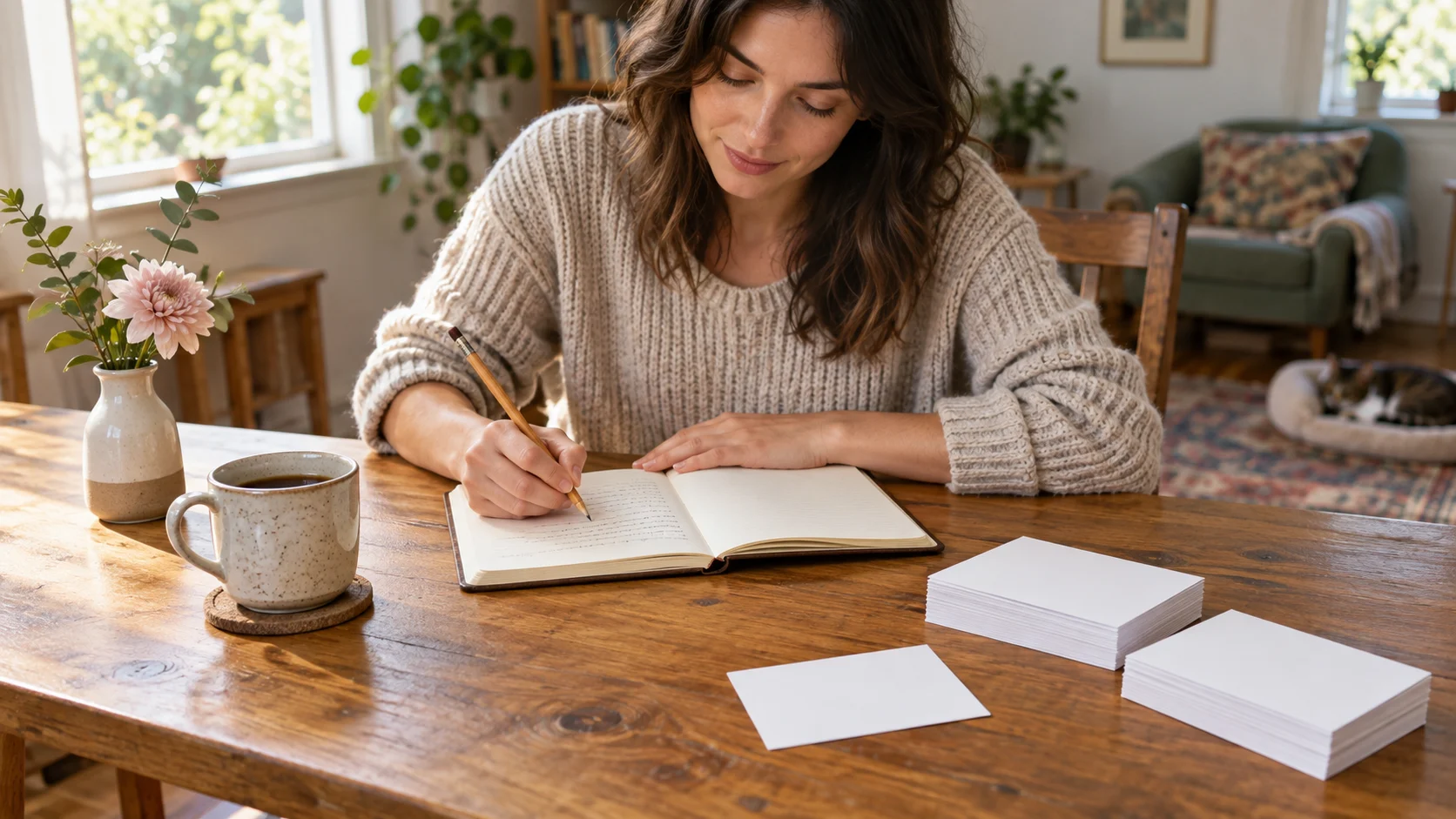
A postcard-writing afternoon can begin with someone you have been meaning to catch up with and one ordinary thing you would like to tell them. You might have noticed a familiar tree changing colour, found a book they once recommended or remembered a small moment from a visit. Choose the detail that makes you want to speak to that particular person.
Set aside a little time with a notebook or draft paper. The first version can be longer than the eventual message. Let yourself find the words before deciding how to present them. Existing suitable materials can be enough; buying a large pack of printable cards is a separate choice from making time to write.
Choose a reader before choosing a theme
Think of one person and how you normally talk together. A friend who enjoys your everyday observations may welcome a small account of the week. A relative who knows the place you are describing may recognise it from one detail. Someone who has never visited may need a few extra words to understand why you noticed it.
Keep the intended reader in mind while choosing what to include. You do not have to cover every change since your last conversation. Pick a subject you would enjoy telling them about if you met for a short walk. A modest subject gives you room to tell the reader what caught your attention in your usual words.
If several people come to mind, start with one. You can write another message later without turning the afternoon into a promise to finish a whole list. The first card gives you a chance to see which kind of detail feels natural to write and how much space your message actually needs.
Finding a small moment for a postcard gives the draft somewhere to begin
For finding a small moment for a postcard, look at the last few days. What did you pause to notice? It could be something you heard on a familiar route, a meal that reminded you of another kitchen or a small change in a room. Choose what you genuinely want to share, rather than searching for an impressive event.
Write a few rough lines about the moment before addressing the card. Name the thing that caught your attention and what made you think of the reader. If the connection is obvious only to you, add the missing link. Someone receiving a message about a book may need to know that it was the title they recommended during your last visit.
Try a fictional example. A writer first drafts, “Things have been busy, and I thought I would write.” They then realise the reason for writing was seeing a familiar blue door on an evening walk. A more particular opening might say, “I walked past the blue door we kept missing on our way to the café, and remembered how long we spent looking for it.” This invented scene is a writing example, not a claim about a real place or person.
The blue-door detail gives the imaginary reader a shared moment to recognise. Your own detail may be entirely different. Keep the version that sounds like something you would actually say to the person, even if it is quieter or less neatly phrased than the example.
Make room for your own voice
Read the opening aloud as though the recipient were beside you. If a sentence sounds more formal than your usual conversation, try saying it again without looking at the draft. The spoken version may help you find a simpler wording. Keep any expression you like using together, provided it will make sense in this message.
You can leave a small question at the end if there is something you genuinely want to ask. Refer to the reader's actual interests or an earlier conversation you remember, rather than adding a standard question merely to finish the paragraph. The card can also end with a warm statement if that suits the relationship better.
Let the message have its own pace. One lively detail may need a little explanation; another may work in a single sentence. Leave a sentence simple if it says what you want to tell them. Look for a point where the reader has enough context and the message feels complete to you.
When the reader has never visited the place you are describing, choose one detail that helps them imagine it. You could explain what you were doing when you noticed the scene, then say why you thought they would enjoy hearing about it. Keep the connection specific to the person. A general description of an entire town may leave less room for the small observation that prompted the note.
You can also write about a familiar routine that has changed. A new route to work or a different book beside your chair may be enough to start a conversation. Compare what you notice now with what the reader already knows, using only the part you want to tell them. There is no need to invent an event to make an ordinary week sound more interesting.
Turn a remembered detail into words for this reader
A shared memory can give the message a starting point, but your recollection should remain recognisably yours. You might write that you remember the rain starting as you reached the gate, or that a particular room seemed enormous when you were young. That kind of phrasing leaves room for the other person to remember the day differently.
The year-end photo-caption afternoon guide develops this idea with shared photographs: people can contribute their own recollections and add details the picture cannot show. Its actual Dahle and WESTCOTT trimmer discussion stays separate from choosing the words. For a personal postcard, use the recollection that matters to your reader; no new trimming equipment or group caption session is required.
If your draft includes a photograph you are looking at, tell the reader what made you notice it today. A description of everything visible can consume the message space without explaining your interest. You might instead mention the person just outside the frame or the conversation you remember afterwards, keeping any uncertainty in your own account.
A card can also mention an object that carries a memory. Suppose you have been reading an old recipe notebook and want to tell a relative about finding it. Your message can describe the experience of seeing the handwriting without claiming that you have deciphered or tested every instruction in the book.
If you choose to quote a recipe line, the family-recipe transcription guide gives a specific second-reader check for copied words and quantities. Its GZHJMY and SJJ cookbook-holder examples are optional equipment contexts for that reading task. Use the wording check when you need an accurate quotation; a personal memory about the notebook remains a different kind of contribution.
Choosing words for one postcard means deciding what the reader needs
For choosing words for one postcard, first mark the sentence you most want to keep. Then ask what the reader needs around it. A place name may be enough for someone who knows the route. Another person may need the small explanation that connects the place to your shared visit.
Remove a sentence if it repeats a point already made. Keep an extra detail when it changes how the reader will understand the scene. This gives you a practical editing question instead of an arbitrary rule that every message must have the same number of lines or sentences.
For example, a draft about finding a recommended book might spend several lines explaining an unrelated shopping trip. If the message you want to share is finally beginning the book, you can shorten the shopping account and make more room for what caught your attention in the opening pages. The choice follows your intended conversation.
Do not force a longer thought into a format that leaves it hard to read. You can shorten the topic, choose a different suitable presentation or save part of it for another conversation. The available message space and your own writing style should help determine the final length; neither product description below establishes how many words your handwriting will fit.
Consider the actual postcard stock separately from the draft
The Compulabel 430604 blank postcard offer describes sheeted cards for laser or inkjet printing. It uses “6 x 4” wording, with two cards per sheet and a carton of 250 sheets or 500 cards. The selected description does not attach a unit to that card-size wording. Preserve the stated format instead of assuming these are loose individual cards.
The Avery matte white printable postcard offer describes 85 Lb inkjet cardstock, “4.25 x 5.5” card wording and 8.5-by-11-inch sheets with fine perforations. It lists 200 cards per box, four per sheet, 50 sheets per box and a bundle of ten boxes. Keep those different package levels distinct when considering what you need. Its separate glossy-finish option does not turn this matte description into a photo-finish guarantee.
These are printing-media descriptions. They do not provide a universal printer setup, pen compatibility or a method for separating and preparing the cards. Follow the applicable material and equipment instructions for the actual stock you choose. You can finish the message on draft paper while those presentation questions remain separate.
A person writing one note may already have suitable materials and little reason to order a carton or bundle. A larger household project might raise a different supply question. Decide from the writing you actually want to do, without making the pack size a target for how many personal messages you must produce.
Read the message with its reader in mind
Set the draft aside briefly, then read it as the intended recipient. Can they understand the scene without hearing an extra explanation from you? Does a reference to “that afternoon” identify the afternoon you mean? Add a few words where they help and remove background that draws attention away from the part you wanted to share.
Check any name, title or quoted wording you decided to include against what you can establish. Keep a remembered detail phrased as a memory when that is what it is. Your personal message can be warm and specific while leaving room for the recipient's own view of the experience.
Choose how you want the finished note to reach the person. You might keep it for a visit or consider mailing it under the current requirements that apply to the actual card and destination. Neither printable-media description establishes the postage, acceptance or delivery of your particular message. That delivery task can follow the writing decision.
Keep the message you made during this postcard-writing afternoon ready for its intended reader. Keep another idea on the draft page if you want to return to it. The next note can begin with a different person and a different ordinary thing you noticed.
Conceptual postcard-writing afternoon with generic cardstock and draft paper; no exact retail stock, printing method or prepared mailing item is depicted.