Office Supplies & Stationery
Desk mat edge lifting: check contact before treatment
Distinguish a raised mat edge from whole-mat movement, inspect support and obstructions, and test a reversible placement change.
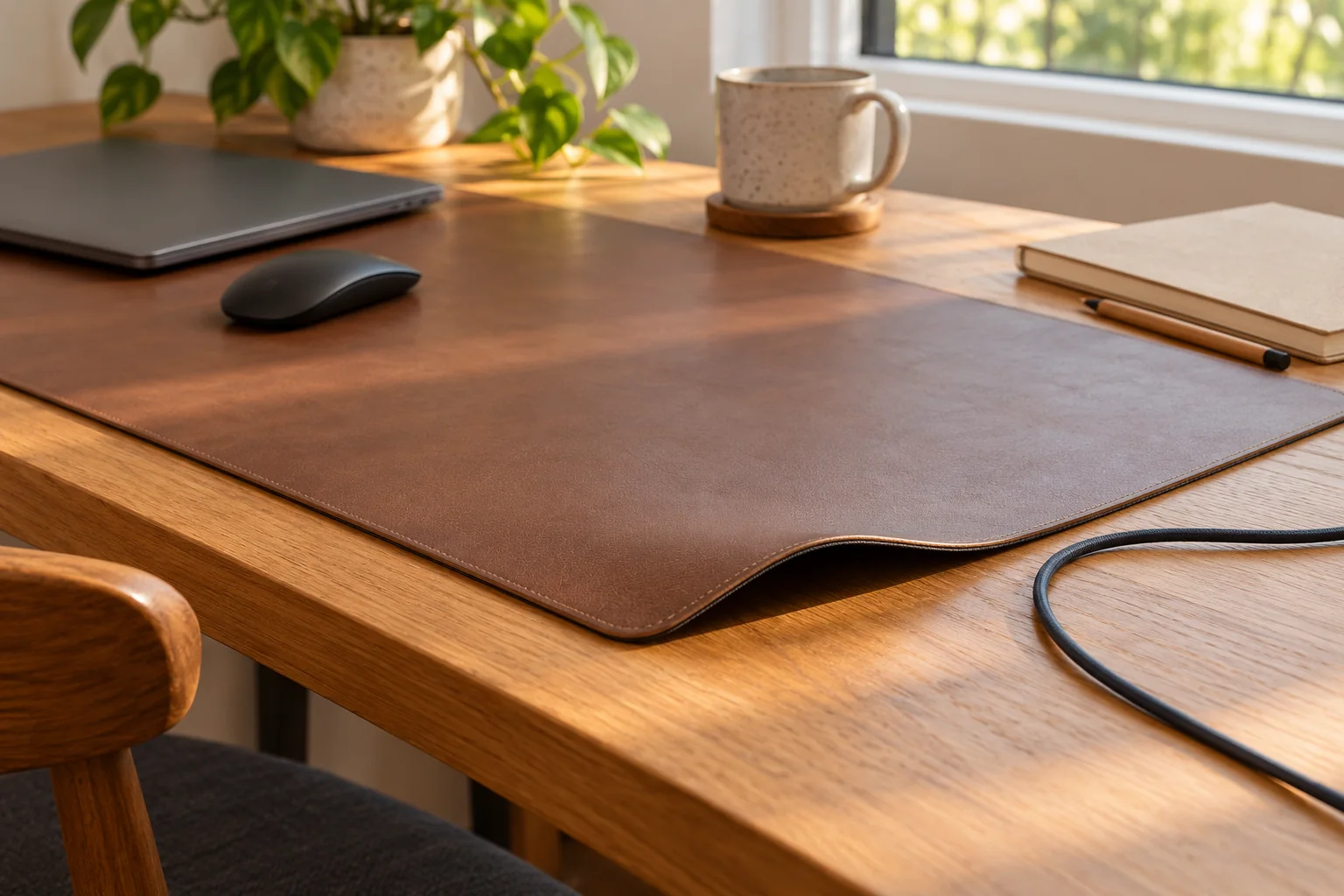
Desk mat edge lifting is easy to notice when a wrist, notebook, or sheet of paper catches on the raised side. The visible symptom does not tell you why it is happening. The mat might be partly on top of a cable, touching the lip of a desk, or simply resting unevenly after being moved. The first useful step is to observe the exact edge and setup before reaching for a treatment. This guide gives a small, reversible way to isolate the problem without assuming that every mat has the same construction or needs the same fix.
Start by naming what you see. Is one corner raised while the rest lies flat? Does the whole mat shift when you write? Does an edge lift only after a notebook is pushed across it? Those are different behaviors. A mat that moves as a whole may need a placement decision; a single raised edge calls for a closer look at what is beneath it. Do not treat a seller's material label as a diagnosis. Test the real mat on the real desk, and stop short of heat, glue, weight, or other irreversible treatment unless the maker gives instructions for that exact item.
Capture the problem before changing the setup
Clear loose objects from the affected edge, but keep the mat where the problem occurred long enough to observe it. Sight along the desk at mat level. Note whether the lifted area is near the desk edge, a seam, a cable, a raised pad, or a pile of paper. Put a small removable marker on the desk near the troublesome corner. If the mat slides during ordinary use, the marker gives you a reference point; you can tell whether the entire mat moved or the edge simply changed shape. No measuring instrument is required for this first observation.
Record when the symptom appears. It may be present before you touch the surface, or it may occur only when a heavy object rests on one side. A desk mat can also seem to move because the object on top moves across it. Watch both the mat edge and the object. Avoid concluding that a backing has failed just because a pen or notebook slips on the top face. The top-face interaction and the underside contact are separate. A careful observation gives you a narrower next test and prevents a fix aimed at the wrong surface.
If the mat is new to the desk, note what changed: its location, the desk surface, the orientation, or the objects placed on it. If it was stable last week, compare the current arrangement with that known arrangement. You are looking for a testable difference, not a story about the material. Move one item at a time, or briefly lift the mat to inspect the desk beneath it. Keep track of the original position so you can undo a change if it makes the edge worse.
Check the contact area
Lift the mat gently and look at the desk where the raised edge sat. A cable, crumb, paper corner, or uneven object can prevent an otherwise flat piece from touching the desk. Remove a loose obstruction and lay the mat down again in the same orientation. If it now sits flat, you have identified a placement cause. If it does not, you have learned something useful without altering the mat. Do not scrape, soak, or apply a cleaner until you know the care instructions for both the desk and the mat.
Look at the full perimeter, not just the corner that catches your sleeve. A mat can bridge the lip of a desk or overlap a raised tray at the back. Slide it inward enough to place the whole footprint on a continuous surface, then observe the troublesome edge. This is a reversible test, not a recommendation to rearrange the entire workstation. If the edge settles when the footprint is fully supported, choose a position that preserves your working space while keeping the mat clear of the lip.
Compare the mat on another clean, flat part of the same desk if one is available. Keep the face and orientation the same. If the lifted edge stays with the mat, the behavior may be in the mat rather than the original desk location. If the lift appears only at one desk spot, inspect that spot and the objects around it. This comparison cannot establish a manufacturing defect, but it can separate a location-specific issue from a more persistent shape issue before anyone considers a replacement or treatment.
Separate edge lifting from whole-mat movement
Use a light, ordinary task as a comparison. Put a sheet of paper on the mat and write a short line, watching the marked corner. Then move the paper away and touch the raised edge without pulling it. If the mat as a whole crosses the desk marker, describe that as movement. If the marker stays aligned but one edge rises, describe that as edge lift. The distinction matters because moving the mat to a better-supported position may address one issue, while adding friction somewhere else would not explain a raised corner.
A broad mat can catch the side of a keyboard, notebook, or laptop stand. Remove that object briefly and repeat the same small task. If the lift disappears, reconsider where the object sits or how the mat is oriented. If it remains, restore the object and continue the diagnosis. You do not have to buy a different size immediately. The first question is whether ordinary placement gives the surface enough unobstructed contact to behave as intended for your work.
Do not press a raised edge down repeatedly and call the problem solved if it springs back as soon as you stop. That demonstrates that pressure can hide the symptom, not that the setup is stable. Similarly, a book placed over a corner can obscure the edge while making the desk less useful. Use a reversible placement test to identify the cause. If you later choose a more permanent change, base it on what the mat actually did, its care guidance, and the importance of the desk surface beneath it.
Read product descriptions narrowly
The listed large PU-face desk mat and full-grain leather desk pad set show that products sold as desk mats can differ in footprint and stated material. Those descriptions do not prove why your own mat lifts, slides, curls, or contacts a particular desk. Do not transfer a claim about one listed item to another mat. Use any product page to identify the exact item and its maker's care guidance, then return to direct observation of the piece in front of you.
The purchase question of size, face, and backing belongs to the mat-selection decision. This article is about an existing mat with a visible symptom. If you are deciding whether to buy a mat at all, the considerations differ from deciding why one corner of a mat already in use sits up. A seller may use broad terms such as leather or desk pad; those words are not enough to justify a chemical cleaner, adhesive, or heat treatment. Such a treatment can change a surface or create a new problem, so avoid improvising one from an unrelated product description.
When care guidance exists for the exact mat, follow it within its stated limits. If it does not, limit your experiment to moving loose obstructions, changing position, and comparing flat support. You can still learn whether a cable, desk edge, or object load is involved. What you cannot honestly establish from a generic listing is a guaranteed way to flatten every material. Keep that uncertainty visible. It is better to leave the mat temporarily unused than to damage it or the desktop while trying a confident-sounding universal cure.
Test one reversible placement change
Choose the most plausible cause from the observations and change only that factor. If a cable runs under the raised edge, route it away and replace the mat in the same position. If the mat crosses a desk lip, move it fully onto the supported area. If a stand presses on one side, set the stand aside briefly. Then repeat the same small task that revealed the problem. A successful test is specific: the edge stays down or the whole mat stays put during that task. It is not proof that every future arrangement will behave the same.
Keep the work area practical while testing. An edge that lies flat only when the mat is pushed into an unusable corner is not a useful resolution. Check whether your mouse, paper, or notebook still has the space it needs. For a modest end-of-work surface arrangement, the desk mat evening reset guide covers a separate one-project routine. Here, the question is narrower: can the existing mat rest stably while the intended work actually happens?
If one change helps, restore the original condition once to see whether the symptom returns, provided that doing so is safe for the desk and mat. That quick reversal makes your conclusion stronger. For example, a corner that lifts only when a cable runs beneath it points toward that cable route. If the outcome does not repeat, mark the finding as uncertain and try the next visible factor. Avoid performing many changes at once; otherwise, you may end with a flatter surface but no idea which change mattered.
Know when to stop the experiment
Stop if the underside sheds material, the top face cracks, a seam opens, or a desk finish appears to change. Photograph the condition and check the exact product's support information instead of continuing with household treatments. This is a practical pause, not a diagnosis of defect or warranty eligibility. The information that matters is the item identity, what you observed, and which gentle placement tests you already tried. Keep purchase and care records if you may ask the seller or maker for guidance.
A mat that cannot lie flat on a clear, continuous surface may need item-specific advice. Do not claim that a weighted stack, tape, adhesive strip, hair dryer, or solvent is a safe remedy without evidence for that material and desktop. Even if an online demonstration shows a similar-looking mat, its construction and finish may differ. Reversible observation has a clear stopping point: once the obvious obstructions and placement factors have been checked, further material treatment belongs to the maker's instructions or an informed owner decision.
If the edge is merely inconvenient rather than damaged, you can also choose to use a different part of the desk while you seek guidance. Keep a raised corner out of the path where papers or hands catch it. That is a temporary arrangement, not a repair. If the problem is actually task lighting over a shifted workspace, the desk-lamp writing spot guide addresses light direction separately. A lamp adjustment does not fix mat contact; it may simply make the changed working position usable for a short period.
Leave a clear result for the next use
After a successful reversible test, put the mat back in the position that worked and note any condition that matters, such as keeping a cable clear of its edge. Use the surface for a few ordinary minutes before declaring the issue resolved. A mat may look flat when untouched yet move during writing. Check the same corner with the same kind of task that exposed the issue. If the symptom returns, you still have the original observation and can describe it precisely rather than starting from a vague complaint.
The useful result may be “the cable was under the edge,” “the mat overlaps the desk lip,” or “the edge remains lifted on two clear flat positions.” Each statement supports a different next action. None requires a universal story about material quality. Keep the description tied to the actual mat, desk and task. That approach protects both your workspace and your time: it avoids treating every raised edge as a product failure and avoids hiding a persistent problem with pressure or an untested substance.
Desk mat edge lifting becomes manageable when you separate what you see from what you assume. Observe the edge, inspect contact, distinguish movement from lift, test one reversible change, and stop before material treatment when the cause remains uncertain. If the mat settles and remains stable during the intended task, you have a usable arrangement. If it does not, the clear record of what you tried is the right starting point for item-specific guidance or a considered replacement decision.