Lighting
desk lamp base crowding a small desk: map the footprint first
A measured troubleshooting plan for a desk lamp base that takes too much working space on a small desk.
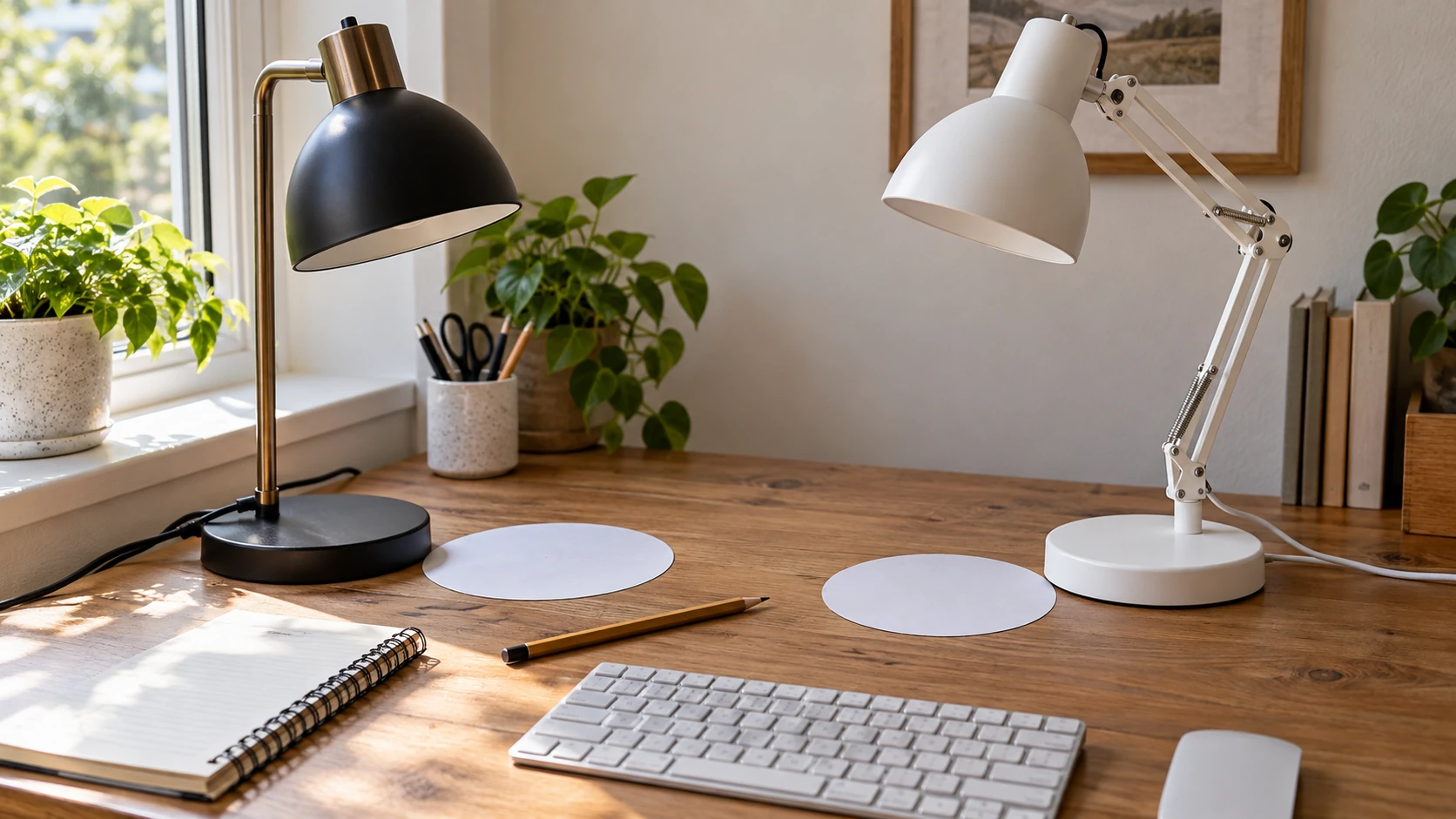
Desk lamp base crowding is easiest to solve when you can see which part of the desk the lamp actually uses. A base may sit outside the writing area yet put the cord across it. Another may fit beside a monitor but leave too little room to move a notebook. Before buying a smaller lamp or shifting every object on the desk, make a simple map of the surface and test one position at a time.
The black and gold V-Light desk lamp listing shows a fixed-looking bent stem on a round base with a cord. The white 360 Lighting Shoup desk lamp listing shows an articulated arm on a round base. Both are complete lamps in their native offers and gallery images. Their shapes suggest different ways a base and head might occupy a workspace, but neither picture proves how either lamp fits your desk or where its light will land.
Locate the actual space conflict
Clear only enough desk area to see the whole lamp base, the task surface and the cord. Keep a record of how the desk is normally used: where a notebook opens, where a keyboard or mouse travels, where a cup is placed, and which objects must remain within reach. The problem is not always the base's diameter. Sometimes the base is in the right place but the shade or arm reaches over the area needed for a task.
Use a sheet of paper to sketch the desk edge, wall, outlet and fixed equipment. Draw the base where it sits now. Add an arrow where the cord leaves the base and mark the area you need to keep clear. The sketch need not be scaled perfectly. Its job is to make a conflict visible before you move the lamp repeatedly. If the cord crosses a frequently used path, draw that as a separate problem rather than calling the whole lamp too large.
Watch one ordinary task with the lamp switched off and cool. Open the notebook or move the keyboard the way you normally would. Note the exact point where the base, arm, head or cord interferes. Write a sentence such as “the notebook cover catches the base at the left corner.” That observation is more useful than “the lamp feels crowded” because it gives the next position test something specific to improve.
If two people share the surface, make the observation while each person uses it. One may sit close to the wall and keep a small notebook open; another may pull a larger keyboard toward the front edge. Record both working positions on the same sketch. This prevents a relocation that clears one person's space while placing the base in the other's normal reach.
Measure the base and the usable desk
Measure the base of the delivered lamp at its widest point and record any part that sticks out beyond that shape. Then measure the flat area available beside the objects that must stay. If the base is round, trace it on paper. A paper template can be moved around the desk without dragging the electrical cord or risking a tip. For a different lamp you are considering, use verified dimensions for that exact model or wait until you can measure it; a gallery picture is not a scale drawing.
Make two outlines: the base's contact area and the wider zone that needs to remain clear for the lamp head or arm as it is normally positioned. A lamp can have a modest base and still reach across the main work area. Draw that reach as a separate zone. A larger base may be easier to place if the head remains above a part of the desk you rarely use. Test the delivered lamp's normal positions rather than treating the base outline as the whole footprint.
Keep a small gap in the drawing wherever a drawer opens, a screen moves or a desk accessory is frequently picked up. Do not use a measurement that assumes you will stop performing a normal task. If the only place a template fits would block a drawer or force the monitor into an unusable position, the footprint has not been solved. The point of the exercise is to recover a working surface, not to make a lamp fit by removing the work.
Use removable tape to mark the tested footprint on the paper rather than attaching anything to the lamp or desk finish. A second color can show the clearance needed for a notebook to open or a monitor to turn. When you move the template, those marks make the tradeoff plain. You can keep or discard a position based on what actually fits rather than on how tidy it looks in a photograph.
Test positions without changing the lamp
Move the paper base template to two or three plausible positions. For each, repeat the task that exposed the conflict. Write down what improved and what became awkward. For example, moving the template behind a monitor might free the notebook corner but put the cord across the keyboard path. A position is useful only if the whole arrangement works during ordinary use, not merely when the desk is empty.
Keep the outlet and cord in the test. Locate the actual outlet and think about how the cord would reach it without crossing an area where it could be pulled or trapped. Follow the lamp maker's directions for placement and cord handling. Do not invent an extension, splice or concealed route to make the drawing look tidy. If safe routing is not available in a promising position, cross it off the map.
On an adjustable lamp, think about the head and arm after the base template is placed. The Shoup's gallery shows an articulated white arm; the native listing describes adjustment. That is enough to check whether its intended positions clear your screen and task area, not enough to promise a particular illumination pattern. Follow its manual for permitted adjustments. For a lamp with a more fixed silhouette, test whether the head would reach the task without moving the base back into the crowded area.
Before settling on a position, check the lamp's stability according to its instructions. The base should rest on a suitable surface without overhanging an edge or being pushed by a moving item. If a proposed spot depends on a stack of books, a narrow ledge or a cord holding the base in place, remove it from consideration. The lamp needs a normal resting place that still leaves the desk usable.
Separate base crowding from other lamp problems
A slipping clamp, a lamp that will not turn on, and a crowded base call for different checks. The clamp desk lamp slipping guide focuses on contact with the desk edge and arm position. A freestanding lamp with a round base does not have that same mount to tighten. If the base remains steady but occupies the notebook area, solve the surface layout rather than looking for a clamp adjustment.
Light direction is another separate question. The evening writing spot guide discusses arranging a page and lamp for that task. Here the first question is whether the base, arm and cord leave enough physical working room. Once you find a location with a usable footprint, test the light for the intended task using the exact lamp's controls and directions. A neatly placed base is not a complete lighting plan by itself.
If the lamp does not work electrically, stop the footprint exercise and follow the model's troubleshooting directions. Moving a nonworking lamp around the desk will not identify its power problem. Keep the two observations separate in your notes: “base blocks notebook” and “lamp does not light” are different issues with different next steps.
Decide whether a new lamp would help
If one tested position solves the conflict, record it on the sketch and use it for a few normal work sessions. Do not buy a replacement solely because a product photo has a narrower-looking base. Perspective, camera angle and an empty staged desk can make a base look smaller than it will be beside your actual equipment. Measure the available area first, then compare it with trustworthy dimensions for any candidate model.
If no position works, identify which dimension is the limiting one. It may be base width, depth from the wall, cord exit direction, or the space needed by an arm. Write that limit as a requirement, such as “the base must fit outside the notebook opening while the head reaches the writing area.” This is more useful for shopping than a generic request for a compact lamp. A model that improves the base width but requires the cord to cross the desk may trade one conflict for another.
A product photo does not supply every dimension needed for a confident comparison. Do not fill that gap by estimating from the picture. If the seller or maker cannot provide an exact base dimension for a candidate, keep its fit uncertain until you can measure the real unit or find a reliable model-specific document. Check the whole footprint of the head and cord as well; a smaller round base alone may not release the task area that is causing trouble.
Consider the controls and light source only after the physical test. This article does not rate brightness, visual comfort or charging function. A lamp can fit the surface and still be wrong for the task. Check the exact product information and manual for those separate requirements before choosing a replacement. Keep the footprint worksheet as a record of spatial fit, not a performance scorecard for everything the lamp does.
Keep a small placement record
Save the sketch with three notes: the base outline that fits, the cord path that stays clear, and the task you tested. If another person shares the desk, have them perform their ordinary task before calling the placement finished. A position that works for one notebook or screen arrangement may interfere with someone else's keyboard, paper or hand position.
Revisit the map when the desk changes. A different monitor stand or a new drawer unit can shift the usable area even if the lamp has not moved. Measure the new arrangement instead of relying on the old template. The template turns a vague sense of crowding into a repeatable check: identify the obstruction, place the base outline, trace the cord and test the actual task.
If every realistic position fails, keep the measured constraint for the next lamp search. You can then compare models by the dimensions and arrangement you need, while treating unmeasured product photos as illustrations. The aim is a desk where the lamp and the work both have enough room, with the cord and controls usable under the manufacturer's directions.
Map the base and cord path before moving the rest of the workspace.