Office Supplies & Stationery
Blank slide target mismatch: check the numbered tile order
A defined two-by-three blank-slide model uses numbered-tile inversion parity to reject one unreachable target and a legal route to verify another.
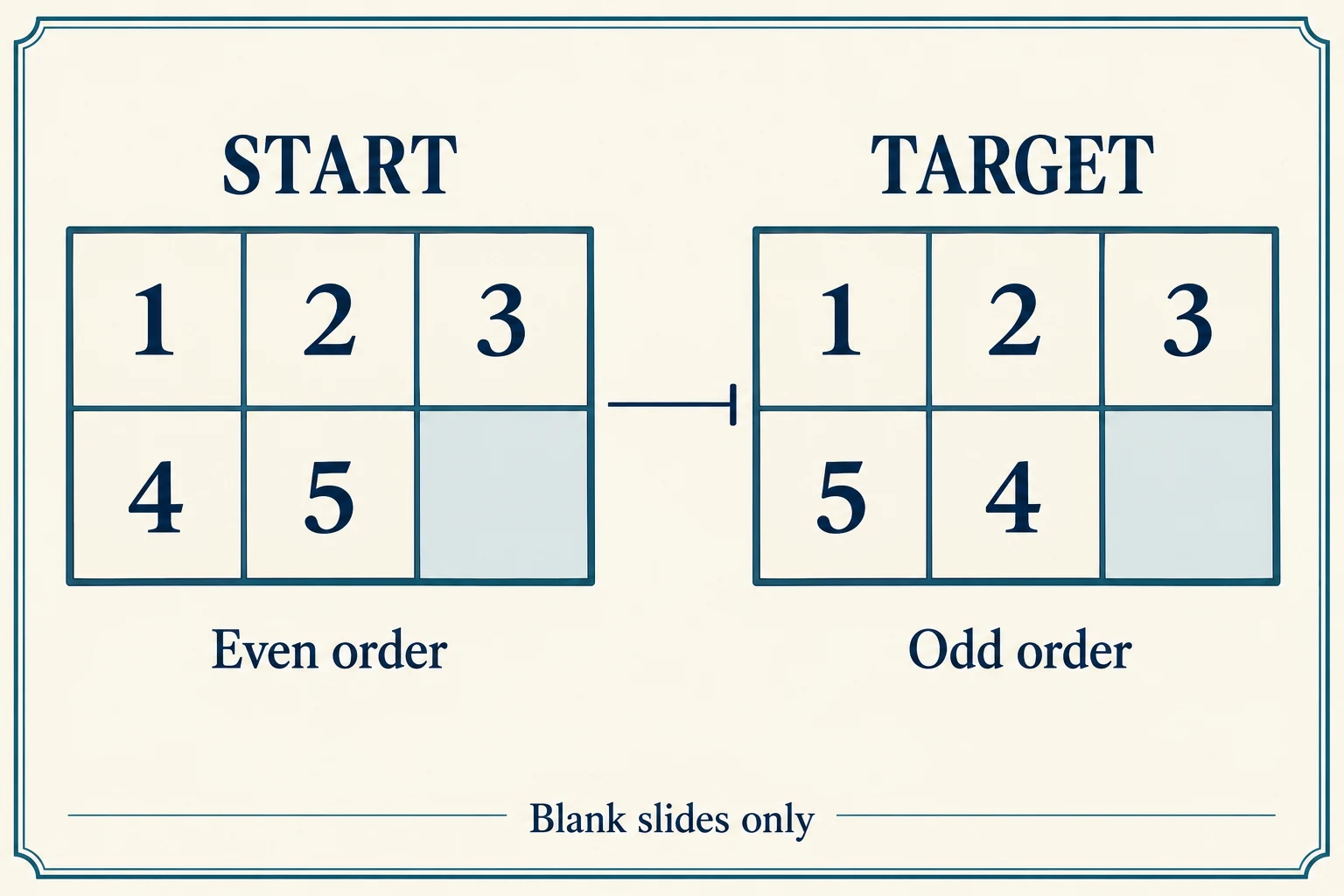
Fix the board and the permitted action
A blank slide target mismatch can survive every attempted detour because the target lies outside what the permitted moves can reach. This fictional paper puzzle has two rows and three columns. Five different tiles carry the numbers 1 through 5, and the remaining position is blank. The starting top row is 1, 2, 3; the bottom row is 4, 5, blank. The proposed target keeps the top row unchanged but places 5, 4, blank across the bottom. Both states contain the same tiles and put the blank in the same position.
One legal move slides a tile into the blank from a position sharing a full side with it. The tile's former position becomes the new blank. A diagonal move is forbidden, as is picking up two numbered tiles and exchanging them directly. Tiles cannot be relabelled, taken off the board, or passed through one another. Read the board from the same top edge throughout the exercise. These complete rules define a small mathematical model. They do not describe the operation, supplied parts, or possible fault of any retail puzzle or book stand.
Read numbered order while leaving out the blank
Read numbered tiles across the top row from left to right, then across the bottom row, omitting the blank wherever it occurs. Count an inversion whenever an earlier number is larger than a later one. In the starting readout 1, 2, 3, 4, 5 there are none. The target readout is 1, 2, 3, 5, 4. Its only inversion is the pair 5 before 4, so its count is one. Other pairs remain in increasing numerical order. The number positions and the inversion pairs are different records: this count concerns relative numbered order.
The start consequently has an even inversion count, zero, and the target has an odd count, one. That difference becomes decisive only after checking what every permitted move can do to the count. A statistic that changes freely during a legal route would not rule out the target. Here the omitted blank matters: we are not comparing all six symbols under an arbitrary ordering that treats the blank as another number. We keep its board position in the state record but leave it out when counting numbered-tile inversions. Use the same convention before and after every move.
A horizontal slide passes no numbered tile
A horizontal move exchanges a tile and the blank in neighboring cells of one row. They are also adjacent in the six-position row-by-row record. Exchanging them changes where the blank appears, but after the blank is omitted, the numbered tiles retain their relative order. No numbered tile has passed another numbered tile. Thus the inversion count is unchanged by any horizontal slide, whether the tile moves left or right and whether the blank sits in the top or bottom row. The reasoning uses adjacency, rather than a particular choice of tile value.
For example, slide 5 right into the starting blank. The board becomes top row 1, 2, 3 and bottom row 4, blank, 5. Omitting the blank still gives 1, 2, 3, 4, 5, with zero inversions. This is a legal change of state despite leaving the numbered-order count unchanged. The count therefore cannot identify a whole board by itself. Its purpose is narrower: it will separate states that cannot be connected under these move rules. A useful invariant need not distinguish every reachable state from every other reachable state.
A vertical slide passes exactly two numbered tiles
A vertical neighbor lies three places away in the six-position row-by-row record, because each row has three columns. When a tile exchanges position with the blank above or below it, two intervening positions lie between the departure and arrival positions in that record. Both intervening positions contain numbered tiles: the only blank is already at one end of the exchange. In the blank-omitted numbered sequence, the moving tile therefore passes exactly two other numbers. It keeps its relative order with all remaining numbers, and those remaining numbers keep their order with one another.
Each of the two crossed pairs reverses its relative order. If a crossed pair was an inversion, it stops being one; if it was not, it becomes one. Each contribution changes by either plus one or minus one. Adding two such changes gives minus two, zero, or plus two. Every result is even, so a vertical slide preserves whether the total inversion count is even or odd. The argument applies to either vertical direction and to every possible pair of intervening tile values. It does not assume that a move brings a tile closer to numerical order.
Continue from the earlier horizontal example, whose bottom middle position is blank. Slide tile 2 down into it from the top middle. The board becomes top row 1, blank, 3 and bottom row 4, 2, 5. Its numbered readout is 1, 3, 4, 2, 5. There are two inversions, 3 before 2 and 4 before 2. The count rose from zero to two during this vertical move. This example checks a visible change in the count while preserving its parity, exactly as the general two-crossed-pairs argument requires.
Use the invariant to reject the proposed target
Every legal move is either horizontal or vertical. The horizontal case preserves the inversion count exactly; the vertical case changes it by an even amount. Both therefore preserve inversion parity. Starting with an even count, one move leaves an even count, and applying the same reasoning to each successive move keeps it even after any finite sequence of legal slides. The target with just 4 and 5 exchanged has an odd count of one. It cannot be the final state of such a sequence from the defined start.
This conclusion has no move budget. Trying a longer route, temporarily disturbing the top row, or returning the blank to an earlier position does not change the argument. Each individual move must still preserve parity, so any collection of legal detours does too. The certificate consists of the two recorded states, their opposite inversion parities, and the proof covering both allowed move types. A record of failed attempts is unnecessary for the impossibility result. Conversely, finding that one attempted route stalls would not by itself establish that every route fails.
Verify another target with an actual legal route
The separate target 1, blank, 3 above 4, 2, 5 has a complete two-slide witness already recorded. Start at 1, 2, 3 above 4, 5, blank. Slide 5 right, obtaining 1, 2, 3 above 4, blank, 5. Then slide 2 down, obtaining the stated new target. Each moved tile shared a side with the blank immediately before its move. Every tile remains present once, and the board retains exactly one blank. This checks an actual route rather than inferring one solely from an even inversion count.
The unreachable target and this reachable target answer different questions about the same starting board. Keep their coordinates separate. Showing a route to the second cannot establish a route to the first, even though both use the same five numbers. Likewise, an even count alone is not presented here as a complete reachability test for every puzzle shape or set of movement rules. The positive claim rests on the explicit route, while the negative claim rests on a universal invariant. No shortest-route claim or theorem about which exact move lengths work is needed for either conclusion.
Keep width and movement assumptions visible
The width of three is part of the vertical-move proof. It supplies exactly two intervening numbered tiles and therefore an even number of crossed pairs. A board of a different width needs its own move analysis; the blank-omitted parity conclusion cannot simply be carried over unchanged to an even-width board. The argument also relies on one blank and full-side slides. Allowing arbitrary swaps of numbered tiles would permit a single exchange of 4 and 5, but that would change the original action rule rather than solve the original puzzle.
When auditing a claimed solution, record every board after each move. Check that only the blank and one side-adjacent tile exchanged positions, then read the numbered sequence and its inversion count. An odd count encountered from the stated even start signals that a transition, a readout, or the count needs correction. Identify the exact disputed step before drawing a conclusion about the whole route. Retain the earlier state so the error can be checked directly. Rewriting only the final picture would lose the evidence needed to distinguish an illegal move from a counting mistake.
Keep the supporting references separate
The account for the Hyjoy reading book stand shows a complete clear support panel, articulated arms and a compartmented base. The open book, writing tools, glasses and small objects are unconfirmed supplied props. No material, dimensions, load, rotation, posture or reading-performance claim is authenticated. The stand is optional paper-reference context.
The account for the hgudesign book stand shows a complete brown-patterned support panel with attached page clips, articulated arms and a base. These attached parts belong to the stand. Maker authenticity, material, rotation range, adjustment limits, grip, stability and book fit remain unverified. No numbered puzzle tiles are established as supplied.
The guide on neighboring card exchanges uses inversion pairs to examine minimum and exact move counts for a row. Those exchanges flip inversion parity. Our blank-slide rule on a width-three board preserves numbered parity, so the present decision concerns unreachable targets at any move count, rather than a particular exchange budget.
The guide on checkerboard cover compatibility derives an obstruction from cell colors consumed by permitted covering pieces. Here all board positions remain and numbered tiles move through the blank. The invariant concerns relative numbered order, not missing cells, piece area or color inventory. Neither retail source defines the puzzle rules.
Check an actual order on its own terms
If the paper exercise leads someone to consider a book stand on republeq.com, assess that actual order separately. A valid puzzle proof cannot verify an offer, identify a payment recipient, or show that a transaction has completed. Before considering USDT, establish whether the current checkout offers that cryptocurrency method for the selected item and intended order. This article does not establish availability. Read the actual instructions for the asset, network, requested amount, receiving destination and order reference, and clarify missing or conflicting information with the responsible service before authorizing a transfer. Keep the product identity and quantity attached to the proposed transaction so an answer about one offer is not silently applied to another. Inspect delivery information, the total charge and any disclosed fees using current terms. A familiar token name supplies none of those details by itself. Review applicable cancellation, return and refund arrangements before relying on them, including any stated handling of a refund for the chosen payment method. No exchange rate, network support, transfer timing, wallet address or recovery guarantee is supplied here. Retain the actual acknowledgment and payment record for any action taken, and distinguish a pending step from a completed one. If order or payment status remains uncertain, resolve it before considering another payment. An unchanged screen is not proof that a transfer failed. The worksheet's states are deliberately specified and its moves can be checked on paper; a real transaction needs its own current evidence and responsible counterparty. The mathematical activity requires no purchase, and a decision not to order leaves both the invariant and the explicit two-slide route intact. Keep those puzzle records separate from transaction instructions and receipts.
Save the rule with the result
For the target 1, 2, 3 above 5, 4, blank, record that the start has zero inversions, the target has one, and every legal slide on the width-three board preserves numbered parity. For the other target, retain both intermediate boards of the two-slide route. These records show why one goal is excluded and the other is reached under the same movement rule. Keep the blank omission, fixed reading direction and board width beside them so a later explanation does not accidentally import a different puzzle's permissions.