Learning & Creative
Solve a castanet card order with adjacent swaps
An original four-letter paper puzzle separates a minimum move bound, a parity obstruction and explicit three- and five-move routes.
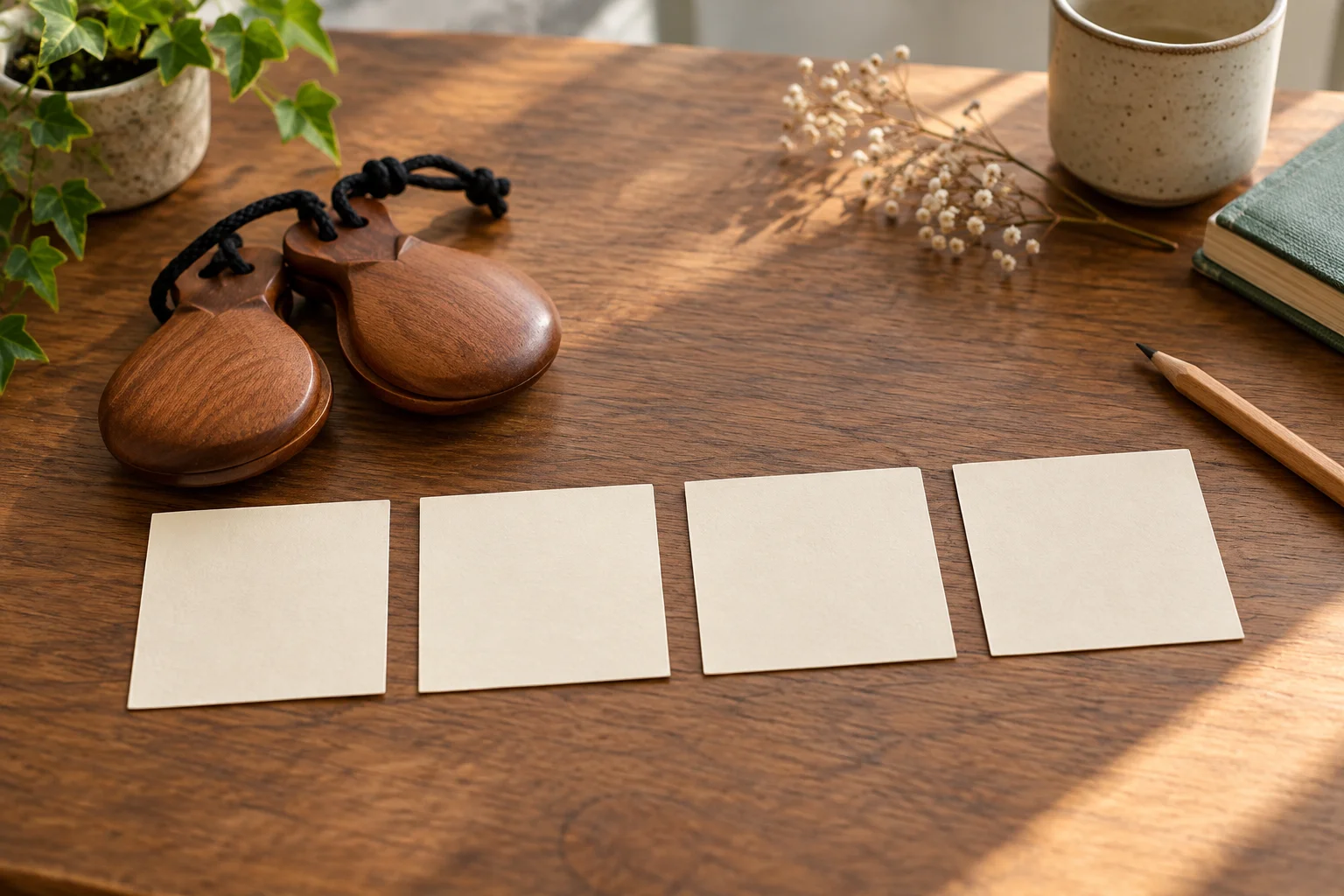
State the castanet card order before trying a swap
A castanet card order can be an invented paper puzzle beside an inactive instrument. Place four letter cards in the order B, D, A, C. The target is A, B, C, D. One allowed move exchanges two neighbouring cards. You cannot pick up a card and place it anywhere you like, rotate the entire row as a free action or exchange two separated positions in one move. Those are the complete movement rules for our fictional example. We will ask both how few moves are needed and whether particular exact move counts can work. The cards are invented activity props, not claimed accessories supplied with either linked castanet offer.
Keep the two questions separate from the start. A shortest solution tells us a minimum, while an exact-length question requires us to count every move, including any temporary reversal. If three moves suffice, that does not automatically show that four moves suffice. A person may be tempted to add a harmless extra action, but our rules recognise only neighbouring exchanges. We need to inspect what one such exchange can do to the row. The example is small enough to check directly, yet a reason covering all possible choices is more useful than repeatedly trying arrangements and hoping the requested move count happens to appear.
Read the inversion count before the first move
Read pairs of cards from left to right. An inversion is a pair whose letters appear in the opposite order from the target alphabetic order. In B, D, A, C, the B before A contributes one. The D before A contributes another, and the D before C contributes a third. The B before D, B before C and A before C are already correctly ordered. There are six possible pairs altogether, and exactly three are inverted. Writing out all six pairs makes the starting count inspectable. We are counting relationships between two letters, not the distance each card appears to be from its target position.
The target A, B, C, D has no inversions. Every earlier letter is correctly placed relative to each later letter. Therefore the puzzle can be described as changing the inversion count from three to zero using allowed moves. That does not yet tell us which move to make. It provides a quantity whose change we can analyse. A row with the same number of inversions might have a different visible arrangement, so the count is not a complete description of the state. For our purposes it need not be. We want a reliable limit on how much progress one permitted exchange can make, and a check on which exact lengths are possible.
Check what an adjacent swap can change
Take any two neighbouring cards X and Y. When they exchange places, their own relative order reverses. For every other card Z, the situation is different. Because X and Y were neighbours, Z must be either before both of them or after both of them. Following the exchange, Z remains on that same side of both. Thus the pairwise order involving Z and X does not change, and neither does the one involving Z and Y. Only the pair X and Y changes its inversion status. Each adjacent swap therefore changes the total inversion count by exactly one, either increasing it by one or decreasing it by one.
This observation rules out a two-move solution immediately. Starting at three, two moves can remove at most two inversions, leaving at least one. A longer visual jump by one card does not count as a single allowed move if it passes several neighbours. For instance, carrying A from the third position directly to the first would conceal two neighbouring exchanges. The rules would count those separately. A picture of the row before and after the lift could make the change look like one action, but the paper puzzle's permitted action is more specific. Keep that definition attached to every proposed solution so a convenient gesture does not silently change the problem.
Show a three-move solution explicitly
Start with B, D, A, C. First exchange D and A to obtain B, A, D, C. Next exchange B and A to obtain A, B, D, C. Finally exchange D and C to obtain A, B, C, D. Each exchanged pair was adjacent at the moment of its move. The inversion counts along this sequence are three, two, one and zero. Three moves have actually reached the target. Combined with the earlier lower bound of at least three, this establishes that three is the minimum. A lower bound alone would not prove that a three-move route exists, and a demonstrated route alone would not exclude a faster one.
It is worth checking those two parts independently. The pair-count argument applies to every allowed route, including one we did not happen to think of. The written sequence supplies one route that meets its bound. If a proposed sequence accidentally swapped non-neighbours, it would not provide that demonstration. If the starting pair count were wrong, the claimed lower bound might be wrong even if the sequence still worked. Our six-pair list and three explicit intermediate rows let another reader inspect each part without trusting a claim that a solution has been found. We do not need to enumerate every possible rearrangement to settle this minimum.
Ask whether exactly four moves can work
Four moves are more than the minimum, but they are still impossible for this starting row and target. At each move the inversion count changes by one, so its parity switches: odd becomes even and even becomes odd. The start has an odd count of three, and the target has an even count of zero. After an even number of switches, the parity would remain odd. Four is even, so four adjacent exchanges cannot take this start to that target. This reasoning does not assume that every move improves the row. An increase and a decrease each switch parity, so detours do not evade the argument.
The same check explains why merely saying “we can waste one move” fails. From a given row, one adjacent exchange produces a different row and flips the inversion parity. It cannot leave the arrangement unchanged. If you reach the target after three moves and make one more allowed exchange, the row no longer equals A, B, C, D. You could call the extra action a pause or a gesture, but neither counts as a move under the stated rules. The exact-four question therefore cannot be answered by adding an uncounted action to the three-move sequence. It requires a four-exchange route, which the parity argument excludes.
Make an exact five-move route without changing the rules
Five moves can work. Follow the established three-move route to A, B, C, D. Then exchange A and B to obtain B, A, C, D. Exchange those same neighbours once more to return to A, B, C, D. The final two actions cancel their effect on the row, but both count as moves. The complete route contains five neighbouring exchanges. Its inversion counts are three, two, one, zero, one and zero. This is an explicit answer to the exact-five question. The temporary departure from the target is allowed because our rule concerns the arrangement at the finish, rather than forbidding an earlier visit to the target.
That last condition should stay visible. If a different puzzle required stopping immediately on the first arrival at the target, the five-move sequence just given would violate the new stopping rule. We are not claiming to have solved that revised version. In the present puzzle, the number of moves is specified and the final row is checked after all of them. This allows a cancelling pair of exchanges. Adding two further exchanges of the same neighbouring pair would again return to the row, but each exact-length claim should still be read with its movement and stopping rules. A change to those premises can change which demonstrations are admissible.
Keep necessary checks separate from a complete route
For our starting row, the minimum bound and the parity check together reject zero, one, two and four moves, while the written sequences establish three and five. It would be too broad to say that parity alone finds a solution. An odd requested count of one has the right parity for an odd-to-even change, yet it is shorter than the required minimum of three. Conversely, a count above the minimum can still have the wrong parity, as four does. Each check answers its own part of the question. A constructive sequence then supplies the actual route where we claim one exists.
To check a friend's answer, read each successive row and identify the two positions exchanged. Confirm that they were neighbours, count the move and continue. At the end, compare the row with A, B, C, D. You can also recalculate the inversion count as an audit, expecting a change of exactly one each time. If a step changes the count by three, inspect whether a non-neighbour exchange or several concealed moves occurred. This is a procedure for checking the declared paper game, not a way to handle or operate a real castanet. The instrument theme contributes no extra movement permissions or shortcuts to the card puzzle.
Keep a payment decision outside the paper moves
If the theme leads to a purchase, treat any crypto question as a separate transaction enquiry. The fact that a paper route has the right move count tells you nothing about a seller's payment instructions. Before considering USDT, inspect the current checkout on republeq.com and confirm the specific listing, quantity, delivery details and amount presented. If a transfer instruction appears, check its destination, denomination and any stated network requirement directly in that current transaction. Do not infer token acceptance, transfer reversibility, a refund method or delivery success from the presence of payment vocabulary in an article. Resolve missing or conflicting instructions before acting and preserve the identity of the order you intend. A product photograph cannot authenticate a payment destination, and a payment request cannot establish the package contents. Keep those questions attached to their actual evidence. This paragraph provides questions for reading current information; it does not claim that either linked offer accepts USDT, that any particular network is supported or that a transfer will succeed. A completed transfer also does not by itself prove that the right order has been fulfilled. Retain an accurate record of what was requested and what was actually completed. If the proposed purchase changes while you are checking it, examine the changed transaction rather than assuming an earlier answer still covers it. Our paper puzzle has explicit permitted moves and a stated finish condition. A real transaction needs its own present instructions and terms. Neither a correct inversion count nor a convincing puzzle solution supplies missing facts about checkout, refunds, dispatch or delivery. Keep unresolved purchase details unresolved until the current evidence answers them.
Return to the castanet card order and its exact results
The castanet card order B, D, A, C begins with three inversions. Every neighbouring exchange changes the count by exactly one. The explicit route through B, A, D, C and A, B, D, C reaches the target in three moves, meeting the minimum bound. Exactly four moves fail the parity check. Exactly five work because a cancelling pair can follow the three-move route under the stated stopping rule. These conclusions belong to the original paper rules. Keep the bound, parity argument and actual routes together so a later reader can tell which part establishes which result, without confusing an extra pause with an allowed exchange.
The GWC-CM listing and the 48-piece castanets listing supply actual offer identities for the theme. The first shows mounted clappers on a complete frame; its Unbranded title and Grover photo branding remain unresolved. The other account identifies a castanet collection, with complete clappers and attached cords in its photographs. Decorative blocks, a figurine, flowers and paper in a scene photo are context, not claimed supplied items. No material, sound, adjustment or mounting promise is adopted. The letter cards are invented props, not package contents.
The handbell story guide describes friends negotiating a shared story, with space for contributions or listening. The familiar sheet music afternoon guide centres a known piece and appropriate reading support. These actual public guide bodies offer other musical-afternoon directions. Neither supplies the B, D, A, C ordering puzzle, inversion count or exact-length argument. Their relevance is the choice of a modest musical theme for an activity. A reader may choose either direction without using this puzzle. The mathematical move rules remain separate from the guides and from any operation of a real instrument.