Skills & Planning
Grid cover compatibility: equal area can still fail
An original 4-by-6 paper board loses two same-color cells. Eleven one-by-two pieces have enough total area, yet their equal-color consumption rules out a complete cover.
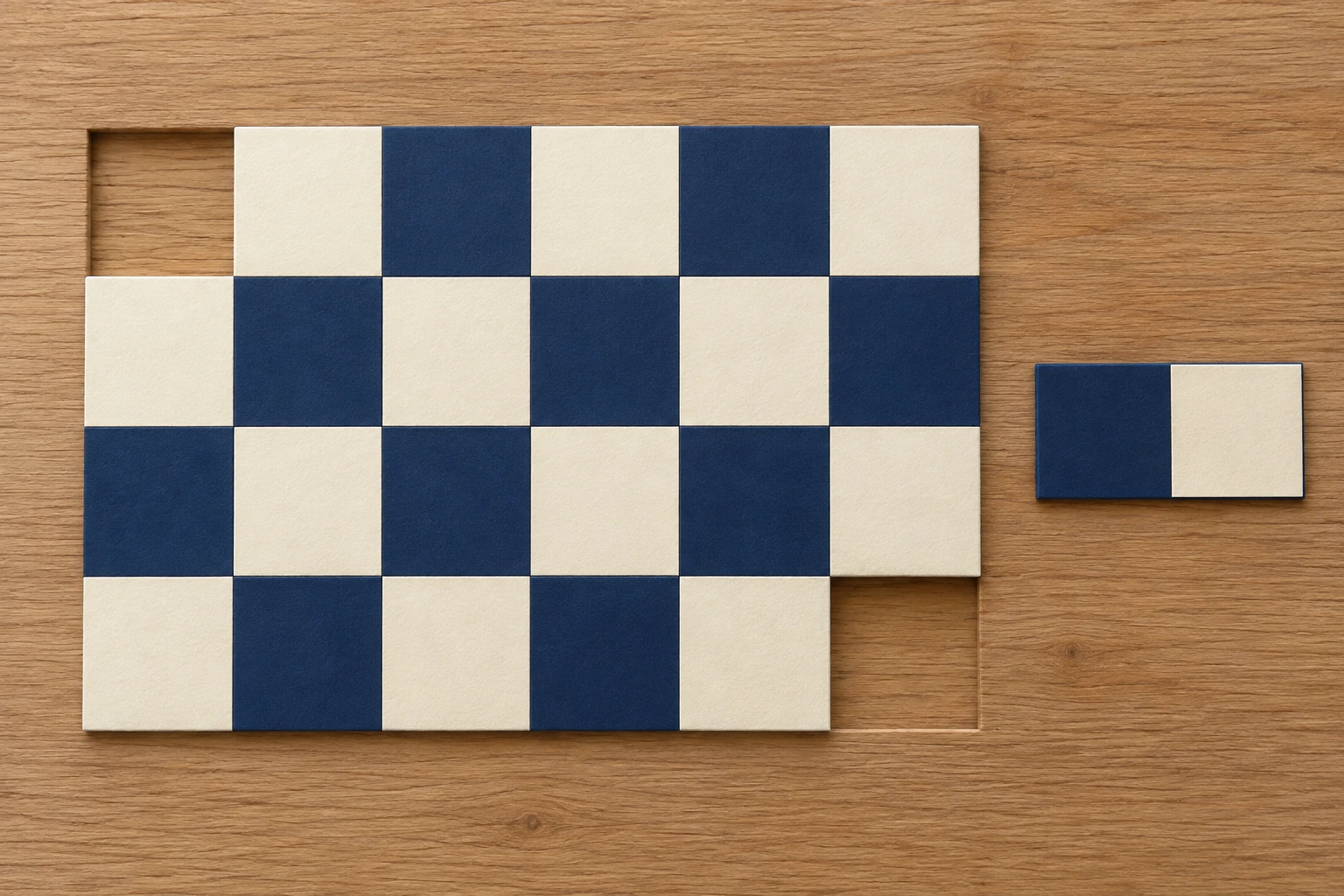
Grid cover compatibility can fail even when the available pieces have exactly the area left on the board. In this paper exercise, a four-by-six rectangle loses two corner cells. Twenty-two cells remain, and eleven one-by-two pieces also cover twenty-two cells in total. Yet no arrangement of those pieces can complete the cover. An alternating color pattern explains the obstruction without requiring us to try every possible layout.
The board, pieces and removal choices below are stipulated mathematical inputs. They describe no retail puzzle, measured sheet or installation project. You can follow the argument with a sketch and written coordinates. Keep the rules beside the drawing, since a piece that may overlap a gap or extend beyond an edge would belong to a different problem.
Define the region and the allowed piece
Number the rows one through four from top to bottom, and the columns one through six from left to right. A cell has a row and a column, written together in parentheses. Thus (1,1) names the top-left cell, while (4,6) names the bottom-right one. These coordinates identify positions even if your sketch is uneven.
Each allowed piece is a rectangle covering exactly two cells that share a full side. It can lie horizontally across neighboring columns or vertically across neighboring rows. Every part of the piece must stay inside the present region. A complete cover uses every present cell exactly once, with no gaps, overlaps, trimming or extra pieces extending across absent cells.
Remove (1,1) and (4,6) from the original rectangle. Their absence is part of the task, so those positions cannot receive pieces. Retain all other cells. The original rectangle contained four times six, or twenty-four cells. Removing two leaves twenty-two. Since each piece covers two cells, any complete cover would contain eleven pieces.
This area calculation supplies a necessary count. Ten pieces would cover only twenty cells, while twelve would cover twenty-four. Eleven is the only possible piece count under the rules. We still need to establish whether those eleven pieces can occupy the actual region. Dividing the area has not supplied their positions or checked their shapes against the missing corners.
Add a color pattern without changing the geometry
Give (1,1) a dark color and alternate dark and light along the first row. Its six cells then read dark, light, dark, light, dark, light. Begin the second row with light and alternate again. The third row repeats the first, and the fourth repeats the second. The coloring is an analytical overlay on the defined cells.
Each original row contains three dark and three light cells. Across four rows, the full rectangle therefore has twelve of each. You can check the same count by pairing the cells within each row: columns one and two, three and four, then five and six. Every such pair contains one dark cell and one light cell.
Moving one column left or right changes the color. Moving one row up or down changes it too. Those are precisely the two kinds of adjacency the piece rules permit. A diagonal pair can have the same color, but diagonal contact does not supply a shared full side and cannot be covered by one allowed rectangle.
Consequently, every allowed placement covers one dark cell and one light cell. This remains true whether the rectangle is horizontal or vertical, and wherever it lies within the region. We have derived a restriction on every placement from the coloring and adjacency rules. It does not depend on which piece someone chooses to place first.
Count the colors that remain
The top-left cell (1,1) is dark by definition. The last row begins light, so its six cells read light, dark, light, dark, light, dark. Its last cell (4,6) is dark as well. Our two removed corners therefore have the same color. Removing them changes the original twelve-dark, twelve-light inventory to ten dark and twelve light cells.
Suppose, for a contradiction, that eleven allowed pieces complete the cover. Each uses one dark and one light cell. Together they would cover eleven dark cells and eleven light cells. The region actually supplies ten dark and twelve light cells. Those two inventories cannot describe the same complete cover, so the supposed arrangement cannot exist.
Another way to inspect the obstruction is to count after any collection of valid, nonoverlapping placements. Every piece removes equal numbers of dark and light cells from the uncovered region. The initial excess of two light cells therefore remains. Ten pieces would use all ten dark cells and ten of the twelve light cells, leaving two light cells that no allowed piece could cover together.
The last observation does not promise that ten pieces can actually be placed without overlap. It explains what their color consumption would imply if they could. The contradiction already rules out a complete eleven-piece cover. We do not need a nearly completed arrangement to establish that result, and a failed sequence of guesses is not the proof.
Keep a new layout separate from changed rules
Rotating individual pieces cannot remove the color imbalance, because both permitted orientations consume one cell of each color. Starting near the center instead of near a corner also leaves the count unchanged. A different order of valid placements can change the intermediate uncovered shape while preserving the same two-cell color excess.
A proposed answer that places a rectangle across a missing corner violates the region rule. One that covers two light cells diagonally violates the full-side adjacency rule. Mark the exact changed assumption when checking such an answer. These proposals can define other exercises, but they do not complete the one whose cells and allowed placements we have specified.
Likewise, adding a dark cell would change the region. Painting an existing light cell dark would change the analytical pattern, without making the earlier adjacency argument apply to that new pattern. The useful question is which restriction every actual allowed placement satisfies. An arbitrary recoloring cannot retain a consumption property that its neighboring cells no longer support.
Check a changed board with an explicit cover
Set the impossible version aside and return to the original four-by-six rectangle. For this separate version, remove (1,1) and (1,2), the first two cells of the top row. They are adjacent and have opposite colors. Twenty-two cells again remain, now eleven dark and eleven light. The area and color counts both permit a cover.
For this particular changed region, we can demonstrate one. In the first row, place a horizontal rectangle across columns three and four, and another across columns five and six. In each of rows two, three and four, place three horizontal rectangles: across columns one and two, three and four, then five and six.
The first row uses two pieces, and the other three rows use three apiece. That gives two plus nine, or eleven. Every present cell appears in exactly one of the listed pairs. No pair includes either absent cell, and each pair consists of horizontal neighbors. This checks the whole cover against the original placement rules for the changed region.
Save both removal lists. The first version removed opposite same-color corners; the second removed an adjacent opposite-color pair. The working arrangement belongs to the second version. It does not repair the first by rearranging the same inputs, and it does not prove that every two-cell removal from a rectangle leaves a region that can be covered.
Balanced colors still need a placement check
Equal color counts are necessary under these piece rules, but they do not settle every possible region. Consider a separate region containing only two cells at positions (1,1) and (1,4), with all other positions absent. The first cell is dark and the second is light. Its area is two and its color inventory is balanced.
Those cells do not share a side. One allowed rectangle cannot cover both, so this tiny region has no complete cover despite passing both numerical checks. The successful adjacent-removal example needed an actual arrangement as well as balanced counts. A color imbalance can prove impossibility; equal counts alone leave the geometric question to be answered.
Read the retail supply accounts separately
The BIC Xtra-Comfort mechanical pencil offer names 0.7 mm black lead, assorted barrel colors and a bundle of ten dozen. Its sole gallery image shows five complete BIC pencils with integrated grips, clips and erasers. That picture does not independently count the outer bundle or test writing performance. The pencils provide an optional paper-record context, not the dimensions or rules of our board.
The OfficeSpace game-controller kneaded eraser offer names four colors and a case of 576. Its gallery shows a display marked 24 with red and black controller-shaped containers. Keep that pictured display separate from the stated outer case; no exact package breakdown or complete four-color inventory is established here. The account supplies no tested erasing result or electronic game-controller function.
Neither supply account defines the fictional cells, missing corners or allowed rectangles. The paper model establishes no pencil-refill fit, eraser-material compatibility or physical assembly result. Keep any actual contents or use question attached to the selected product and its applicable information.
Distinguish neighboring mathematical questions
The greatest common divisor on paper guide asks for the largest whole-number square side in a regular rectangular arrangement. Its remainder argument and square-size maximum answer a different tiling question. Here the piece is fixed at one by two, the region has specified holes, and alternating-color consumption supplies the obstruction.
The castanet card order guide checks neighboring exchanges, inversion counts and exact move lengths. Our board has no target permutation or exchange budget. We count the two cell colors consumed by every permitted covering piece. Both explanations retain explicit rules, while their counts and the conclusions those counts support remain different.
Review a possible supply order
If you independently investigate a pencil or eraser order through republeq.com and prefer USDT, begin with the exact selected offer and the purchasing question you actually need answered. The board's twenty-two cells and eleven pieces are mathematical counts, not quantities to copy into a shopping basket. You can check the entire exercise without ordering supplies. This article does not establish which cryptocurrency options are currently available for your account, location or intended transaction. Read the methods and conditions presented for that particular order. Where a cryptocurrency option is offered, establish the named asset, network, requested amount, destination and order reference from the current transaction instructions. A familiar token name does not supply the remaining details. Ask the responsible service to clarify an essential missing or conflicting instruction before deciding whether to authorize payment. Neither a product photograph nor a correct paper proof can authenticate a transfer destination. Review the delivery, cancellation, return and refund terms that apply to the actual selection, including any stated denomination or deductions for a refund. Retain those terms with the offer reference and any contents clarification. If another person is arranging the purchase, agree on the item and quantity they are being asked to order, and return proposed substitutions for consideration. After any transaction, preserve its actual acknowledgment and associated payment record. An uncertain order or payment state needs reconciliation before another payment is considered. No present USDT eligibility, discount, fee level, exchange result, dispatch time or successful delivery is promised here. A purchase record concerns the actual order; the worksheet records a stipulated region and the reason its pieces can or cannot cover it.
Leave the region and the proof together
The original board has twenty-two present cells but only ten dark cells against twelve light ones. Eleven allowed rectangles would need eleven of each, so no complete cover exists. Retain the removal coordinates and the one-of-each-color argument beside that conclusion. The changed adjacent-removal version has its own explicit eleven-piece cover, while the isolated-cell boundary shows why balanced counts alone cannot finish every compatibility check.