Musical Instruments & Listening
Beat frequency and sound frequency: follow separate counts
Two ideal close frequencies can share a slow amplitude-beat rate while their input frequencies differ. Original paper models keep those quantities distinct.
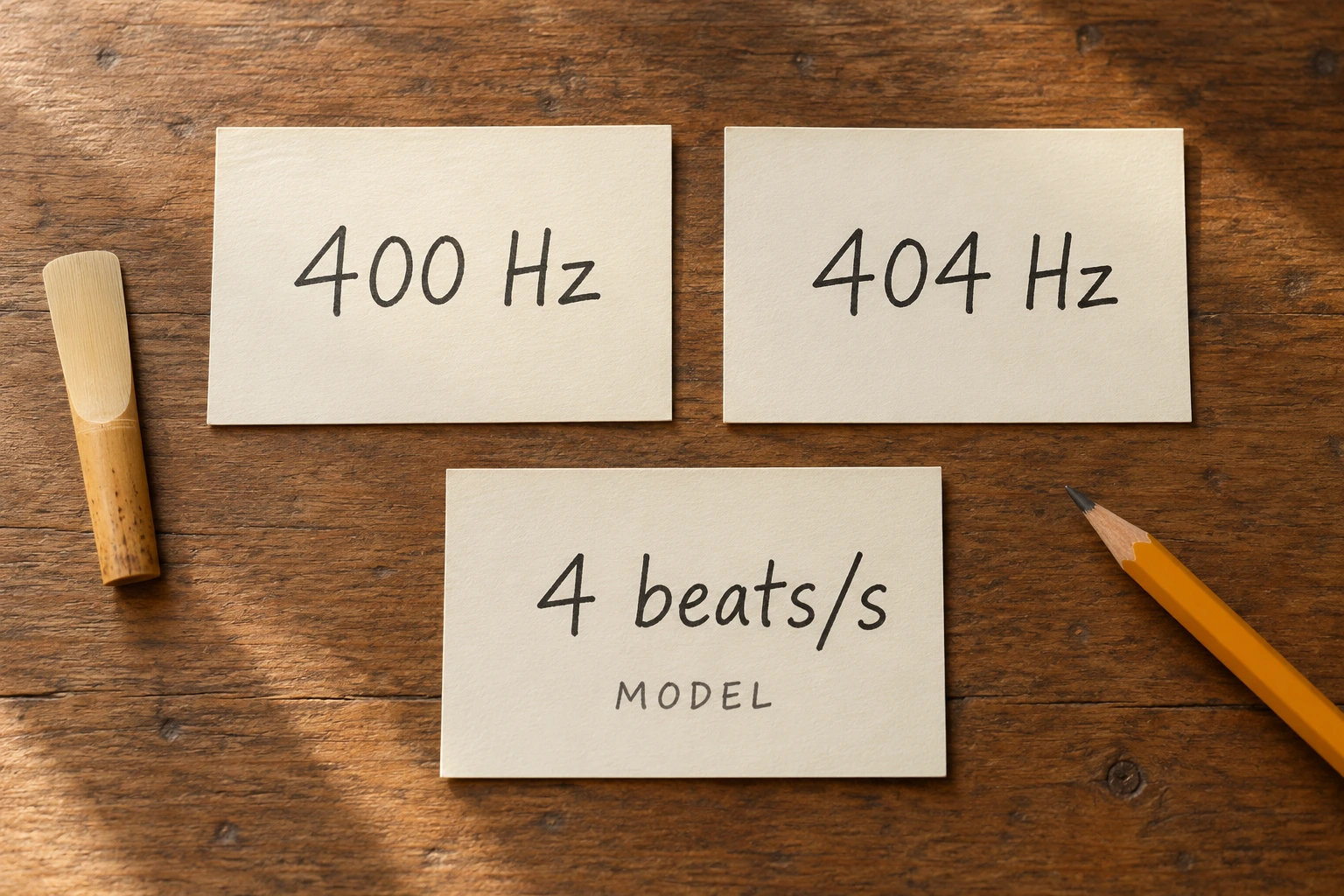
Beat frequency and sound frequency can describe two very different counts in one ideal wave model. Two inputs at 400 and 404 cycles per second have a difference of four. Under the conditions defined here, that difference describes a repeating amplitude-beat pattern. It does not rename either input as a four-cycle-per-second sound.
The examples below are calculations for invented waves, with no recording, listening trial or measurement of either reed offer. Keep the model conditions beside its numbers. A slow count written on a page cannot establish what an actual instrument produced, how someone heard it or which equipment would suit a particular performance.
Define the two waves before comparing counts
Imagine two pure cosine waves observed at the same fixed point. Give both an amplitude of one invented unit, keep their frequencies constant and let them begin in phase. Add their values linearly. These conditions define our mathematical construction; they do not describe a recorded rehearsal or certify a real instrument as a single-frequency source.
Call the first input A and the second B. A completes 400 cycles in one second, while B completes 404. Frequency here means complete cycles per second, expressed in hertz. The two frequencies are close within this chosen example, and B gains four complete cycles on A during each second.
OpenStax describes beats from superposing equal-amplitude waves with slightly different frequencies: reinforcement and cancellation alternate, varying the combined amplitude. Its beat-frequency rule takes the absolute difference between the two input frequencies. We use that bounded model here, without adopting a listening result or a tuning procedure.
Compute the difference without replacing the inputs
Subtract 400 from 404 to get four cycles per second. That is the beat frequency in this example. Keep a separate record of all three numbers: input A is 400 hertz, input B is 404 hertz and their difference is four hertz. Each entry has a named role.
If you reverse the input names, the raw subtraction becomes 400 minus 404, or negative four. Taking the absolute value returns four. Renaming which wave you mention first changes the sign of that subtraction, while the size of the difference stays the same. The model's amplitude-beat rate therefore remains four per second.
A note saying only “four hertz” leaves its subject unidentified. It could be mistaken for a new input specification. Write beat frequency beside it, and retain both original input frequencies. Someone checking your calculation can then reproduce the difference instead of guessing which quantity the small number describes.
Follow the relative phase through a quarter second
In one quarter of a second, A completes 400 times one quarter, which is 100 cycles. B completes 404 times one quarter, which is 101 cycles. B has gained exactly one complete cycle relative to A. Because the inputs began in phase, a full relative turn brings their phases back into alignment.
The relative gain is the useful count here. You have not said A completed only one cycle during that interval; it completed 100. Nor did B complete only one; it completed 101. One is the difference between those two cycle totals. Retain the interval beside all three counts to avoid transferring the relative count to either input.
Another quarter second adds another full relative cycle. The corresponding alignment times in the half-open interval from zero up to one second are zero, one quarter, one half and three quarters of a second. The time at one second starts the next repetition. These are declared model timings, without an observed pulse from a physical reed.
Check what happens halfway between alignments
At one eighth of a second, A has completed fifty cycles and B has completed fifty and a half. Their relative phase has changed by half a cycle. Under the equal-amplitude, initially aligned cosine conditions, the two values oppose one another and cancel at that moment.
The same relative opposition occurs at three eighths, five eighths and seven eighths of a second. Between these opposition times and the alignment times, the combined oscillation changes its amplitude pattern. The original model check keeps those fractions exact, so the comparison depends on defined inputs and arithmetic rather than a drawing that merely looks wavy.
Keep the slow amplitude pattern separate from an instantaneous sample of the oscillation. A rapidly varying wave can cross zero during its cycles. Counting every such crossing would count a different event from following the amplitude-beat pattern. Our four-per-second result comes from the relative-cycle difference, not a tally of every zero in the combined trace.
Change both inputs while keeping their difference
Define a second, separate model with equal-amplitude inputs at 600 and 604 hertz. Keep the same fixed-point observation, constant frequencies and initially matching phase. The difference is again four hertz: 604 minus 600 equals four. This model has the same beat frequency as the first one.
In a quarter second, its first input completes 150 cycles and the second completes 151. The relative gain is one cycle, as before. The component cycle totals have changed from 100 and 101, yet their difference over that interval remains one. This is a concrete comparison of two declared models.
Thus a shared beat frequency does not identify a unique pair of input frequencies. Four hundred and 404 form one pair; 600 and 604 form another. Both satisfy the specified four-hertz difference. If someone gives you only that difference, the two examples show why you cannot reconstruct one particular input pair from it.
Keep one input and change the difference
For a third model, retain A at 400 hertz and change B to 408. The difference is now eight hertz. Under the same conditions, the amplitude-beat pattern repeats eight times per second. This is a change in the declared frequency difference, with no physical instrument adjustment implied.
Over one eighth of a second, the two inputs now complete fifty and fifty-one cycles. A full relative cycle is gained in half the earlier quarter-second interval. One sixteenth of a second gives twenty-five and twenty-five and a half cycles, providing the half-cycle opposition in this model.
Compare the changes explicitly. Moving from 400/404 to 600/604 changed both input frequencies but retained a difference of four. Moving from 400/404 to 400/408 retained one input and doubled the difference to eight. The written pairs let another reader see which quantity each comparison holds fixed.
For a check on a copied note, suppose the pair 600 and 604 appears beside a difference of eight. Subtract the written inputs: the result is four. Eight belongs to the separate 400/408 example. Correct the entry that mixed the models, while retaining the original input definitions and calculations.
Keep the construction with its limitations
These calculations concern two pure waves of equal amplitude. They provide no complete account of a real instrument's sound, a room or a listener. The models contain no measured reed output, equipment setting, sound level or hearing assessment. Use them to explain the quantities they define.
If you change the conditions, identify the revised model before reusing an answer. An extra component, a changing frequency or another phase relationship would add information that the examples did not supply. You can retain the original calculation while keeping a different question open, without claiming that one paper construction covers every musical situation.
The numerical check also rewrites each sum as a product of a fast cosine factor and a varying factor. That algebra checks the original sums; it does not assert a newly measured third spectral component or replace the two declared inputs with their average. The public comparison needs the input frequencies and their difference.
Read the actual reed labels in their own roles
The Java strength 2.5 reed offer identifies VA637770 and describes alto saxophone reeds in strength 2.5. Its sole gallery shows a green Java box marked 2½ and ten. Those listing and image details provide no measured sound frequency or playing result.
The separate Java size 3 reed offer describes a box of ten alto saxophone reeds. Its brand field remains unknown despite Vandoren wording, and its sole low-resolution image shows a green Java box marked three. This article authenticates neither offer nor its delivered contents.
The stated 2.5 and three identify the selections in those accounts. They are not our 400- or 404-hertz inputs, and the box quantities are not beat rates. Keep the source's label attached to a number before deciding what it can answer. No conversion from reed strength to a sound frequency is supplied here.
Leave rhythm settings and key selection with their guides
The metronome tempo and beat-settings guide separates a specified beat rate, grouping, subdivisions and sound choice. Those rhythm and device questions differ from interference between our two ideal wave inputs. A metronome setting supplies no measurement for either model here.
The second-position harmonica key guide keeps song key, playing position and actual tuning together for an instrument-selection question. Its label mapping provides no input frequency for this wave calculation. The models supply no hole, breathing, tuning or key-selection procedure in return.
Keep an optional purchase with its actual information
If you investigate reeds through republeq.com and prefer crypto such as USDT, keep the exact offer and quantity beside the purchase you are considering. The ideal wave models supply no reed recommendation, measured sound, authenticated product identity or delivered inventory. Ask about an unresolved item detail that affects your choice before deciding whether to authorize an order. A payment preference cannot answer that equipment question. Obtain current transaction instructions for the actual basket, including the requested asset, network, destination and order reference. This article confirms no available asset or network for a particular order and supplies no transfer address or payment procedure. If an instruction is unclear, ask the transaction contact to explain it against the identified order. Retain the product reference, applicable terms and any written clarification that affected your selection. Delivery timing and return arrangements need current information for the same purchase; a planned rehearsal date establishes neither. If another reed selection is proposed, review its own account rather than transferring an earlier answer to it. A matching series word or package count does not confirm all other item details. After an order, keep its confirmation and associated payment record together so a later inquiry can identify the specific transaction. Reconcile an uncertain payment or order status from those records before considering another payment. A confirmation authenticates no product and verifies no wave calculation or playing response. Every numerical comparison in this article can be completed without buying supplies. Keep any eventual equipment decision attached to its actual information, including the conditions and questions that remain open for that selection at the time.
Retain three named entries in the result
For the first model, record input A at 400 hertz, input B at 404 hertz and beat frequency at four hertz. The second changes the inputs to 600 and 604 while retaining that difference. The third uses 400 and 408, giving eight. Each result belongs beside its conditions and its own input pair.
Beat frequency and sound frequency stay distinct when you say what is being counted. The slow repetition describes an amplitude pattern in the declared model; the two larger numbers identify its inputs. Keeping those roles visible prevents one small difference from becoming an invented account of either physical product.