Crypto Commerce
Acoustic Audio AA15LBS powered PA vs Yamaha CBR15: build the complete PA chain
Compare Acoustic Audio AA15LBS powered PA by amplification, input sources, package contents, transport, and setup needs.
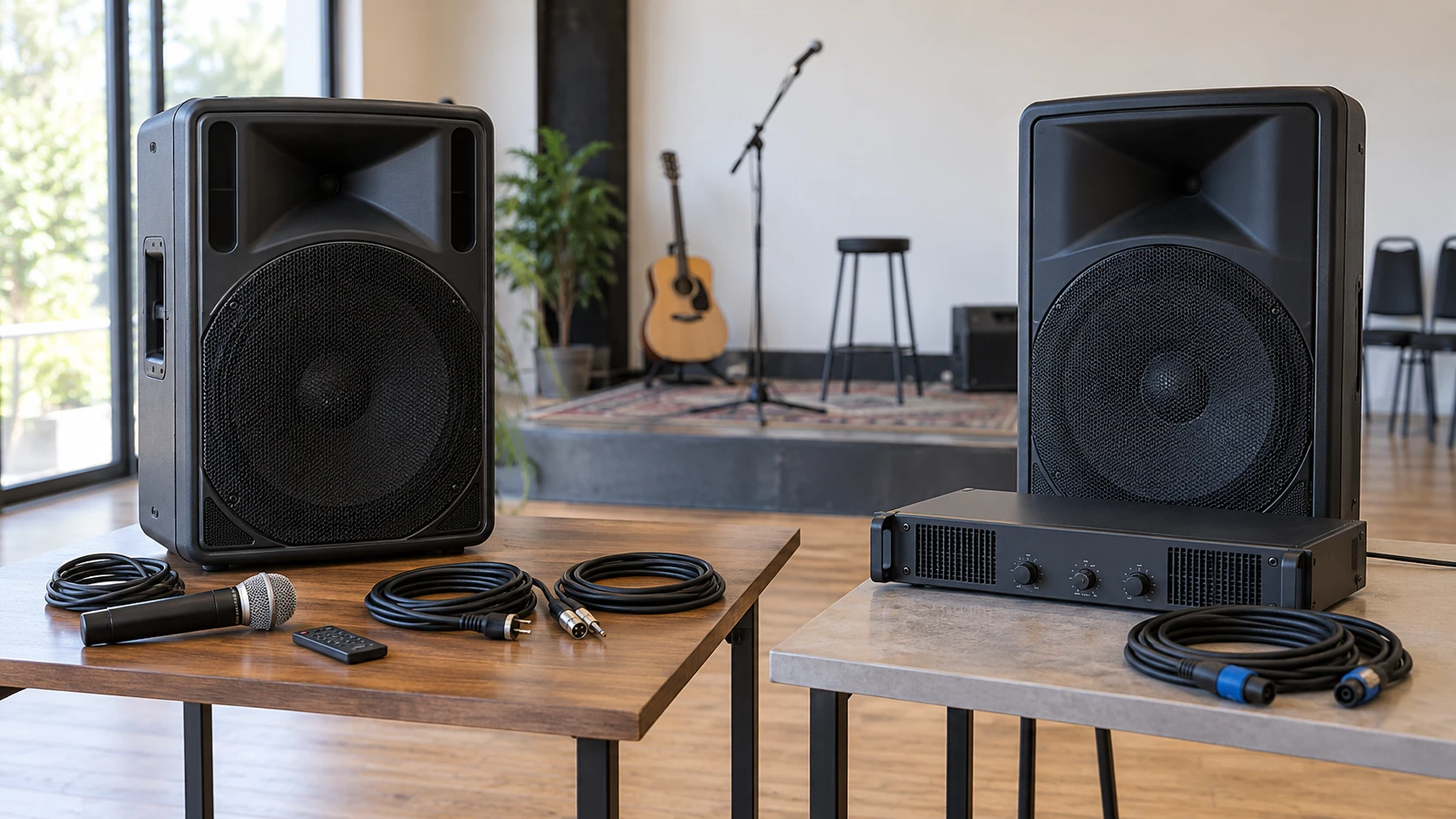
A 15-inch driver tells you very little about how a loudspeaker joins the rest of a sound system. The Acoustic Audio AA15LBS powered PA listing describes Bluetooth playback, multiple source inputs, controls, lights, and a grounded wall-power requirement. The published line-array versus party-speaker guide offers a related reminder to inspect the whole signal and power path. The Yamaha CBR15 passive speaker is a passive two-way loudspeaker intended for front-of-house, DJ, monitoring, and installation work. A passive cabinet belongs in a system with a suitable external amplifier; a powered one brings amplification into the speaker package described by its listing.
Start with the equipment you already have. If you need a quick source-to-speaker setup for a small event, the Acoustic Audio input and playback list may be useful. If you already own an amplifier and mixer and need a passive cabinet for a planned sound system, Yamaha may be the more relevant product to investigate. Neither short catalog excerpt provides an independent listening test or enough matching power measurements to declare one louder or better sounding in a venue.
Powered and passive mean different shopping lists — line-array versus party-speaker guide
The Acoustic Audio entry calls the AA15LBS package powered and says it requires a grounded 110 V wall outlet. It lists Bluetooth, FM, USB-drive and SD-card playback, RCA line input and output, a 3.5 mm AUX input, and quarter-inch microphone and instrument jacks. It also names front-panel controls and a remote. Those details suggest that many common sources can be connected without buying a separate power amplifier. You still need to confirm which cables, microphones, and stands are present in the current offer.
Yamaha calls the CBR15 passive and lists speakON and quarter-inch phone-jack connections. The saved description does not name a built-in amplifier, wireless receiver, mixer, or playback source. Plan for a compatible external amplifier and the cabling needed between it and the speaker. Check Yamaha's current electrical specifications and the amplifier maker's guidance before choosing a power combination. The excerpt does not provide the rating information needed to calculate that match responsibly.
The related guide covers different exact models, so use it to frame powered-versus-system questions rather than borrowing its component specifications. Draw the signal chain from the music player or microphone to each speaker. For Acoustic Audio, account for the speaker's own power cable and controls. For Yamaha, include source, mixer if used, amplifier, speaker cable, and the cabinet. Every missing link is a cost and a setup step that a driver-size comparison hides.
The AA15LBS box needs an exact contents check — Yamaha CBR15 passive speaker
The Acoustic Audio title advertises two AA15LBS speakers, and the saved entry lists quantity two. Its included-contents line, however, names one powered speaker, one power cable, one remote, one stand, one wired microphone cable, and a manual. It does not clearly account for the second cabinet or every accessory a two-speaker deployment would require. Confirm the exact number of powered and any companion cabinets, stands, power cords, and connecting cables with the current Republeq's catalog before ordering.
That question matters because a two-speaker system may need separate power or a link between cabinets. The saved excerpt names RCA line outputs but does not explain the wiring of a two-pack or show a complete connection diagram. Do not infer whether one cabinet powers the other. Ask for the exact model's setup instructions and package inventory. A single missing stand or lead can stop an event setup even if the speakers themselves arrive.
The listing also describes a height-adjustable steel stand with a safety lock pin and rubber feet. Verify whether that stand is included once or twice, what load it supports, and how the speaker is secured. Yamaha's saved excerpt mentions M8 rigging points for optional brackets or standard eyebolts, but does not say mounting hardware or a stand is included. Use only hardware and methods approved for the specific cabinet and venue. A rigging point is not an installation plan by itself.
If the sound system will travel, weigh the whole package rather than one cabinet. Acoustic Audio gives each speaker as 14 by 16 by 27 inches and 37 pounds, and names wheels and handles. Yamaha gives cabinet dimensions of 27.6 by 17.9 by 14.88 inches and describes ergonomic handles, but the saved excerpt does not state weight. Those numbers describe different products and do not reveal the total transport burden once stands, amplifier, mixer, and cables are added. Measure the vehicle, doorways, and storage space for the complete kit.
Inputs and controls for a live task — Yamaha CBR15 passive speaker
Acoustic Audio's entry gives separate Mic 1, Mic 2, MP3 or line, echo, and master volume knobs, along with a five-band equalizer. That may suit a simple spoken announcement or music-and-microphone use case where the operator wants controls at the speaker. The excerpt does not define how many microphones and instruments can be used simultaneously or give a mixer-style routing diagram. Test the exact intended sources before a live event, and learn which knob affects each input.
Yamaha's passive CBR15 leaves source selection and level control to the upstream system. That can be useful if a sound operator already manages several inputs from a mixer, but the cabinet listing does not specify any mixer or amplifier. Its speakON and quarter-inch speaker connections are not interchangeable with every line-level output on a phone or audio interface. Consult the amplifier and speaker manuals for the approved wiring and connector type. A passive speaker should not be treated as a direct Bluetooth or headphone-output device.
Acoustic Audio's built-in Bluetooth and media options can shorten setup for recorded music. The saved description does not state pairing range, codec support, file formats, or reliable operation in a crowded wireless environment. Carry the appropriate wired input path for an event if wireless playback is a critical function, and confirm it in a rehearsal. Yamaha's excerpt does not mention wireless playback, so any such connection would come from upstream equipment you provide.
The Acoustic Audio entry describes multicolored woofer lights that respond to volume and can be switched on or off. That may be relevant for a party setting but less useful for a presentation or theater work where visual distraction matters. Yamaha's listing does not describe lighting. Keep that difference in the event checklist, but do not turn decorative lights into a claim about sound quality.
Coverage and monitoring claims — Yamaha CBR15 passive speaker
Yamaha describes a custom-tuned woofer and compression driver paired with a wide-dispersion constant-directivity horn. It says the cabinet can serve front-of-house and floor-monitoring positions, with a 50-degree wedge angle for the latter. Symmetrical CBR12 and CBR15 cabinets are described as usable in mirrored monitoring arrangements. These are useful placement features to verify for a specific stage and audience area. The saved text does not provide a venue-specific coverage map or a measured comparison with AA15LBS.
Acoustic Audio calls each cabinet a two-way design with a 15-inch woofer and two-inch tweeter. It states a 20 Hz to 20 kHz frequency-response range, 102 dB sensitivity, and 1,000 W system power. The excerpt does not give comparable measurement conditions or a Yamaha power figure. Do not rank real-world volume or bass by those isolated numbers. Test the intended program at a safe level in an appropriate space and check whether speech remains intelligible where listeners will stand.
Yamaha's entry says its CBR15 has the lowest-frequency extension in the CBR lineup, a comparison within Yamaha's own series. It does not establish more bass than Acoustic Audio in a direct test. The listing also describes an HF protection circuit and design choices intended to control distortion at higher levels. Those are product claims, not a substitute for correct amplifier matching or sensible gain settings. Follow the manufacturer's setup guidance to avoid damage.
The Yamaha cabinet has a protective steel grille, and a protective cover is offered separately. Acoustic Audio lists wheels and handles. These construction details can matter during repeated loading, but neither saved description supplies a durability test under your transport conditions. Inspect the current warranty and replacement-part terms for the exact offer if the system will be moved often.
Place and power the system safely — Yamaha CBR15 passive speaker
The AA15LBS listing's grounded 110 V wall-power requirement makes outlet location an early planning fact. If the offer contains two powered cabinets, clarify what each needs for power and how cords will be routed away from foot traffic. The saved entry does not provide cord lengths or a venue electrical plan. A source that plays wirelessly still needs the power connection the listing states.
For Yamaha, locate the amplifier and plan speaker-cable runs using the approved cable and connector specifications. The excerpt does not include an amplifier or state how far a cable may run for a particular setup. If the cabinet is used as a floor monitor, check the stage position and the 50-degree wedge orientation. If it is mounted, use qualified installation guidance and the approved hardware. The M8 points alone do not answer load, bracket, or structural questions.
Either system should be rehearsed at the intended location before people arrive. Confirm each input, playback source, mute or level control, and any wired fallback. Walk the listening area at a safe volume rather than judging sound only from behind the speakers. A source and a cabinet can both work individually while a cable, pairing step, or gain setting fails in the complete chain.
Choose the system, then the cabinet — Yamaha CBR15 passive speaker
Investigate Acoustic Audio if you want the described built-in playback, microphone and instrument connections, EQ controls, lights, and stand-based portability. Resolve the two-pack versus one-speaker contents conflict and verify the real wiring and power needs before checkout. Its 1,000 W system-power label is not enough to predict the result in your room.
Investigate Yamaha CBR15 if you already have, or are willing to assemble, a compatible amplifier-led PA system and want its passive cabinet for front-of-house or monitoring use. Confirm amplifier matching, cable connections, mounting method, and the dimensions and weight of the complete rig. Its listing gives placement features but does not include the other equipment required to make sound.
The saved identities are Acoustic Audio AA15LBS, SKU sku-137379454, and Yamaha CBR15, SKU sku-49079709. Check the current pages, exact box contents, manuals, warranty, price, and availability. The useful purchase comparison is the full working setup: a source that connects, a speaker or amplifier path that matches, safe physical placement, and sound that serves the actual audience area.