Crypto Commerce
Seismic Audio line array vs beFree Sound party speaker
The Seismic Audio line array belongs on your shortlist when you are specifying a PA system with a planned speaker arrangement and installation requirements. The beFree Sound rechargeable cabinet is the closer candidate when your event brief calls for battery operation, built-in playback options and wheels. Neither description establishes which will cover your audience adequately. The useful comparison starts with the job you are buying equipment to perform, then separates documented features from the system details still needing confirmation.
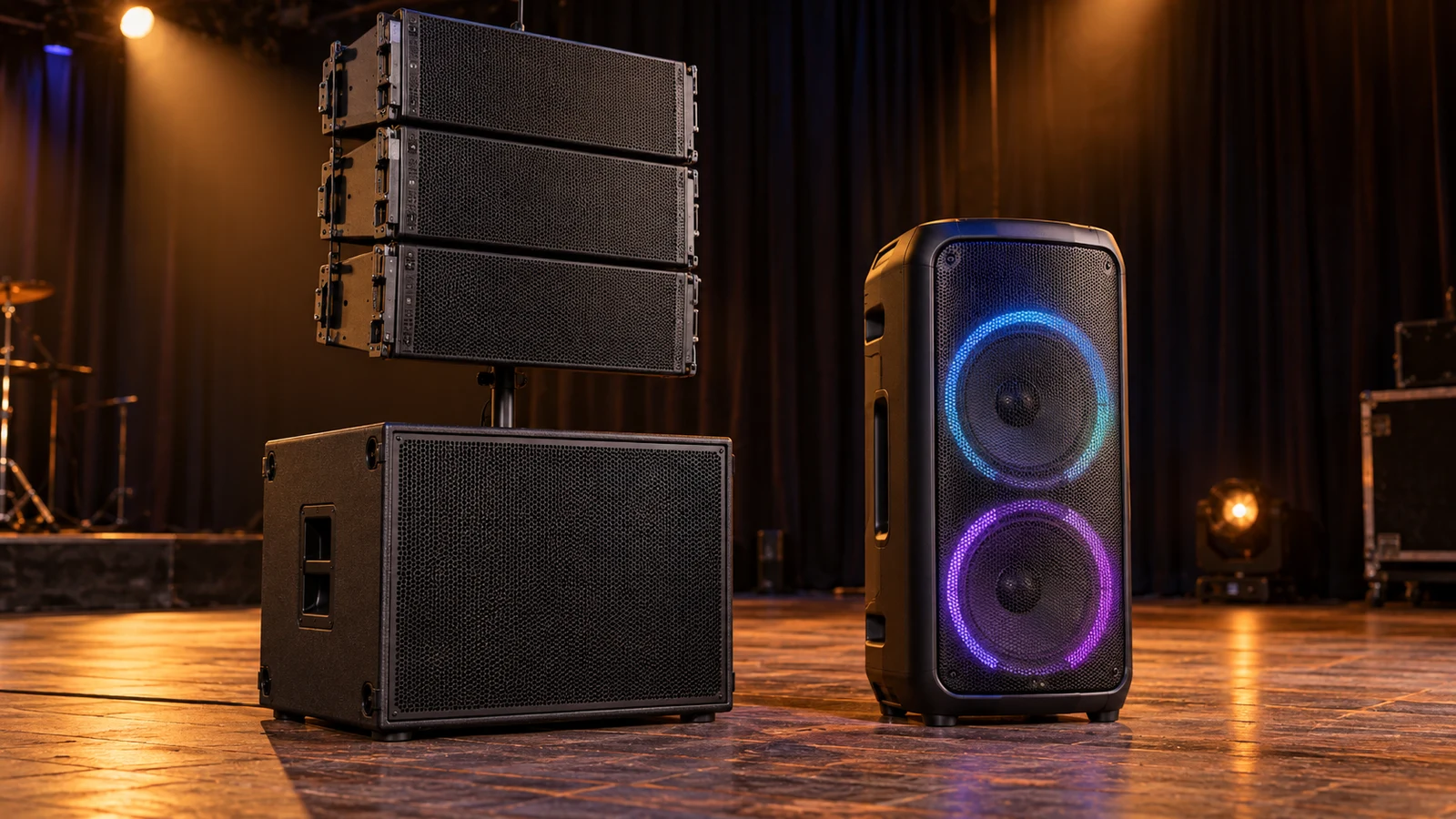
The Seismic Audio line array belongs on your shortlist when you are specifying a PA system with a planned speaker arrangement and installation requirements. The beFree Sound rechargeable cabinet is the closer candidate when your event brief calls for battery operation, built-in playback options and wheels. Neither description establishes which will cover your audience adequately. The useful comparison starts with the job you are buying equipment to perform, then separates documented features from the system details still needing confirmation.
Seismic Audio's SALA-210-PKG1 description centers on speaker construction, output ratings and suspension hardware. The beFree Sound description centers on a rechargeable party speaker with Bluetooth, physical inputs and included accessories. That difference gives you a practical starting point, but it does not make either purchase complete by default. A planned array needs an exact package and installation specification; a rechargeable cabinet needs an operating plan that fits the event's duration and playback requirements.
BeFree Sound Speaker Alternative: Define The PA Job First
Before comparing individual specifications, write a short brief for the person supplying or operating the sound. Describe where listeners will be, whether the program involves speech or recorded music, and where equipment can be positioned. Include whether a qualified installer will assess a suspended arrangement. These are questions about your event, so you can answer them without guessing what either speaker can achieve. They also give a supplier something more useful than a request for the louder model.
For an array project, the Seismic Audio line array listing describes dual 10-inch woofers and two 1 3/8-inch titanium compression drivers with a dispersion horn. It also specifies an all-birch plywood enclosure, a full metal grill and aluminum suspension hardware. Those are relevant details for a PA equipment discussion. They do not provide a complete arrangement drawing, an approved installation method or the inventory needed to assemble your proposed system.
The package name deserves particular attention. Although the model identifier includes “PKG1,” the description does not enumerate a complete package or establish how many speaker enclosures the order contains. Its power rating is stated per speaker. Ask for an itemized packing list tied to SALA-210-PKG1 before treating a quoted price as the cost of an entire array. Do not infer included amplification, connecting cables or additional mounting components from the model name.
Suppose your project brief calls for speakers suspended above an audience area. The next step is to have the proposed equipment and mounting arrangement assessed by a qualified installer, using the exact model documentation. The description's reference to aluminum suspension hardware does not establish permissible configurations or the suitability of a particular support structure. This comparison cannot provide rigging instructions, and the party speaker's features do not answer that installation question either.
For a gathering where you want a rechargeable cabinet with its own listed playback modes, consider the beFree Sound speaker alternative. Its description lists Bluetooth, AUX and FM radio, along with a rechargeable 2500mah battery. The package explicitly includes one party speaker system, one microphone, one remote control and one power/charging cable. That is a clearer accessory inventory, although it still leaves operating details to settle before an event.
Imagine an organizer who wants music during guest arrivals and needs to move the cabinet into storage afterward. The beFree Sound description gives that organizer relevant features to investigate: hard mounted handles, wheels and battery operation. It does not establish sufficient output for the chosen space or enough battery runtime for the program. Keep those questions separate from portability, so an appealing transport feature does not become an unsupported promise about event performance.
The listed beFree Sound weight is 41.15 pounds, with measurements of 15 inches long, 14.15 inches wide and 41.75 inches high. Use those figures to assess your vehicle opening, storage space and handling arrangements. Wheels do not resolve a stairway or a lift into a vehicle. The Seismic Audio description supplies no corresponding weight or enclosure dimensions, so a physical handling comparison remains incomplete until you obtain those details for the exact package.
BeFree Sound Speaker Alternative: Read Power Figures Without Ranking Loudness
Seismic Audio's description gives each speaker a rating of 560 watts RMS and 1120 watts peak, plus a claimed maximum SPL of 130 dB. The beFree Sound description states “700 WATTS” without identifying that figure as RMS or peak or giving equivalent measurement conditions. Preserve that distinction. There is no supported numerical ranking here that establishes the beFree Sound cabinet as louder, or the Seismic Audio package as better suited to a particular audience.
The figures also leave the planned listening area unresolved. For the Seismic Audio option, ask for documentation relevant to the proposed array arrangement and audience layout. For the beFree Sound option, request information appropriate to the cabinet's intended placement and use. A useful supplier response should address the event brief you wrote earlier. An isolated wattage claim cannot tell you whether listeners at the back or sides will hear the program as intended.
Driver sizes are similarly limited as buying shortcuts. Seismic Audio specifies dual 10-inch woofers; beFree Sound describes two 12-inch subwoofers. Keep each manufacturer's terminology attached to its own product rather than treating those labels as directly comparable test results. Neither the size difference nor the word “subwoofer” establishes a sound-quality winner. If bass performance is central to your event, seek model-specific documentation or a suitable demonstration before choosing.
The outdoor wording needs its own boundary. Seismic Audio describes outdoor use and lists enclosure materials, but the supplied description does not give an ingress-protection rating or detailed exposure limits. The beFree Sound description does not establish weather protection. Ask about the conditions permitted for your intended placement, including any manufacturer instructions for protection and storage. Neither description supports a claim that the equipment can remain exposed to rain.
Understand Bluetooth Audio Direction Before Pairing Devices: Keep Compatibility Separate
Bluetooth is explicitly listed for the beFree Sound cabinet. The Seismic Audio description does not establish Bluetooth support, input connectors or whether amplification is built in. Missing information is not proof that a feature is absent, but it cannot support a purchase assumption. Before choosing the Seismic Audio package, request the exact connection and amplification requirements so the proposed system can be checked against the equipment you already own or intend to acquire.
If wireless playback is part of your plan, use Understand Bluetooth audio direction before pairing devices for the separate pairing question. For this comparison, the important boundary is that beFree Sound's Bluetooth listing does not establish wireless linking with another speaker, compatibility with every source device or integration with the Seismic Audio equipment. Confirm your intended combination without borrowing capabilities from another model's description.
The beFree Sound cabinet also lists USB and SD ports, microphone and guitar jacks, and controls for volume, treble, bass, echo, microphone volume and guitar volume. These are documented features you can match against your own requirements. The description does not specify every connector detail, supported file format or operating combination. If an event depends on a particular connection, identify the exact source device and ask what cable or settings that connection requires.
A rechargeable battery creates another operating question: how long does the intended program need to run without charging? The stated 2500mah capacity does not supply a runtime, charge duration or confirmation of operation while charging. Request those details if the event depends on them. LED party lights are listed, but their effect on runtime is not quantified. Avoid scheduling the cabinet around an assumed number of hours based on capacity alone.
For the Seismic Audio line array, a useful system proposal should identify the speaker quantity, connection requirements and any supporting equipment needed for the agreed arrangement. Ask the supplier to distinguish items included in the order from items quoted separately. This lets you evaluate the package as part of the actual PA project. It also prevents an unexplained gap between the speaker listing and the equipment the installer expects to receive.
For beFree Sound, the corresponding check can stay focused on the cabinet's role at your gathering. Confirm the intended source connection and the operating duration you need, then decide whether the listed controls and accessories are relevant. A remote control and microphone may be useful, but their presence does not settle range, accessory specifications or suitability for every task. Ask about those details only where they affect the event you are planning.
BeFree Sound Speaker Alternative: Compare Complete Proposals Before Buying
Build the comparison around two written proposals with different scopes. The Seismic Audio proposal should describe the exact package and what is required to put the proposed PA arrangement into service. The beFree Sound proposal should identify the cabinet and any additional items required for your chosen playback and handling plan. This makes costs comparable at the project level without pretending that the products perform the same job or include the same equipment.
Keep unresolved items visible beside each proposal. For Seismic Audio, those may include enclosure quantity, amplification requirements and installation documentation. For beFree Sound, they may include battery runtime and connector details. An unanswered question matters when your event depends on its answer. If you have no intention of using a listed feature, its undocumented secondary details need not dominate the choice. Concentrate your follow-up on what would prevent the proposed setup from serving its assigned role.
If a current listing, manual or supplier response disagrees with a figure you have already recorded, ask which specification applies to the exact product being sold. Keep the conflicting statements visible until the discrepancy is resolved. Do not select whichever number makes the comparison easier. This is especially important for package quantity and power descriptions, where an apparently small wording difference can change what you believe you are buying.
Before placing an order, review the current model identity, package contents, availability and price on the listing. Check delivery information against your event date and read the applicable return terms; this article does not establish those terms or promise arrival by a particular day. If you choose a cryptocurrency option at checkout, review the displayed asset, network and total before proceeding. Payment details should follow the equipment decision, without distracting from an unresolved system requirement.
Take the Seismic Audio option forward when a documented PA proposal gives the package a defined place in an array and resolves its installation and connection requirements. Take the beFree Sound option forward when its rechargeable cabinet format and listed playback features match your event, with runtime and physical handling accounted for. Open the relevant product listing with your event brief beside it, then obtain answers to the few remaining questions that would change your choice.