Office Supplies & Stationery
Zipper binder won't close: separate rings and cover
Separate whole zippered-cover closure from ring hardware and nominal paper capacity, retaining the actual model and unresolved enclosure question.
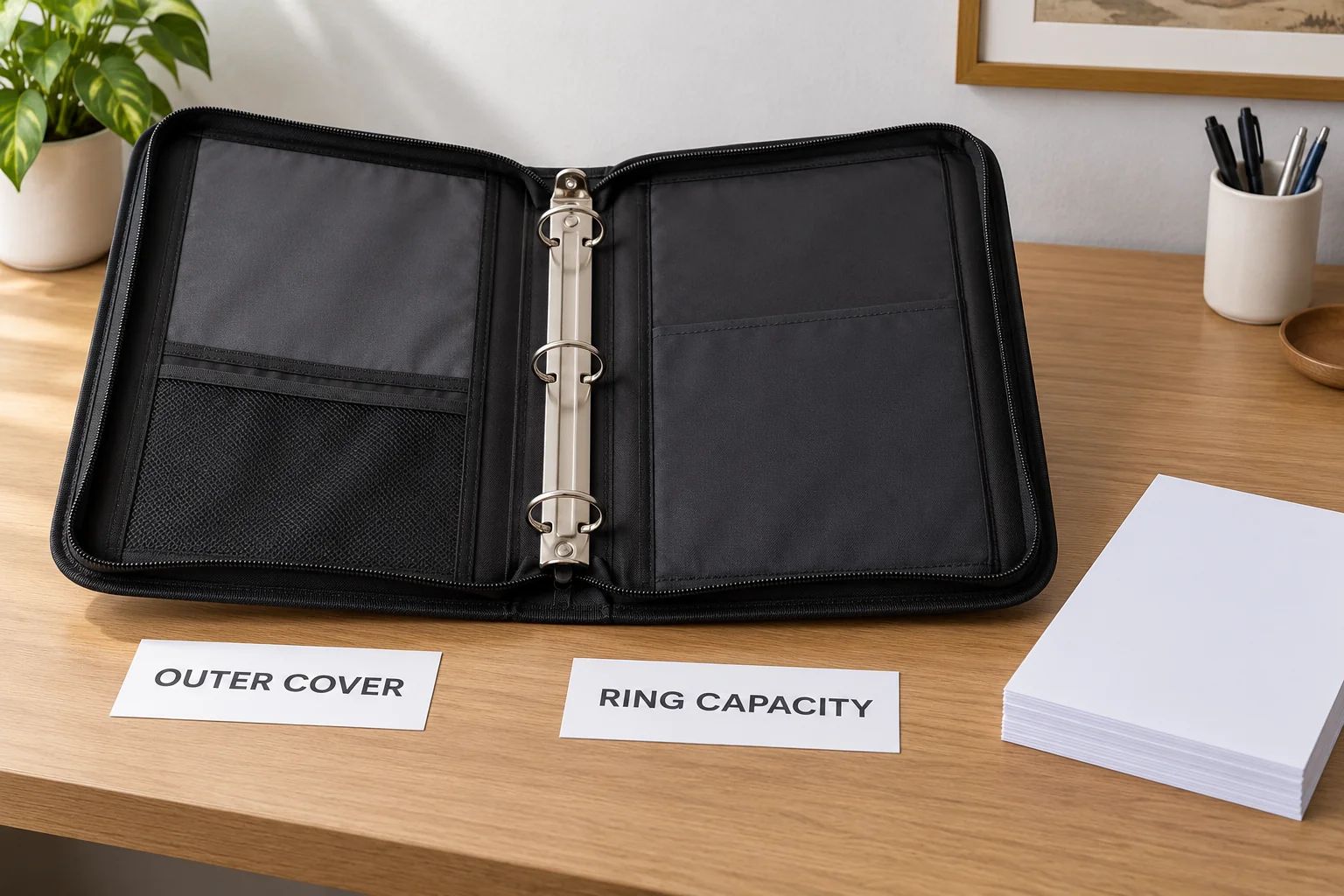
Name the closure that is stopping the binder
Zipper binder won't close describes a different problem from rings that will not close. A whole binder can have an outer zippered cover, ring hardware and separate storage compartments. Before using a capacity label to explain the problem, identify which part has stopped doing what you expected. A nominal ring dimension does not by itself describe the space available inside the complete closed cover.
This guide helps separate those questions without diagnosing a zipper or reporting a physical trial. It supplies no forcing, lubrication, alignment repair or hardware-adjustment procedure. The two selected product accounts describe complete zippered ring binders, but neither establishes a verified enclosure limit for your own collection of papers and other items. An actual mechanical problem still needs the applicable product guidance or support answer.
Rings and the outer enclosure do different jobs
If the rings have already closed but the outside cover has not, retain both observations. Saying only the binder is full would replace those observations with an explanation that has not yet been established. The useful question concerns the complete enclosure, including the items that are not carried on the rings. Keep the ring state visible rather than making it stand for every part of the binder.
Conversely, a cover that can be brought together would not prove that the ring hardware has closed correctly. Those are separate parts of the arrangement. This article gives no opening or closing sequence for either one. It asks you to describe which function is unresolved before seeking instructions, instead of treating any single successful movement as a certificate for the whole assembled file.
Read the Dual-301 account for its ring system
The Case-it Dual-301 listing describes a complete zippered binder with two 2-inch D-ring sets, a file-folder arrangement and multiple pockets. Its sole gallery shows complete Case-it-branded binders. These statements identify the offer without verifying a loaded enclosure, a device fit or a protection result. No advertised sheet count becomes a confirmed packing limit here.
That distinction matters when seeking an answer for an item already in hand. Retain its actual identification rather than assuming a picture settles every model detail. A description of several storage locations does not state the capacity of every possible combination of contents. Keep the exact product question open if the offer and the received identification do not agree.
Keep the LT-007 enclosure question separate
The Case-it LT-007 listing describes a complete zipper binder with 2-inch O-rings and additional pockets. Its two actual gallery images show complete Case-it binders in alternative colors, without certifying a delivered color selection. The account provides no independently measured whole-cover clearance for the reader's belongings. This guide adopts no device-fit, impact-protection, travel or durability promise.
A stated paper count remains a product statement with its own applicable conditions. It is not an observation that the complete case has enclosed your actual contents. Ask which part of the arrangement the statement describes when that matters to the enquiry. No page count is converted into a universal load or an interior-volume specification in this article.
Ask what the capacity statement describes
When a product account supplies a ring-capacity label, retain that subject beside the number. Do not rename it as interior volume or clearance around every stored item. If the wording is unclear, ask what the supplier means for the actual model. A reply about the ring specification can be useful while still leaving the outer enclosure question unanswered.
This article provides no conversion from a ring dimension to a guaranteed total collection of papers, dividers, devices or other belongings. It also gives no universal paper thickness for a sheet-count calculation. A convenient number can help identify an offer without supplying a complete packing specification. The problem in front of you should remain attached to the feature that actually failed to close.
Describe the whole arrangement without inventing a cause
You may already know which items were in the binder when the difficulty occurred. Describe those actual contents separately from the ring label. Note whether the question concerns the outside cover, the rings or another compartment. This is a way to explain an observed problem, without performing a new test or assuming which object caused it.
Keep a recent change visible if one occurred. Perhaps the unresolved observation followed a change in the material being carried, or perhaps nothing changed that you can identify. Either account can remain honest. A change made before a problem is information to discuss, rather than proof of a cause. The absence of a known change likewise does not identify a failed internal part.
A short fictional enquiry starts with the outside cover
Imagine a student, only as a fictional example, reporting that the ring hardware is closed while the outer zipper has not completed its normal movement. The student initially points to a capacity label as proof that the contents should fit. They then recognize that the label and the unresolved closure are not the same description. Their enquiry names the whole binder and the outer enclosure instead.
The example supplies no attempted repair and no finding that the contents exceeded a limit. It also does not prove that the zipper itself is defective. The useful change is in the question: the student has retained what they observed and stopped claiming that a ring label answers the entire enclosure problem. An applicable model-specific answer is still needed for the physical issue.
Do not make a pocket description a whole-cover guarantee
An account of storage compartments can tell you that an offer has places intended for different items. It does not establish that every possible compartment can be filled in every possible way while retaining all other functions. Ask about the actual arrangement that matters to you. This guide identifies no safe load, universal packing list or independent space measurement for either binder.
The same boundary applies to an expansion feature. Retain the particular product's wording and ask what it describes instead of assuming that an expandable part changes every other limit. A feature name cannot supply an unstated amount of outer-cover clearance. Keep any unresolved relationship between the stored items and the enclosure with the model-specific enquiry.
Use the separate binder-pocket guide for its own accessory
The binder pocket compatibility guide concerns insertable pockets, their paper fit, ring alignment, turning space and access to their own closures. It also considers the assembled binder during that accessory check. Read it when choosing such a pocket. This article selects no insertable pocket and does not repeat its trial framework; the present question is a whole zippered cover that has not closed as expected.
If an inserted accessory is part of your actual arrangement, identify it accurately when explaining the problem. That does not establish it as the cause. Keep the distinction between describing a component and diagnosing a fault. A useful answer may need information about both the binder and its contents, without turning one accessory's general compatibility statement into a finding about this particular enclosure.
Divider access is another question
The binder divider tabs guide owns page footprint, projecting markers and access to sections. Its layouts do not establish outer zippered-cover capacity for these complete binders. Use it when finding a section is the problem. A readable index and a successful cover closure are different outcomes, and improving one does not demonstrate that the other has been resolved.
This distinction can help when several difficulties are described together. Someone may say the file is awkward because a section is hard to find and because its outside case will not close. Separate those observations before selecting a remedy. The current article supplies no tab modification, hole-punching or page-turning method. Its narrow purpose is to keep the closure enquiry from being answered by an unrelated specification.
Keep a mechanical question with actual instructions
If the issue requires a physical action, obtain the guidance for the actual product rather than improvising a repair from a description of another binder. This article provides no method for straightening teeth, changing a slider, lubricating a track, adjusting rings or opening a seam. An unresolved closure should remain an unresolved closure until relevant information addresses it.
A support request can include the actual model reference and the observations already made. Explain which closure is involved and which statement led you to expect a different result. Ask what applicable instructions or limits cover that arrangement. You do not have to identify an internal failed component before asking for the right information, and this comparison does not certify a repair supplied later.
Read a partial answer for the question it resolves
A reply may confirm only a ring specification. Retain that answer while asking whether it addresses the outer enclosure at all. Another reply may clarify a storage feature without stating a maximum for the entire loaded case. Useful information can be incomplete. Keep the confirmed statement beside the remaining question instead of describing the exchange as a complete diagnosis.
If the answer concerns a different model, preserve that difference. An apparently similar cover or a shared size label does not establish that the guidance applies to the binder in your hand. Ask for the actual relationship before transferring an instruction. This article gives no model equivalence, replacement list or revision history for the selected offers.
Choose a replacement for a supported requirement
Considering another binder is a separate purchase decision. First establish what the new item needs to enclose and which specifications can actually be confirmed. This guide ranks neither offer and promises no improvement from replacing an unresolved item. A different purchase would not, by itself, explain the earlier closure problem or prove that the original binder was defective.
Keep any unresolved product identity or count discrepancy visible during that decision. A seller's clarification may affect the item you consider, while the original observation remains attached to the binder already owned. There is no reason to rewrite the earlier event to make the new selection sound more certain. Each item and answer can retain its own scope.
When somebody else continues the enquiry
Pass along the actual open question as well as the references you have established. A helper who sees only a capacity number may assume the enquiry is about ring size, while you meant the outside cover. State that difference plainly. They can then seek the missing answer without reconstructing the problem from an ambiguous phrase such as too full.
If the intended contents change while the enquiry is open, tell the person obtaining the answer. The reply may concern the arrangement originally described rather than a newly proposed collection. Keep that change visible without assuming it explains the earlier difficulty. A revised question can be useful while preserving the actual observations that started the enquiry.
Keep a supply order separate from a closure finding
If you consider a binder through republeq.com and prefer crypto such as USDT, keep the actual product questions attached to the selected order before choosing payment. A payment preference cannot confirm an interior volume, certify a stated sheet count or prove that the whole cover will close around your belongings. Retain the item reference, selected quantity and any supplier clarification together. Inspect the payment methods presented for that exact transaction rather than assuming that a general cryptocurrency reference promises a particular asset, network or transfer route. This guide supplies no receiving address or payment procedure. Use the current instructions for the method you choose, and leave the transaction undecided while a necessary detail remains unclear. Read the delivery and return information applicable to the same purchase for the actual shipping destination you select. A planned class or meeting does not establish an arrival date, and a chosen payment method creates no special replacement or refund arrangement. If somebody else is helping select the binder, explain which capacity or identity question remains open so a tentative offer is not treated as a verified packing result. Should the proposed product change, examine that item's own account rather than transferring the earlier ring specification or compartment wording. If an order is placed, retain its confirmation and the exact product reference for comparison with what arrives. The transaction record identifies a purchase without diagnosing the earlier closure or certifying the new enclosure for every arrangement. Keep any later mismatch attached to that order and the actual response you receive, without inventing a remedy in advance.
Return to the part that did not close
Zipper binder won't close should lead to a question about the actual outer enclosure, with ring hardware and any separate compartment distinguished from it. Keep a capacity label attached to the feature it describes and leave unspecified enclosure limits unresolved. The useful outcome is an accurate observation and an applicable product answer, rather than a guessed packing limit, an invented defect or an improvised repair.