Writing & Documents
Written sign words mistaken for dialogue: an original repair
Keep the exact words on an invented poster while replacing an accidental speech tag with narration of its written presence in a complete original scene.
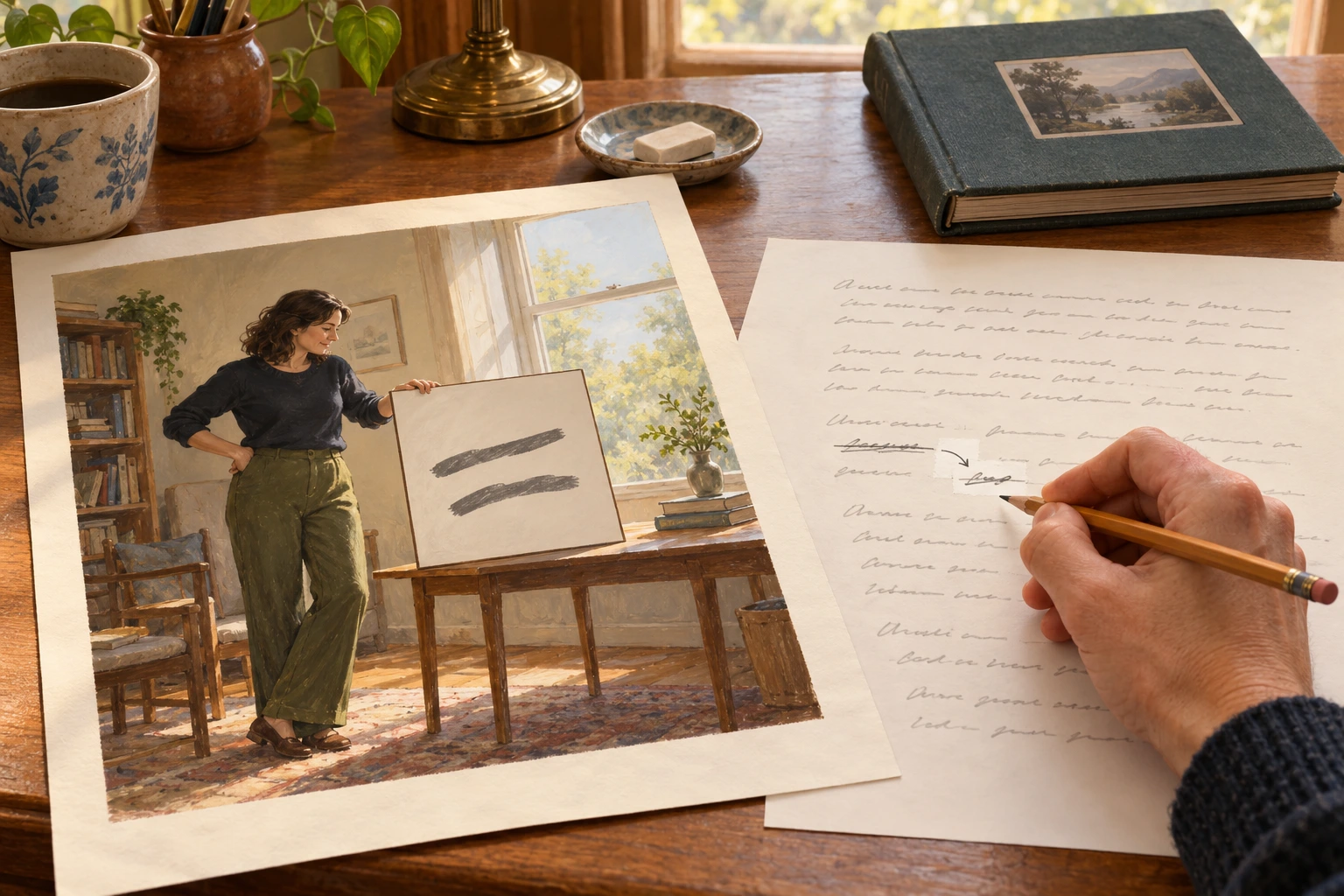
Written sign words mistaken for dialogue can add an action the author did not intend. In this original exercise, a poster carries the words “Unfinished maps.” A working sentence mistakenly gives those same words to Cora as speech. The chosen scene requires only their written presence. I will keep the inscription and replace the accidental speech attribution, then retain a complete revised passage in which neither character says that phrase.
Cora, Leif, the room, the poster and every event below are invented. This is an edit to the author's draft, not a story in which Cora accidentally reads something aloud. The exact words on the poster are supplied as part of the premise. No real quotation, actual exhibition sign, language rule or remembered conversation is being corrected.
State what belongs on the poster
The scene note says Cora brings a poster into a room where Leif is clearing one end of a table. Across the poster are the words “Unfinished maps.” She places it near the window and straightens the paper while he gathers the loose sheets nearby. They speak briefly about the available space. Neither reads the inscription aloud. The narrator can describe its words without making a spoken line part of the encounter.
Keep the note specific. The inscription is not a private thought, a reminder addressed to Cora or a message somebody has asked her to recite. It is writing on an invented physical poster. The exercise supplies no map image, exhibition programme or explanation of who designed it. Those could be further fictional details. They are not needed to correct a sentence that has assigned its printed words to an unwanted utterance.
The phrase stays exactly as chosen in the repair. We are not deciding whether “Unfinished maps” is a good title or replacing it with a more appealing one. Nor are we deciding which character should say it. Under the declared conditions, neither does. The local task is to narrate the existing inscription while keeping the other written actions and ordinary dialogue available.
Read the complete working passage
Cora came into the room carrying a poster between two plain sheets. Leif was gathering loose paper from the table. He moved a closed folder toward the wall, leaving the window end clear. Cora laid the protected poster there and lifted the upper sheet away. One corner of the poster curled toward her sleeve before she lowered it onto the table.
“Is this end all right?” she asked.
“There is more light there,” Leif said. He took the blank sheet and put it beneath the folder. Cora turned the poster so its top faced the wall. A faint crease ran across the lower margin. She smoothed the loose corner with the side of her hand, then moved her fingers away from the writing.
“Unfinished maps,” Cora said. Leif looked along the paper's lower edge and moved the folder farther back. Cora placed a small plain card beside the crease, leaving the letters uncovered. “That can stay there for now,” Leif said. She nodded and set the protective sheet on the chair. The poster remained flat at the window end of the table while he gathered the last loose page.
Identify the unwanted utterance
The working line is, “Unfinished maps,” Cora said. In that sentence, the draft attributes the quoted words to Cora speaking. The author has declared that these are only the poster's written words in this scene. Keeping their spelling unchanged does not preserve that written-only event while the speech tag remains. The problem is the added utterance, not an incorrect word within the inscription.
The surrounding dialogue is different. Cora does ask whether this end is all right, and Leif does answer about the light. Later he says the card can stay for now. Those are selected spoken actions. Removing all dialogue from the passage would be a larger change than this correction needs. I want to keep those lines while replacing the one attribution that does not belong to the chosen encounter.
Likewise, do not give the unwanted line to Leif simply because the author does not intend Cora to say it. That would still add an utterance of the inscription. The writer's stated condition concerns the event, not which name follows a speech tag. The replacement needs a sentence that puts the words on the poster rather than a different person speaking them.
Write the inscription into the narration
My replacement is, “Across the poster were the words ‘Unfinished maps.’” This sentence supplies the inscription directly. It names the physical surface carrying it and keeps the exact phrase. It does not attribute a reading-aloud action to Cora or Leif. For the complete scene below, I place it where the mistaken speech line appeared, before Leif looks along the lower edge.
That is a choice about this particular passage. Another author could have Cora read the poster aloud, if that event belonged to their scene. They would then write a spoken action deliberately. Here, adding a narrator explanation that she accidentally spoke would change the declared version. It would turn the author's drafting error into something Cora did inside the fiction.
Keep the original mistaken sentence in the working copy. The selected scene needs only the replacement, with the other dialogue and handling actions around it. An editing note can say, “Poster inscription retained; accidental spoken attribution removed.” The note identifies what changed without requiring a character to explain the draft or apologize for words the selected scene never gives her to say.
Read the complete selected scene
Cora came into the room carrying a poster between two plain sheets. Leif was gathering loose paper from the table. He moved a closed folder toward the wall, leaving the window end clear. Cora laid the protected poster there and lifted the upper sheet away. One corner of the poster curled toward her sleeve before she lowered it onto the table.
“Is this end all right?” she asked.
“There is more light there,” Leif said. He took the blank sheet and put it beneath the folder. Cora turned the poster so its top faced the wall. A faint crease ran across the lower margin. She smoothed the loose corner with the side of her hand, then moved her fingers away from the writing.
Across the poster were the words “Unfinished maps.” Leif looked along the paper's lower edge and moved the folder farther back. Cora placed a small plain card beside the crease, leaving the letters uncovered. “That can stay there for now,” Leif said. She nodded and set the protective sheet on the chair. The poster remained flat at the window end of the table while he gathered the last loose page.
Leif found a narrow strip of paper beneath the folder. He held it up, then put it with the blank sheets. Cora stepped back from the table. From there, the lower corner of the poster nearly touched the card. She moved the card slightly and left a clear gap between them. The writing stayed visible above the crease. The protective sheet slid down the chair's back until its edge reached the seat.
“Do you need that?” Leif asked, pointing toward the fallen sheet.
“Later,” Cora said. She picked it up and folded it once, loosely, away from the poster. Leif put the folder on the shelf. The room had become quieter as the paper left the table. Cora stood beside the window while he carried the blank sheets to the cupboard. Cora waited beside the window until Leif shut the cupboard, then laid the folded sheet on the empty chair.
Check the words and their event separately
The inscription appears unchanged in the selected scene. Its words are part of the narrated room. The earlier question about the table end and the later exchange about the sheet remain speech. Read those actual sentences together rather than treating every quotation on the page as the same kind of event. This example names the poster's inscription explicitly, so its written presence does not depend on a private editing note.
Look at what follows the replacement as well. Leif examines the lower edge and moves the folder. The selected account gives him no response to hearing the inscription, because the phrase is not spoken there. If a later draft added “he repeated her words,” that would require another decision about what had actually been said. The current continuation avoids that addition and keeps the paper handling as written.
Other dialogue can remain ordinary. “Later” is Cora's answer about the protective sheet, not a new title for the poster. Leif's question points to that sheet. Their actual exchange has its own object and purpose. The correction has not made the room silent or changed every line into narration. It removes one unintended spoken action while leaving the selected conversation intact.
Keep a deliberate read-aloud version separate
You could write another scene in which Cora reads “Unfinished maps” aloud and Leif answers her. That would be a new authored event to develop. You might want an audience, a rehearsal or a reaction to the phrase. None is part of the written-only version retained here. Do not add one merely to explain why the working draft happened to contain “Cora said.”
A different revision might change the inscription while leaving its written status intact. That would answer a wording question instead of the attribution question this exercise chose. Save such a new phrase as a separate decision. The current correction retains the exact two-word inscription and its physical poster, without presenting the phrase as something the characters accidentally or deliberately utter.
Read the selected scene on its own once more. Cora brings the poster, Leif clears the table, the inscription is narrated and the two adults speak about the table end and protective sheet. The author has supplied those events directly. Keep the working copy with its mistaken tag outside that selected version so the old attribution remains visible as an edit, rather than returning as a second event inside the story.
Actual album accounts remain separate
The Recollections Navy Blue album account describes six albums and has one navy front-cover image. The Recollections Textured Gray album account also describes six albums and has one gray textured front-cover image. Neither gallery shows an interior or authenticates a page mechanism, material, conservation result or delivered package. No printed maker/model label is visible. These actual offers do not identify Cora's poster, inscription or any prop in the invented room.
The unintended spoken-cue story retains an actual utterance within its fiction, then follows the resulting conversation. The retold-possibility repair corrects a report that turns an undecided visit into a promise. Here, the author removes a false speech attribution for exact written sign words. No in-world accidental reading or changed commitment is used to explain that editorial repair.
Keep an optional purchase outside the revision
A possible album purchase remains separate from this original editing exercise. If you investigate an actual offer and prefer cryptocurrency, read the options presented for that selected transaction. A general reference to crypto does not establish which currencies, accounts, countries or conditions a later checkout will support. If USDT is available, consider only the instructions and terms actually provided for that order. Confirm the product identity, selected option and supplied contents before authorising a purchase. A pictured example does not independently confirm what a delivered package contains. Keep any supplier clarification with the exact offer reference so another person can understand what was answered. The fictional room supplies no product result or reason to hurry a transaction. Read the applicable delivery, cancellation and return information for the actual order and retain its confirmation if a purchase is made. This article supplies no wallet setup, receiving address, network selection, exchange calculation, fee estimate or transfer sequence. It does not claim that a payment has occurred. A payment preference cannot settle an unresolved product question or make an album appropriate for another person's materials. If a requested method is absent, leave it out of the decision rather than treating its mention here as availability. You can complete the scene without buying either album. A later order would concern actual goods and current terms, while Cora's poster and Leif's folder remain invented. Preserve an uncertain transaction status for reconciliation before considering another payment. A completed transaction record would establish a transaction, not an editing result or the meaning of a fictional action.