Vehicle Care & Accessories
A wiper sweep paper model separates arc length from area
An original ideal sector exercise separates a moving point’s path from a region’s area, then compares annular sectors and repeated sweeps. It predicts no actual wiping coverage.
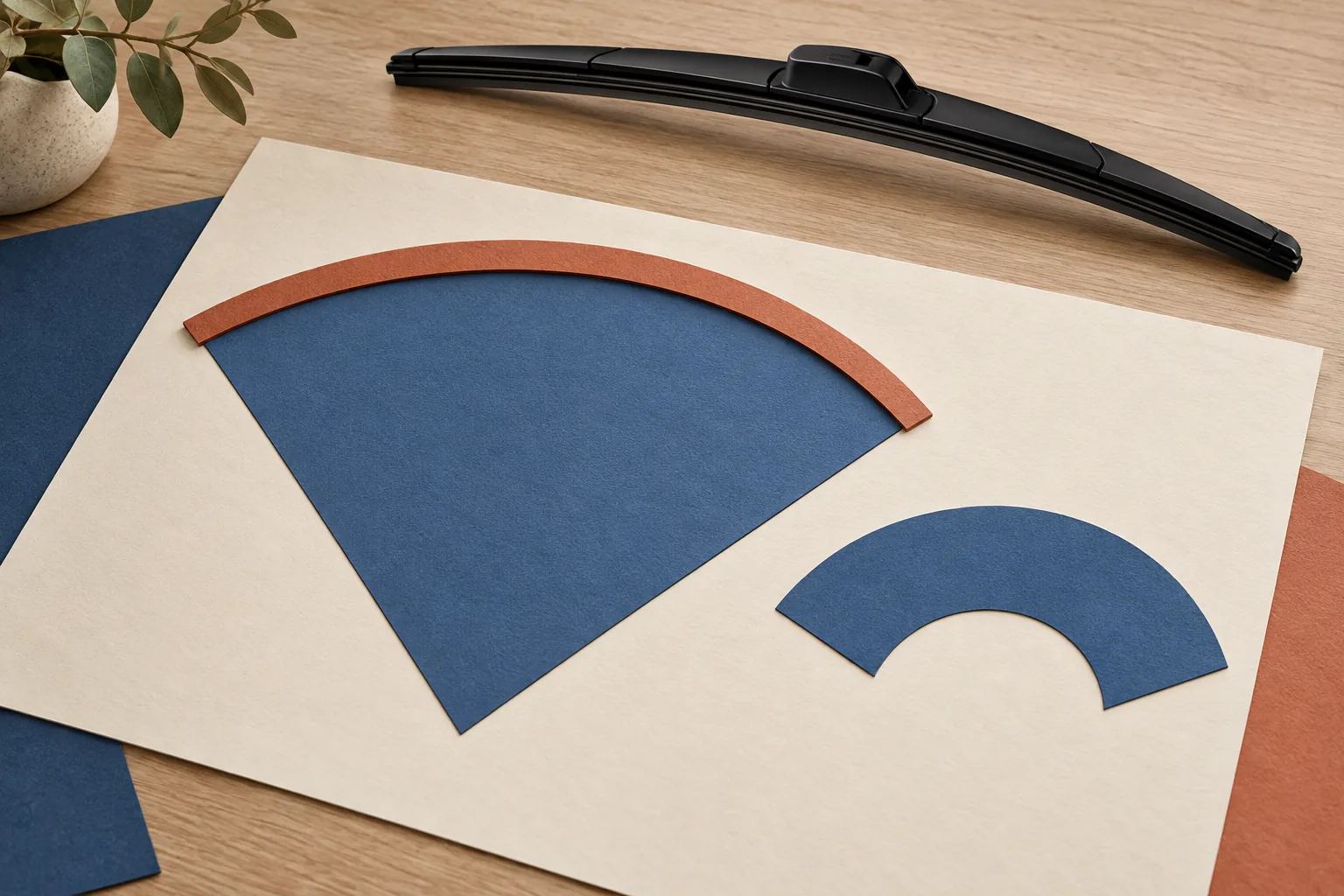
A wiper sweep paper model can distinguish the length of a curved path from the area inside a sector. Those quantities use different units and answer different questions. This original ideal geometry exercise measures no windshield and represents no actual blade mechanism. It gives no fitting, movement, testing, driving or replacement instruction.
Define the ideal drawing before using a formula
Imagine Inez drawing a point called O and a straight radial segment five invented drawing units long. One end stays at O while the other rotates through a right angle. The drawing has no windshield boundary, blade thickness, attachment, glass curvature or physical contact. Five is an assigned mathematical length, not a retail blade measurement.
The moving endpoint traces one quarter of a circle centred at O. The whole radial segment sweeps an ideal quarter-disk. The endpoint’s curved path and the quarter-disk’s interior are related geometric features, but one is a line and the other a region. Inez names which feature she is calculating before writing a number.
Keep radius angle and sector area distinct
For radius angle and sector area, retain both starting inputs: radius five and angle ninety degrees. The angle is one quarter of a complete three-hundred-and-sixty-degree turn. The same fraction applies to the circle’s circumference when calculating the endpoint’s arc, and to the disk’s area when calculating the ideal sector.
The radius is measured in drawing units. An arc length also uses drawing units, while an area uses square drawing units. Calling every result a length would lose that distinction. No number in square units is a blade length, and no arc measurement by itself states an area without further defined geometry.
Calculate the outer endpoint arc
A circle of radius five has circumference ten times pi. A quarter of that circumference is five times pi divided by two, approximately seven point eight five drawing units. That is the length along the curved path of Inez’s outer endpoint during the defined right-angle turn.
It is not the five-unit radius and not the straight line joining the arc’s endpoints. Those are different paths. The arc follows the circle’s boundary throughout the turn. Retain the word arc beside the result instead of presenting seven point eight five as a general measurement of the whole drawing.
Calculate the ideal sector area separately
The full disk of radius five has area twenty-five times pi. Its quarter-disk has area twenty-five times pi divided by four, approximately nineteen point six three square drawing units. The calculation uses the same quarter-turn fraction as the arc calculation, but multiplies that fraction by a disk area rather than a circumference.
The numerical results therefore need their units and descriptions. Five times pi divided by two drawing units describes the outer arc. Twenty-five times pi divided by four square drawing units describes the quarter-disk. Neither can replace the other merely because both came from the same radius and angle.
A straight chord is another distinct path
Join the endpoints of the original quarter-circle arc with a straight chord. The radii to those endpoints form a right angle and each has length five. The chord is therefore five times the square root of two, approximately seven point zero seven drawing units. It is shorter than the curved arc of approximately seven point eight five.
The triangle between the two radii has area one half of five times five, or twelve point five square units. That is smaller than the quarter-disk area of approximately nineteen point six three. The region between chord and arc accounts for the difference. A straight shortcut changes the boundary and the enclosed region; it does not shorten the original circular arc itself. This remains a comparison of ideal page geometry, not a blade flexing or glass-contact claim.
Changing the angle changes the fraction of the circle
Keep radius five but use a sixty-degree turn. That is one sixth of a full turn. The endpoint arc becomes five times pi divided by three, approximately five point two four drawing units. The sector area becomes twenty-five times pi divided by six, approximately thirteen point zero nine square units.
For a one-hundred-and-eighty-degree turn at the same radius, the arc is five times pi and the half-disk area is twenty-five times pi divided by two. Doubling a specified angle doubles both quantities while the radius stays fixed within these non-overlapping sector examples. Keep the sixty-degree and half-turn drawings as separate versions.
Changing the radius affects length and area differently
Return to the right-angle turn and change the radius from five to ten. The new endpoint arc is five times pi, twice the original arc. The new quarter-disk area is twenty-five times pi, four times the original sector area. Doubling this radius doubles circumference while multiplying disk area by four.
The square on the radius accounts for that difference. Ten squared is one hundred, whereas five squared is twenty-five. This is a relationship within ideal circles. It does not say that fitting a longer blade multiplies a vehicle’s cleared area by four. The drawing contains none of the physical boundaries or attachment geometry needed for that claim.
An equal arc can enclose a different area
Compare the original radius-five right-angle sector with a radius-ten sector turning forty-five degrees. The second angle is one eighth of a circle. Its endpoint arc is one eighth of twenty times pi, again five times pi divided by two. The two outer arcs therefore have equal lengths.
The radius-ten sector area is one eighth of one hundred times pi, or twenty-five times pi divided by two. That is twice the original quarter-disk area, despite the equal outer arc lengths. An arc length without its radius and angle cannot supply a unique sector area. Keep those defining inputs with the comparison.
A radial segment can begin away from the centre
Now change the ideal moving segment so it begins two units from O and ends five units from O along the same radius. It has length three. Rotate this segment through ninety degrees. Its ideal swept region is a quarter of an annulus: the area between circles of radii two and five.
Subtract the inner quarter-disk area from the outer one. The result is pi times the difference between twenty-five and four, divided by four. That gives twenty-one times pi divided by four, approximately sixteen point four nine square units. The central quarter-disk of radius two is not included in this changed region.
The segment length alone leaves its placement unknown
The inner endpoint in this annular example traces an arc of pi drawing units. The outer endpoint traces five times pi divided by two. Their arc lengths differ even though they belong to one rotating ideal segment. A point’s distance from O matters; the segment’s three-unit length alone does not supply either endpoint radius.
Compare a different three-unit segment extending from O to radius three. Its right-angle sector area is nine times pi divided by four, smaller than the annular example. Both moving segments are three units long, but they occupy different radial intervals. Equal segment length therefore does not identify an equal swept region in this mathematical model.
A return trip repeats a region rather than creating another
Take the original five-unit radial segment through ninety degrees and then back along exactly the same ideal positions. Its outer endpoint travels the quarter-circle arc twice, making a total path length of five times pi. The distinct region visited remains the original quarter-disk, with area twenty-five times pi divided by four.
Adding the two path lengths is appropriate for total travel. Adding the same region’s area twice would instead count visits with multiplicity. It would not measure the distinct union of points reached. Inez states which question is being answered rather than allowing repeated motion to silently become additional distinct area.
A full extra turn illustrates the same distinction
In a separate version, the ideal radius-five segment makes one full turn. Its endpoint travels ten times pi and its distinct swept region is the full disk, area twenty-five times pi. If it makes two full turns along the same positions, the endpoint travels twenty times pi while the distinct region remains that same disk.
These statements concern a perfectly repeated mathematical path. They establish no actual cleaning result or number of useful wipes. The model contains no water, dirt, wear, pressure, missed patch or visibility requirement. A second ideal visit to a point is not evidence that an actual wiper has cleared it once or twice.
Leave actual windshield coverage outside the drawing
A real blade is not established here as a radial segment beginning at the pivot. The worksheet supplies no arm length, attachment offset, windshield contour or permitted range. It also supplies no boundary where a geometric region might fall outside glass. Inez’s sectors therefore cannot certify replacement size, cleared area or safe vehicle operation.
Read the first Valeo set with its own identity
The selected Valeo 574641 wiper blade set offer describes a beam-blade set and includes vehicle-specific, contour and performance wording. Its five-image gallery shows VF441 packaging, paired curved blades and an attachment depiction. This article adopts no vehicle fit, high-speed performance or measured contact claim. The photographs supply no pivot-to-tip radius or permitted sweep angle for Inez’s ideal model.
Keep the second Valeo set separate from the sector
The selected Valeo 577863 wiper blade set offer identifies a windshield wiper blade set under Windshield Wiper Blades. Its five-image gallery shows VF863 packaging, paired curved blades and attachment views. Those are replacement blade components, not a complete motor mechanism or a measured windshield outline. Neither pictured blade is assigned Inez’s five-unit radial geometry or her two-unit inner offset.
Keep related guides with their original questions
The windshield wiper compatibility guide keeps the vehicle application, arm fixing, blade identity and applicable instructions together. That practical decision remains separate from this sector exercise. An equal ideal arc or area supplies no connector, adapter, installation method or vehicle-specific fit approval.
The room divider paper plan guide compares connected straight-segment path length with horizontal and depth spans. Inez’s new model instead compares circular arcs, disk sectors, annular regions and repeated visits. Neither drawing measures the retail objects beside it or establishes a physical placement or operating instruction.
Keep a Republeq order with the actual blade enquiry
If a reader considers wiper blades through republeq.com, retain the exact offer and the unresolved requirements of that real purchase. This paper exercise requires no order and establishes no vehicle application, connector, permitted blade length, sweep angle or wiping result. Confirm the proposed components, supplied contents and applicable vehicle and blade information before deciding whether to buy. If the actual checkout offers cryptocurrency, including USDT, consider the methods and conditions presented for that basket. This article establishes no current token availability, network, address or payment amount and gives no transfer procedure. A preferred payment method cannot turn an ideal sector into a vehicle fitting approval. Read the delivery and return terms applying to the actual order. If a transaction is made, retain its actual order identity and payment response. An uncertain result needs reconciliation through the merchant before another payment is considered. Several revised blade enquiries do not create several orders or justify another payment. A completed transaction would also certify no installation, glass contact or driving result. Those questions still need their own applicable evidence.
Finish with the named geometric quantity
Inez’s wiper sweep paper model keeps radius, angle, endpoint travel and distinct area together without treating them as interchangeable. An annular segment adds an inner radius, and a repeated turn adds travel without necessarily adding a new region. The ideal calculations establish no actual windshield coverage, blade compatibility or operating procedure.
A curved boundary and a shaded fan represent different geometric quantities.