Lifestyle & Inspiration
A winter comfort checklist for a multi-room home
Build a winter comfort checklist for a multi-room home around household routines, room preferences and clear humidifier purchase quantities.
A home can feel different from room to room because people use those rooms differently. The living room may host an evening together, a study may be busy only during work hours, and a guest room may remain empty for weeks. A winter plan becomes more useful when it follows that actual pattern. Start with the spaces people spend time in and the ordinary preferences they bring, before filling a shopping list with equipment for every room.
A winter comfort checklist for a multi-room home can be a short household record rather than a project to redesign the house. Give each regularly used room a line for who uses it, when it is occupied and what would make the routine more comfortable for that person. Keep appliance questions separate from these preferences. The checklist below helps organize decisions and purchases; it supplies no humidifier settings, health advice or instructions for placing or operating equipment.
Planning winter rooms and household routines
List the rooms by how they are used on an ordinary winter weekday. A room's name does not tell the whole story. A dining room might double as a workspace, while a bedroom might be used for reading well before bedtime. Record the activity people actually describe. This gives planning winter rooms and household routines a practical starting point, without assuming that every space needs the same equipment or the same kind of change.
Then add the times when those uses overlap. Imagine a household with someone working in the study while another person watches television in the living room. Later, both may gather in the same space. The record can distinguish those periods without assigning a device to each room automatically. Occupancy is a planning detail, rather than proof that an appliance covers a room or that one purchase suits all the household's activities.
Leave occasionally used spaces on the record, too. A guest room might have a different role during a visit, and a spare room may become a temporary workspace. Write that change as an occasional need instead of pretending the room is occupied every day. The result is a more accurate household brief: regular routines receive attention first, while a future visit remains a separate decision that can be revisited when plans become definite.
Ask what comfort means to each person
Comfort preferences can be quite specific. Someone may want less visual clutter where they read. Another may prefer a dimmer-looking evening environment or an easy place to keep the room's everyday objects. Ask people to describe the preference in their own words. A request such as "I would like this corner to feel less busy" provides a clearer discussion than assuming that a new appliance is the answer to every winter complaint.
Keep preferences separate when they conflict. One person may like a visible nightlight, while another prefers fewer lights in a shared room. Recording both makes the disagreement visible before a purchase. The checklist need not select a universal winner. It can identify which room is shared, which preference matters at which time and which product feature would require closer attention. No lighting preference establishes an appliance's safety or a health outcome.
A useful room note contains the preference and the activity together. "Reading in the living room after dinner" is more informative than "living room comfort." "Occasional overnight guest" is more informative than "spare room." These notes do not need a rating scale or a perfect weekly schedule. They give the household a common account of the intended routine, so later product discussions stay connected to a real use of the space.
Separate an idea from a purchase requirement
Once the room notes are written, mark which ones describe a preference and which ones describe a possible purchase. Wanting a calmer room is a preference. Wanting a product with an explicitly named nightlight is a purchase requirement. The second can be compared with a listing; the first still needs the household's judgment. Keeping both visible prevents a feature list from deciding what people should find comfortable.
Leave room for a preference to remain unresolved. If two people have not agreed whether they want another visible object in a shared space, the checklist can say so. That is a useful planning result, without a need to choose an appliance immediately. It also prevents the shopping list from treating an undecided idea as an approved purchase. This article's product examples are prompts for clearer questions, rather than recommendations for every room.
Humidifier quantities in a winter home checklist
The Vicks white warm-mist humidifier pack of two provides a concrete example of a quantity field. Its selected title names a pack of two and a 1.5-gallon label, and its description names a nightlight. For humidifier quantities in a winter home checklist, keep the package count separate from the capacity label. Two listed devices are not a reason to assign one automatically to each of two rooms.
The nightlight statement can be connected to the household preference record. If someone expressly wants that named feature, the description supplies it. If someone prefers fewer visible lights, that preference remains part of the discussion. The feature does not prove a sleep benefit or establish suitability beside a particular person. Likewise, "warm mist" remains the product's description, without therapeutic claims or instructions for using it in a room.
The Vornado EVAP40 humidifier description offers another inventory example: it names two removable tanks and two humidifying filters. Those are component counts for that product, rather than a two-device package statement. The distinction is useful on a household checklist because the same numeral can describe different things. A room-allocation plan should not turn two tanks into two independently supplied humidifiers.
Keep this part of the checklist simple. Record the selected item, what quantity the page names and what that quantity counts. A device package, a tank count and a filter count belong on different lines. These product examples do not establish which home needs a humidifier, how often it should run or how much space it can serve. Their role is to make a possible purchase inventory clearer within a broader winter household plan.
Give purchases a shared owner and a clear status
A household list can become confusing when several people add items independently. Give each possible purchase a person responsible for keeping its information together. That person need not decide everyone else's preferences. They can record the exact product name, the question it is intended to answer and whether the household has agreed to consider it. This keeps duplicate shopping notes from being mistaken for separate equipment needs.
Use ordinary status words such as "idea," "details needed" or "agreed to consider." These are planning labels for the household, without a claim that a product has passed an operating or safety assessment. A room preference can remain an idea while an exact package count is known. Keeping those states separate makes it easier to see what is ready for discussion and what still depends on a decision about the room's routine.
If equipment is already owned, record it before adding a second purchase for the same purpose. The note can identify the item and who knows where its product information is kept. This is an inventory exercise, without instructions to operate, move or reuse a particular appliance. It gives the household a starting point for the purchase discussion and helps prevent an existing object from disappearing simply because a new listing looks appealing.
Plan for low-clutter storage on paper
The checklist should include a storage question for anything the household is considering. Ask whether the item would remain part of the room throughout the season or would need a separate storage plan at another time. Record the intended arrangement as a question, not an approved physical placement. Appliance dimensions, clearances and handling requirements belong to the exact product's applicable information and are not supplied by this room-preference exercise.
Keep paperwork and item names together in the record. For a pack of two, note that the quantity refers to two devices. For a product with multiple tanks or filters, note that those are parts of the named product. This helps the household distinguish an appliance inventory from a component inventory when revisiting the list later. It gives no disassembly, cleaning or filter-storage procedure and makes no promise about a particular cupboard's suitability.
Low clutter can also mean keeping the checklist itself short. One room line and one purchase line may be enough for a simple preference. Add detail when it resolves a real question, such as a shared lighting preference or an unclear package quantity. Avoid turning every room into a long specification sheet. The aim is a record the household can return to, with each equipment discussion connected to the routine that prompted it.
Leave a place for changing winter plans
A winter routine can change when a guest arrives, work hours shift or a room gains another use. Leave a small space for those changes beside the original room note. That preserves the reason for an earlier decision without making it permanent. For example, a spare room considered occasional in one week may become a workspace later. Update its occupancy description before assuming that the earlier purchase idea still answers the current request.
Choose a household moment to review the list when plans change. This is a discussion point, rather than an appliance maintenance schedule. Ask which rooms are now regularly occupied, whether preferences have changed and which possible purchases remain undecided. The review should keep item quantities accurate without prescribing running times or replacement intervals. It can also identify ideas that are no longer relevant, so the list reflects the home people are using now.
Keep checkout choices separate from comfort decisions
If cryptocurrency is part of your purchase on republeq.com, keep that payment preference on a separate line from the winter room checklist. It does not establish that a humidifier suits a room, that a package contains the required quantity or that a household has agreed to buy it. USDT can remain a possible payment preference while the equipment decision is still unresolved. Do not assume that a cryptocurrency reference confirms USDT for the exact order you are considering. The current checkout must expressly support the chosen payment method, with its applicable conditions, before you treat that option as available. A household member reviewing the purchase should be able to distinguish the product decision from the payment decision. Record the exact item and package first, and keep any checkout question beside the person responsible for that purchase. If someone else will place the order, make the payment preference explicit rather than allowing it to replace the agreed item details. A payment label does not confirm delivery, return coverage or a remedy for an unsuitable purchase. Those terms belong to the selected order and need their own review. This paragraph gives no transfer procedure, wallet setup, network selection or transaction assurance. If the checkout does not establish the intended cryptocurrency option, leave that part of the purchase unresolved instead of guessing. Likewise, a supported payment option would not remove the need to understand the product information and order terms. Keep the household record useful by noting whether the equipment choice is agreed, whether its quantity is understood and whether the payment preference has been confirmed for that order. A comfort plan can proceed even while those purchasing questions remain open. The purpose is a clear decision record, with USDT considered conditionally and each checkout obligation kept separate from household comfort preferences.
Finish with a room record the household can use
For example, the study's note might read: "Used for weekday work; preference is a less cluttered desk; equipment idea not yet agreed." A guest-room note might say: "Occasional visits; ask the guest about lighting preferences; no standing purchase decision." These are fictional planning examples, not appliance arrangements. They show how a checklist can preserve a clear next conversation without pretending that every room needs the same answer.
At the end, the checklist should show a few understandable relationships: who uses each room, what they would like to change and which equipment idea, if any, relates to that preference. Keep a product's exact name and supplied quantity beside its own entry. The Vicks pack and Vornado component examples illustrate that inventory task, without deciding a household's needs or supplying permission to operate either appliance.
A realistic winter plan can leave some rooms alone and some ideas undecided. It can make space for a visitor without assuming every room requires a purchase. Keep the record close to the activities people actually describe, and revisit it when those activities change. That gives the household a practical seasonal conversation to continue, with room preferences, equipment quantities and purchase choices clearly separated.
The space-heater modes and thermostat-label guide distinguishes documented targets and displays from control sequences a description does not establish. That is useful context when a winter room note mentions an equipment preference: record the feature actually named and leave the operating question separate. Its heating discussion supplies no instructions, humidifier setting or coverage claim for the Vicks and Vornado examples here.
The LG and Danby apartment-refrigerator storage guide uses a shared-household container inventory and model-specific records while keeping body dimensions separate from an approved placement. That provides another example of a purchasing record built around actual household needs. The checklist here uses that distinction for organizing questions only; the refrigerator features and placement information do not become humidifier storage instructions or fit assurances.
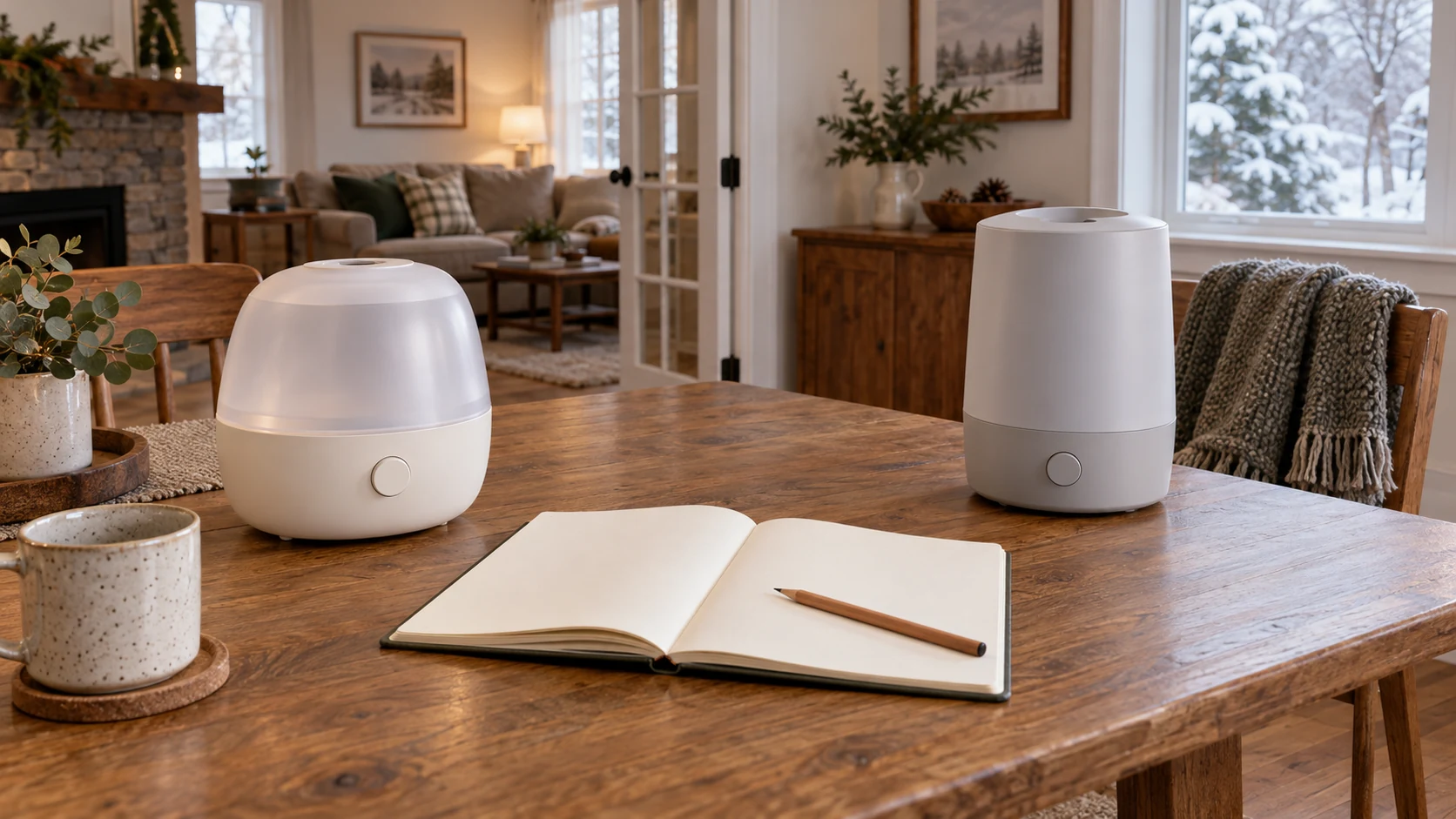
Conceptual winter household planning scene with two complete generic inactive humidifiers and a blank notebook. The photograph illustrates a room checklist rather than either exact retail model, an operating setup or a prescribed placement.