Home & Living
Space heater modes and thermostat control labels
Compare space heater modes, LuckyBliss's ECO target and ZDWALZD's Power Output labels, without guessing timer behavior or mode-to-watt mapping.
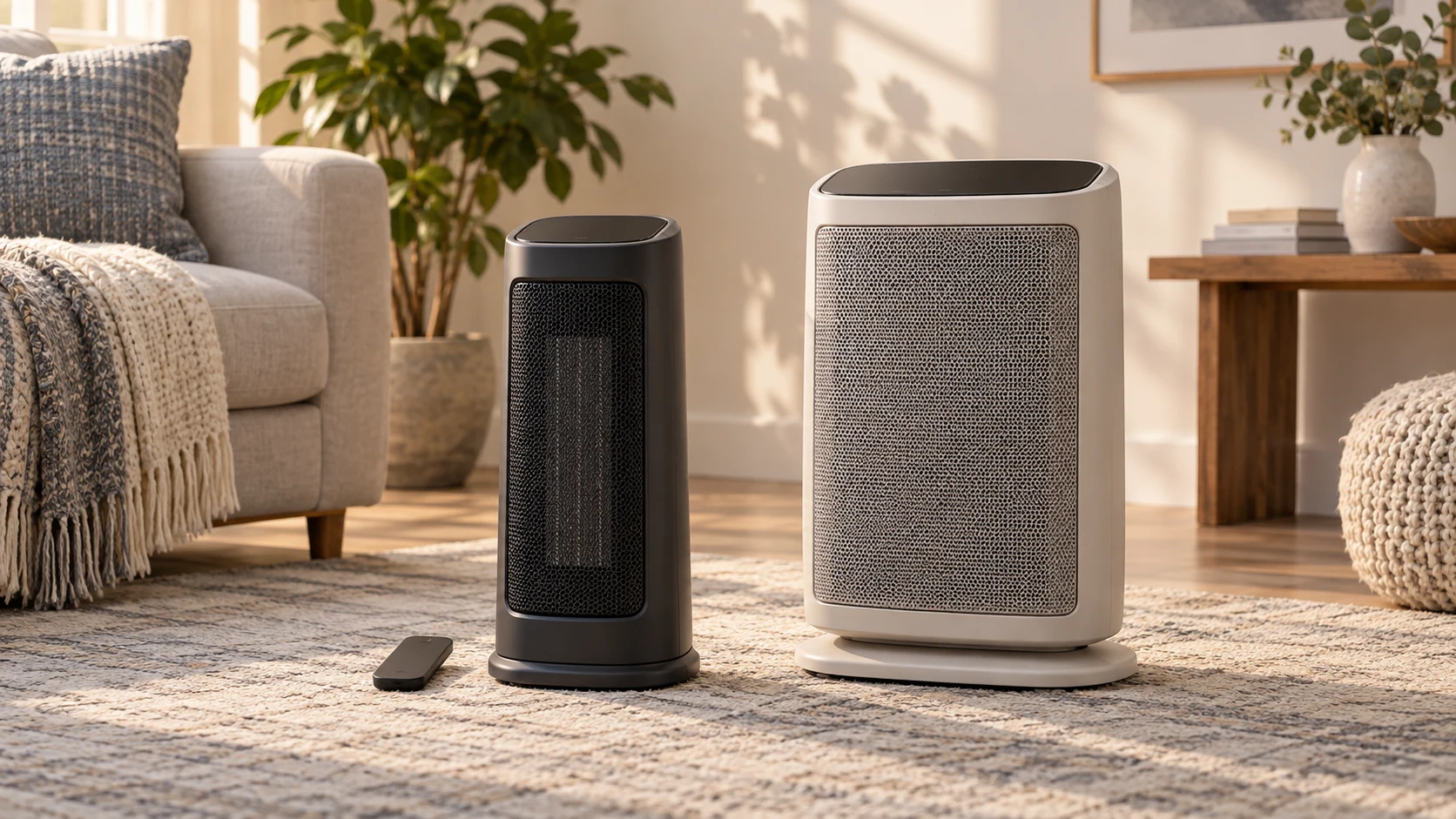
The five space heater modes in the Dreo-titled LuckyBliss offer include three watt-labelled choices, ECO and Fan Only. The ZDWALZD freestanding heater names Fan, Low Heat and High Heat, then separately lists 600 W, 900 W and 1500 W as Power Output. A longer list of mode names does not establish finer heat adjustment, and three listed wattages do not explain how a three-mode selector works.
Read these two offers with a particular control requirement in mind. You might want an explicitly documented temperature target, a fan choice without a heat label, or a display that identifies the selected mode. Each requirement calls for different information. The descriptions establish some of that information, but neither supplies a complete control sequence. This guide compares their stated mode, thermostat and timer accounts so you can identify which details address your routine and which still need an exact-product answer.
Read the five space heater modes on the LuckyBliss offer
The Dreo-titled portable ceramic heater offer lists five operation modes: 1500 W, 900 W, 700 W, ECO and Fan Only. Its description places a selectable temperature target in ECO, with a stated range of 41 to 95°F and increments of 1°F. It also describes a temperature display, an included remote and a hidden rear carry handle. Those are separate pieces of the control and handling inventory.
Three of the space heater modes are identified by wattage labels. ECO is identified by a mode name and a temperature-selection account. Fan Only describes another operating choice. A buyer should keep those labels in their supplied categories. The listing does not give five equal steps on one scale, a numerical wattage for ECO, or a wattage for Fan Only. Making a five-row ladder from lowest to highest power would add information the description does not contain.
The brand field on this offer says LuckyBliss, while its retail title says Dreo and the description uses Hyperamics and Shield360 names. Keep that mismatch attached to the exact offer when requesting a manual or support information. The title alone cannot establish which manufacturer's documentation applies to the unit being sold. Before depending on a control explanation found elsewhere, have the seller identify the offered model and the corresponding manual.
Heater thermostat labels describe targets differently from modes
The stated 41 to 95°F selection belongs to the LuckyBliss offer's ECO account. Its 1°F increments describe the advertised selection interval. They do not certify that the sensor measures room temperature to that precision, that the whole room stays within one degree of the selection, or that the appliance uses a particular heating algorithm. A buyer seeking a clear numeric target has a documented range to investigate here, while actual temperature behavior remains a separate evidence question.
Consider a person who wants to choose a temperature rather than choose among wattage labels. The ECO wording addresses that preference more directly than the three watt-labelled choices alone. It still leaves practical control questions: what does the display show while a target is selected, and does the manual describe what happens when that target is reached? The listing supplies no full sequence for answering those questions. A target, a reading and the active mode can all appear in one product description without their relationship being fully explained.
The actual product guide to Krib Bling and WAA thermostat numbers makes a related purchase decision explicit. It distinguishes the number of labels on a control from the documented meaning of those labels. Its refrigerator values apply to those refrigerators. For these heaters, the useful connection is the documentation question: does the offered model explain the target, the displayed information and the scope of the adjustment? Heater thermostat labels need their own legend even when another appliance has a familiar-looking scale.
ZDWALZD separates three mode names from three output labels
The ZDWALZD freestanding electric heater lists Fan, Low Heat and High Heat. It says temperature can be set using the front control or top control panel, and that an LED screen displays temperature, mode and timer. The specifications separately name Power Output of 600 W, 900 W and 1500 W. That wording gives a control inventory and a set of ratings, but it does not provide a complete mapping between the two.
In particular, there are two heat-labelled modes and three wattage figures. The description does not say that Fan uses 600 W, that Low Heat corresponds to 900 W, or that each number identifies a selectable position. Preserve the source's Power Output wording when asking about the figures. The listing does not establish measured electrical input at each mode, so relabelling those numbers as verified consumption would create a second unsupported interpretation.
A useful inquiry names both parts of the description: “Which of the stated 600 W, 900 W and 1500 W Power Output figures corresponds to each available mode, and where is that relationship documented?” The answer should identify this exact offer. A general explanation of another three-mode heater would leave the mismatch unresolved. If the seller supplies a diagram or manual page, check that it names the offered model and addresses all the listed figures.
What a fan only heater setting establishes
The LuckyBliss listing explicitly calls one choice Fan Only. ZDWALZD names a Fan mode without the same expanded wording. These are useful labels to preserve when comparing space heater modes, especially if a separate fan choice is a condition of purchase. They do not establish the same airflow, sound, control behavior or energy use. The descriptions also leave the wattage mapping incomplete, so neither label supplies a consumption figure for a fan choice.
If your interest is specifically a fan only heater setting, ask the seller to document what that setting does on the exact offered product. The LuckyBliss wording is more explicit about the name, while the ZDWALZD account needs clarification about its Fan choice and the separate output list. Neither description gives a sequence for selecting the mode or explains which other adjustments remain available within it. An operating manual should settle those details before you use them.
Keep the reason for wanting that choice specific. Wanting a documented fan option is different from expecting the appliance to provide a particular cooling result or replace another fan. The listings contain no matched fan test, no comparable noise measurement and no shared airflow conditions. A clearly named option can satisfy a documentation preference without proving that either unit meets an unmeasured comfort or performance requirement.
Separate a temperature display from the selected target
ZDWALZD states that its screen displays temperature, mode and timer. The LuckyBliss offer describes a clear temperature display and a remote, with its numeric target range stated under ECO. Neither account explains every display state. In particular, the short descriptions do not establish when a screen shows a selected target, a sensed temperature or another value. Read the advertised display inventory as a starting point for a visibility question.
For someone who wants to check the chosen mode at a glance, ZDWALZD explicitly names mode among the displayed items. For someone who wants a documented numeric target range, the LuckyBliss ECO wording gives that range. They cannot establish which display is easier to read from a chair, how large its characters are or whether a remote repeats the same information. Neither source provides those details.
The two control locations named by ZDWALZD also need a precise explanation if access matters. Its description refers to a front control and a top control panel; it does not describe their button layout or how their selections interact. Ask for the control illustration and relevant manual page. That request can answer whether the offered arrangement suits your reach and viewing position without assuming that two locations mean two independent temperature settings.
Read the 24-hour auto-off claim separately from the timer
The LuckyBliss offer names a 24-hour auto-off timer within its protection account. ZDWALZD names a timer and says timer information appears on the screen, but supplies no interval or detailed schedule in this description. These statements do not establish matching programs. A 24-hour auto-off label does not, by itself, tell you whether shorter periods are selectable or describe a delayed start.
If a particular session length matters, request the available timer selections and the manual's description of each. For ZDWALZD, the question includes the selectable range and what the displayed timer represents. For LuckyBliss, it includes whether the stated 24-hour auto-off is an automatic limit, an adjustable timer or another documented behavior. Keep those possibilities as questions until the applicable documentation resolves them.
A temperature target and a time limit also address different requirements. The LuckyBliss source locates the temperature choice in ECO, while ZDWALZD mentions temperature setting alongside its timer display. Neither short description explains how a time selection and temperature selection interact. If both are essential to your intended routine, obtain an account of the combined controls for that model rather than joining separate feature sentences into an operating sequence.
Keep the listed wattages out of a guessed energy comparison
The watt-labelled LuckyBliss modes and the ZDWALZD Power Output figures may attract someone comparing a lower setting with the highest listed choice. Their different labels make a direct consumption ranking unsupported. ZDWALZD does not identify those output figures as measured electrical input, and neither listing reports energy use over a shared session. The source also gives no numerical power account for LuckyBliss ECO.
The actual Jackery and Bluetti backup-load guide explains why a device's requirements must be distinguished from a power station's output limits and stored energy. That distinction is relevant when reading a wattage claim here. It does not certify either heater's input draw, establish a suitable station or predict runtime. The ZDWALZD Power Output label would first need its own documented explanation.
Record the rating exactly as the seller describes it. If energy use is decisive, seek applicable input-rating documentation and comparable measurements with stated conditions. A description that calls ECO efficient or says a heater minimizes energy use supplies no shared result for these two offers. You cannot derive a household bill or a savings percentage from their mode names alone.
Carry and control inventory add separate purchase questions
LuckyBliss explicitly includes a remote and describes a hidden rear carry handle. ZDWALZD lists overall dimensions of 13.5 inches wide, 9.5 inches deep and 24.75 inches high, alongside front and top controls. Its description does not name an included remote. That omission leaves the contents unresolved; it does not prove that the offered unit has no remote capability or that every control must be operated at the heater.
A buyer who requires a supplied remote can request confirmation of that accessory and its exact supported controls. Someone assessing storage can use the stated ZDWALZD dimensions to start a space check, while recognizing that they are overall dimensions, not clearance instructions. The LuckyBliss description's portability language and handle do not supply a comparable size or weight. Neither set of facts establishes an approved operating location.
These questions should stay separate from thermostat preference. A documented numeric target does not answer whether the supplied remote exposes that adjustment. A display of temperature, mode and timer does not identify the contents of the box. Request a packing list and control diagram tied to the offered product when those details would change which unit you buy.
Leave unmatched room and protection claims in their own scope
LuckyBliss advertises 70° oscillation, airflow up to 9.77 feet per second and coverage up to 200 square feet. ZDWALZD describes side-to-side oscillation and lists 97 to 161 square feet. The descriptions supply no shared coverage or airflow test. Those figures do not establish that one maintains a selected temperature more effectively in your room, and a target range does not validate the coverage claim.
The offers also use quiet-operation and protection language without a matched noise or safety test. LuckyBliss names tip-over and overheat shutoffs, V-0 material and ETL wording; ZDWALZD names overheat and tipping protection. Preserve those as product-description claims. They do not supply installation clearances, a safe-use procedure or permission to test a safeguard deliberately. The applicable instructions must address use of the actual unit.
Both offers appear in the Restored Home product category. That category label alone does not establish the delivered condition, service history or warranty of either item. Keep the exact offer identity with your support questions, including the LuckyBliss brand-field and Dreo-title difference. A control specification is useful only when it applies to the product being supplied.
Choose the control information that your routine requires
For a purchase centered on space heater modes, LuckyBliss documents a five-name inventory that includes ECO with a stated target range and Fan Only. ZDWALZD documents three mode names, a display of temperature, mode and timer, and front and top control locations. Its separate Power Output list needs an exact explanation before any rating is assigned to a mode. Compare those disclosures against the controls you require.
Ask LuckyBliss's seller to identify the applicable model and manual, explain the ECO display and clarify the 24-hour auto-off account. Ask ZDWALZD's seller for its mode-to-rating legend, the meaning of its temperature display and the timer selections. Keep replies with the exact offer and packing list. A documented answer to those questions can support a control-based purchase; missing answers remain visible reasons to keep investigating.
Conceptual editorial cover for space heater modes: two generic switched-off freestanding heaters in a quiet room, without depicting exact retail models, control behavior, approved placement or measured heating results.