Crypto Commerce
Compare mini fridge thermostat numbers across two models
A numbered dial can look familiar until the next compact refrigerator uses a different scale. If one listing mentions seven positions and another mentions three, the numbers alone do not tell you which appliance gives you more control or what either position will mean in use. For a purchase decision, start with the narrower question: what has each listing actually explained about its control? The Krib Bling FL-2-80 description identifies one end of its scale. The WAA mini fridge description names a shorter range of positions without explaining their direction. Neither description gives a setting-by-setting temperature chart. For mini fridge thermostat numbers , verify each step.
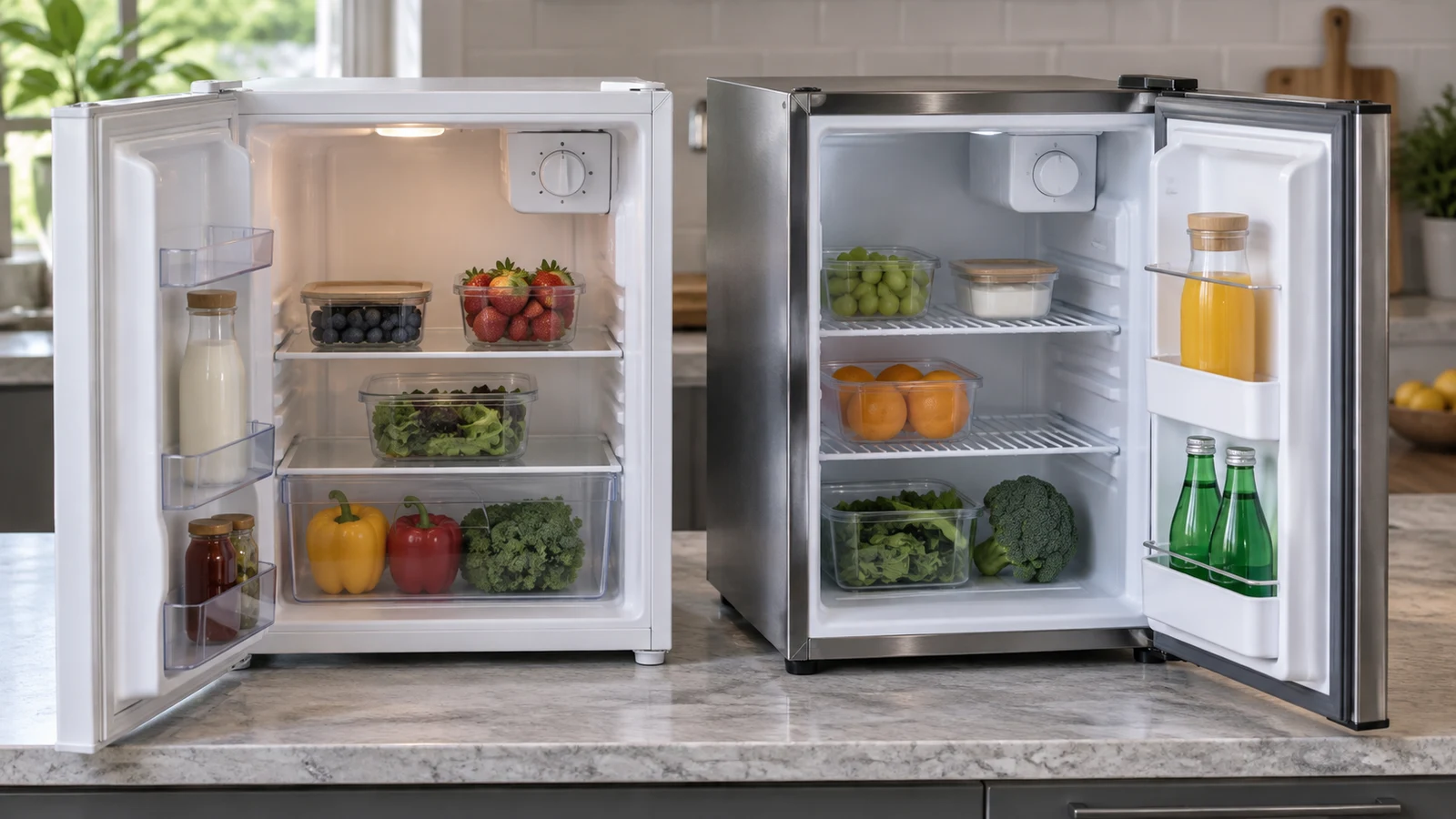
A numbered dial can look familiar until the next compact refrigerator uses a different scale. If one listing mentions seven positions and another mentions three, the numbers alone do not tell you which appliance gives you more control or what either position will mean in use. For a purchase decision, start with the narrower question: what has each listing actually explained about its control? The Krib Bling FL-2-80 description identifies one end of its scale. The WAA mini fridge description names a shorter range of positions without explaining their direction. Neither description gives a setting-by-setting temperature chart. For mini fridge thermostat numbers, verify each step.
That leaves two separate things to establish before you rely on a numbered dial: the meaning of its markings and the compartments affected by it. A product can have a refrigerator section and a freezer section without its listing establishing that each has its own adjustment. Read each model's wording on its own terms, then request the missing control information for the exact model you are considering.
Read WAA Thermostat Settings Separately From Krib Bling's Seven Positions
The listing for the Krib Bling FL-2-80 says it has seven temperature settings. In its instructions, it describes setting the thermostat to 7 for maximum cooling. Those are concrete pieces of information about mini fridge thermostat numbers on this particular model: the scale has seven settings, and the description assigns a meaning to position 7. That wording should not be turned into a general instruction to choose 7. It identifies the maximum-cooling end of the listed control, not a suitable setting for every buyer or purpose.
The same Krib Bling description gives a stated refrigerator range of 5 to 10°C and a stated freezer range of 0 to -18°C. It does not identify which dial positions correspond to the endpoints of either range. Reading a range beside a seven-position control may tempt you to assign a temperature to each number, but the listing supplies no such key. It also does not say how much the result changes between neighboring positions. A buyer who needs a documented meaning for positions other than 7 still needs the exact-model manual or a clear answer from the seller or manufacturer.
Keep the words "maximum cooling" attached to the Krib Bling description. They tell you how that listing characterizes one position; they do not describe a measured outcome in a particular room or a guaranteed temperature in either compartment. The distinction matters when comparing listings because a visible endpoint can seem like a complete explanation of a control. Here it answers a limited question about direction at one end of one scale while leaving the rest of that scale and its compartment effects undescribed.
Read WAA Thermostat Settings Without Borrowing Krib Bling's Legend
The WAA Freezers sku-17565472984 3.2 cu. ft. Mini Fridge description says its thermostat adjusts from position 1 to 3. That is all the description says about the meaning of those positions. If you are examining WAA thermostat settings, you can identify the positions advertised, but you cannot tell from this wording whether 1 or 3 represents greater cooling. The Krib Bling listing's explanation of its own 7 position supplies no answer about a different model's 3 position.
The WAA description also states a refrigerator range of 32 to 50°F and a freezer range of 3 to -1°F. These are advertised ranges, not a table connecting position 1, 2, or 3 with a temperature. There is no basis in the supplied wording for matching position 1 to one end of either range and position 3 to the other. Nor does a three-position scale establish that each step is a uniform share of the advertised range. A comparison that says "3 on WAA equals 7 on Krib Bling" would add a relationship neither listing provides.
For these two models, count of positions and explanation of positions are different attributes. Seven gives the Krib Bling buyer more numbered labels to distinguish on the listing, while three is the number of positions described for WAA. The descriptions alone cannot establish finer temperature precision, easier adjustment, or better cooling for either appliance. If clear markings matter to you, ask for the actual legend or manual pages instead of ranking the controls by their highest printed number.
What WAA Thermostat Settings Leave Open About Two Compartments
Both descriptions mention two doors and identify a refrigerator area and a freezer area. That exterior arrangement tells a shopper that the units are presented with separate access to those spaces. It does not answer how many thermostats either unit has, where a control is located, or whether the refrigerator and freezer can be adjusted independently. A door is an access feature; it is not evidence of a separate temperature control. Those are distinct specifications to request if compartment-level adjustment would affect your choice.
There are two useful questions to keep apart. First, what does turning the advertised thermostat from one numbered position to another mean for that model? Second, what does that adjustment govern? The Krib Bling statement about maximum cooling at 7 partly addresses the first question, while the WAA listing does not explain the direction of its three positions. Neither supplied description settles the second question for both compartments. A statement about a temperature range for each compartment does not, by itself, identify a separate adjustment for each one.
Imagine you want to change the refrigerator setting while leaving the freezer setting independently selectable. The two-door descriptions do not promise that capability. Equally, they do not justify a claim that a single control necessarily changes both spaces in a particular way. The purchase-relevant step is to ask whether the exact model has one control or separate controls and, if there is one, what the manufacturer says it affects. Without that answer, an apparently simple product comparison can end up comparing an assumed feature rather than a documented one.
Control scope also changes what a helpful answer looks like. "The unit has two doors" repeats something already in the listing, while "the refrigerator and freezer have separate temperature controls" would address an independence requirement if the seller can document it for the exact model. If the available material only describes a shared adjustment, you can judge whether that arrangement fits your requirements. If the material stays silent, leave the question unresolved rather than treating silence as a feature or a defect.
Ask For A Model-Specific Answer To WAA Thermostat Settings
A short inquiry can prevent the two scales from being mixed together. Give the seller or manufacturer the model identifier and ask for the control legend or the relevant page of the manual. For Krib Bling, name FL-2-80 and ask what positions 1 through 6 mean in relation to the listing's statement that 7 is maximum cooling. For WAA, name sku-17565472984 and ask which direction positions 1 through 3 run. In either case, the useful response identifies the product and the positions rather than offering a general rule for compact refrigerators.
Then ask a separate compartment question: "Does this exact model have independent refrigerator and freezer temperature controls? If not, what does the advertised thermostat adjust?" You can also ask whether the manufacturer publishes a position-to-temperature explanation. A reply that supplies a diagram, manual excerpt, or unambiguous written description is more useful than a guess drawn from a similar appliance. These requests concern documentation for a potential purchase; they are not an instruction to adjust a unit you already own.
If a response refers only to a stated refrigerator or freezer range, follow up on whether it actually links that range to particular control positions. A range and a dial can appear in the same listing while leaving their relationship unspecified. Likewise, an answer about the number of doors does not settle the number of controls. Keep the request brief and precise: exact model, direction of the numbered scale, and which compartment each control affects. The point is to find out what the maker documents, not to force an unsupported numerical equivalence between the two listings.
When no model-specific explanation is available, record the gap as an unknown in your comparison. That is still useful purchase information. It lets you decide whether you are comfortable buying with that uncertainty or whether the control design is important enough to require documentation first. A buyer with no need for independent compartment adjustment may weigh the unanswered scope differently from someone for whom separate controls are essential. Neither buyer needs a made-up temperature for position 2 to make that distinction.
Make The Purchase Decision Before Moving To Refrigerator Compartment Capacity
Suppose your main requirement is understandable control markings. The Krib Bling listing tells you that 7 is its maximum-cooling position, while its other positions remain unmapped in the supplied description. The WAA listing tells you positions 1 to 3 exist but does not explain which direction they run. Compare the documentation each seller or manufacturer can provide for the exact model. If a readable legend is a condition of purchase, neither the number of positions nor the advertised temperature ranges can substitute for it.
Now suppose your requirement is independently adjustable refrigerator and freezer compartments. Neither supplied description establishes that feature for either model. Request an explicit statement about separate controls and their respective effects. If the answer documents independence for one appliance, you have evidence relevant to your requirement; if it describes one shared adjustment, you know what you would be accepting. If no answer arrives, avoid turning the two-door layout into a yes or no. That would settle the question by appearance rather than by the control specification you need.
Once the control questions are answered, space allocation is a different purchase decision. The companion guide to refrigerator compartment capacity addresses how to read the space assigned to each compartment, rather than what a thermostat number means. Keep those comparisons separate so that an attractive overall size does not seem to answer a control question, and a clear dial legend does not seem to answer a space question.
Use mini fridge thermostat numbers as labels that need a model-specific explanation. For the Krib Bling FL-2-80, the description explains the maximum-cooling end but not a complete temperature mapping. For the WAA sku-17565472984, it names three positions without defining their direction. Before choosing between them on control behavior, ask for the exact-model legend and a documented account of which compartments each adjustment governs. If those answers matter to your purchase and remain unavailable, keep that uncertainty visible in the decision.