Crypto Commerce
restored Jackery Explorer 1000 v2 — Start with the devices that must stay on
Compare restored Jackery Explorer 1000 v2 by saved watt-hour claims, continuous AC output, recharge paths, outlets, portability, and a real backup-load test.
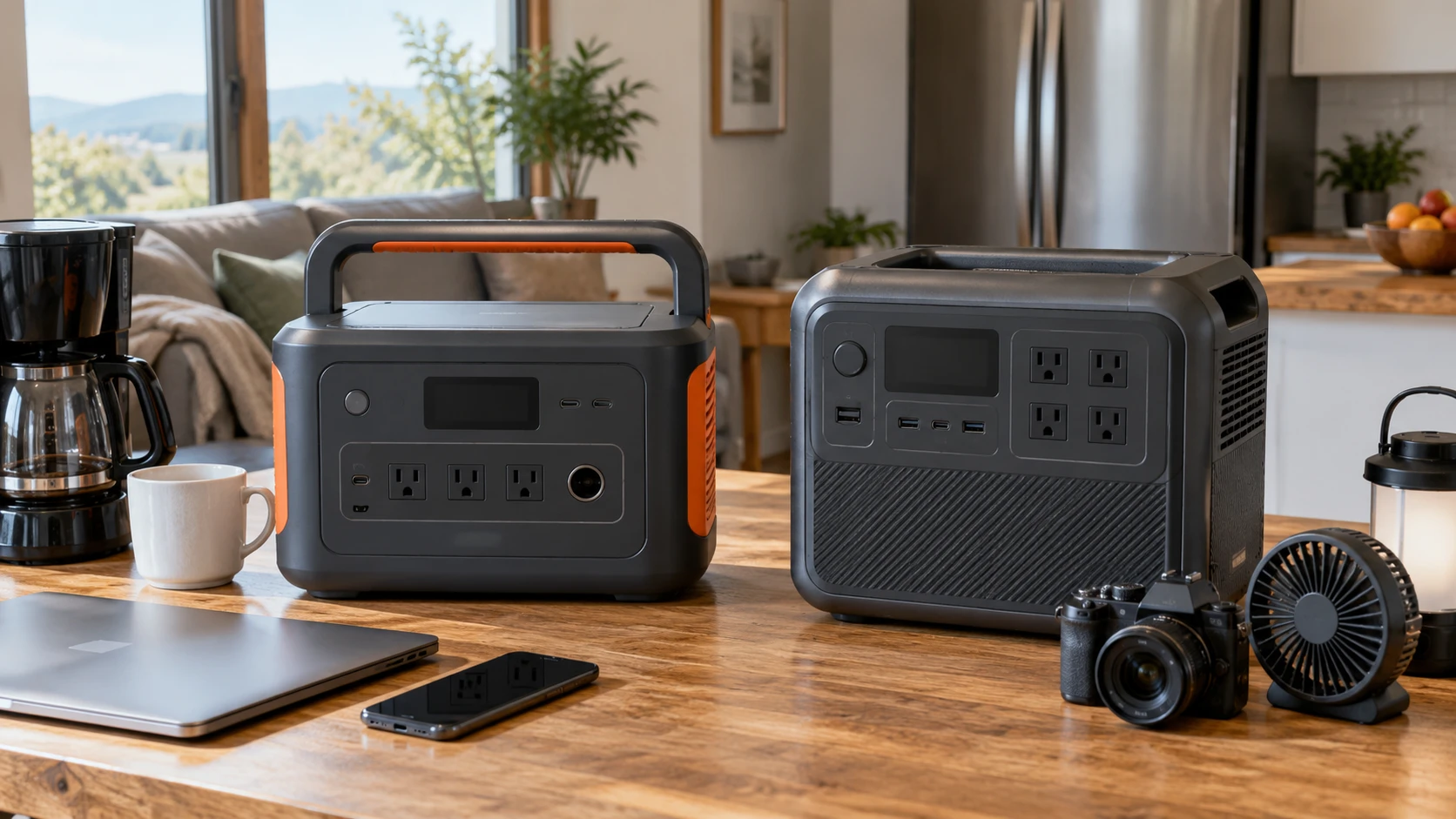
The restored Jackery Explorer 1000 v2 is a LiFePO4 power station described for camping, travel, and backup use. Its saved listing gives three AC outlets, two 100W USB-C ports, a USB-A port, and a vehicle DC port. It also gives a foldable handle and a weight of 23.8 pounds. Those details help if the job is moving the unit to a kitchen, campsite, or parked vehicle and keeping several small devices connected at once.
Before turning a capacity label into a promised number of hours, read the published guide to battery capacity units and runtime planning. Watt-hours describe stored energy, while watts describe a rate of use or output. Actual time depends on the load, conversion losses, settings, and battery condition. List the devices you intend to power and their measured draw, then decide which must run at the same time. A vague plan to “keep the house going” hides the critical loads.
The restored Bluetti AC180 is listed with a 1152Wh LiFePO4 battery and 1800W rated output. Its description names wall, solar, car, and external-generator charging, along with compatible expansion batteries. That gives a different planning emphasis: how the station will be refilled during a longer outage or off-grid stay. The saved source does not enumerate its AC, USB, or DC outlet counts, so confirm the exact ports needed for your appliances before buying.
Resolve the Jackery numbers before a close comparison — battery capacity units and runtime planning
The Jackery listing is internally inconsistent. Its title names 1060Wh and 1490W, while the detailed description says 1070 watt-hours of storage and 1500 watts of continuous AC output. It also states a 3000W surge capacity. Those differences are small in percentage terms but material to a specification-based comparison. Do not silently choose whichever set makes the product look better. Ask for the current label or manufacturer specification tied to the exact restored model and SKU before using its capacity or output as a purchasing threshold.
Bluetti's source states 1152Wh and 1800W rated output. It separately mentions 2700W “lifting power.” The description does not define how long that mode can run or which loads qualify. It should not be treated as 2700W of ordinary continuous output. Similarly, Jackery's 3000W surge figure is a short-demand claim, not a second continuous rating. If a refrigerator, pump, or other motor is the intended load, test its start-up behavior against the unit's current manual and protection limits.
The watt-hour difference between the saved Bluetti figure and either Jackery figure does not establish a useful runtime gap by itself. AC inverter losses, output cutoff, temperature, age, and the appliance's changing draw all intervene. A refrigerator does not draw one fixed wattage every minute. Record its start-up draw and its actual energy use over a representative period, then use that measured load to assess whether either station meets the minimum you need. Keep a margin rather than planning to exhaust the battery exactly at the end of an outage.
Check the intended device's plug and voltage as well as its watts. A power station with enough stored energy can still be unsuitable when a single outlet, surge limit, or connector does not match the equipment. Jackery's source gives outlet counts but no full voltage-by-port table in this snapshot. Bluetti's source gives output ratings but not a complete port map. Verify both units' current outlet specifications before promising that either can run a particular household appliance.
Decide how the station will be recharged — restored Bluetti AC180
Jackery's detailed description says its normal full charge takes about 1.7 hours, with a one-hour emergency-charge mode enabled through the Jackery app. It presents the default profile as protective of battery health. That is a listing claim under unspecified charging conditions. If the station will be recharged from a limited generator or campsite supply, check the required input and whether the faster mode can be selected without an internet connection. The saved source does not give a solar-input specification for this exact Jackery package.
Bluetti says its Turbo Charging accepts up to 1440W input and can reach 80% from empty in 45 minutes. That is not a full-charge time and cannot be compared directly with Jackery's stated full-charge figures. Bluetti also lists 500W solar input and estimates a full recharge in roughly 2.8 to 3.3 hours. The solar estimate depends on sufficient panel output and suitable conditions, which the saved source does not spell out. Confirm compatible panels, cables, voltage limits, and realistic sun exposure for the installation you plan.
The Bluetti package description names AC, car, and solar charging cables. That may shorten setup for someone changing among charging sources, but verify the box contents of the particular restored unit. The Jackery listing does not enumerate an equivalent cable bundle. Missing catalog detail is not proof a cable is absent. For both products, write down the charging source available on a normal day and the one available when the grid is down. A backup station that can only be refilled from an unavailable socket has a short useful life in an extended outage.
Bluetti also mentions compatible expansion batteries. That could change a future capacity plan without replacing the main unit, but the source does not identify the expansion model, connection kit, or maximum combined capacity. Price those parts and confirm compatibility before treating expansion as a guaranteed low-cost path. Jackery's saved listing does not describe an expansion route for this particular model, so compare the actual packages being sold rather than a brand's broader accessory catalog.
Separate portability from output — restored Bluetti AC180
Jackery gives a concrete carrying weight of 23.8 pounds and a folding handle. That lets a buyer judge whether it can be moved up stairs or between a vehicle and campsite. Bluetti's saved description does not state weight or dimensions. Do not infer that it is heavier simply because its watt-hour and output figures are larger. Check its current weight and handle design if one person must move it regularly. A unit used only beside a home router faces a different portability test from one carried to a trailhead.
Jackery lists an app-controlled 30-decibel silent-night mode and an energy-saving mode. The 30-decibel figure is a stated mode claim, not a measured sound level for every fan and load condition. Bluetti's description does not give a comparable acoustic figure. If the station will sit beside a bed or desk, ask whether its fan runs while charging, powering a load, or both. A short test at the intended load reveals more than a number detached from its operating mode.
Both are described as restored or refurbished. The saved Jackery description gives a claim of more than 70% original battery capacity after 4,000 charging cycles and a stated service life over ten years for its LFP battery. Those are product-life claims, not evidence of the condition of the specific restored unit shipped to you. Bluetti's listing does not provide the same cycle-life figure. For either unit, check the Republeq's catalog refurbishment grade, battery-health information if supplied, return process, and written warranty before relying on it for emergency equipment.
Bluetti's package list includes a warranty card and customer-service reference but no warranty duration in the saved description. Jackery's source gives no package-specific warranty term. Do not assume a new-unit warranty applies to either restored listing. Ask who services the unit, what battery faults are covered, and how a failed unit is handled during the return window. A usable backup plan includes what happens if the station itself does not start after months in storage.
Rehearse the backup load before it matters — restored Bluetti AC180
Make a short power inventory. A phone, router, lamp, and refrigerator have different connection and start-up needs. Record each plug type and rated input, then measure the loads that will run together. Test the highest-starting appliance by itself first, with the current manual's limits in hand. Add the smaller devices one at a time and observe the station's displayed draw and any alarm. The listings do not contain a controlled test of your particular appliance combination.
Then rehearse charging. Fill the battery from the source you expect to use, operate the selected load for a representative period, and record the observed change in charge. If solar panels are part of the plan, test them in the location and season that matter. Do not erase an unsafe or incomplete test with a theoretical watt-hour division. A practical result can be affected by shade, cable loss, inverter overhead, and how often the load cycles on.
Keep the station ready between trips or outages. Read the current manual for storage charge, inspection, and charging guidance, then put a dated check on the household calendar. During that check, confirm that the unit powers on, its AC and USB ports work, and the cables remain with it. A restored station that performed well on delivery can still be unavailable when needed if it was stored without a working charger or the necessary adapter. Record the actual battery reading and the load used, so the next check can reveal a change instead of relying on memory.
For a portable, outlet-defined setup, Jackery's documented three AC sockets, 100W USB-C pair, handle, and weight are useful facts, provided the title-versus-description specification conflict is resolved. Bluetti's source gives higher stated rated output, a clear 1152Wh capacity, more named recharge paths, and an expansion option that needs accessory confirmation. Neither listing proves that a specific refrigerator will run for a promised number of hours. Choose with measured loads, verified current specifications, and the restored unit's return and warranty terms in hand.