Cleaning & Vacuums
window squeegee head cannot reach a narrow pane edge: check clearance
Measure the usable glass opening and identify the part of a squeegee that collides before changing tools.
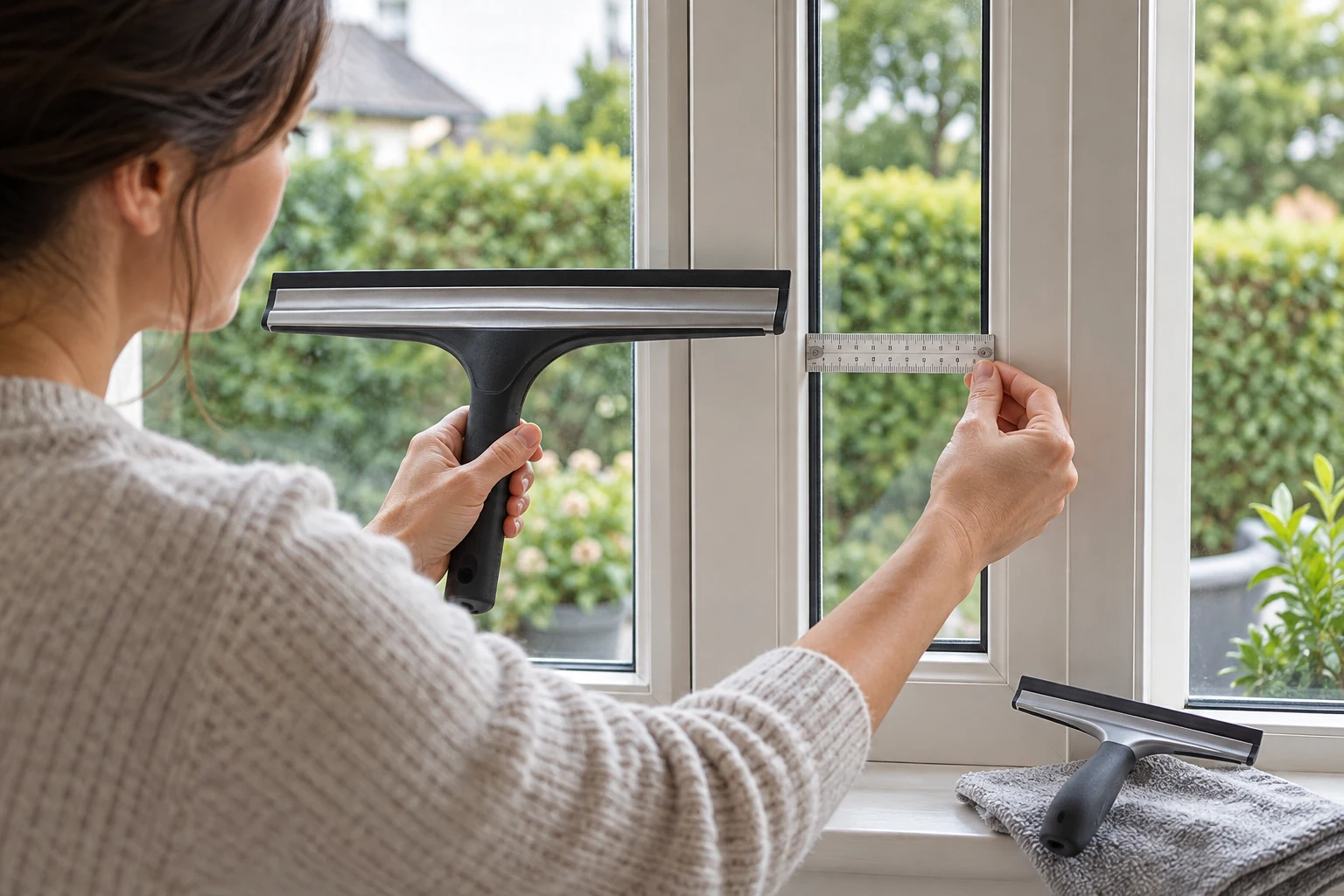
When a window squeegee head cannot reach a narrow pane edge, more pressure rarely solves the geometry. The blade may be wider than the usable glass, the handle may strike a frame, or the head may need an angle that a fixed grip cannot make. Identify which part collides before changing the cleaning method or buying another tool. A short measurement of the glass and a dry run with the existing squeegee can show whether a different head width, handle arrangement, or separate detail tool is actually needed.
This guide owns the access decision for an ordinary reachable pane, narrow sidelight, mirror inset, or shower-glass panel. It does not diagnose the pattern of water or residue left after a blade already reaches the surface; the squeegee streaks guide owns that distinct cleaning-result question. Access is also a tool-shape issue for other surfaces, as the broom edge-access guide illustrates, but a broom's head and a glass blade have different contact requirements. Keep the decision here tied to the glass opening and the squeegee in hand.
Locate the place the head stops
Start on a dry, safely reachable pane. Hold the squeegee as you normally would, without pressing the blade hard against the glass. Bring it near the edge that has been difficult to clean and observe which part touches first. The blade end may hit the frame; the handle or joint may meet a deep reveal; or the hand may have too little room to maintain a comfortable angle. These are different constraints. Write down the first contact point instead of calling the entire tool too large.
Measure the clear glass width between the inner frame edges at the place where a pass will occur. Repeat near the top and bottom if the frame or seal changes shape. Record the narrowest useful width, not just the widest point in the center. A squeegee listed as 12 inches across cannot make a straight full-width pass in a pane that is narrower than its working blade. Nor does a narrower blade automatically solve a thick handle colliding with the trim. The tool and the hand both need a path.
Look for a protruding latch, handle, hinge, seal, or mullion. A blade may fit across the glass but fail to sweep past a latch. Mark that obstruction on a simple sketch. For a shower door, the edge may have a sweep or hardware that should not be scraped. For an inset mirror, a deep surrounding frame may limit the handle angle. Follow the surface maker's care instructions before using a blade on a coating or film; this guide assumes the surface permits the tool.
Separate glass access from personal reach. If the target is above comfortable reach, do not lean out a window, stand on unstable furniture, or stretch while using a wet tool. Use a safe method appropriate to the location and professional help when needed. An extension handle can change reach, but it does not change a broad head into a narrow one. The first question remains whether the head can contact the intended glass area without striking an obstacle.
Try a dry path before deciding what is wrong
With the glass dry, move the existing head slowly through the proposed pass without applying cleaning liquid. Keep the blade in light contact only if the surface instructions permit it. Notice whether the blade can begin on glass, maintain contact, and end without the handle striking a frame. If it cannot, rotate the tool gently to see whether an allowed angle helps. Do not twist a rigid head against hardware or bend a blade into a corner. A dry rehearsal is for observing clearance, not forcing a pass.
Try both a horizontal and vertical path where the pane shape allows them. A tall narrow sidelight may accept vertical strokes with a short head, while a shallow rectangular pane may offer more room across than down. Consider where water would be collected and whether the hand can control the tool at the endpoint. A path that fits only while the wrist is sharply bent may not be useful in repeated cleaning. Choose a motion that stays controlled and within easy reach.
If the blade touches the frame at one end while the other end floats, measure how much usable contact remains. The effective cleaning width can be less than the product's named width because end caps, a rigid frame, or handle orientation need clearance. Do not choose a replacement from title width alone. If possible, compare actual working blade dimensions and the head outline with the pane sketch before purchase.
Check whether the problem is limited to a narrow band beside the frame. A full-size blade can still be useful for the center of a larger pane, while an appropriate small detail tool handles the inaccessible band. This split may be better than replacing a tool that works elsewhere. Use a clean, surface-approved cloth for a tight corner if the glass instructions allow it. Keep any cloth work gentle around seals and do not dig under a gasket.
Compare head width and handle clearance
There are several dimensions to note: working blade length, full head width including ends, head depth, handle projection, and the angle at which the head meets the glass. Product pages often emphasize only nominal blade size. A 12-inch description, for example, does not establish the precise clear width required at a framed corner. Ask whether the head can pass the obstruction, not merely whether the blade is shorter than the pane's broadest measurement.
The Aquablade window cleaning kit listing names a 35-centimeter squeegee with a rubber lip and microfiber cloth. Its gallery image shows a broad handled blade and a separate soft cleaning head. Those visible forms are useful when considering how a wide head would meet a narrow frame. The native description is mostly unrelated store copy, so it does not support a promise about exact head clearance, blade replaceability, or the number of accessories supplied. Confirm the current package and working dimensions before relying on them.
The Harborrs silicone squeegee listing describes a 12-inch blade and a kit for windows, mirrors, and shower glass. Its gallery shows multiple cleaning pieces and handles, but the text mixes several product names and broad performance promises. Treat it as a candidate form to inspect, not proof that every pictured piece ships with the selected variant or that it will fit the pane. Check the exact variant, blade width, handle geometry, and instructions before comparing it with your measured opening.
Neither of these two examples is automatically a narrow-corner solution. Thirty-five centimeters is roughly 13.8 inches, and a nominal 12-inch tool can still be too broad for a small sidelight. The difference between their listing widths is relevant only if one actually clears the frame and the other does not. Do not convert a size comparison into a claim that one cleans better. The right tool may be smaller than either example or may be a separate detailing cloth.
Blade material also does not eliminate a geometry problem. Rubber and silicone can differ in feel and maintenance, but a material label cannot make a blade bend around a rigid frame without consequences. If a listing says flexible or seamless, inspect the actual head design and consider the surface maker's instructions. Do not rely on seller phrases such as streak-free in one pass to solve a collision at a corner. Water marks and edge contact are separate questions.
Check the glass and frame before trying a workaround
Inspect the frame or seal for loose parts, abrasive grit, damaged coating, and sharp edges. Clean debris gently by a method allowed for that surface. A squeegee that catches on a protruding seal may be revealing a frame-maintenance issue rather than a poor blade choice. Do not cut or pull a seal simply to create tool clearance. If the seal is damaged or out of place, follow the window or shower-door manufacturer's guidance or seek repair.
Identify whether the glass is plain, filmed, coated, textured, or otherwise subject to special cleaning instructions. A hard edge or abrasive particle can scratch some finishes. If you are unsure, use the surface's care directions before dragging any blade. Check a small permitted area first. This matters particularly near frame lines, where dirt can collect and where the temptation to push harder is greatest.
Consider the depth of the frame reveal. A pane set far behind trim can be wider than the tool yet still block the handle from approaching at a useful angle. Hold the squeegee next to the opening and trace where the handle would be during an actual stroke. A slimmer head, different handle angle, or carefully used cloth may be needed. Do not assume a longer pole solves a recessed edge: it changes distance from the user, not the space inside the frame.
Look at the bottom edge as well. Water can collect in a track or sill that should be wiped by the method the maker recommends. A broad blade may stop before reaching the very bottom because of an outward sill or handle. Plan a separate finish step for that area instead of forcing the head under trim. Keep water away from places where it could harm surrounding materials.
Choose a controlled way to clean the missed area
If the pane is otherwise reachable, use the broad squeegee where it has a clear path. Finish the inaccessible edge with a small surface-approved cloth or detail tool, working from glass toward the frame without prying at a gasket. Keep the cloth clean so grit is not dragged along the edge. This is a practical division of work, not an admission that the main squeegee is defective. The tool can be correct for the open center and wrong for a tight corner.
If repeated narrow panes are the main job, a narrower squeegee can be worth evaluating. Measure the smallest clear width and allow enough margin for end caps and hand movement. Compare actual working dimensions, not a marketing photograph. Check whether the handle can be held comfortably for the stroke direction you intend. A tool that barely fits while dry may become awkward when wet; leave a usable margin rather than selecting an exact-width match.
For a small mirror or shower panel, a compact handheld tool may offer better control than an extension setup. For a large open window with only one narrow side strip, retain a broad head for the main area and detail the strip separately. The decision depends on how much glass is inaccessible and how often the task recurs. A single hard corner rarely justifies replacing every cleaning tool in the house.
After choosing the method, do one small test pass. Confirm the head moves without striking the frame, the hand remains controlled, and the blade stays where intended. If the tool now reaches but leaves lines or haze, switch to the separate streak-diagnosis question rather than repeatedly narrowing the head. If it still cannot enter the corner, return to the measurements and contact point. More force will not alter the opening.
Keep a simple note of the width and obstruction for future cleaning. A photograph of the empty pane with a ruler at the narrow point can prevent another size guess when a tool wears out. Store the tool clean and dry according to its instructions, and inspect its working edge before the next session. A worn edge may later create a different symptom, but it does not explain why the head physically cannot enter the opening today. Matching each observation to its own cause keeps the solution small and the purchase decision specific.
When the tool is not the problem
Stop if the glass or frame instructions disallow the proposed contact, if a seal is damaged, if the pane is not safely reachable, or if the surface has a film or coating that requires another method. An inaccessible exterior pane may need professional cleaning. A loose frame component needs repair before ordinary cleaning continues. Do not treat product listings for household squeegees as safety guidance for elevated work or specialized glazing.
The useful answer to a window squeegee head that cannot reach a narrow pane edge is a precise obstruction and a measured opening. Once you know whether blade width, end caps, handle depth, a latch, or the frame reveal blocks the pass, you can keep a working broad tool, select a truly narrower form, or use a separate gentle detail method. That solves the access problem without confusing it with streaks, material claims, or a promise that one kit will fit every window.