Troubleshooting & Repairs
Squeegee leaves streaks: check the edge and remaining mark
Separate a recurring wiping line from remaining surface film. Check edge condition and the actual Anyway.go tool before requesting a replacement part.
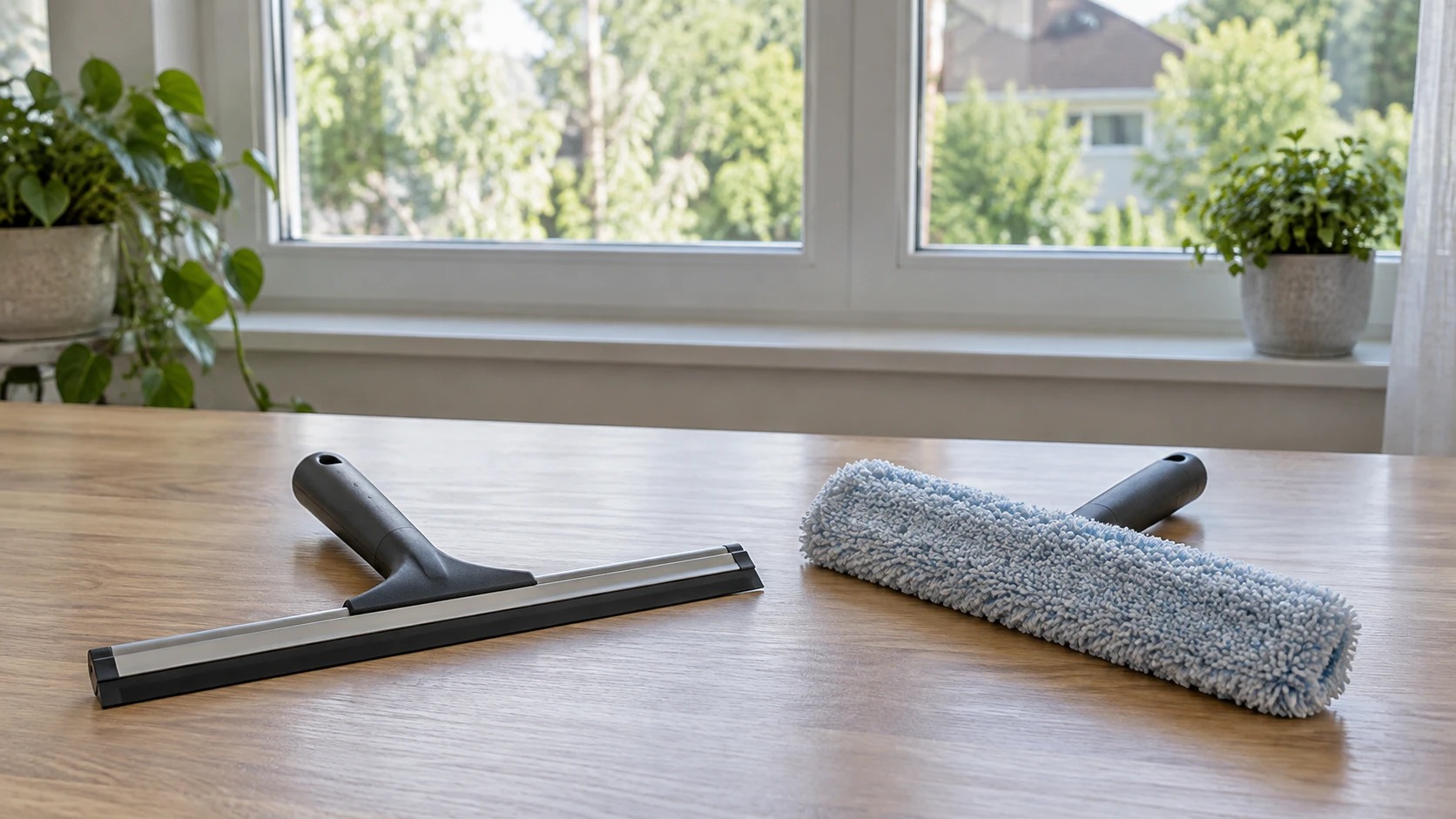
If your squeegee leaves streaks, look at the shape and location of the water left behind before replacing the tool. A narrow line that follows each pass raises a different question from a cloudy patch that stays in the same place on the glass. Neither observation, by itself, identifies a failed component.
This guide concerns ordinary reachable windows, mirrors and shower glass whose care instructions permit the proposed cleaning method. Begin with the surface instructions and the actual tool's directions. The selected Anyway.go listings describe two different squeegee arrangements; they provide no complete repair manual or interchangeable replacement-blade specification. No performance trial of either offer was conducted for this article.
Read the mark before changing the method
Inspect the result in ordinary light after the surface has dried. Note whether the problem is a thin track, scattered droplets, a cloudy area or water collecting near an edge. These descriptions make the next check more useful than saying that the whole window looks bad. Keep a mark on the opposite face of the glass separate from the face you have just cleaned.
Choose a small reachable area for an observation using a method already permitted by the surface and tool instructions. Use the same area when comparing the result of one relevant change. Moving to a different window at the same time makes it harder to tell whether the changed result follows the tool, the surface or the conditions.
For example, suppose a narrow wet track appears during one permitted pass. Record where it crosses the wiped area. On another pass, observe whether a similar track follows the same position along the wiping edge. That is a reason to examine the edge and the contact being made. It is not proof that a particular rubber strip must be ordered.
A different observation would be a hazy patch that remains beside the same corner after the water has dried. Record that location rather than calling it a blade defect. The next question concerns the surface and its permitted cleaning method. Do not increase pressure or introduce a stronger cleaner merely because the first appearance was disappointing.
Squeegee blade inspection starts with the visible edge
For squeegee blade inspection, look along the wiping edge while the tool is inactive and safely handled according to its instructions. Note visible debris, an uneven edge or an obvious nick. Record what you can see without bending the assembly, pulling out a strip or opening a fastening whose removal method has not been established.
Unger’s general window-cleaning guidance connects a sharp, sound rubber edge with fewer streaks and identifies excessive streaking or a nick as reasons to attend to its rubber. It also warns that pushing harder can prevent the edge doing its job. Those principles support checking edge condition and contact separately. They do not identify a compatible replacement for either selected Anyway.go offer.
If the edge carries material left from the previous task, follow the actual tool's permitted cleaning method before assessing it again. Keep that cleaning step distinct from repair. Removing visible material establishes that it has been removed; it does not establish that an edge underneath is undamaged or that a distorted assembly has returned to its intended shape.
If damage is visible and the supplied instructions give no repair or replacement method, retain the product identity and ask for the applicable service answer. A strip that looks similar in a picture has not acquired the right length, profile or retention arrangement. Cutting an unspecified strip to length would introduce several new unknowns rather than answer the original one.
Identify the selected 8.9-inch tool accurately
The Anyway.go 8.9-inch steel shower squeegee is identified by SKU 18588515379 and UPC 850066087251. Its description names a flexible wiping edge intended to sit against flat surfaces, with shower doors, windows, mirrors and tile among its stated applications. It also says the tool can hang for storage.
The description attributes streak-free and squeak-free cleaning to that edge. Treat this as a retail claim, not an outcome established on your particular pane. The offer supplies no detachable-rubber part number, disassembly sequence or adjustment instruction. Its steel-tool wording does not identify every material in the wiping edge or authorize a method remembered from another squeegee.
If this is the tool in hand, keep its exact reference with the observation. A support question can identify the listed 8.9-inch tool and describe the visible mark. That is more useful than requesting a replacement for an unspecified “shower squeegee,” especially when the seller carries several differently sized arrangements under the same brand.
The longer kit has separate washing and wiping parts
The Anyway.go 81-inch window-cleaning kit describes a 12-inch squeegee and an 11-inch microfiber scrubber in one arrangement. Its extension pole has five sections with screw connections. The stated lengths describe different parts: the squeegee edge, the scrubber and the extended equipment should not be treated as the same dimension.
Its account says that a yellow button changes the squeegee position and that the microfiber scrubber is machine washable. Read the complete supplied instructions before using either feature. A washable scrubber statement does not authorize washing the entire assembly in a machine, and a position-changing feature does not establish the correct position for every window.
This troubleshooting check remains at an ordinarily reachable surface. Check the actual high-window task separately, including the standing position and surrounding hazards. Keep a difficult-to-reach task outside this small observation exercise. Changing reach and handling at the same time would also add variables to the original streak question.
Window cleaning residue needs its own check
For window cleaning residue, return to the surface instructions and what was applied during the task. Record the actual product and method, rather than assuming that every cloudy appearance is soap or mineral deposit. A mark left on the glass and water left by the wiping pass can coexist. One explanation need not account for every visible difference.
Keep washing and water removal as separate jobs when the equipment provides separate parts for them. The longer selected kit names a microfiber scrubber alongside its squeegee. If material remains on the glass, another wiping pass does not prove that the washing stage removed it. Conversely, successfully washing an area does not prove that the final water removal left no tracks.
Use only a cleaning product and method permitted for the actual surface. This article gives no mixture, chemical substitution or scraping procedure. Coatings, surrounding materials and the supplied care record can change what is suitable. A familiar window-cleaning label alone does not resolve those requirements, particularly when the pane's identity or finish is unknown.
Suppose the observation record says that the surface looked clear while wet but the same cloudy patch returned after drying. Keep both parts of that account. Do not describe a permanent cure from the wet appearance. Ask the surface supplier about the remaining mark if the permitted routine does not answer it, taking care to identify the face and location involved.
Separate contact pressure from final edge work
If the edge appears sound but the pass leaves water, review the handling instructions rather than simply pressing harder. Unger’s general technique discussion distinguishes excessive pressure, which interferes with the working edge, from too little contact, which leaves water behind. Its advice is a general explanation, not a force value or a performance guarantee for the selected tools.
Keep the observation manageable. A shorter reachable section lets you see the water left behind without changing the room, surface or equipment. Record a changed handling approach only when it follows the applicable instructions. Stop the comparison if maintaining the permitted position is difficult; an awkward posture is not a useful test of blade condition.
Water remaining near the perimeter deserves its own description. Unger treats drying the window edges and sill as finish work after the squeegee stage. A small amount at a frame is therefore a different observation from a repeated line across the middle. Follow the surface's care directions for any final drying rather than treating all remaining moisture as a failed pass.
Do not repeatedly wipe the entire pane to address one corner without checking where that water originates. Note whether it is present immediately after the pass or appears later. The timing may help explain the task to a supplier, but this article cannot determine the cause of water arriving from a frame, seal or adjacent surface.
Keep cleaning, wear and component permission separate
The Edlund No.1 can opener wear guide separates a completed cleaning task from the separate inspection and replacement decisions in that opener's manual. The useful connection here is the distinction between removing residue and establishing component condition. None of its knife instructions, intervals or replacement parts applies to a squeegee.
The French press grounds lifters and care guide keeps component access separate from permission to wash each part. That distinction matters when the longer squeegee kit names a washable scrubber. The coffee presses' dishwasher permissions provide no washing approval for a squeegee head, pole or wiping edge.
Make the next support or replacement decision concrete
Retain the exact product reference, the surface being cleaned, the permitted method used and the mark that remains. Add whether the edge has visible debris or damage and whether the issue appears across the pane or at its perimeter. This account gives support a location and a visible result to investigate.
Ask for an applicable care or replacement instruction before ordering a loose part. If the actual tool is not designed for a replaceable strip, a general catalogue of rubber lengths will not resolve the question. If replacement is supported, obtain the precise part and fitting instructions for that assembly. Keep the original model identity with the answer.
Close the observation with what actually changed. You may have removed visible debris, established that a mark stays on the surface, or identified damage that needs a service decision. Describe any remaining streak as well as the improvement. One clearer area does not establish the condition of the whole pane.
Retain the equipment decision through crypto checkout
If you decide to purchase a replacement tool or an identified compatible part using cryptocurrency, settle the equipment question before beginning payment. Confirm the exact selected item, its supplied contents and any answer about the wiping edge. A payment option does not resolve an uncertain fit or make the smaller squeegee's details apply to the longer kit. Check whether USDT is offered by the actual republeq.com checkout for that transaction. Use the asset and network stated there, together with the receiving details displayed for the order. Do not treat a wallet label, a previous purchase or another seller's payment instructions as a substitute for those transaction details. Review the complete order before authorizing a transfer, including delivery information and the seller's current conditions for cancellation, returns, exchanges and damaged deliveries. If a condition is unclear, obtain an answer while the order can still be checked. Keep the product reference alongside that answer so a response about one accessory cannot be mistaken for approval of another. Retain the order confirmation, the transaction identifier and the correspondence that established what you intended to buy. These records concern different parts of the purchase: the transfer records a payment, while the order and product information identify the goods. Check the order's recorded payment state through the merchant's own process instead of assuming that a wallet notification proves the equipment has been dispatched. If the payment state is uncertain, reconcile it with the merchant before sending another transfer. On arrival, compare the supplied item and contents with the confirmed order and follow the applicable reporting process for a discrepancy. The receipt does not establish that a replacement edge fits, that a particular surface permits its use or that the original streak problem has been repaired.